# How rising data center power demand is reshaping the U.S. energy landscape
> Data center power demand is projected to grow 24% annually through 2030, driving new gas, nuclear uprates, and storage deployments across the U.S. grid.
Source: https://savrn.com/blog/data-center-power-demand-growth
Author: Chad Everett Harris
Published: 2026-10-12
---
Rising data center power demand growth is reshaping U.S. energy planning by accelerating new generation builds, nuclear uprates, and storage deployments across grid operator footprints. Black Hills Corp. will add 564 MW of new natural gas generation at its Cheyenne Prairie site in Wyoming between 2027 and 2029, while managing 2.1 GW of third-party turbine and fuel cell resources to serve Google’s planned data center 1. Constellation Energy and Google will add 890 MW of capacity at 11 existing nuclear plants across PJM through equipment upgrades, with the first project expected online by 2028 and full completion in the early 2030s 4. In response to reliability shortfalls, PJM plans to acquire 6.8 GW of new capacity to cover a gap from its last two base capacity auctions 9. Meanwhile, 4-hour battery storage is now 65% to 75% cheaper than new open-cycle gas peakers in the U.S. for 2026 commercial operation, according to Wood Mackenzie 8.
## Gas generation gets built first
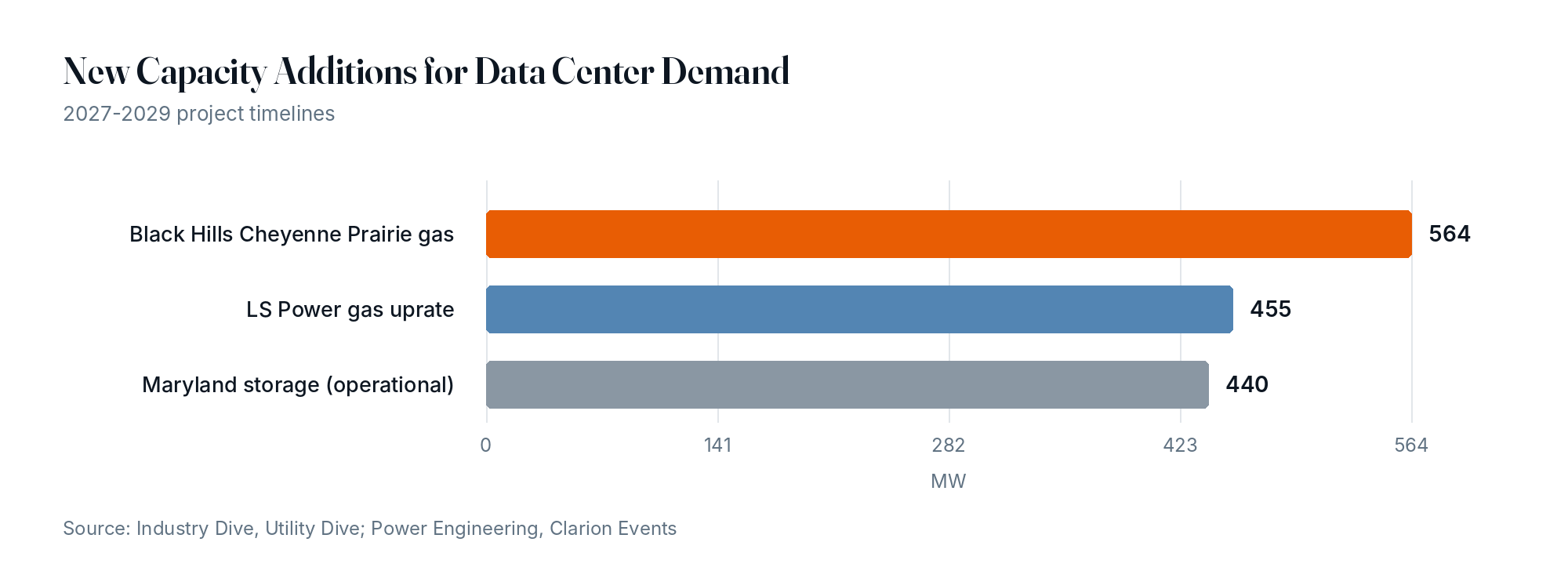
Black Hills Corp. will add 564 MW of new natural gas-fired generation at its Cheyenne Prairie Generating Station in Cheyenne, Wyoming between 2027 and 2029. The project is part of a larger arrangement to serve Google’s planned data center, which also includes managing about 2.1 GW of third-party turbine and fuel cell resources 1. Black Hills said Google would cover the costs of serving the data center, with contractual protections intended to shield existing utility customers from project-related expenses 1. For example, Google has advanced $399 million for long-lead equipment purchases, which Black Hills expects to reimburse before July 2027 1.
Black Hills’ 564 MW gas plant and LS Power’s 455 MW uprate lead near-term additions for data center load. Source: Industry Dive, Utility Dive; Power Engineering, Clarion Events.Black Hills’ 564 MW gas-fired generator under construction for Google’s Wyoming data center.
### Black Hills’ gas expansion and Google partnership
Black Hills would not own those resources but would collect a microgrid management fee for coordinating grid operations, reliability services, and dispatch across the contracted resources and market purchases 1. The new gas units will be owned by a non-regulated Black Hills affiliate, not the Wyoming utility. The utility projects about $150 million in net income from the project in 2030 and $2.4 billion in unlevered free cash flow through 2048 1.
### LS Power’s expansion and fundraise
LS Power bought the Hunterstown plant from Platinum Equity in 2024 2. LS Power plans to add 455 MW to its 810-MW combined cycle Hunterstown power plant in Adams, Pennsylvania. The uprate is part of PJM’s Expedited Interconnection Track process, which the grid operator approved for three projects totaling 2.1 GW on October 8, 2026 2. PJM expects the LS Power project to come online by mid-2029 2. The fast-track process, which opened for applications on July 31, 2026, is set to expire at the end of 2027 2. PJM’s Expedited Interconnection Track process is designed for projects larger than 250 MW that are backed by a primary siting authority and can begin operating within three years 2. These approvals come amid tight supply conditions in PJM, where little new generation has come online in recent years while data center demand continues to rise 2.
LS Power has raised $6 billion for LS Power Equity Partners IV, exceeding its initial $4 billion target. The fund will focus on acquiring operating assets, including natural gas power plants, renewable energy resources, and battery storage 22. The firm plans to invest in infrastructure supporting demand response, which allows large electricity users to reduce consumption during grid stress in exchange for compensation 22. According to LS Power Chief Operating Officer Darpan Kapadia, “Power demand is growing at rates that we haven’t seen for decades” 22. Close to a third of the capital raised for the latest fund has already been deployed, with $1.7 billion going toward the acquisition of natural gas plants from Constellation Energy in March 22.
### Industry constraints and demand outlook
McKinsey’s Global Energy Perspective 2026 projects data center electricity demand could grow at a compound annual rate of 24% through 2030, but the availability of power infrastructure will determine how much computing capacity developers can bring online 18. Engineering, procurement, and construction capacity, alongside interconnection approvals and permitting, are key constraints 18. Faster expansion would require improvements across those areas, rather than a stronger demand for computing alone 18. Natural gas is often viewed as the fastest path to adding firm power capacity, and competition for pipeline infrastructure could cause delays in building gas-powered generation 18. Locating closer to gas-producing basins can reduce the need for new pipeline infrastructure 18.
What to take from this
Black Hills Corp. will add 564 MW of new natural gas-fired generation at its Cheyenne Prairie Generating Station in Cheyenne, Wyoming between 2027 and 2029.
Constellation Energy and Google have committed to an 890-megawatt nuclear uprate program across 11 existing plants in the PJM Interconnection.
Maryland awarded two transmission-connected battery storage projects totaling 440 megawatts and 1,760 megawatt-hours in its first solicitation under the Next Generation Energy Act.
The Finnish Licensing and Supervisory Authority (LVV) ordered work to stop at Muhos and Kajaani because major site preparation occurred before environmental impact assessments were completed.
Voltus raised $225 million in its Series D round to scale its bring your own distributed capacity program for data centers.
## Nuclear uprates accelerate fastest
Constellation Energy and Google have committed to an 890-megawatt nuclear uprate program across 11 existing plants in the PJM Interconnection 4. The deal, backed by a 20-year power purchase agreement, will upgrade turbines, steam generators, and digital control systems to extract more output from current reactors 4. Constellation expects the first uprate to be complete by 2028 and the full batch finished in the early 2030s 4; the project budget totals $4.3 billion, or just over $4,800 per kilowatt 4.
Constellation Energy’s nuclear uprate project at Diablo Canyon, adding capacity for Google data centers.
Vistra and the U.S. Department of Energy are advancing separate uprate projects that will add 433 megawatts at Beaver Valley in Pennsylvania and Davis-Besse and Perry in Ohio 13. The DOE has issued a conditional loan commitment of up to $4.2 billion to support these upgrades 13. Meta has signed 20-year power purchase agreements to receive over 2,600 megawatts from Vistra’s nuclear fleet, including the 433 megawatts of incremental capacity 13; Meta’s purchases under those agreements are scheduled to begin in late 2026, with additional capacity added through 2034 13.
Google said its Constellation agreement brings the total new U.S. nuclear capacity it has helped enable through uprates and reactor restarts to more than 1.5 gigawatts 13. Constellation’s Paul Adams explained that each plant is different, so the scale and scope of upgrades vary, while the approach is consistent: new and more efficient equipment to get more megawatts from the same plant 4. The Limerick plant near Philadelphia will gain 348 megawatts, while Salem in southern New Jersey will receive a 97-megawatt boost 4.
The uprate program’s $4,800-per-kilowatt cost is less than half what Southern Co. incurred for Vogtle Units 3 and 4, although it exceeds utility-scale solar with storage and Constellation’s $1.6 billion Three Mile Island restart effort 4.
PJM expects electricity demand to grow more than 5% annually over the next decade across its 13-state footprint and views new supply as essential to reliability and price stability 4; Jeff Shields, a PJM spokesperson, said the grid needs “all the megawatts of electricity supply we can get to meet growing demand” 4. The Department of Energy reports U.S. nuclear plants have an average capacity factor of 92.3%, far above combined-cycle gas (59.9%), wind (34.3%), solar (23.4%), and gas peakers (17.2%) 4.
## Storage deployment surges
Maryland awarded two transmission-connected battery storage projects totaling 440 megawatts and 1,760 megawatt-hours in its first solicitation under the Next Generation Energy Act 23. Flatiron Energy’s Chalk Point Storage Project received 400 megawatts and 1,600 megawatt-hours, while REV Renewables’s Jade Meadow III Battery Storage Project received 40 megawatts and 160 megawatt-hours 23.
Maryland’s 440 MW/1,760 MWh energy storage system deployed to meet data center load peaks.
The Maryland Public Service Commission selected its first-round storage awards on Oct. 1, 2026, the statutory deadline for the first solicitation under the Next Generation Energy Act 23. By law, Maryland must open bidding for its second round by Jan. 1, 2027, and announce awards by Oct. 1, 2027 23.
Wood Mackenzie reported that in the United States, 4-hour battery storage for a 2026 commercial operation date is 65% to 75% cheaper than new open-cycle gas turbine peakers, depending on state-level carbon pricing 8. The firm projects gas turbine prices will reach $600/kilowatt by the end of 2027, a 195% increase since 2019 8. GE Vernova, Siemens Energy, and Mitsubishi each face gas turbine backlogs ranging from 35 gigawatts to 116 gigawatts 8. Battery manufacturing scale continues to push storage costs down 8.
In North America, data center load growth contributes to a supply deficit cycle for gas generation capacity through the late 2030s, keeping thermal capital costs elevated and reinforcing the long-term economic case for renewables and storage 8. Ahmed Jameel Abdullah, principal analyst at Wood Mackenzie, said the economic shift is decisive and widening 8. In the Middle East and Africa, four-hour storage is forecast to fall 33% to $80/megawatt-hour by 2035, displacing gas peaking on cost across every gas market in the region 8.
## Permitting bottlenecks stall projects
Google’s subsidiary Tuike Finland Oy had arranged power supply through Fingrid, the Finnish transmission system operator, and identified sites with excess grid capacity 5. Tiina Paloniitty, associate professor of environmental and sustainability law at the University of Helsinki, emphasized that compliance with forestry rules does not satisfy separate environmental impact assessment obligations 5. The Finnish Licensing and Supervisory Authority (LVV) ordered work to stop at Muhos and Kajaani because major site preparation occurred before environmental impact assessments were completed 5. LVV required suspension of activities including tree removal, excavation, blasting, and road construction no later than October 23 5. The agency stated that proceeding with such work could undermine the assessment process by limiting the ability to identify environmental impacts, examine alternatives, and prevent harmful effects 5.
LVV’s decision followed a September 18 request for information from Google’s subsidiary Tuike Finland Oy, the municipalities of Muhos and Kajaani, and local building-control authorities 5. According to the agency, the preparatory activities triggered intervention under Finland’s Environmental Impact Assessment Act 5. Stephen Sopko of HyperFrame Research explained that permanent conversion above 200 hectares is the regulatory trigger, whereas preparatory tasks alone do not meet that threshold 5. Google acknowledged it did not meet its own standards and said it would plant trees across 130 hectares at Muhos as part of its biodiversity plan 5. Stephen Sopko noted that reversible activities like surveys and measurements can proceed ahead of permits; clearing 300 hectares and calling it anticipation violates the law 5.
## Ratepayer cost allocation under scrutiny
The U.S. Department of Energy urged PJM Interconnection on October 7, 2026, to revise its reliability backstop procurement plan to prevent cost shifts onto existing utility customers from data centers and other large loads 9. PJM failed to acquire enough capacity in its last two base capacity auctions to meet its reserve margin targets 9. The grid operator intends to acquire 6.8 GW of new capacity to make up for the shortfall for the 2028/29 delivery year 9.
### Cost allocation reforms under pressure
FERC found parts of PJM’s proposal, those dealing with cost allocation, transmission owner exit rules, and load-serving entity collateral requirements, may be unjust and unreasonable 9. The agency established a hearing process set to run through February to address those issues, but said PJM could propose its own fixes using guidance FERC included in its order 9. The U.S. Department of Energy said PJM should adopt FERC’s recommended revisions to its backstop procurement plan to advance the Ratepayer Protection Pledge’s principles 9.
The U.S. Department of Energy agreed with FERC that PJM should allocate the backstop procurement’s costs based on updated load forecasts 9. Without up-to-date and project-level information, PJM cannot reliably reconcile its base forecast with Load Adjustments, avoid omissions and double counting, revise the reliability backstop procurement target, or ensure that costs are allocated to the customers who caused them 9.
PJM plans to file a proposal at FERC to revise its backstop procurement plan by October 29, 2026, in response to FERC’s decision 9. The grid operator intends to hold a special Members Committee meeting on October 22, 2026, to consult with its members on the substance of the upcoming filing 9. PJM will also schedule a special Transmission Owners Agreement-Administrative Committee meeting 9.
FirstEnergy’s Jersey Central Power & Light requested a $253 million increase in base distribution rates and recovery of $476 million in previously deferred storm costs, spreading recovery over a 10-year period on customer bills 3. The average residential customer would see a total bill increase of about 8.8%, the utility said, though it would not hit bills until 2028 3. The utility called it a “balanced approach” that invests in infrastructure while minimizing bill impacts 3. In a statement emailed to Utility Dive, the FirstEnergy utility said affordability and reliability “shouldn’t be an either-or decision” 3. JCP&L’s rate filing “prioritizes both simultaneously by including offsets that cover the increase in rates in 2027, keeping our customers from feeling these impacts until 2028,” the utility said 3.
Other large rate requests noted in the PowerLines report were made by Oklahoma Gas & Electric, Indiana-Michigan Power Co., Dominion Energy Virginia and CenterPoint Energy in Texas 3. Collectively, utilities serving about 11 million customers in the South requested $2.2 billion, PowerLines report said, “bringing the region to $9 billion in total rate increase requests so far in 2026” 3. Northeast utilities serving about 5.6 million customers requested $900 million in the third quarter, followed by $800 million in rate hikes requested by Midwest utilities serving 7.9 million customers, and $600 million in the West for utilities serving 20.8 million customers 3.
## Virtual power plants scale up
Voltus raised $225 million in its Series D round to scale its bring your own distributed capacity program for data centers 10. The raise, internally called “Project Accelerate,” followed rapid growth in dispatch activity across multiple grids, including daily dispatches in the Southwest Power Pool and emergency calls in the Mid-Atlantic 10. The Series D target would more than double its current capacity, while relying heavily on battery deployment through its acquisition of Brightfield 10.
### PJM framework changes support growth
PJM’s recent framework changes let sites that previously participated in demand response but not last year be reactivated as new capacity 10. The regional grid operator also agreed to count incremental capacity, such as new batteries added at existing locations 10. Voltus plans to use Brightfield’s team to identify sites ready for battery deployment as part of the BYOC program before expanding to new customers 10. The company will also rely on partnerships with Octopus Energy U.S. and Sunrun to expand beyond commercial and industrial demand response 10.
### Daily dispatches mark industry turning point
Voltus began dispatching assets every day of the year in summer 2025, marking a turning point for both the company and the wider industry 10. CEO Dana Guernsey said the company had “the embarrassment of riches, in that we were able to really pick and choose investors that were going to bring more than just capital” 10. The round was co-led by Generation Investment Management, Activate Capital, and Vitol 10.
### Everyday Electric rebrands and expands offerings
Everyday Electric, formerly Renew Home, rebranded in October 2026 and acquired Smartcar to integrate electric vehicles into its virtual power plant offering 16. In June 2026, it announced a partnership with Tesla and Sunrun to make nearly 17 gigawatts of distributed capacity available nationwide 16. The company manages more than 8 million residential smart thermostats and aims to deploy its Everyday VPP across HVAC systems, EVs, stationary batteries, and solar systems 16. CEO Ben Brown said the company wants to save customers $5 billion over the next five years 16. Smart thermostats remain central to its strategy, given their widespread adoption 16. Parks Associates projects annual smart thermostat sales of 8.1 million by 2030 16.
### Platform shifts from compliance to customer-centricity
Brown said the company’s platform improves on the compliance-based mindset that for years defined single-purpose “programmatic” offerings 16. It reflects a growing recognition among utilities and grid operators that modern VPPs represent high-quality wholesale and distribution-level capacity without the centralized generators’ “single point of failure” risk 16.
### National VPP potential and policy context
In 2023, the U.S. Department of Energy estimated the country had 30 to 60 gigawatts of broadly defined VPP capacity and could scale to 80 to 160 gigawatts by 2030, potentially meeting 20% of peak demand 16. A study by Rewiring America found that hyperscalers could unlock more than 100 gigawatts of U.S. grid capacity by 2029 and offset all AI loads expected to come online by then 16.
### Platform features and customer incentives
Everyday Electric’s Everyday VPP integrates directly with customers’ distributed energy resources, making it easier for customers to opt into money-saving programs, track energy performance, and get personalized recommendations 16. For utilities, the platform offers “hyper-local dispatch, AMI-based measurement and verification, real-time forecasting, and load shaping,” bundled into a pay-for-performance model 16.
### Fee structure and behavioral insights
The company’s approach avoids platform or marketing fees, a distinction from earlier demand response programs 16. In a late 2024 interview, Brown said data from his company indicates smart thermostat owners are more than three times more likely to buy an EV than the general public and significantly more likely to consider heat pumps and home solar or storage 16. “We want to be able to support people in the next step in their journey, that is a key part of how our platform is evolving,” Brown told Utility Dive this month 16.
## Carbon-aware scheduling emerges
Operators compare emissions profiles across time and location, then choose execution windows that minimize carbon output while meeting service-level constraints 11. Operators assess which workloads can shift in time or location without violating service-level agreements (SLAs), latency requirements, data residency constraints, or change-control policies 11. The outcome is a set of scheduling policies that favor cleaner windows while maintaining service objectives 11. Compute-hungry tasks can run without forcing incremental demand at higher-emitting hours 11.
Mission-critical, latency-sensitive applications remain fixed, but batch analytics, data backups, AI model training, report generation, and non-urgent patching often can shift 11. Operators first catalog workloads by flexibility class, power profile, and compliance constraints before piloting scheduling policies on clearly deferrable tasks 11.
Instrumentation and metering improve visibility into workload power draw and realized emissions impacts 11. Behind-the-meter resources, such as on-site solar, wind, or geothermal paired with modest battery storage, increase certainty that incremental energy comes from low-carbon sources 11. While few sites can size batteries to cover full facility load, even small storage capacity can support energy-intensive, deferrable tasks during clean grid windows 11.
Electricity grids are dynamic. Solar production peaks during daylight, wind output varies seasonally and hourly, and some regions benefit from geothermal, hydro, or nuclear baseload 11. Grid conditions change by the hour based on demand, transmission constraints, and market dispatch 11. As a result, the emissions intensity of a kilowatt-hour can swing significantly across a single day 11. Carbon-aware computing takes advantage of this variability by aligning flexible workloads with periods when low-carbon energy is most available 11.
### Implementation challenges and realistic gains
Common hurdles include limited observability into tenant workloads (particularly in colocation facilities), difficulty predicting workload power draw due to dynamic CPU/GPU utilization and I/O patterns, and uncertainty in renewable forecasts 11. Perfect optimization is unrealistic for most data center environments 11. Carbon-aware computing can deliver real reductions by capturing the “clean hours” that already exist on many grids 11. Over time, it becomes another reliability-minded tool - one that lowers emissions while respecting the operational realities that keep data centers running 11.
## How SAVRN builds for this
SAVRN builds AI factories that generate their own power on site and run water-free cooling, with a training institute at the front of every campus that reskills the local workforce. SAVRN also publishes and maintains public research tools that track the same trends this article covers: the [Data Center Moratorium Tracker](/data-center-moratorium-tracker), the [Water Tracker](/data-center-water-tracker), the [Data Center Delay Tracker](/data-center-delay-tracker), the [Grid Operator Watchlist](/data-center-grid-operator-watchlist), the [Capital Atlas](/data-center-capital-atlas) and the US Data Center Map.
## What to do next
The article showed that utilities are racing to add gas, nuclear uprates, and storage to meet data-center demand, while permitting, cost-allocation, and operational practices lag behind. These gaps create financial and reliability risks that coordinated action can reduce.
1. Operators should adopt carbon-aware scheduling to shift flexible workloads toward cleaner generation windows, easing pressure on new gas builds and uprated nuclear units.
2. Utilities should integrate virtual power plant capacity into resource plans, using aggregated distributed resources to meet peak needs without waiting for bulk transmission upgrades.
3. Community leaders should engage early in permitting reviews for generation and storage projects, ensuring environmental assessments address cumulative impacts and avoid avoidable delays.
4. Capital partners should structure financing that rewards storage and uprate projects with clear revenue stacks, reducing reliance on single revenue streams that may shift with market rules.
5. Regulators should finalize cost-allocation frameworks that prevent existing ratepayers from subsidizing large-load interconnection costs, aligning charges with cost causation.
6. Operators should coordinate with utilities on microgrid management agreements that define operational boundaries, fee structures, and data-sharing protocols before commercial operation begins.
## Frequently asked questions
### How much new natural gas generation will Black Hills Corp. add at Cheyenne Prairie and when?
Black Hills Corp. will add 564 MW of new natural gas-fired generation at its Cheyenne Prairie Generating Station in Cheyenne, Wyoming between 2027 and 2029 1. The project is part of a larger arrangement to serve Google’s planned data center 1.
### What is the cost of the Constellation Energy and Google nuclear uprate program and when will it be complete?
The uprate program’s budget totals $4.3 billion, or just over $4,800 per kilowatt 4. Constellation expects the first uprate to be complete by 2028 and the full batch finished in the early 2030s 4.
### How much capacity does PJM plan to acquire to cover its reliability shortfall?
PJM plans to acquire 6.8 GW of new capacity to make up for the shortfall for the 2028/29 delivery year 9. The grid operator failed to acquire enough capacity in its last two base capacity auctions to meet its reserve margin targets 9.
### How much cheaper is 4-hour battery storage than new open-cycle gas peakers for 2026 commercial operation?
Wood Mackenzie reported that in the United States, 4-hour battery storage for a 2026 commercial operation date is 65% to 75% cheaper than new open-cycle gas turbine peakers, depending on state-level carbon pricing 8.
### What battery storage projects did Maryland award in its first solicitation under the Next Generation Energy Act?
Maryland awarded two transmission-connected battery storage projects totaling 440 megawatts and 1,760 megawatt-hours 23. Flatiron Energy’s Chalk Point Storage Project received 400 megawatts and 1,600 megawatt-hours, while REV Renewables’s Jade Meadow III Battery Storage Project received 40 megawatts and 160 megawatt-hours 23.
### How much capital has LS Power raised for its latest fund and how much has been deployed?
LS Power has raised $6 billion for LS Power Equity Partners IV, exceeding its initial $4 billion target 22. Close to a third of the capital raised for the latest fund has already been deployed, with $1.7 billion going toward the acquisition of natural gas plants from Constellation Energy in March 22.
### What is the projected compound annual growth rate for data center electricity demand through 2030 according to McKinsey?
McKinsey’s Global Energy Perspective 2026 projects data center electricity demand could grow at a compound annual rate of 24% through 2030 18. The availability of power infrastructure will determine how much computing capacity developers can bring online 18.
### How much new nuclear capacity has Google helped enable through uprates and reactor restarts?
Google said its Constellation agreement brings the total new U.S. nuclear capacity it has helped enable through uprates and reactor restarts to more than 1.5 gigawatts 13. The Constellation deal adds 890 megawatts across 11 existing plants in PJM 4.
### What virtual power plant capacity does the U.S. Department of Energy estimate could be available by 2030?
In 2023, the U.S. Department of Energy estimated the country had 30 to 60 gigawatts of broadly defined VPP capacity and could scale to 80 to 160 gigawatts by 2030, potentially meeting 20% of peak demand 16. A study by Rewiring America found that hyperscalers could unlock more than 100 gigawatts of U.S. grid capacity by 2029 16.
### What rate increase did FirstEnergy’s Jersey Central Power & Light request and when would it affect customer bills?
FirstEnergy’s Jersey Central Power & Light requested a $253 million increase in base distribution rates and recovery of $476 million in previously deferred storm costs, spreading recovery over a 10-year period on customer bills 3. The average residential customer would see a total bill increase of about 8.8%, though it would not hit bills until 2028 3.
Sources
1. [Black Hills to build 564 MW of new gas, manage 2.1 GW microgrid for Google data center in Wyoming](https://www.power-eng.com/onsite-power/microgrids/google-wyoming-data-center-black-hills-natural-gas/), Power Engineering, Clarion Events, Oct 09, 2026.
2. [PJM approves fast-track interconnection for 2.1 GW from Engie, LS Power](https://www.utilitydive.com/news/engie-ls-power-pjm-expedited-interconnection-eit/832613/), Industry Dive, Utility Dive, Oct 09, 2026.
3. [US electric, gas utility rate requests spike to $4.5B in Q3: PowerLines](https://www.utilitydive.com/news/q3-electric-gas-rate-requests-powerlines-analysis/832609/), Industry Dive, Utility Dive, Oct 09, 2026.
4. [Constellation and Google go in on nuclear uprates to…](https://www.canarymedia.com/articles/nuclear/constellation-google-nuclear-uprates), Canary Media, Oct 08, 2026.
5. [Permits, Not Power, Halt Google’s Finland Data Centers](https://www.datacenterknowledge.com/regulations/permits-not-power-halt-google-s-finland-data-centers), Informa TechTarget, Data Center Knowledge, Oct 08, 2026.
6. [Massachusetts shifts clean energy funds to help heat homes this winter](https://www.utilitydive.com/news/massachusetts-clean-energy-funds-winter-heating-oil/832521/), Industry Dive, Utility Dive, Oct 08, 2026.
7. [Power system plans to meet large-load demand miss near-term solutions: analysts](https://www.utilitydive.com/news/power-system-plans-to-meet-large-load-demand-miss-near-term-solutions-some/832508/), Industry Dive, Utility Dive, Oct 08, 2026.
8. [4-hour storage cheaper than gas peakers across global markets: WoodMac](https://www.utilitydive.com/news/4-hour-storage-cheaper-than-gas-peakers-across-global-markets-woodmac/832489/), Industry Dive, Utility Dive, Oct 08, 2026.
9. [DOE presses PJM on ratepayer protections from large load costs](https://www.utilitydive.com/news/doe-pjm-ferc-ratepayer-protection-large-load-data-center/832479/), Industry Dive, Utility Dive, Oct 08, 2026.
10. [Voltus raises $225 million to scale BYOC for data centers](https://www.latitudemedia.com/news/voltus-raises-225-million-to-scale-byoc-for-data-centers/), Latitude Media, Oct 08, 2026.
11. [How Carbon-Aware Scheduling Can Cut Data Center Emissions](https://www.datacenterknowledge.com/sustainability/how-carbon-aware-scheduling-can-cut-data-center-emissions), Informa TechTarget, Data Center Knowledge, Oct 08, 2026.
12. [Can edge compute undercut demand for mega gas plants?](https://www.latitudemedia.com/news/can-edge-compute-undercut-demand-for-mega-gas-plants/), Latitude Media, Oct 07, 2026.
13. [Constellation, Vistra uprate deals signal fastest path to new nuclear megawatts](https://www.power-eng.com/nuclear/google-constellation-doe-nuclear-plant-investment/), Power Engineering, Clarion Events, Oct 07, 2026.
14. [California amps up pressure on grid buildouts that…](https://www.canarymedia.com/articles/transmission/california-amps-grid-upgrades), Canary Media, Oct 07, 2026.
15. [At Yotta, not a word on slowing down the AI infrastructure build-out](https://www.latitudemedia.com/news/at-yotta-not-a-word-on-slowing-down-the-ai-infrastructure-build-out/), Latitude Media, Oct 07, 2026.
16. [Smart thermostat aggregator rebrands, launches ‘whole-home’ virtual power plant](https://www.utilitydive.com/news/smart-thermostat-aggregator-rebrands-launches-whole-home-virtual-power-p/832367/), Industry Dive, Utility Dive, Oct 07, 2026.
17. [Mixed outlook for energy expenditures this winter](https://www.eia.gov/todayinenergy/detail.php?id=68264), U.S. Energy Information Administration, Oct 07, 2026.
18. [Data Center Power Demand to Grow 24% Annually by 2030: McKinsey](https://www.datacenterknowledge.com/energy-power-supply/data-center-power-demand-to-grow-24-annually-by-2030-mckinsey), Informa TechTarget, Data Center Knowledge, Oct 07, 2026.
19. [Connecticut’s solar ambitions hit skepticism from a…](https://www.canarymedia.com/articles/solar/connecticut-solar-utility-skepticism), Canary Media, Oct 07, 2026.
20. [How utilities lost their grip on Washington](https://www.latitudemedia.com/news/how-monopoly-utilities-lost-influence-in-washington/), Latitude Media, Oct 06, 2026.
21. [Tesla is now making more EVs that can double as a home…](https://www.canarymedia.com/articles/electric-vehicles/tesla-evs-as-home-battery), Canary Media, Oct 06, 2026.
22. [LS Power Raises $6B To Capitalize On Data Center Power Demand](https://www.bisnow.com/news/national/data-center-power/ls-power-raises-6b-to-capitalize-on-data-center-power-demand), Bisnow, Oct 06, 2026.
23. [Maryland nets 440 MW/1,760 MWh in first bulk energy storage procurement](https://www.utilitydive.com/news/maryland-nets-440-mw1760-mwh-in-first-bulk-energy-storage-procurement/832261/), Industry Dive, Utility Dive, Oct 06, 2026.
24. [Top electric power sector and utility conferences in 2027](https://www.utilitydive.com/news/top-electric-power-sector-and-utility-conferences-in-2027/832259/), Industry Dive, Utility Dive, Oct 06, 2026.