The SAVRN Index: One Place for GPU Market Pricing and Price Changes
One place that captures all of the GPU market pricing and pricing changes: what the SAVRN Index tracks, how it tracks it, and what the information is worth.
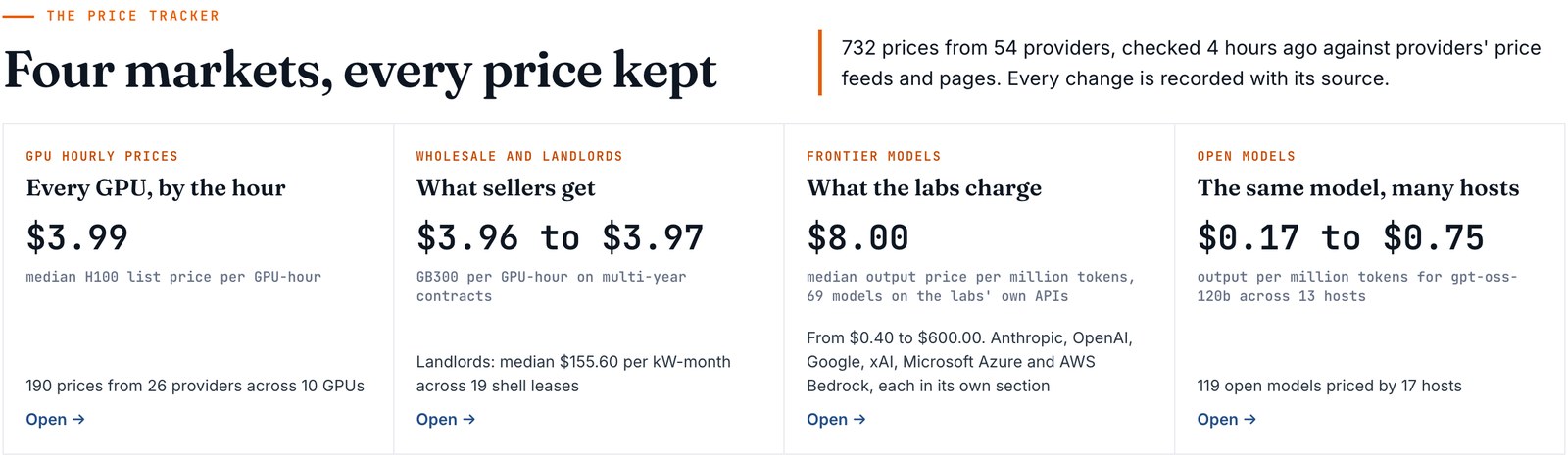
The SAVRN Index is one place that captures all of the GPU market pricing and pricing changes. As of September 13, 2026, it tracks 732 prices from 54 providers 1. Specifically, every price is checked every three hours against the seller’s own feed or page. Moreover, every change is recorded with its date and its source 1. The same Index holds the register of 113 companies that fund, build, own and run AI infrastructure 1. In addition, it carries a scarcity index that reads 84.9 on a 0 to 100 scale, and the SAVRN Standard, the seven principles every offering is measured against 1. This post introduces each research topic in the Index. For each one, it says what the information is worth to a buyer, a seller, an investor or a planner.
Why this matters now
The market for AI capacity has no exchange, no ticker and no standard unit 1. Instead, the same capacity is sold three ways. First, a landlord sells powered space by the kilowatt-month. Second, a GPU cloud sells accelerator time by the GPU-hour. Meanwhile, a model company sells the output of that same hardware by the million tokens 1. Each seller quotes in its own unit, on its own page. Moreover, each one changes the number without an announcement 1.
Furthermore, the contracts behind those prices sit in filings and press reports. For example, Nebius disclosed in a Form 6-K that its five-year agreement with Microsoft is worth about $17.4 billion through 2031 7. Notably, that capacity sits in Vineland, New Jersey. Similarly, Reuters reported that Anthropic will spend $45 billion over six years with Nscale in West Virginia 12. In particular, that agreement represents about 460 megawatts of Vera Rubin capacity 12. However, neither disclosure states a price per GPU-hour, so a buyer has to derive one 2.
Meanwhile, the inputs behind that capacity are getting scarcer. For instance, large gas turbines now take more than five years from order to delivery 10. In addition, average turbine prices rose from roughly $2,000 per kW to $3,000 per kW in six months 10. Likewise, primary-market data center vacancy stood at 1.4 percent on June 30, 2026 5. At the same time, 80.4 percent of under-construction capacity was already preleased 5. Therefore, a buyer comparing an H100 hour, a GB300 contract and a token price used to read each page, find the filing, and convert the units by hand 1. Instead, the SAVRN Index does that work once, on one site, and keeps it current 1.
What to take from this
- The SAVRN Index is one place for GPU market pricing and every price change, checked every three hours against the sellers' own feeds and pages.
- It covers four markets: GPU hours, wholesale contracts and landlord rents, frontier model tokens and open model tokens, all converted to one unit.
- The same hour of H100 time runs from $1.63 on spot to $12.29 on demand, and a $128.00 rent quote becomes $261.46 over a lease term.
- A register of 113 companies, a scarcity index of 84.9 and the seven-principle SAVRN Standard sit beside the prices.
- Every figure carries its source, its unit and its check date, and the history is never deleted.
What the SAVRN Index holds
The Index has five sections, all under the SAVRN Index 1. First, the overview introduces the seven principles and the reference set. Second, What AI Costs is the price tracker 1. Specifically, it has pages for GPU cloud prices, frontier model prices, open model prices, wholesale and colocation, and price changes 1. Third, Companies is the register of 113 companies, one page each 1. Finally, the Scarcity Tracker scores eleven indicators of scarcity, and the SAVRN Standard measures seven offerings against seven principles 1.
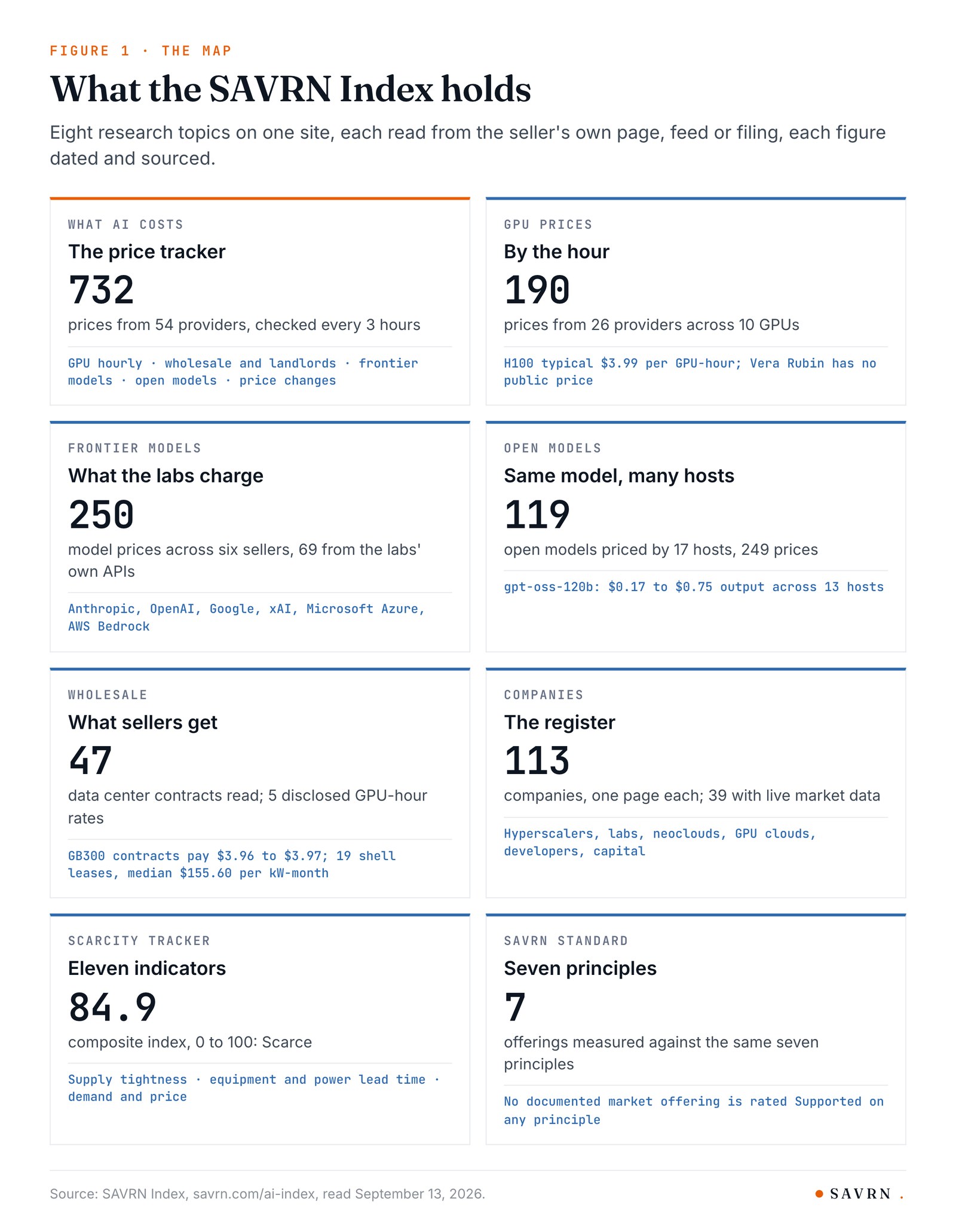
Each section answers a different question. For example, the price tracker answers what a unit of AI capacity costs today and what it cost last week. Similarly, the register answers who is behind the capacity. Likewise, the Scarcity Tracker answers how tight the inputs are. Finally, the Standard answers what a controlled AI environment should include, and which offerings include it 6.
How a price gets into the Index
The tracker reads the seller’s own source first. For instance, where a price feed exists, it reads the feed 1. Specifically, those feeds include the Microsoft Azure retail prices API, Oracle’s cost estimator, the AWS Bedrock offer files and Hugging Face Inference Providers 1. Where there is no feed, it reads the provider’s own price page instead 1. In particular, those pages include the pricing pages of Anthropic, OpenAI, Google, xAI and Fireworks, and about eighteen GPU clouds 1. Every tracked price carries the published text as the provider wrote it 1. In addition, it carries how the capacity is sold, the date of the check, whether a feed or a page was read, and a link to the source 1.
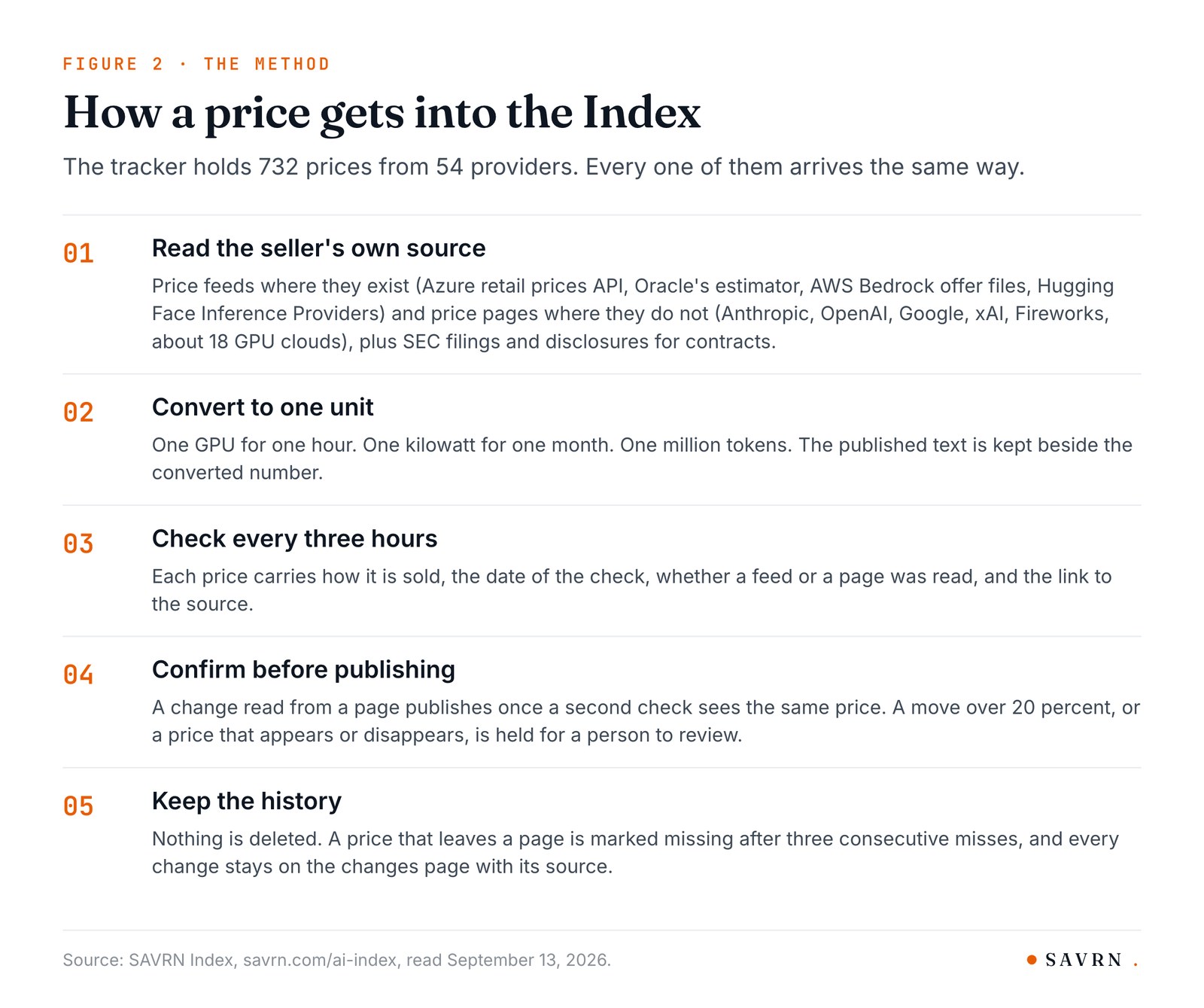
A change read from a price page publishes once a second check sees the same new price 1. As a result, a page glitch never becomes a recorded move. Moreover, a move of more than 20 percent is held for a person to review before it publishes 1. Likewise, the same hold applies to a price that appears or disappears 1. Nothing is deleted. Specifically, a price that leaves a provider’s page is marked missing only after three consecutive checks fail to find it, and its history stays 1. Finally, where a page refuses automated checks, the Index says so on the row. It does not work around the refusal 1.
What a GPU hour costs
The GPU page holds 190 prices from 26 providers across 10 GPUs 2. Specifically, every one is converted to one GPU for one hour and shown beside the provider’s own published price 2. However, GPUs are sold in whole units, so each card also shows the server or rack price. For example, an H100 server holds 8 GPUs, and a GB300 NVL72 rack holds 72 2.
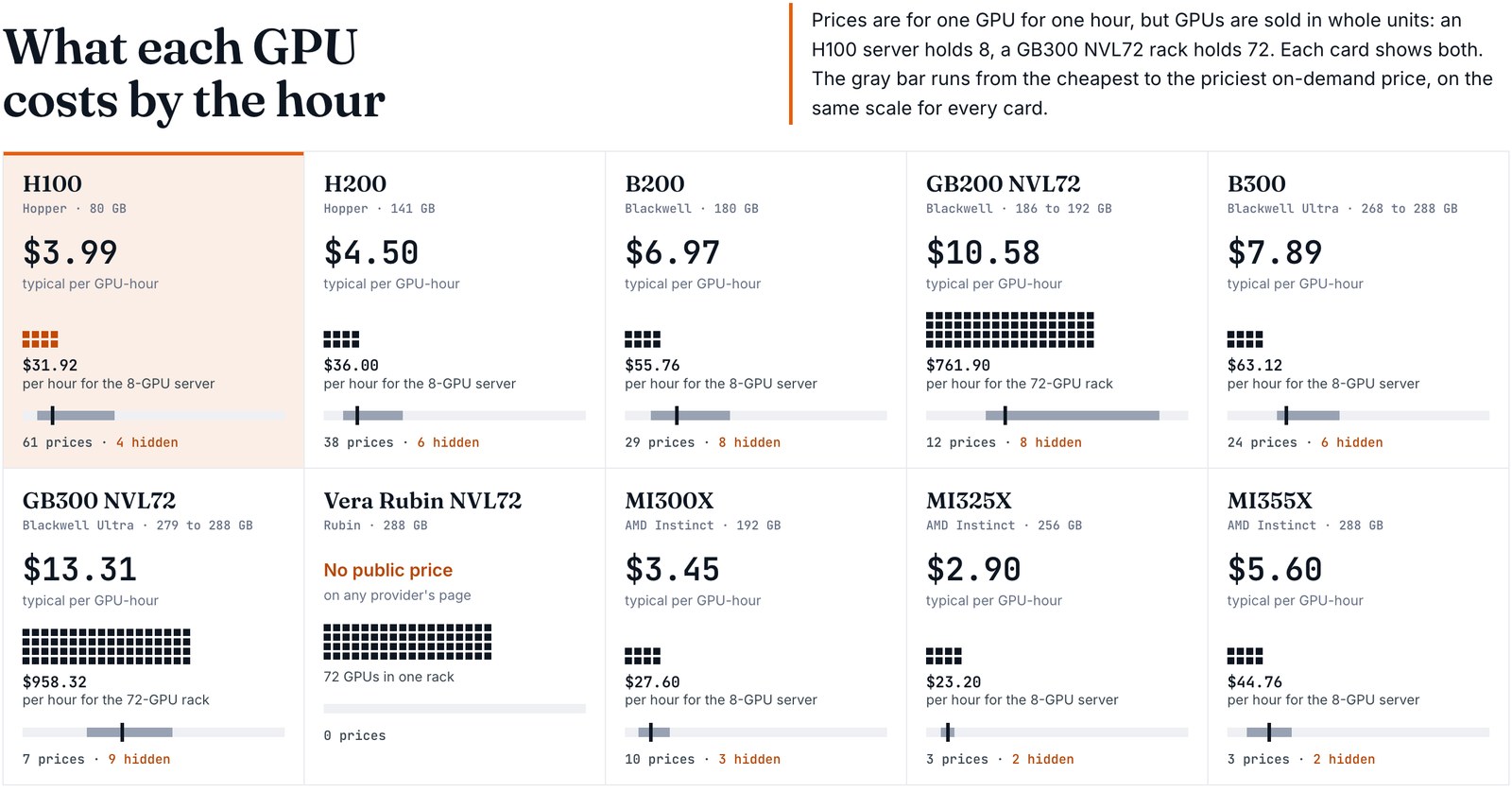
On September 13, 2026, the typical H100 price was $3.99 per GPU-hour, from 61 prices 2. That is $31.92 per hour for the 8-GPU server 2. Meanwhile, the H200 was $4.50, the B200 $6.97 and the B300 $7.89 2. In addition, the GB200 NVL72 was $10.58 per GPU-hour, or $761.90 per hour for the 72-GPU rack 2. Likewise, the GB300 NVL72 was $13.31, or $958.32 per rack-hour 2. Similarly, AMD’s MI300X was $3.45, the MI325X $2.90 and the MI355X $5.60 2. Notably, Vera Rubin NVL72 has no public price on any provider’s page 2.
How wide one market is
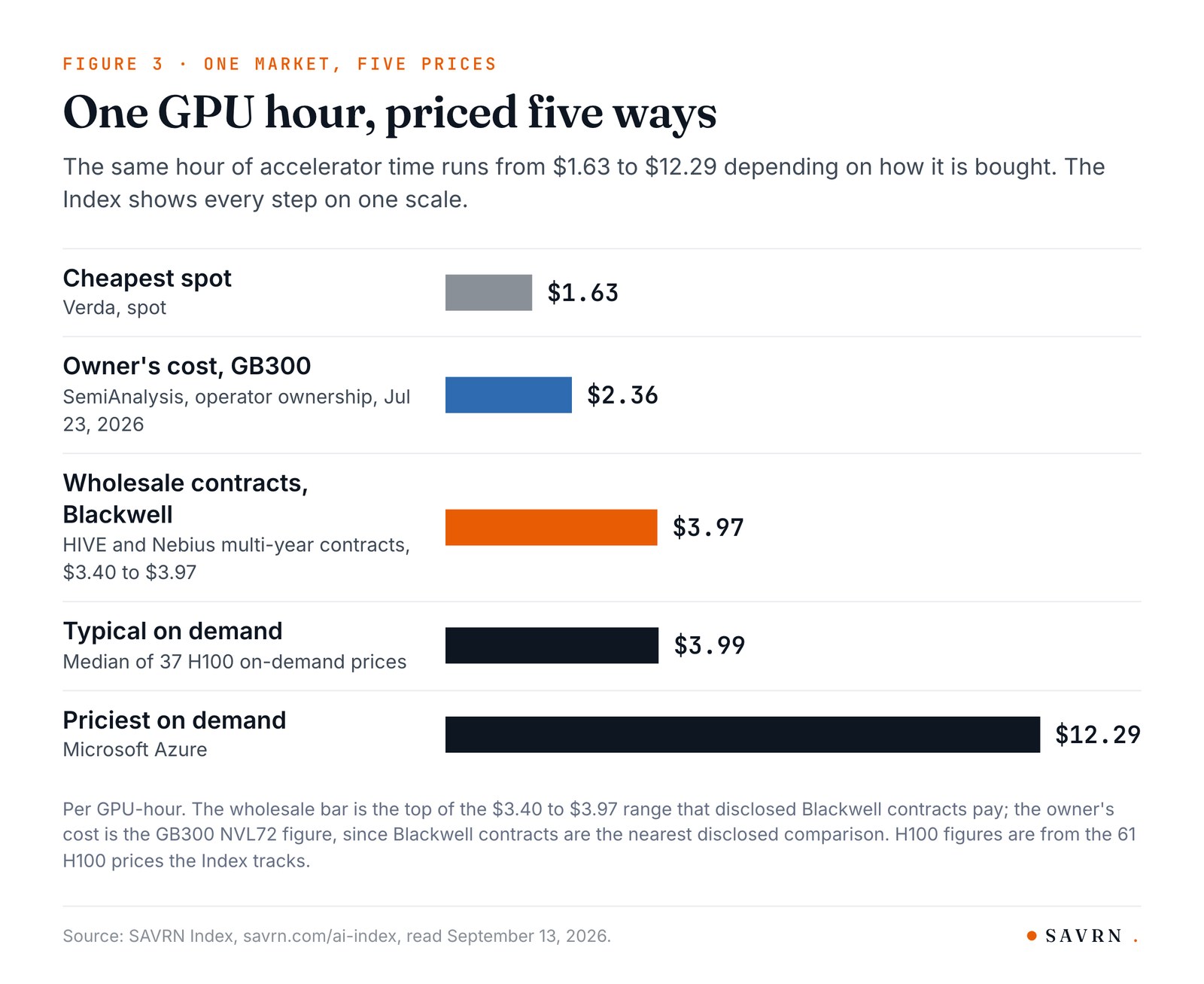
In particular, the H100 shows the spread inside a single market. For instance, the cheapest H100 hour is $1.63 at Verda on spot 2. By contrast, the priciest on-demand hour is $12.29 at Microsoft Azure 2. Specifically, of the 61 H100 prices, 37 are on demand, 15 are reserved and 9 are spot 2. In addition, 4 offers carry no published price 2. Notably, nine of the 16 GB300 offers the Index tracks show no public price at all 2.
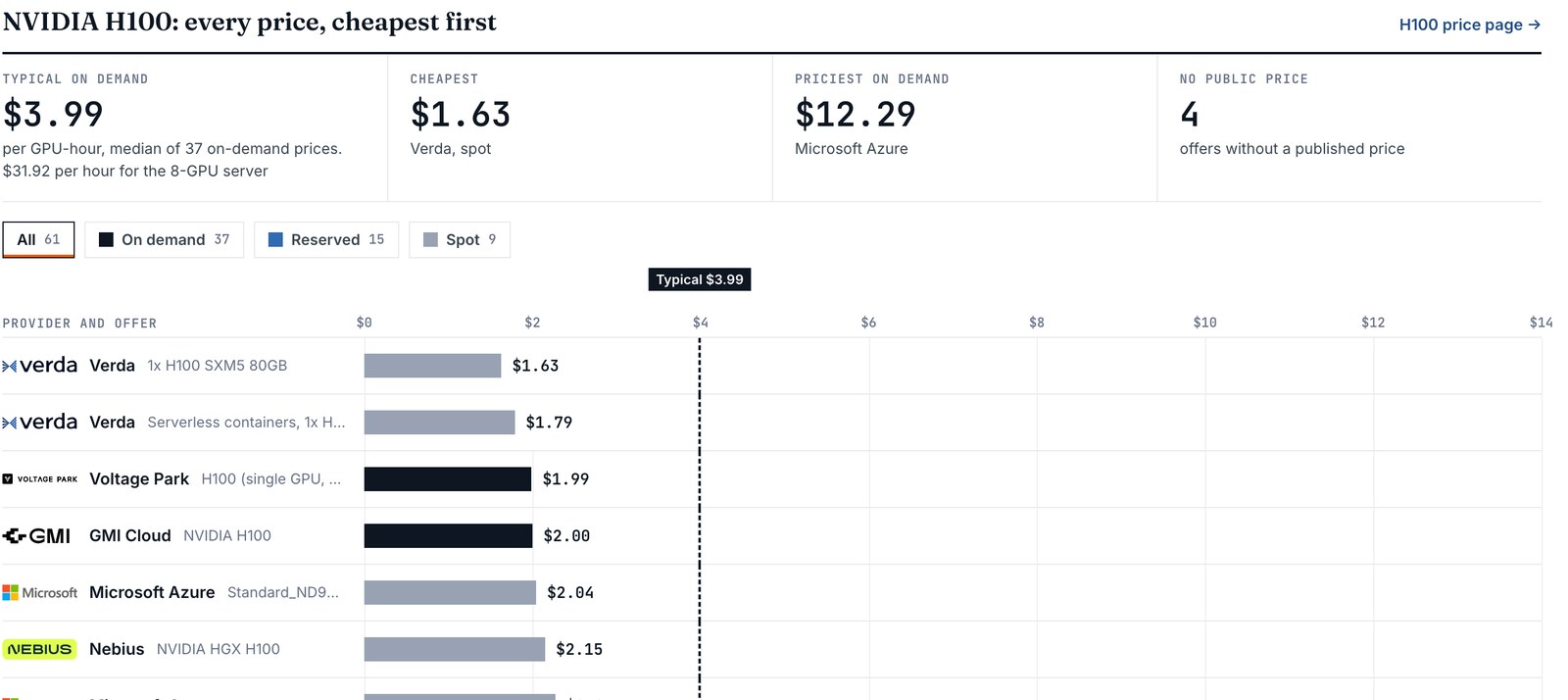
For a buyer of GPU time, this is the value of the page. Specifically, it shows the whole range for one GPU before signing, with the seller’s own words next to the converted number 2. Consequently, a price that looks cheap on one page can be compared with 60 others in one place.
What wholesale contracts and landlords are paid
The wholesale page shows what GPU owners are paid on multi-year contracts by hyperscalers, labs and enterprises 2. In addition, it shows what landlords charge for the buildings, and who sells capacity to whom 2. Specifically, it holds 5 disclosed contract rates per GPU-hour and 19 shell leases with a median of $155.60 per kW-month 2. Notably, it also holds 47 data center contracts, of which 18 disclose no rate 2.
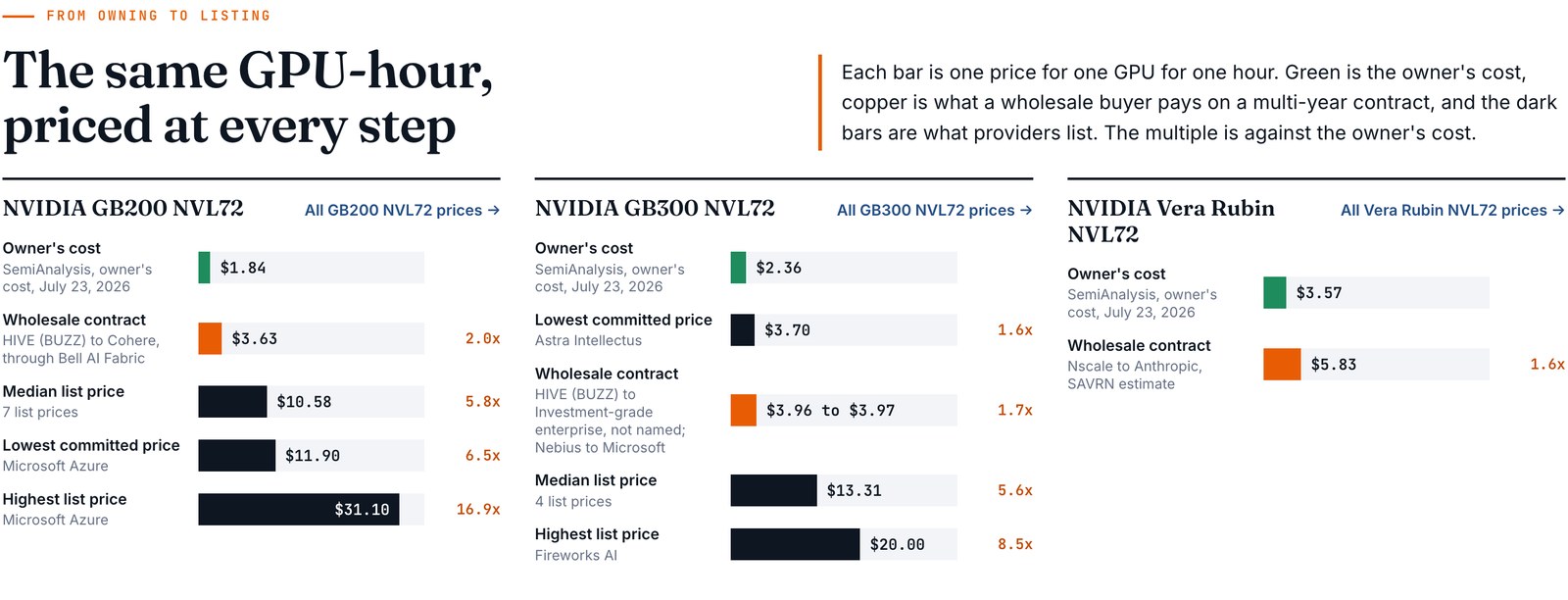
The page prices the same GPU-hour at every step from owning it to listing it. The owner’s cost comes from SemiAnalysis. Its total cost of ownership is $3.57 per GPU-hour for Vera Rubin, against $1.84 for GB200 and $2.36 for GB300, in the operator ownership scenario 9. For GB200, the HIVE contract with Cohere through Bell AI Fabric pays $3.63, 2.0 times the owner’s cost 2. Meanwhile, the median list price is $10.58, 5.8 times 2. Furthermore, the highest list price is $31.10 at Microsoft Azure, 16.9 times 2. For GB300, the lowest committed price is $3.70 at Astra Intellectus 2. Wholesale contracts pay $3.96 to $3.97, whereas the highest list price is $20 at Fireworks AI, 8.5 times the owner’s cost 2.
The disclosed contracts
Each disclosed contract is divided by its GPUs and the hours in its term. The rate is what the seller receives before its own costs. For example, Nebius to Microsoft works out to $3.97 per GPU-hour 2. Specifically, that rate comes from $17.4 billion for 100,000 GB300 GPUs over five years 2, 7. Likewise, HIVE to an unnamed investment-grade enterprise is $3.96, on $350 million for 2,016 GB300 GPUs over five years 2. Similarly, HIVE to Cohere is $3.63, on $220 million for 2,304 GB200 GPUs over three years 2. Finally, HIVE’s Dell contracts are $3.40, on $30 million for 504 Blackwell GPUs over two years 2. By contrast, the Nscale contract with Anthropic is about $45 billion over about six years for about 460 MW 2, 12. That is $1,358.70 per kW-month 2. However, the GPU count is not disclosed, so no per GPU-hour rate is stated for it 2.
What the tenant pays
Landlords quote base rent per kilowatt-month. However, the tenant pays more than the quote. Specifically, across the 47 leases SAVRN read, $128 of quoted Year-1 base rent becomes $261.46 per kW-month averaged over the term 2. That is 2.04 times the quote 2.
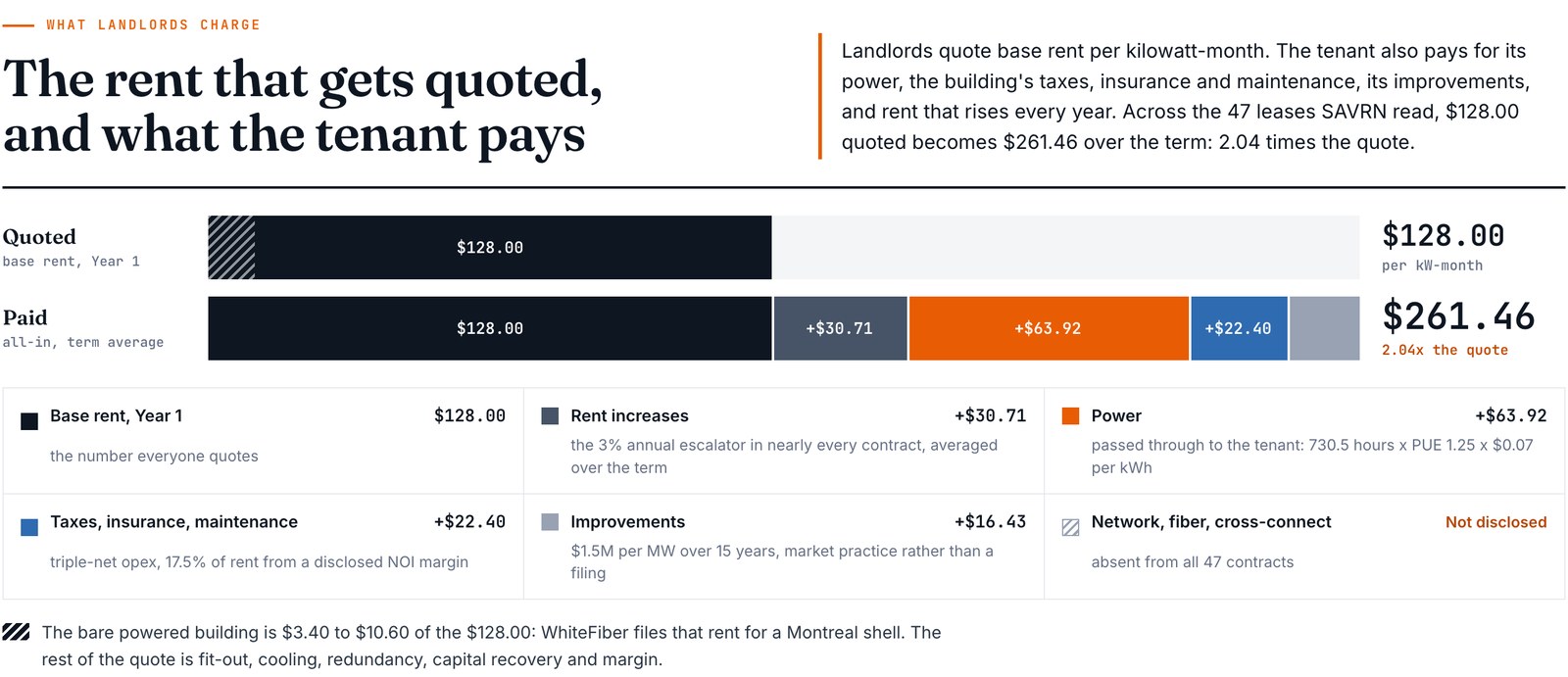
First, the build-up starts with base rent of $128 2. Second, rent increases add $30.71, from the 3 percent annual escalator in nearly every contract 2. Third, power adds $63.92, passed through at 730.5 hours times a PUE of 1.25 times $0.07 per kWh 2. In addition, taxes, insurance and maintenance add $22.40, and improvements add $16.43 from market practice rather than a filing 2. However, network, fiber and cross-connects are absent from all 47 contracts 2. Notably, the bare powered building is $3.40 to $10.60 of the $128, the rent WhiteFiber files for a Montreal shell 2. The rest, therefore, is fit-out, cooling, redundancy, capital recovery and margin 2. Consequently, a developer or landlord can see which parts of a quote are escalators, power, operating expense and improvements before a term starts.
One GPU-hour sold as tokens
Finally, the wholesale page also prices a GPU-hour as the tokens it produces. Specifically, Anthropic pays Nscale about $5.83 for an hour of one Vera Rubin GPU, SAVRN’s estimate from the contract 3. At Claude Fable 5.1 list prices, the tokens that hour produces bill $111.03 3. That is 19.0 times what Anthropic pays 3. Furthermore, one 72-GPU rack sold every hour of the year bills $70.0 million a rack-year 3. Notably, the throughput behind that figure is CoreWeave’s measurement on a pre-production rack, costed by SemiAnalysis 3. Importantly, the token counts are DeepSeek R1 tokens priced at Claude rates 3.
What frontier and open models charge
The frontier model page holds 250 model prices across six sellers 3. Specifically, Anthropic has 13, OpenAI 37, Google 13, xAI 7, Microsoft Azure 75 and AWS Bedrock 105 3. Of these, 69 are from the labs’ own APIs 3. There, the median output price is $8 per million tokens, and the range runs from $0.40 to $600 3. Furthermore, each row shows input, cached input and output at the standard tier 3. In addition, it shows the batch and committed-capacity prices each seller publishes, the last change and the check date 3.
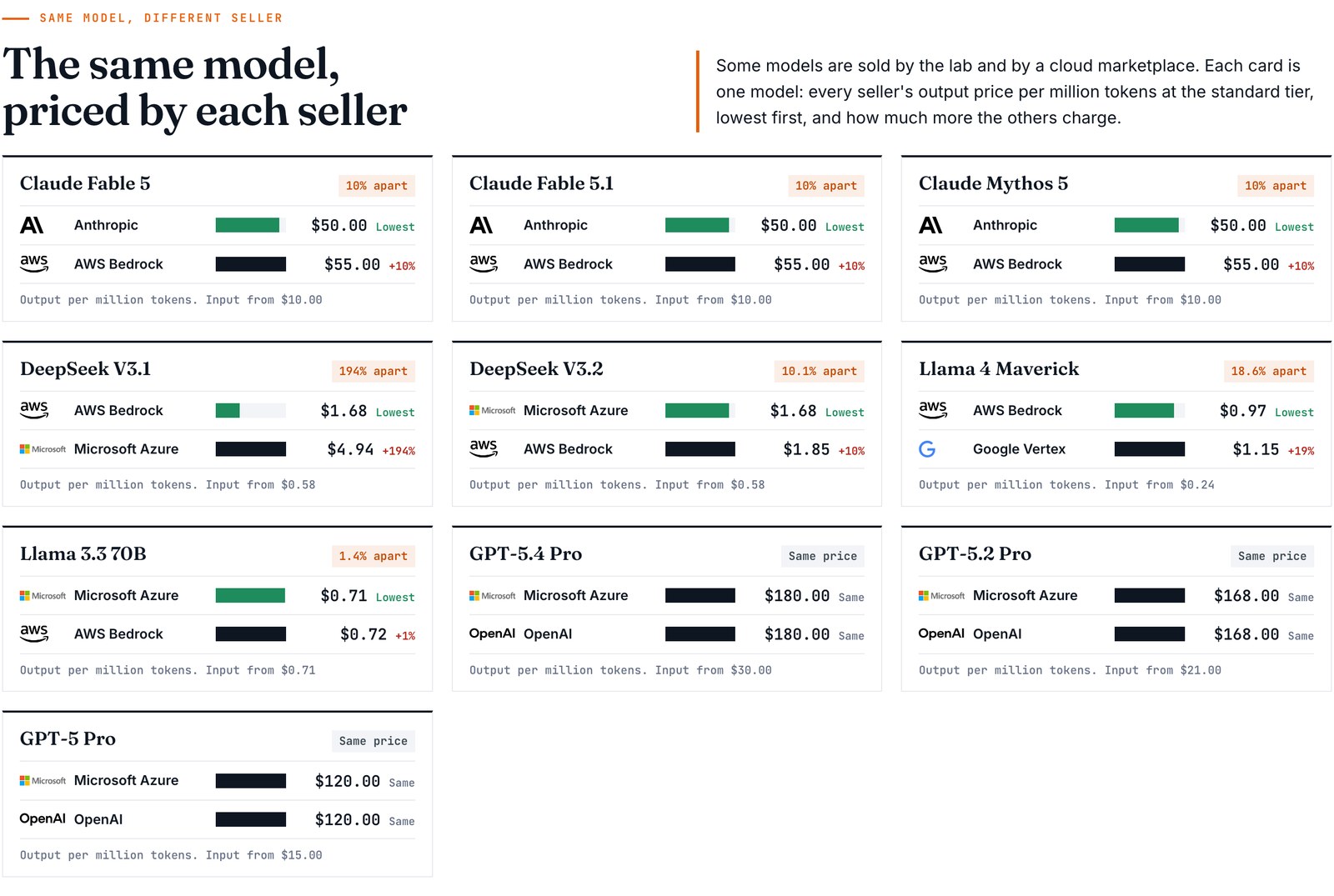
Ten models are sold by more than one seller, and the page compares each seller’s output price. For example, Claude Fable 5, Claude Fable 5.1 and Claude Mythos 5 are $50 per million output tokens at Anthropic and $55 at AWS Bedrock, 10 percent apart 3. In contrast, DeepSeek V3.1 is $1.68 at AWS Bedrock and $4.94 at Microsoft Azure, 194 percent apart 3. Meanwhile, GPT-5.4 Pro is $180 at both OpenAI and Microsoft Azure 3. Anthropic’s own price page lists Claude Fable 5.1 at $10 per million input tokens, $0.25 for cache hits and $50 per million output tokens 8. Likewise, it lists Claude Opus 5 at $5 input and $25 output 8.
Per GPU-hour, on every model row
In addition, every frontier table carries a Per GPU-hour column 3. Specifically, it shows what the tokens one Vera Rubin GPU writes and reads in an hour bill at that model’s price 3. At Claude Fable 5.1, for instance, the GPU-hour bills $111.03 3. Likewise, at Claude Opus 5 it bills $55.51, at Claude Sonnet 4.6 $33.31, at Claude Sonnet 5 $22.21 and at Claude Haiku 4.5 $11.10 3. Therefore, a buyer of model output can see, on the same row, what the price means for the hardware underneath it.
Open models, many hosts
The open model page covers 119 open-weight models priced by 17 hosts 4. That is 249 prices in all, 215 of them from Hugging Face Inference Providers 4. An open-weight model is the same model wherever it runs. Hence, every difference in price is the host’s 4. For gpt-oss-120b, for example, 13 hosts charge from $0.17 per million output tokens at DeepInfra to $0.75 at Groq and Cerebras 4. That is a 4.4 times spread 4. Fireworks, for instance, lists gpt-oss-120b at $0.15 input and $0.60 output on its serverless price page 11. Those are the same figures the Index carries 4. Similarly, DeepSeek-V4-Flash-0731 runs from $0.18 to $1.32 across five hosts, a 7.3 times spread 4. By contrast, GLM-5.3-Flash is $0.50 at every host that serves it 4.
The ladder from the building to the token
The pricing overview opens with a five-step ladder 4. Specifically, it shows the same AI capacity sold as rent, as accelerator-hours and as tokens 4. Moreover, every figure on it comes from Twenty Cents to Twenty-Five Dollars, SAVRN’s end-to-end pricing of 47 disclosed contracts 4.
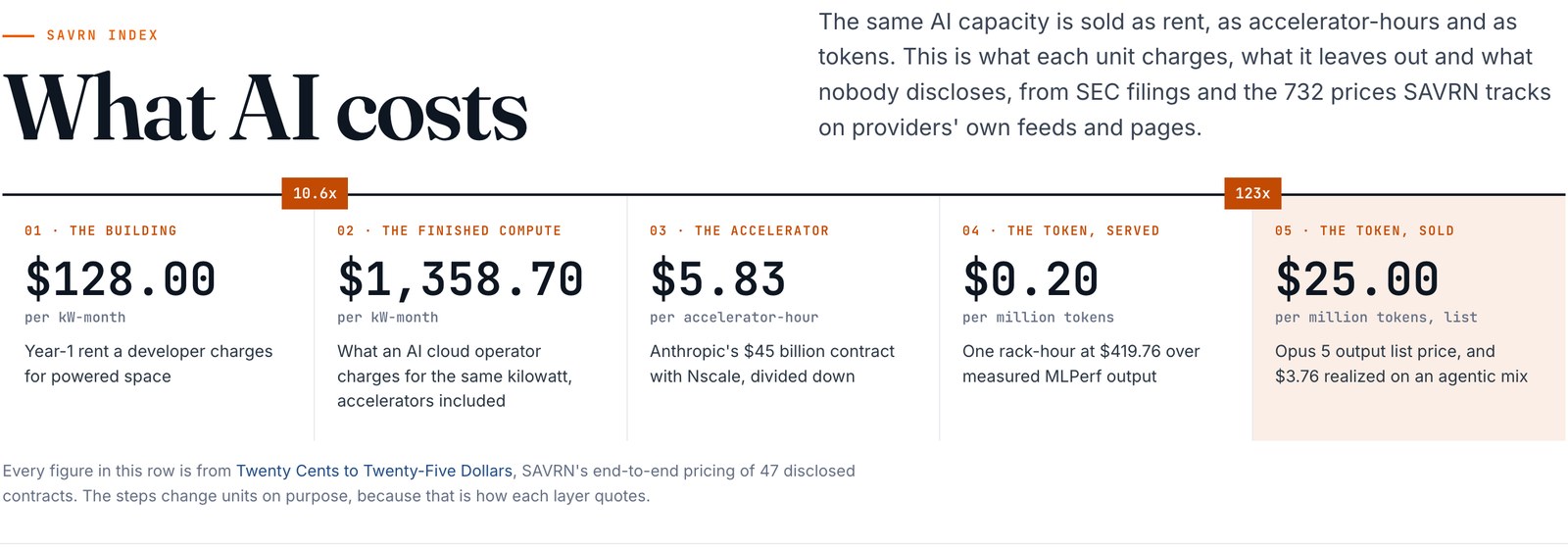
Step one, the building, is $128 per kW-month, the Year-1 rent a developer charges for powered space 4. Step two, the finished compute, is $1,358.70 per kW-month 4. That is what an AI cloud operator charges for the same kilowatt with accelerators included, 10.6 times step one 4. Step three, the accelerator, is $5.83 per accelerator-hour, Anthropic’s $45 billion contract with Nscale divided down 4. Step four, the token served, is $0.20 per million tokens, one rack-hour at $419.76 over measured MLPerf output 4. Finally, step five, the token sold, is $25 per million tokens list, the Claude Opus 5 output price 4. By contrast, the realized price on an agentic mix is $3.76 4. From step four to step five is 123 times 4. The steps change units on purpose, because that is how each layer quotes 4.
The overview then reduces three businesses to one kilowatt-month. For example, a neocloud acting as developer charges $128 and keeps $24 4. Likewise, an AI cloud operator acting as tenant charges $1,358.70 and keeps $363 4. Meanwhile, a model company charges $2,717.85 and keeps $1,359 4. As a result, an investor can see in one chart where the margin sits at each layer of the same kilowatt.
What is not in the price
A quoted price that leaves things out is not the price. Therefore, the overview closes with what sellers do not charge for and do not say 4. For example, Fluidstack, Lightning AI and TensorWave show no public price for any GPU the Index tracks 4. Likewise, network, fiber and cross-connects are not disclosed in any of the 47 contracts, so no quoted rent includes them 4. Furthermore, no contract discloses how many tokens a rack produces or how busy it runs 4. Instead, SAVRN measures throughput from MLPerf results 4. Similarly, tenants pay for fit-out, but no filing states the amount 4. Accordingly, SAVRN carries $16.43 per kW-month from market practice 4.
The discounts are large and unstated. For instance, an Opus 5 input token lists at $5 per million and bills at $0.25 once it is cached and batched 4. Furthermore, five contracts withhold the tenant’s name, including CoreWeave’s build-to-suit and Riot’s investment-grade counterparty 4. In addition, TeraWulf redacted the capacity and rent for Lake Mariner, and Cipher and CleanSpark redacted their escalator percentages 4. Finally, full-stack contracts such as Nscale’s price the building and the compute together, with no separate rent 4.
What moved
The changes page lists every price change the Index has recorded, newest first 4. Specifically, each row carries the old price, the new price, the percentage and the feed or page it came from 4. As of September 13, 2026 the Index had recorded 5 changes across its 732 tracked prices 4.
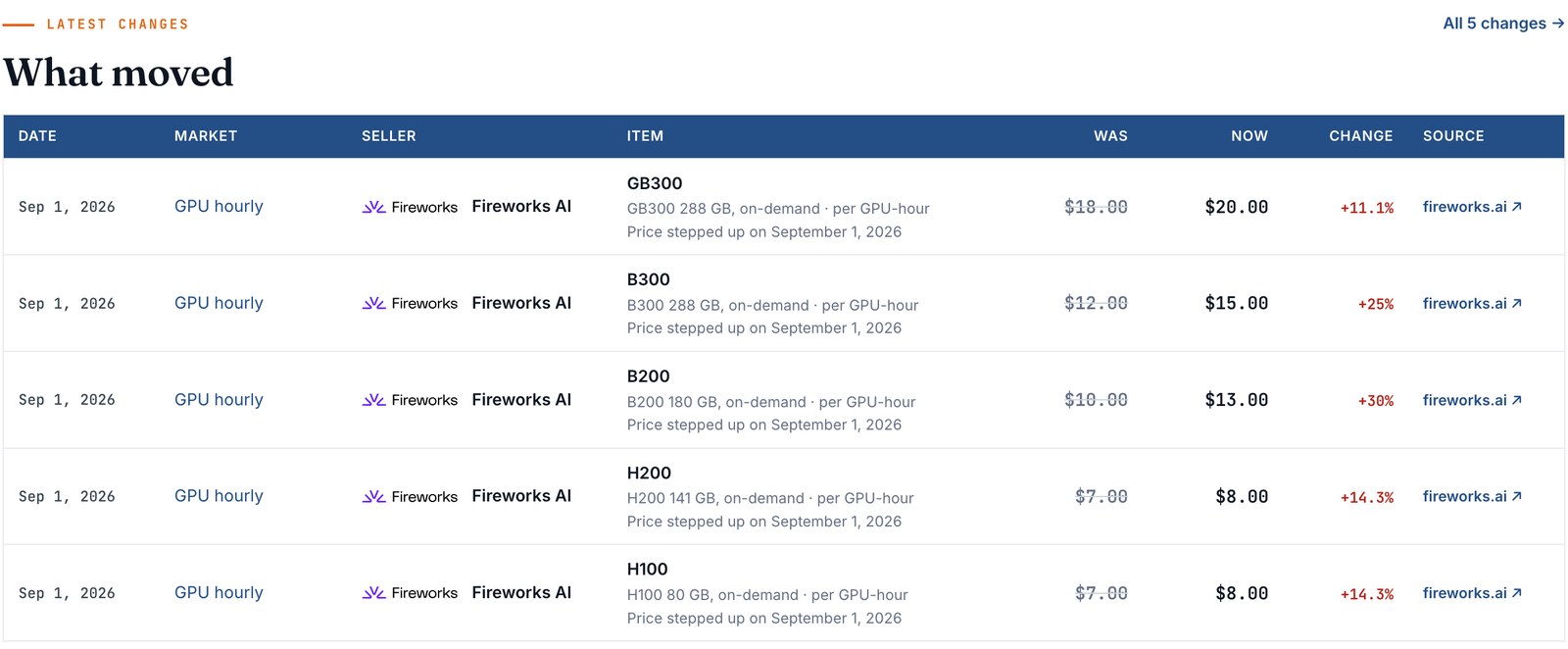
All five came on September 1, 2026, when Fireworks AI stepped up its on-demand GPU prices 4. For instance, GB300 went from $18 to $20 per GPU-hour, up 11.1 percent 4. Likewise, B300 went from $12 to $15, up 25 percent, and B200 from $10 to $13, up 30 percent 4. Similarly, H200 and H100 went from $7 to $8, up 14.3 percent each 4. This page is where the record of the market accumulates. Every future move appears here with its source, and the history is never deleted 4.
The register of 113 companies
The companies page is the register: 113 companies that fund, build, own and run AI infrastructure, one page each 4. Specifically, each profile carries the company’s official logo and the social accounts the company links from its own site 4. In addition, the 39 that trade on NASDAQ or NYSE carry delayed live market data 4. Moreover, profiles draw on the Capital Atlas record of sites, financing transactions and deals 4. Likewise, where a company’s prices are tracked, its profile shows them 4.
Furthermore, the register groups the market into ten categories 4. Specifically, it holds six hyperscalers, three frontier AI labs, 23 neoclouds, 17 GPU clouds and two chipmakers 4. Similarly, it holds 21 data center developers, 19 private equity and infrastructure firms, 12 pension and state investment funds, and nine market intelligence and brokerage firms 4. Finally, it holds one controlled AI environment, which is SAVRN’s own row 4. For an investor or lender, the register is where a contract rate, a filing and a company’s record sit on one page.
How scarce the inputs are
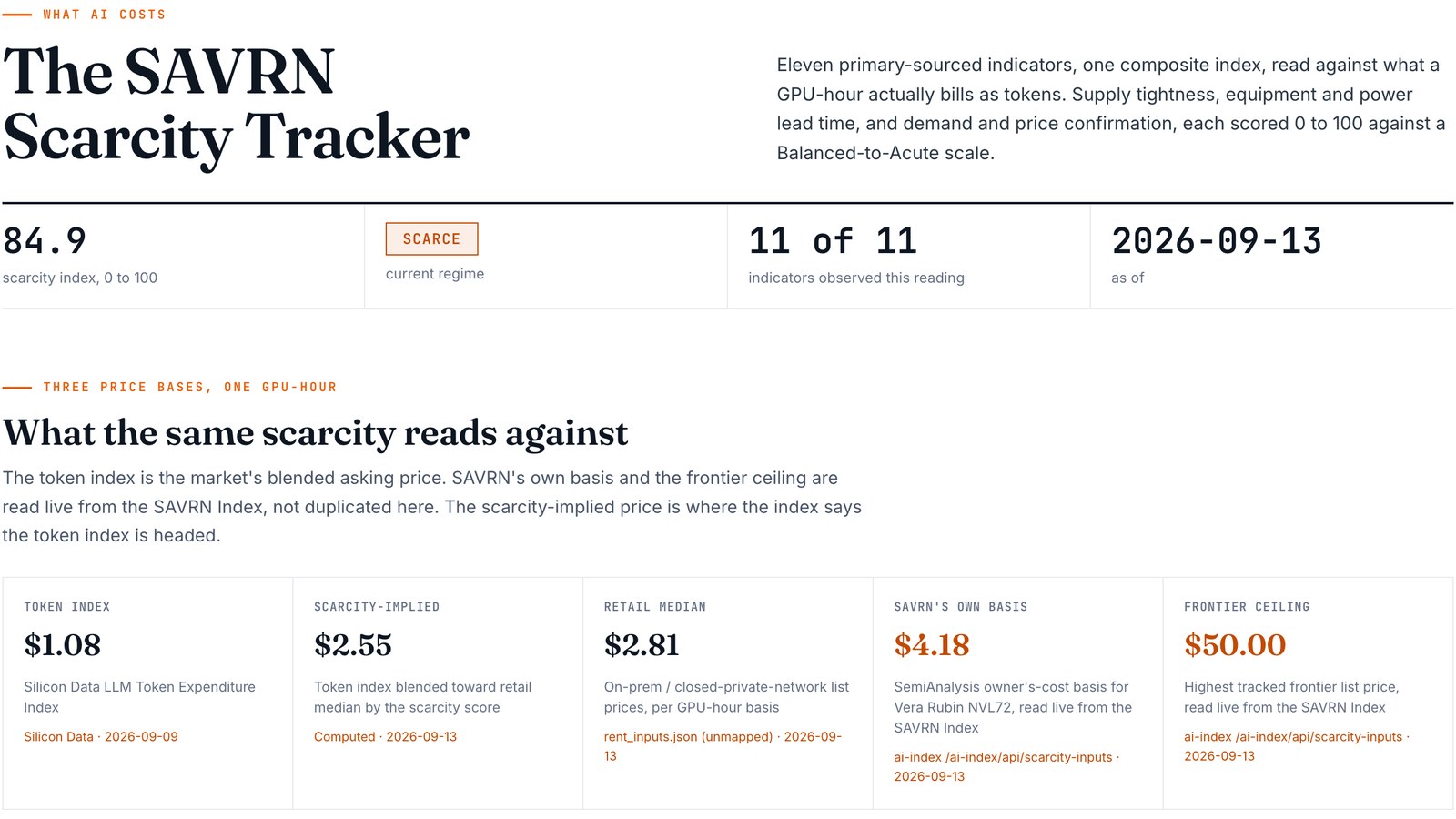
The Scarcity Tracker scores eleven primary-sourced indicators from 0 to 100 against a Balanced-to-Acute scale 5. It weights them and rolls them into one composite index 5. On September 13, 2026, the index read 84.9, in the Scarce regime, with all eleven indicators observed 5. Specifically, the bands are Balanced under 40, Tight from 40, Scarce from 70 and Acute from 85 5. Furthermore, every value traces to a dated source with a verbatim excerpt 5. Moreover, the tracker refreshes weekly 5.
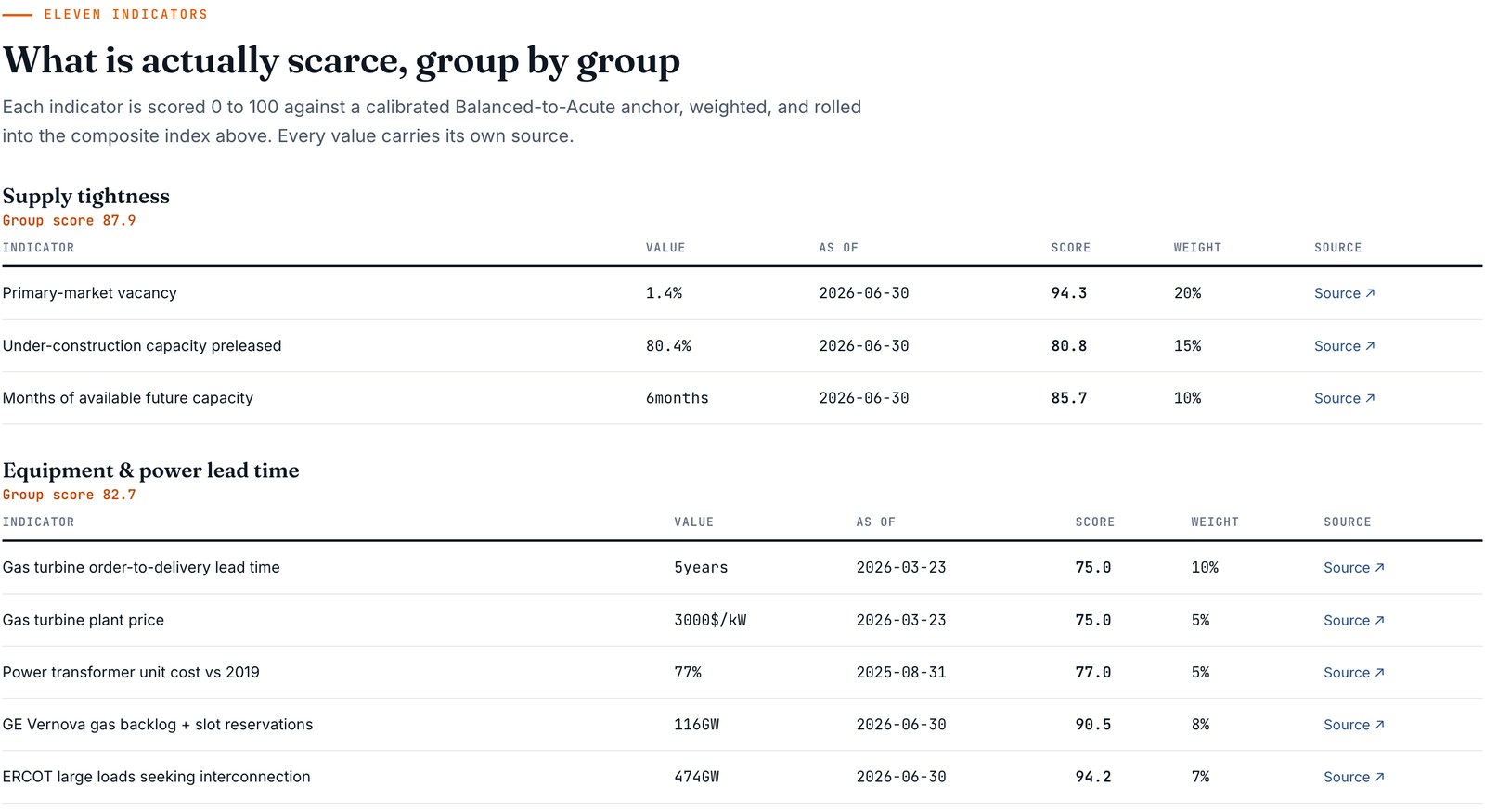
Supply tightness scored 87.9 5. Specifically, primary-market vacancy was 1.4 percent, 80.4 percent of under-construction capacity was preleased, and six months of future capacity were available, all as of June 30, 2026 5. Equipment and power lead time scored 82.7 5. Specifically, the gas turbine lead time was five years and the plant price $3,000 per kW 5. Likewise, power transformer unit cost was 77 percent above 2019 5. In addition, GE Vernova’s gas backlog with slot reservations was 116 GW, and 474 GW of large loads were seeking interconnection at ERCOT 5. Demand and price confirmation scored 82.3 5. For instance, combined 2026 hyperscaler capital expenditure guidance was $732.5 billion 5. Similarly, the H100 rental rate index was $2.64 per GPU-hour, and colocation rent growth was 8.3 percent for 3 to 10 MW requirements 5.
Five prices for one GPU-hour
In addition, the tracker reads the same scarcity against five price bases. The token index is $1.08, the market’s blended asking price from the Silicon Data LLM Token Expenditure Index 5. The scarcity-implied price is $2.55, where the index says the token index is headed 5. Meanwhile, the retail median of on-premises and closed-private-network list prices is $2.81 5. SAVRN’s own basis is $4.18, the SemiAnalysis owner’s cost for Vera Rubin NVL72 read live from the Index 5. Finally, the frontier ceiling is $50, the highest tracked frontier list price 5.
Furthermore, a rent coverage table shows what share of a megawatt’s annual token output pays the rent under two disclosed wholesale contracts 5. For the Oracle and OpenAI contract on GB300 NVL72 at 100 tokens per second per user, rent takes 76 percent of output at the token index 5. By contrast, it takes 20 percent at SAVRN’s basis and 2 percent at the frontier price 5. For the Monarch and Anthropic contract on the same basis, the figures are 92 percent, 24 percent and 2 percent 5. For a planner, that is the whole story in one table. Specifically, it shows which inputs are tight, by how much, and what the same GPU-hour is worth at five prices.
The SAVRN Standard
The Standard sets out seven principles, the minimum to expect from a controlled AI environment 6. They are brought together under one accountable operator, workforce first 6. Specifically, the seven are workforce reskilling, independent operations, data custody, customer model capability, supply assurance, infrastructure control and power provision 6.
Furthermore, seven offerings are measured against it 6. For each principle, the rating is Supported, Partial, Not established or Not yet assessed, backed by a cited source 6. Counting Supported and Partial together, Microsoft Azure Local disconnected operations scores 4 of 7 and Google Distributed Cloud air-gapped 4 of 7 6. HPE Private Cloud AI air-gapped edition scores 5 of 7, as do AWS AI Factories and Dell AI Factory 6. Likewise, Oracle OCI Dedicated Region scores 4 of 7 6. However, every one of those scores is made of partials. None of the six documented offerings is rated Supported on any principle 6. Moreover, power provision is not established for any of them, and workforce reskilling has not yet been assessed for them 6. SAVRN wrote the Standard and builds to every principle 6. Accordingly, its controlled AI environment is rated 7 of 7 and carries the SAVRN Standard seal 6.
Six references, one system
Finally, the Index sits inside a set of six primary-sourced references 6. SAVRN refreshes them on a schedule and links them into each other, so a project can be followed from the money committed to the docket that stopped it 6. For example, the Capital Atlas records who is funding AI data centers 6. Similarly, the Delay Watchlist records project-level slippage, and the Moratorium Tracker maps every state measure and local moratorium 6. Likewise, the Water Tracker holds every water measure that touches a data center 6. In addition, the Grid Operator Watchlist covers ERCOT, PJM, MISO, CAISO, SPP, NYISO, ISO-NE and FERC 6. Finally, the Scarcity Tracker is the sixth 6. Ultimately, capital, delay, policy, water, grid and scarcity are one system seen from six sides 6.
Who the information is for
A buyer of GPU time sees the whole range for one GPU before signing 6. For the H100, that is $1.63 to $12.29 an hour, against a typical $3.99 2. It is also against the $3.40 to $3.97 that multi-year contracts pay for newer Blackwell hardware 6. A buyer of model output sees that the same model can cost 10 percent more at one seller than another, or 194 percent more 6. Likewise, an open model’s price varies 4.4 times by host 6. A developer or landlord sees what a $128 quote becomes over a term, $261.46 6. In addition, it sees which parts are escalators, power, operating expense and improvements 6.
Meanwhile, an investor or lender sees the contract rates that public filings imply 6. Notably, it also sees that 18 of 47 data center contracts disclose no rate at all 6. Similarly, a planner sees which inputs are scarce and by how much: vacancy at 1.4 percent, turbines at five years, 474 GW waiting at ERCOT 6. Furthermore, anyone returning to the Index sees every price change since the last visit, with its source 6. Specifically, the tracker checks every three hours and keeps the history 6. Each figure exists somewhere, in a provider’s page, a filing or a report, in its own unit. However, the Index puts them in one unit on one site 6. Moreover, it keeps them current, keeps their history, and keeps the source one click away 6. That is what a reference price is; until now, however, the AI capacity market did not have one.
How SAVRN builds for this
SAVRN builds and operates AI factories that communities are proud to host. Each campus generates its own power on site with fuel cells and runs water-free cooling 6. In addition, each campus places the SAVRN Training Institute at its front to reskill the local workforce 6. The Index exists because SAVRN prices its own capacity in the same market it tracks; a market without a reference price, however, is hard to build in or buy from.
SAVRN publishes and maintains the public research references 6. They are the Data Center Moratorium Tracker, the Water Tracker, the Data Center Delay Tracker, the Grid Operator Watchlist, the Capital Atlas, the U.S. Data Center Map and now the SAVRN Index 6. SAVRN wrote the SAVRN Standard 6. Moreover, it measures its own controlled AI environment against it in the same table as every other offering, with the same ratings and the same cited sources 6. In addition, SAVRN’s own cost basis appears in the Scarcity Tracker, read live from the Index rather than entered separately 6. Consequently, SAVRN’s numbers are held to the same source rule as everyone else’s 6. Finally, the earlier posts The Unmetered Rack and The Price of Intelligence set out the economics the Index now tracks live. Similarly, Your Data Is Worth More Trained Than Handed Over shows the customer model principle in practice.
What to do next
- Start at What AI Costs for the ladder from the building to the token and the four markets.
- Open the GPU page, choose a GPU, and read every price for it, cheapest first, with the provider’s own published text.
- Open the wholesale page to see what the same GPU-hour costs to own, what contracts pay, and what a landlord’s quote becomes over a term.
- Compare sellers and hosts for the same model on the frontier and open model pages.
- Check the changes page for what moved since your last visit, with its source.
- Open a company’s profile in the register for its tracked prices, market data and record.
- Read the Scarcity Tracker to see which inputs are tight and what a GPU-hour is worth at five price bases.
- Read the SAVRN Standard to see how seven offerings measure against seven principles, then hold any offer you receive to the same seven.
Frequently asked questions
What is the SAVRN Index?
The SAVRN Index is a public reference on savrn.com. It captures GPU market pricing and pricing changes in one place. In addition, it holds the register of 113 AI infrastructure companies, the Scarcity Tracker and the SAVRN Standard 1.
How many prices does the Index track, and how often are they checked?
As of September 13, 2026, the Index tracks 732 prices from 54 providers across four markets. The tracker checks them every three hours against the providers’ own price feeds and pages 1.
What does an H100 cost per hour?
The typical H100 on-demand price on September 13, 2026 was $3.99 per GPU-hour, the median of 37 on-demand prices. However, the cheapest was $1.63 at Verda on spot, and the priciest on demand was $12.29 at Microsoft Azure 2.
What do wholesale GPU contracts pay?
The five disclosed contracts pay $3.40 to $3.97 per GPU-hour for Blackwell hardware. Specifically, Nebius to Microsoft is $3.97, two HIVE contracts are $3.96 and $3.63, and HIVE’s Dell contracts are $3.40. The Nscale contract with Anthropic does not disclose a GPU count, so no rate is stated for it 2.
How is a GPU-hour priced as tokens?
Anthropic pays Nscale about $5.83 for an hour of one Vera Rubin GPU. At Claude Fable 5.1 list prices, the tokens that hour produces bill $111.03, 19.0 times the contract rate. The throughput comes from CoreWeave’s measurement, costed by SemiAnalysis 3.
What is the price ladder?
It is the pricing overview’s five steps for the same capacity: $128 per kW-month for the building, $1,358.70 per kW-month for finished compute, $5.83 per accelerator-hour, $0.20 per million tokens served and $25 per million tokens sold at list. Every figure comes from SAVRN’s pricing of 47 disclosed contracts 4.
What does a scarcity index of 84.9 mean?
It places the market in the Scarce regime. The bands are Balanced under 40, Tight from 40, Scarce from 70 and Acute from 85. The reading combines eleven weighted indicators, each scored 0 to 100 5.
Which companies are in the register?
The register holds 113 companies: hyperscalers, frontier AI labs, neoclouds, GPU clouds, chipmakers, data center developers, private equity and infrastructure firms, pension and state investment funds, market intelligence and brokerage firms, and SAVRN. The 39 that trade on NASDAQ or NYSE carry delayed live market data 4.
What is the SAVRN Standard?
It is a set of seven principles for a controlled AI environment: workforce reskilling, independent operations, data custody, customer model capability, supply assurance, infrastructure control and power provision. Seven offerings are rated against it with cited sources 6.
What is not in a quoted price?
Network, fiber and cross-connects are absent from all 47 contracts. No contract discloses throughput or utilization, fit-out amounts are not filed, and several contracts redact tenant names, capacity, rent or escalators. The Index lists each gap beside the price 4.
Sources
- SAVRN Index record, part 1 of 6: About this record, SAVRN internal record, Sep 13, 2026.
- SAVRN Index record, part 2 of 6: GPU prices by the hour, SAVRN internal record, Sep 13, 2026.
- SAVRN Index record, part 3 of 6: One GPU-hour sold as tokens, SAVRN internal record, Sep 13, 2026.
- SAVRN Index record, part 4 of 6: The price ladder from the building to the token, SAVRN internal record, Sep 13, 2026.
- SAVRN Index record, part 5 of 6: The SAVRN Scarcity Tracker, SAVRN internal record, Sep 13, 2026.
- SAVRN Index record, part 6 of 6: The reference set: six references, one system, SAVRN internal record, Sep 13, 2026.
- Nebius Group Form 6-K: commercial agreement with Microsoft, U.S. Securities and Exchange Commission, Sep 8, 2025.
- Claude Platform pricing, Anthropic, Sep 2026.
- Vera Rubin NVL72 vs GB200 NVL72 inference, SemiAnalysis, Jul 23, 2026.
- 5-year waits and rising costs: how demand is redefining the gas turbine market, Utility Dive, Mar 23, 2026.
- Fireworks AI serverless pricing, Fireworks AI, Sep 2026.
- Anthropic to rent AI computing power from Nscale for $45 billion, source says, Reuters, via AOL, Aug 26, 2026.
Want the next one?
When a new piece publishes on SAVRN Insights, you get one email with what it covers and a link to read it. Choose the research that interests you.
Also send me
Receive a short introduction on days 3, 7 and 14, plus the updates you select. Unsubscribe in one click. Privacy
The SAVRN Index: One Place for GPU Market Pricing and Price Changes
Get new SAVRN Insights by email
A short introduction on days 3, 7 and 14, plus new SAVRN research articles. Unsubscribe at any time.
We use your address to send the introduction and updates described above. See our Privacy Policy.