# SAVRN + [Your University]: A Communiversity for the AI Economy

> The university is the academic anchor. SAVRN is the community partner. The SAVRN Institute connects them, and every group in the region has something to gain.

Source: https://savrn.com/blog/university-workforce-partnership-communiversity
Author: Chad Everett Harris
Published: 2026-10-16

---

A **university workforce partnership** usually means a vendor sells courses to a campus. A Communiversity, however, is something larger. In this model the university is the academic anchor, SAVRN is the community partner, and the SAVRN Institute is the platform that connects them. As a result, the university gains new learners and new revenue, while the region gains workers, employers and investment. We call it **SAVRN + [Your University]**, because the model is built to fit the university that already anchors a region.

<div class="btab"><p class="btab-cap"><b>Table 1</b> Key figures: the workforce and market a Communiversity is built to serve</p><div class="brows"><div class="br"><div class="br-k">Data center operators struggling to hire or keep staff</div><div class="br-v">nearly 2 in 3</div><div class="br-b">Report difficulty retaining staff, finding qualified candidates, or both, 2025 <sup class="cite">[1]</sup></div></div><div class="br"><div class="br-k">Jobs supported by the US data center industry</div><div class="br-v">4.7 million</div><div class="br-b">Including about 600,000 people employed directly, 2023 <sup class="cite">[3]</sup></div></div><div class="br"><div class="br-k">Data center contribution to US GDP</div><div class="br-v">$727 billion</div><div class="br-b">Total contribution in 2023 <sup class="cite">[3]</sup></div></div><div class="br"><div class="br-k">Electrician openings projected each year</div><div class="br-v">72,700</div><div class="br-b">On average from 2025 to 2035; employment grows 9%, much faster than average <sup class="cite">[2]</sup></div></div><div class="br"><div class="br-k">Median electrician pay</div><div class="br-v">$63,190</div><div class="br-b">Per year ($30.38 an hour), 2025 <sup class="cite">[2]</sup></div></div><div class="br"><div class="br-k">Working-age adults with some college and no credential</div><div class="br-v">37.6 million</div><div class="br-b">Under 65, start of the 2023-24 academic year <sup class="cite">[4]</sup></div></div><div class="br"><div class="br-k">US employer spending on training</div><div class="br-v">$102.8 billion</div><div class="br-b">Organizations with 100 or more employees, up 4.9% in 2025 <sup class="cite">[5]</sup></div></div><div class="br"><div class="br-k">Firms that have adopted AI</div><div class="br-v">about 18%</div><div class="br-b">Census business survey, year-end 2025 <sup class="cite">[7]</sup></div></div><div class="br"><div class="br-k">Workforce Pell program length</div><div class="br-v">150 to 599 hours</div><div class="br-b">Clock hours over 8 to under 15 weeks, from July 2026 <sup class="cite">[6]</sup></div></div><div class="br"><div class="br-k">SAVRN Institute catalog</div><div class="br-v">43 courses</div><div class="br-b">10 departments, 4,668 hours of instruction, 9 proposed certificate programs <sup class="cite">[8]</sup></div></div></div></div>

## What is a Communiversity?

A Communiversity is a university and its community building the AI economy together. SAVRN, in particular, is not proposing to be a training vendor. Instead, SAVRN proposes to be the university's community economic development partner. The SAVRN Institute, as a result, becomes the physical and operational center of that partnership.

Each side brings what it already does well, because neither should rebuild what the other has. The university brings academic expertise, faculty, research and the ability to award approved credentials. SAVRN, meanwhile, brings industry relationships, the AI Factory, applied-learning environments, employer engagement and a plan for attracting business and investment. Ultimately, the partners can build something far larger than a technical education program.


## Why the AI economy needs a new kind of partnership

Regions with technology companies, data centers and infrastructure investment still leave many residents outside that economy. Taking part, in fact, takes more than a degree. For example, nearly two in three data center operators report difficulty retaining staff, finding qualified candidates, or both <sup class="cite">[1]</sup>. The industry, meanwhile, supported 4.7 million US jobs in 2023, including about 600,000 people employed directly <sup class="cite">[3]</sup>.

So the demand is real, although the pathways are thin. Communities need technical skills, industry relationships and employers ready to hire locally. Companies, by contrast, need qualified workers, training facilities and places to demonstrate new technology. Universities, in turn, need new revenue and new ways to serve learners beyond traditional degrees. A Communiversity is designed to meet all three needs in one place rather than three.

## The benefits for the university

The first benefit is new learners. Notably, there are 37.6 million working-age Americans with some college and no credential <sup class="cite">[4]</sup>. Most of them will never return for a four-year degree, since their lives and jobs have moved on. However, many would enroll in a short, specialized program tied to a real job. Because the Institute organizes employers around the university, those learners arrive with a reason to finish.

The second benefit is new revenue that does not depend on the university financing a building and hoping students arrive. US organizations spent $102.8 billion on training in 2025, up 4.9% <sup class="cite">[5]</sup>. Rather than chase that market alone, the university partners with SAVRN to cultivate it. In short, SAVRN develops the market while the university participates in the revenue from serving it.

<div class="btab"><p class="btab-cap"><b>Table 2</b> Where new educational revenue comes from</p><div class="brows"><div class="br"><div class="br-k">Professional certifications</div><div class="br-v">Program fees</div><div class="br-b">SAVRN identifies industry demand and connects learners with programs, while the university delivers approved education and collects program fees</div></div><div class="br"><div class="br-k">Corporate workforce contracts</div><div class="br-v">Contracts</div><div class="br-b">SAVRN recruits employers that need specialized training, while the university provides customized instruction and educational oversight</div></div><div class="br"><div class="br-k">Executive education</div><div class="br-v">Executive programs</div><div class="br-b">SAVRN builds relationships with industry leaders and infrastructure investors, while the university provides executive education and university expertise</div></div><div class="br"><div class="br-k">AI adoption programs</div><div class="br-v">Program fees</div><div class="br-b">SAVRN engages local businesses and organizations, while the university provides professional education and applied instruction</div></div><div class="br"><div class="br-k">Sponsored workforce pathways</div><div class="br-v">Funded cohorts</div><div class="br-b">SAVRN assembles employers and community partners, while the university delivers education through funded cohorts</div></div><div class="br"><div class="br-k">National institutional partnerships</div><div class="br-v">Institutional agreements</div><div class="br-b">SAVRN connects other communities and training facilities, while the university provides curriculum, instruction and approved educational services</div></div></div></div>

The third benefit is timing. Beginning in July 2026, Workforce Pell can fund programs of 150 to 599 clock hours that run 8 to under 15 weeks, once a governor approves them and they pass a value-added earnings test <sup class="cite">[6]</sup>. Short technical certificates built to employer requirements are, specifically, that shape. See how the [Institute's technician certificates map to Workforce Pell](https://savrn.com/institute/workforce-pell).

Finally, the university keeps academic control. A formal agreement sets responsibilities, pricing, costs, intellectual property and compensation, while the university alone decides what it teaches and what credentials it awards.

## The benefits for workers and residents

For residents, the benefit is a shorter, clearer path to a better job. In particular, electricians alone are projected to see about 72,700 openings a year from 2025 to 2035, and the median electrician earned $63,190 in 2025 <sup class="cite">[2]</sup>. Similarly, AI infrastructure needs technicians in critical power, cooling, fiber networks and GPU systems.

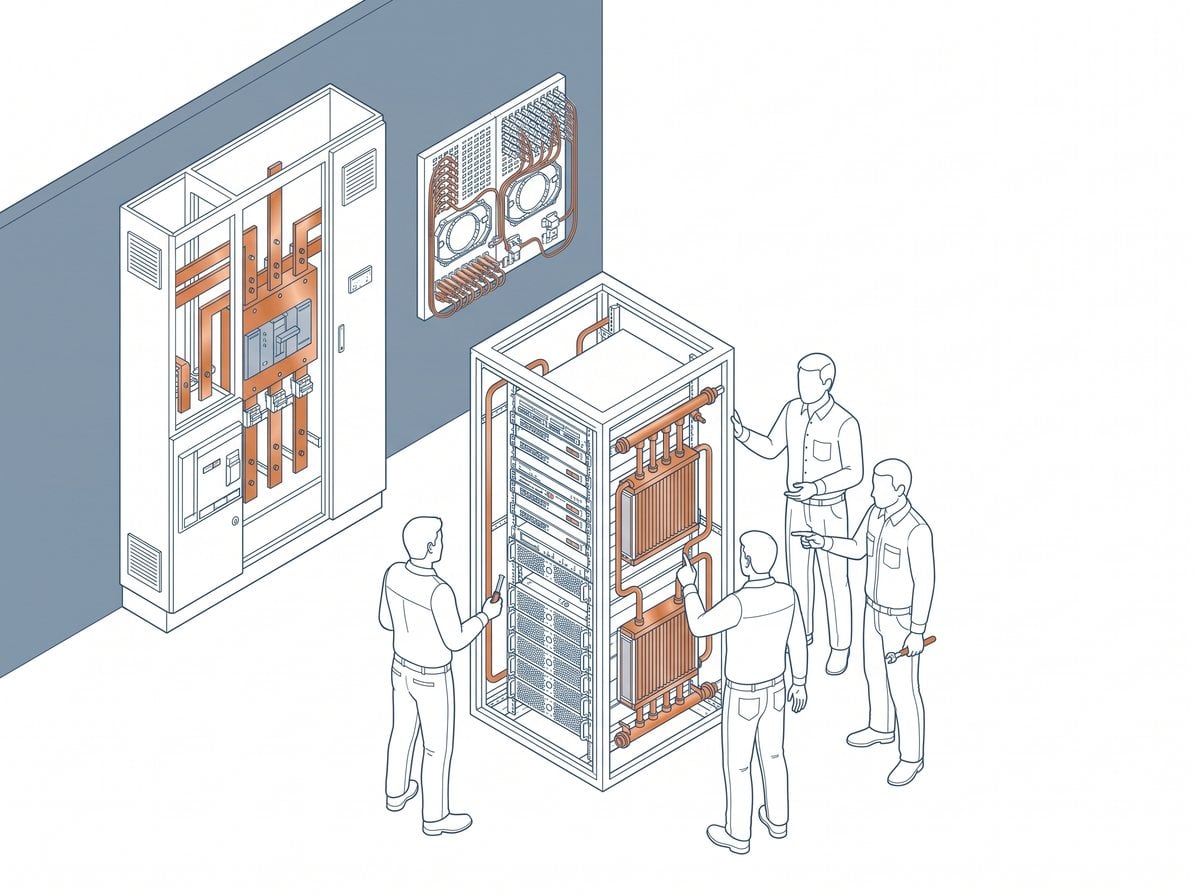
<figure class="bfig"><img src="/media/communiversity-workforce-17528144.jpg" alt="Instructor and adult trainees at an open liquid-cooled server rack"><figcaption>Hands-on training on the equipment AI infrastructure actually runs on, because employers hire for it</figcaption></figure>

The Institute is designed for people who are not seeking a traditional degree: a working electrician, a data center technician, a manufacturing supervisor or an enterprise IT manager. Veterans and career changers can likewise explore pathways, and each program connects to employers who hire for those skills. Importantly, the [SAVRN Institute catalog](https://savrn.com/institute/catalog) already publishes 43 courses across 10 departments, with 4,668 hours of instruction and 9 proposed certificate programs <sup class="cite">[8]</sup>.

## The benefits for employers

For employers, the benefit is a workforce built to their own requirements. Because SAVRN brings industry into the room, companies help define the skills a program teaches. Additionally, they can commit equipment, training resources or hiring pathways, and then recruit from the cohorts they helped shape.

Employers can also use the Institute directly. For instance, a company can train its own employees there, demonstrate new technology or teach alongside faculty. That matters because hiring ranks among operators' top challenges <sup class="cite">[1]</sup>.

## The benefits for local businesses

Small businesses gain practical help with AI adoption, since only about 18% of US firms had adopted AI by year-end 2025 <sup class="cite">[7]</sup>. In other words, most businesses have not. Consequently, the Institute can host workshops that show owners what AI can do for their operations and where to start.

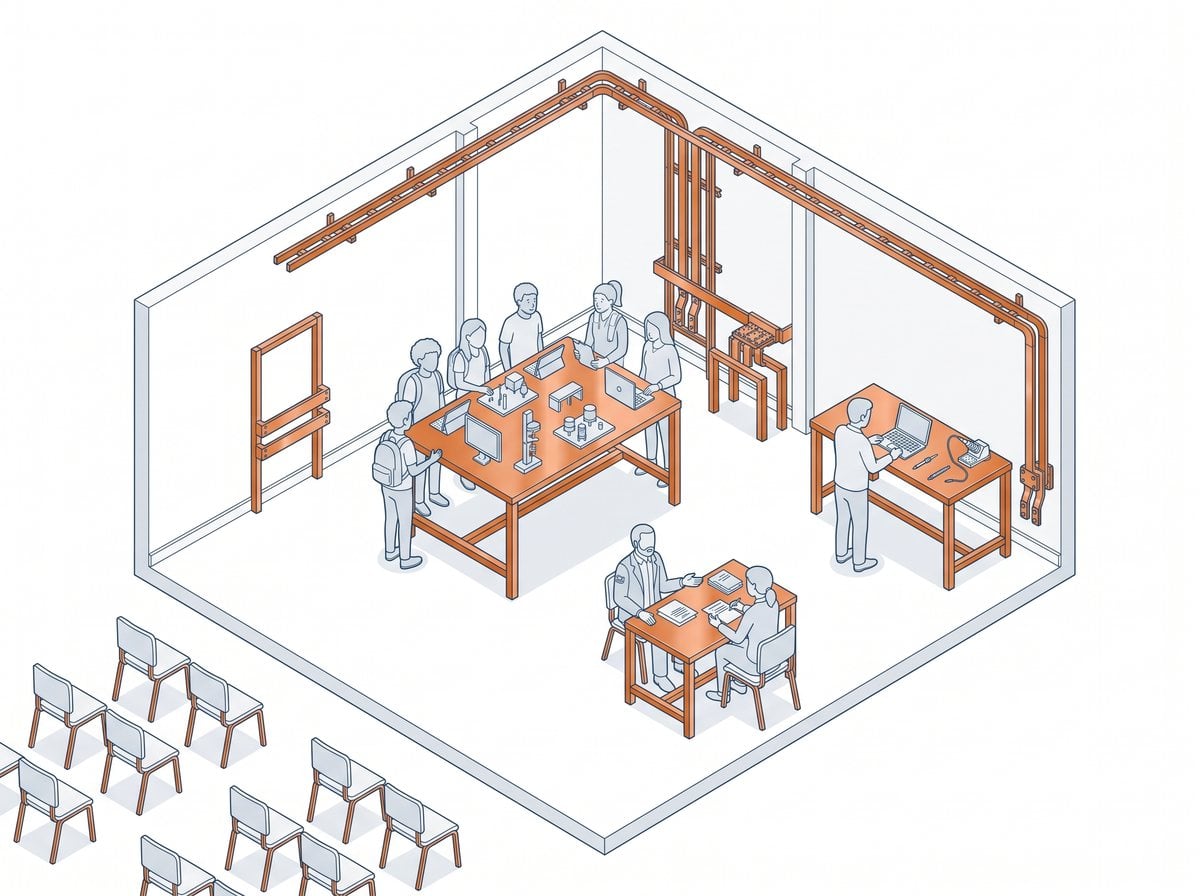
<figure class="bfig"><img src="/media/communiversity-community-fd4318c3.jpg" alt="High-school students, a veteran and a small business owner in a community room"><figcaption>A community-facing building, open to students, veterans and small businesses alike</figcaption></figure>

In addition, local suppliers benefit when new employers arrive. Electrical contractors, mechanical firms, fiber installers and facilities companies all gain customers when the region attracts infrastructure investment.

## The benefits for students and families

High-school students can attend technical demonstrations and career-exploration events at the Institute. As a result, families can see where a career in AI infrastructure begins. Moreover, the model connects K-12 schools, community colleges, working professionals and university pathways, so a student can move from a first certificate to an advanced degree without starting over.

## The benefits for the region and economic developers

Picture an AI infrastructure manufacturer weighing an expansion into the region. Its leadership visits the Institute and, notably, sees more than classrooms. Instead, it sees a training environment, university expertise, workforce pathways, space for equipment demonstrations and a community partner ready to organize local relationships.

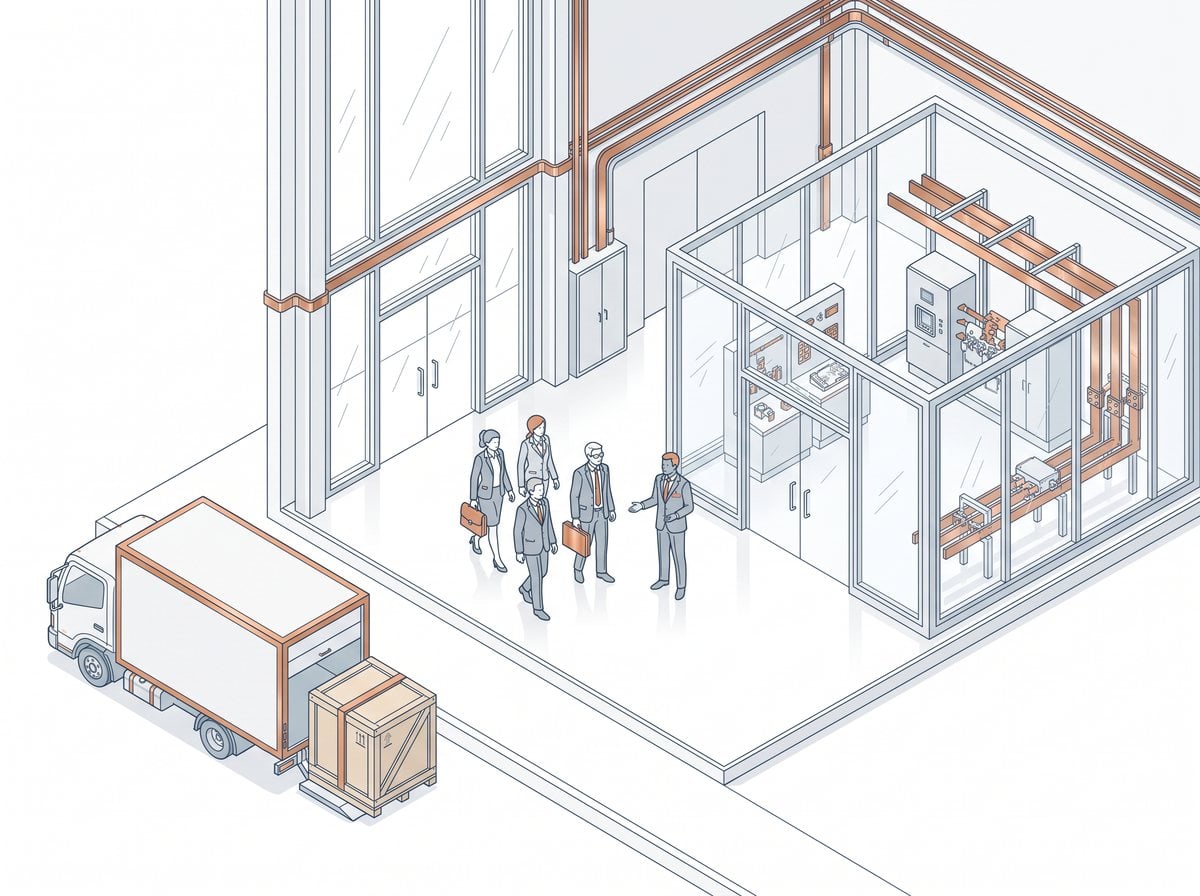
<figure class="bfig"><img src="/media/communiversity-industry-3bfd6cf5.jpg" alt="Company delegation arriving at an institute with a glass equipment demonstration hall"><figcaption>Companies can train, demonstrate and recruit in one place rather than three</figcaption></figure>

For economic development organizations, that becomes a capability they can market, because companies do not come to a region only for access to infrastructure. Rather, through SAVRN and its university partner, they gain an organized ecosystem for developing the workforce that operates it. Therefore, the Institute also serves as a venue for industry demonstrations, investor visits and public events.

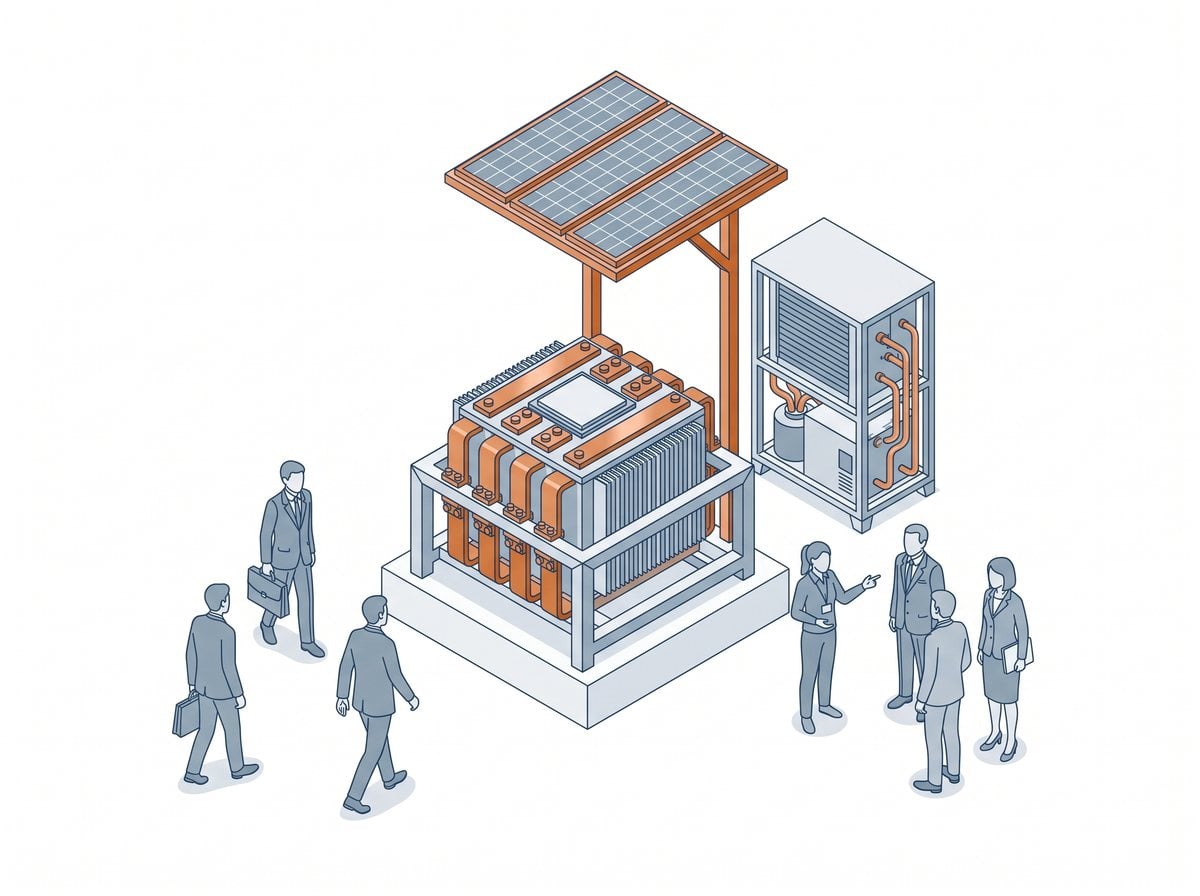
<figure class="bfig"><img src="/media/communiversity-investment-5741bb2b.jpg" alt="Investors and officials around a compact AI compute block with solar canopy and closed-loop cooling"><figcaption>A working demonstration of AI infrastructure designed around energy, water and land use</figcaption></figure>

SAVRN's AI Factory concept adds one more dimension: a working demonstration of how AI infrastructure can address energy, water, land use and community concerns. Although promising, those characteristics are validated site by site for any actual installation. For more, read about [how an AI factory can give a community more than it takes](https://savrn.com/blog/how-an-ai-factory-can-give-a-community-more-than-it-takes).

## What SAVRN brings

The difference between this model and a conventional university partnership is the scope of SAVRN's role. In fact, SAVRN's success is measured partly by the economic activity it helps bring into the community, not only by the number of courses delivered.

<div class="btab"><p class="btab-cap"><b>Table 3</b> Seven roles SAVRN proposes to play</p><div class="brows"><div class="br"><div class="br-k">Community development partner</div><div class="br-v">Regional growth</div><div class="br-b">For the university: connects educational programs to regional economic development, while the community gains business attraction and workforce opportunity</div></div><div class="br"><div class="br-k">Industry recruitment partner</div><div class="br-v">Employers</div><div class="br-b">For the university: introduces employers and corporate training customers, while the community gains relationships with companies that may expand or hire locally</div></div><div class="br"><div class="br-k">AI infrastructure partner</div><div class="br-v">Applied learning</div><div class="br-b">For the university: applied learning on specialized technology, while the community gains wider exposure to AI infrastructure and technical careers</div></div><div class="br"><div class="br-k">Institute development partner</div><div class="br-v">Teaching space</div><div class="br-b">For the university: a distinctive teaching and demonstration environment, while the community gains a community-facing destination for education and industry</div></div><div class="br"><div class="br-k">Employer engagement partner</div><div class="br-v">Paid programs</div><div class="br-b">For the university: training programs employers will purchase, while the community gains education tied to identifiable workforce needs</div></div><div class="br"><div class="br-k">Technology adoption partner</div><div class="br-v">AI adoption</div><div class="br-b">For the university: new educational markets in enterprise AI, while the community gains help for local businesses to understand and adopt AI</div></div><div class="br"><div class="br-k">National expansion partner</div><div class="br-v">Replication</div><div class="br-b">For the university: education delivered beyond its home region, while the community gains a model other communities can replicate</div></div></div></div>

## How the benefits compound

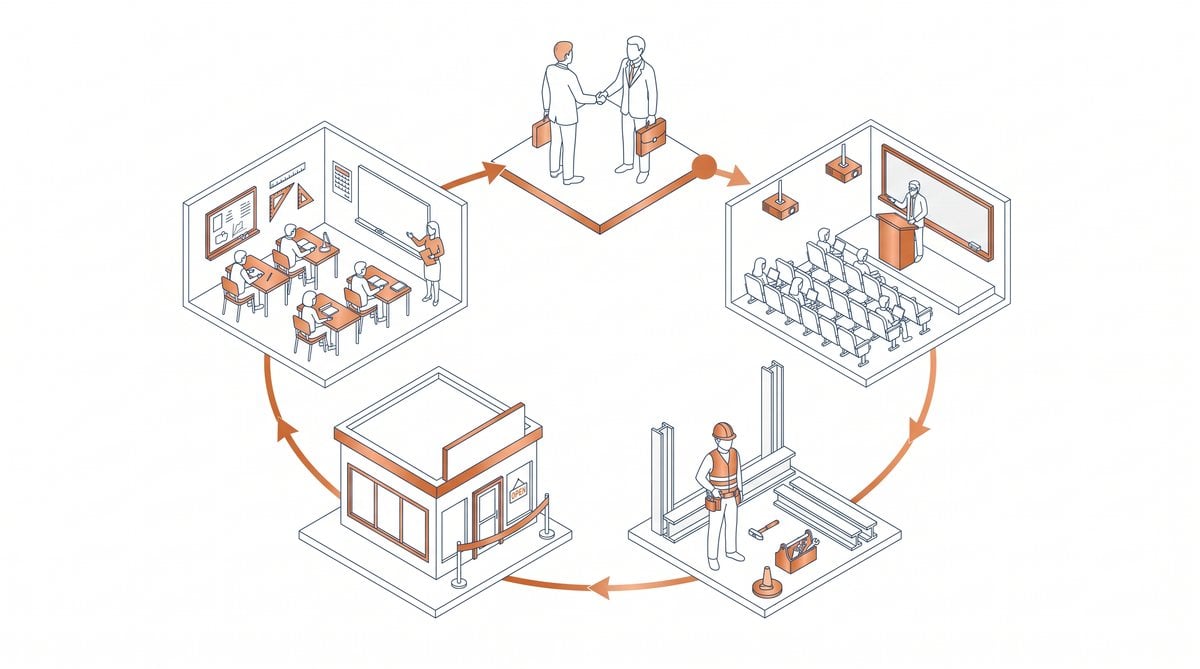
The largest opportunity is a cycle in which economic development and education reinforce one another. It starts when SAVRN attracts industry participation and companies name the skills they need. Second, the university creates approved programs and pathways. Third, residents gain skills tied to identifiable employers. Fourth, the region becomes more attractive to additional businesses. Finally, new employers and new technologies create recurring demand for professional education.

<figure class="bfig"><img src="/media/communiversity-cycle-bf131c08.jpg" alt="Five connected scenes in a loop from company handshake to returning learners"><figcaption>Industry, education, jobs, new business and returning learners feed one another, so demand renews</figcaption></figure>

None of this is automatic, however. Employers must take part, programs must meet real needs, and workforce outcomes must be measured and published. Even so, the cycle gives a university a concrete framework for connecting its revenue to the economic growth of the community around it.

## From one flagship to a national model

The first university partner becomes the academic anchor of a flagship SAVRN Institute. Subsequently, once the model works in one region, other communities can adapt it. For instance, a regional university might provide instruction, a community college might operate workforce labs, local employers might fund cohorts and economic development organizations might support recruitment.

For SAVRN, that is a repeatable community partnership model, whereas for the university it is a way to extend its educational reach into new professional and institutional markets without building a campus in every community. Any broader arrangement, of course, depends on the university's approval, financial terms and accreditation requirements. Accordingly, see how [university partnerships for workforce training](https://savrn.com/institute/university-partnerships) are structured today.

<figure class="bfig"><img src="/media/communiversity-mark-0696376d.jpg" alt="Open book whose pages unfold into a town skyline and campus clock tower"><figcaption>SAVRN brings the industry to the university, and the university’s opportunity to the community.</figcaption></figure>

## The first step

The first step is a joint evaluation of a flagship SAVRN Institute partnership. Specifically, people from the university and SAVRN would each take responsibility for academic programs, employer development, facilities and commercial feasibility. The goal is not simply to build an Institute; rather, it is a new relationship between technology infrastructure, higher education, industry and the communities that host them. To start the conversation, simply write to [Chad Harris](mailto:chad.harris@savrn.com?subject=Communiversity).

*Chad Harris, Founder, SAVRN*

<details class="bsrc" markdown="1">
<summary>Sources</summary>

1. [Uptime Institute, Global Data Center Survey 2025, July 2025, annual survey of data center owners and operators, staffing section](https://intelligence.uptimeinstitute.com/resource/uptime-institute-global-data-center-survey-2025)
2. [US Bureau of Labor Statistics, Occupational Outlook Handbook, Electricians, median pay, employment, 2025 to 2035 projections and annual openings](https://www.bls.gov/ooh/construction-and-extraction/electricians.htm)
3. [US Chamber of Commerce, Why Expanding Data Centers Is a Win for Communities Across America, March 17, 2026, 2023 direct and supported jobs and GDP contribution](https://www.uschamber.com/technology/why-expanding-data-centers-is-a-win-for-communities-across-america)
4. [National Student Clearinghouse Research Center, Some College, No Credential, 2025 report, adults who left college without a credential as of the 2023-24 academic year](https://nscresearchcenter.org/some-college-no-credential/)
5. [Training magazine, 2025 Training Industry Report, November 2025, total training expenditures of US organizations with 100 or more employees](https://trainingmag.com/2025-training-industry-report/)
6. [New America, Workforce Pell: What You Need to Know, program length, governor approval and the value-added earnings test](https://www.newamerica.org/insights/workforce-pell-what-you-need-to-know/)
7. [Federal Reserve Board, FEDS Notes, Monitoring AI Adoption in the US Economy, April 3, 2026, citing the Census Business Trends and Outlook Survey](https://www.federalreserve.gov/econres/notes/feds-notes/monitoring-ai-adoption-in-the-u-s-economy-20260403.html)
8. [SAVRN Institute, published course catalog, departments, courses, instructional hours and proposed certificate programs as of October 2026](https://savrn.com/institute/catalog)

</details>

## Frequently asked questions

### What is a Communiversity?

A Communiversity is a partnership in which a university and its community build the AI economy together. In this model, the university is the academic anchor, SAVRN is the community partner, and the SAVRN Institute is the platform where the university, employers, investors and residents meet.

### What is a university workforce partnership with SAVRN?

It is a partnership in which SAVRN acts as the university's community economic development partner rather than a training vendor. Specifically, SAVRN brings industry relationships, applied-learning environments and employer engagement, while the university delivers approved education and credentials.

### How does the university earn revenue from the partnership?

SAVRN helps develop the market, while the university participates in the revenue from serving it. Revenue can come from professional certifications, corporate workforce contracts, executive education, AI adoption programs, sponsored pathways and national institutional partnerships. Ultimately, a formal agreement sets pricing, costs and compensation.

### Does the university keep control of its programs and credentials?

Yes. The university retains academic control over what it teaches and what credentials it awards. SAVRN's role, instead, is to connect those programs to employers, equipment, facilities and recruitment.

### Who are the learners?

Mostly people who are not seeking a traditional degree: working electricians, data center technicians, manufacturing supervisors, enterprise IT managers, veterans and career changers. Notably, 37.6 million working-age US adults have some college and no credential.

### What will the Institute teach?

The SAVRN Institute catalog publishes 43 courses across 10 departments, with 4,668 hours of instruction and 9 proposed certificate programs. In particular, subjects include AI infrastructure operations, critical electrical systems, advanced cooling, fiber networking, GPU infrastructure and technical facilities management.

### Can Workforce Pell pay for these programs?

Possibly, although only for programs that qualify. From July 2026, Workforce Pell covers programs of 150 to 599 clock hours over 8 to under 15 weeks, once a governor approves them and they pass a value-added earnings test. Therefore, each program must qualify on its own.

### How do employers take part?

Employers help define the skills each program teaches, and they can commit equipment, training resources, hiring pathways or funding. Additionally, they can train their own employees, demonstrate technology and recruit at the Institute.

### What does the community get beyond jobs?

High-school career events, pathways for veterans and career changers, AI workshops for small businesses, and briefings for local government on how new technology affects public services. Some programs earn tuition, while others can be funded by employers, philanthropy, public workforce programs or community sponsors.

### How does a university start?

With a joint evaluation of a flagship SAVRN Institute partnership, covering academic programs, employer development, facilities and commercial feasibility. To begin, contact Chad Harris by email at SAVRN.