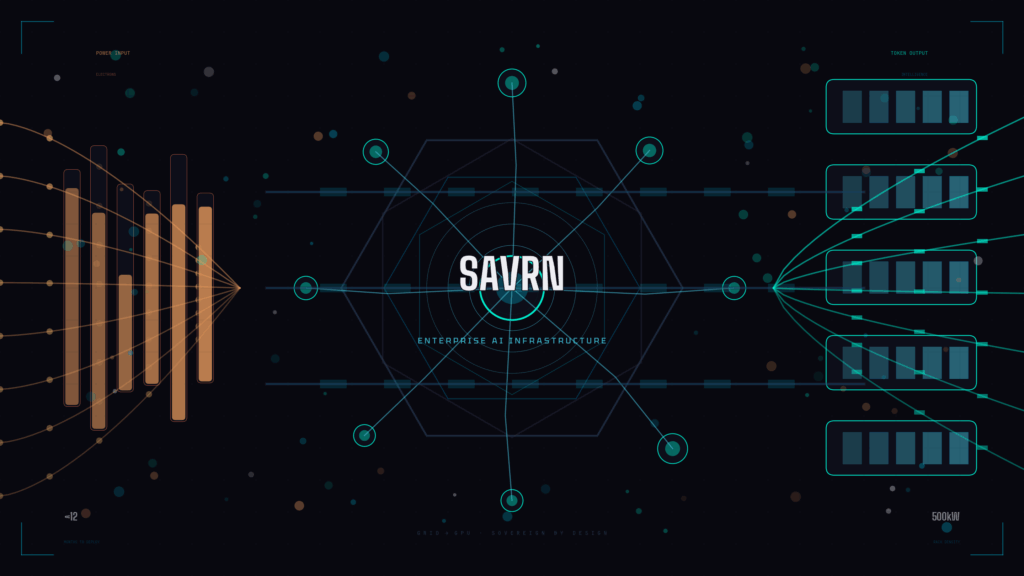
The Savrn Doctrine: Redefining AI Infrastructure From Electrons to Intelligence
The Savrn Doctrine AI infrastructure is solving the artificial intelligence revolution has exposed a critical infrastructure gap. Traditional data centers simply cannot bridge this divide. As a result, enterprises face an uncomfortable reality. Global data center electricity consumption will reach 945 TWh by 2030. To put this in perspective, that equals Japan’s entire annual electricity demand. Moreover, grid interconnection wait times now stretch beyond five years. Consequently, these bottlenecks threaten AI deployment timelines across every industry.
The Savrn Doctrine emerges as a comprehensive framework to address these challenges. Specifically, it reimagines AI infrastructure as an industrial manufacturing challenge. In other words, this approach requires vertical integration from power generation through token delivery. Therefore, this paradigm shift represents more than incremental improvement. Instead, it signals the transition from Cloud Computing to AI Utilities. In this analysis, we examine how the Savrn Doctrine addresses the physics of intelligence. Additionally, we explore why traditional infrastructure models fail to meet modern AI demands. Learn more here.
The End of Cloud Computing as We Know It
The Cloud Computing era defined value through access. Companies rented virtual servers and paid for capacity regardless of output. However, this model has reached its structural limits. According to the International Energy Agency, data centers consumed approximately 415 TWh of electricity in 2024. This represents roughly 1.5% of global electricity consumption. More importantly, AI-related servers now drive the fastest-growing demand segment. In fact, accelerated computing electricity consumption will grow 30% annually through 2030.
Traditional data center infrastructure was designed for a different era. For instance, most colocation facilities still operate at 10-15 kW per rack. These specifications worked for general-purpose computing workloads. Nevertheless, AI workloads demand fundamentally different infrastructure. NVIDIA’s latest Blackwell GPU configurations require between 60-132 kW per rack. Furthermore, next-generation systems will push requirements toward 250 kW. As a result, fewer than 5% of existing data centers can support even 50 kW per rack. This creates a massive infrastructure readiness gap.
The Savrn Doctrine addresses this discontinuity directly. Instead of selling access to compute resources, Savrn positions itself as an intelligence refinery. In essence, it converts raw electrons into economic value through vertical integration. This represents a fundamental paradigm shift. Rather than treating data centers as real estate developments, Savrn treats them as manufacturing operations. Consequently, inputs and outputs are precisely controlled throughout the entire process.
The Four Phases of Value Creation
The Savrn Doctrine establishes a comprehensive framework with four distinct phases. Each phase builds upon the previous one. Together, they create a vertically integrated chain. As a result, this approach eliminates the dependencies plaguing traditional infrastructure.
Phase One: Electrons as Industrial Feedstock
The raw material of the AI economy is not silicon. It is electricity. This fundamental insight drives the Savrn approach to power generation. Currently, the most significant constraint is not chip availability. Instead, it is grid interconnection timelines. According to Lawrence Berkeley National Laboratory, median wait times now exceed five years. To illustrate, this represents a dramatic increase from approximately two years in 2008. Additionally, in Northern Virginia, wait times can stretch to seven years or longer. This market already consumes 25% of local electricity supply.
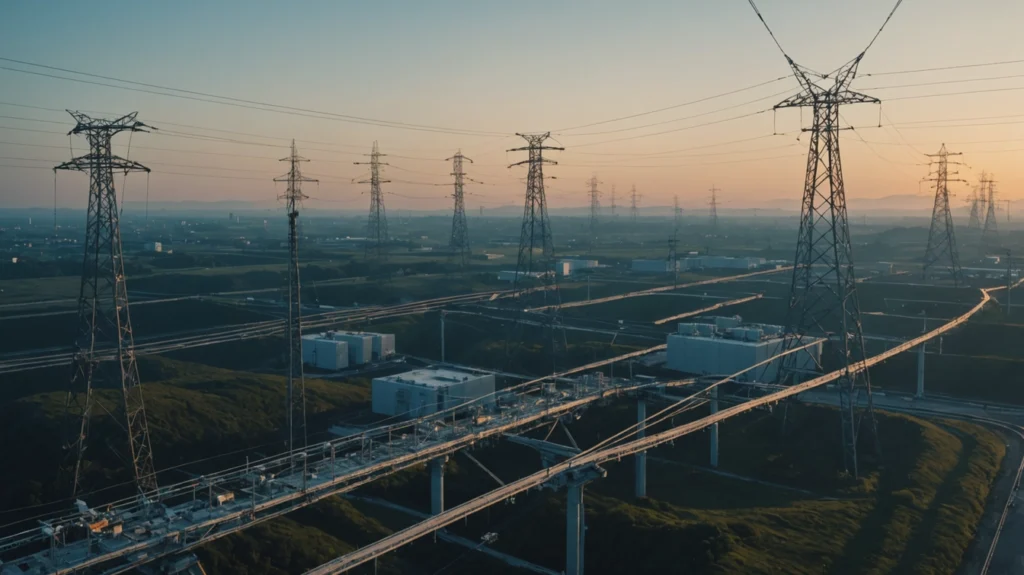
Savrn solves this constraint through sovereign power generation. Rather than waiting years for grid interconnection, Savrn brings generation directly to the facility. Specifically, on-premise generation partnerships enable rapid deployment. As a result, this approach compresses time-to-electron from 48+ months to approximately 12 months. Moreover, by controlling generation, Savrn guarantees power availability. Meanwhile, competitors remain trapped in utility queues. Grid Strategies estimates that 60 GW of additional capacity will be needed by 2030. Therefore, independent power generation becomes increasingly attractive.
Phase Two: Manufactured Compute Infrastructure
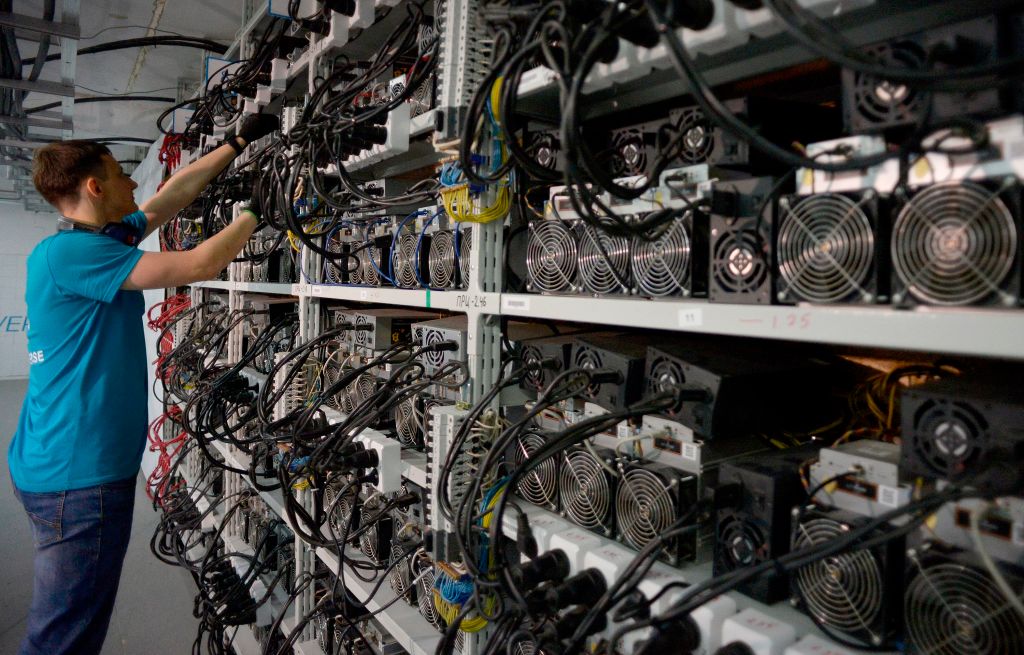
Traditional data center development follows a construction project model. This approach is slow, bespoke, and limited in density. In contrast, the Savrn Doctrine reimagines infrastructure as a manufactured product. Through modular, high-density GPU pods, Savrn achieves 235 kW per rack. This dramatically exceeds current industry capabilities.
To put this in perspective, consider current industry benchmarks. AFCOM’s 2024 State of the Data Center Report shows average density at 12 kW per rack. Meanwhile, hyperscale operators average approximately 36 kW per rack. Even NVIDIA’s GB200 NVL72 rack designs require 132 kW per rack. Consequently, Savrn’s 235 kW density represents a substantial leap. This enables significantly more compute capacity within smaller footprints.
The manufactured infrastructure approach delivers additional benefits. By standardizing pod design and production, Savrn deploys capacity faster. In fact, deployment happens faster than competitors can complete traditional construction. Therefore, this manufacturing-first philosophy transforms timelines from years to months. As a result, enterprises can deploy AI capabilities with unprecedented speed.
Phase Three: The Sovereign Core
Enterprises possess vast quantities of sensitive data. This data represents their most valuable competitive assets. However, much of it remains stranded. Specifically, sovereignty, security, and compliance constraints prevent AI utilization. Public cloud environments cannot provide the isolation that regulated industries require. Therefore, the Savrn Doctrine introduces the Sovereign Core. This is a completely air-gapped, zero-trust stack for sensitive workloads.
The Sovereign Core supports comprehensive compliance frameworks. These include FedRAMP, HIPAA, SOC2, and GDPR. As a result, built-in compliance architecture eliminates extensive customization requirements. Furthermore, the air-gapped design ensures complete isolation. Sensitive training data and inference operations remain separate from external networks. Consequently, this addresses security concerns preventing enterprise AI adoption.
By unlocking stranded data assets, the Sovereign Core enables new possibilities. Enterprises can now apply AI to their most valuable information resources. In other words, AI transforms from a limited tool into a comprehensive platform. Therefore, organizations can address their most critical intelligence requirements securely.
Phase Four: Tokens as Economic Currency
The final phase reconceptualizes AI infrastructure output. Traditional metrics focus on uptime, availability, and capacity utilization. In contrast, the Savrn framework measures value through token generation. A token represents concrete business value. For example, it could be a solved problem, a generated image, or a strategic decision.
This approach introduces a new industry metric: TGPM. This stands for Tokens Generated Per Megawatt. TGPM measures the yield intensity of AI infrastructure. Legacy data centers suffer from low TGPM for several reasons. First, high cooling waste results in PUE values exceeding 1.5. Second, low density configurations waste space. Third, suboptimal system design reduces throughput. In contrast, the Savrn platform targets high TGPM. On-site power generation eliminates transmission losses. High-density liquid/air hybrid cooling minimizes waste. Purpose-built AI compute maximizes throughput. Together, these factors optimize every electron for intelligence generation.
The Physics of Speed: Why Time Matters
Speed represents the most critical differentiator in AI infrastructure today. The gap between enterprise demand and available infrastructure continues to widen. As a result, competitive advantages emerge for organizations deploying faster. Goldman Sachs Research forecasts global data center power demand will increase 165% by decade’s end. Similarly, BloombergNEF projects US demand will more than double to 78 GW by 2035.
Most traditional operators function as real estate developers. They wait for utility permissions while projects stall. However, the Savrn Doctrine transforms this model entirely. Operators become industrial controllers of their own power sources. This distinction produces dramatic timeline compression. Industry-standard grid deployments require 48+ months. In contrast, the Savrn platform delivers electrons-to-inference within 12 months.
The implications for competitiveness are substantial. Organizations deploying AI three to four years earlier capture significant advantages. These include market intelligence, operational efficiency, and customer experience improvements. In rapidly evolving markets, this timeline advantage determines industry leadership. Therefore, speed becomes a strategic imperative rather than an operational preference.
Redefining Economic Metrics: Beyond Cost Per Megawatt
Traditional data center economics center on cost per megawatt. This metric treats power as the primary input. However, it assumes relatively uniform output efficiency. The Savrn Doctrine challenges this framework by introducing TGPM. This shift reflects a fundamental truth. Enterprises do not purchase megawatts. Instead, they purchase business outcomes delivered through generated intelligence.
The efficiency advantages supporting high TGPM stem from integration. With 235 kW rack densities, more processing occurs within smaller footprints. Consequently, overhead per unit of compute decreases significantly. The target PUE of less than 1.3 ensures power reaches compute resources efficiently. For comparison, the 2024 Uptime Institute Survey reports an industry average of 1.56 PUE. Many legacy facilities operate above 1.7. Meanwhile, Google achieves around 1.08-1.10. This demonstrates that significant efficiency gains remain achievable.
Additionally, sovereignty adds economic value that traditional metrics miss. By enabling sensitive data processing, Savrn unlocks previously inaccessible opportunities. This expansion beyond non-sensitive workloads represents substantial incremental value. Therefore, cost-per-megawatt frameworks fail to capture the complete picture.
Why Hyperscalers Cannot Compete
A reasonable question emerges: why cannot hyperscale cloud providers adopt similar approaches? The Savrn Doctrine identifies three structural barriers. These prevent traditional operators from replicating this model effectively.
First, grid dependency creates inescapable constraints. Hyperscalers have grown too large to operate off-grid. As a result, they remain tethered to multi-year utility queues. Their existing investments assume grid power availability. Therefore, transitions to on-premise generation become economically challenging. Second, legacy infrastructure debt limits adaptation. Billions invested in low-density facilities cannot be easily retrofitted. The physics of cooling 235 kW racks differ substantially from 10-15 kW installations. Consequently, purpose-built infrastructure is required rather than upgrades.
Third, the sovereignty gap proves most difficult to bridge. Hyperscaler business models depend on multi-tenant public cloud architectures. This fundamentally conflicts with true air-gapped sovereignty. Even private cloud offerings cannot provide complete isolation. Therefore, hyperscalers must compromise on sovereignty to maintain their core business model. As a result, only purpose-built sovereign infrastructure can serve this addressable market.
Strategic Implications for Enterprise Leaders
The Savrn Doctrine carries significant implications for enterprises. Traditional procurement models may no longer align with competitive requirements. Instead of buying cloud capacity, enterprises should consider Sovereign Token Capacity. This represents a guaranteed supply of intelligence generation capability. Planning horizons should extend ten years or longer.
This framing shifts AI infrastructure from IT procurement to strategic investment. In a constrained world, power availability limits AI deployment. Therefore, securing infrastructure access becomes a competitive advantage. Enterprises waiting for traditional capacity may fall behind. Meanwhile, competitors with sovereign infrastructure move forward. Consequently, early infrastructure decisions determine future market position.
For investors, the Savrn model represents infrastructure arbitrage. It acquires stranded power and development time at relatively low cost. Then it converts these inputs into high-value sovereign intelligence capacity. The economics favor operators who compress timelines and maximize efficiency. As a result, returns exceed what traditional data center investments can match.
Conclusion: The First Sovereign AI Utility
The Savrn Doctrine represents a comprehensive reimagining of AI infrastructure. It addresses the fundamental constraints limiting enterprise AI adoption. By treating the complete value chain as a single integrated process, Savrn establishes a new category. This category is the Sovereign AI Utility.
This approach resolves critical bottlenecks that traditional infrastructure cannot address. Sovereign generation solves power availability constraints. Manufactured high-capacity pods overcome density limitations. Air-gapped sovereign cores meet security requirements. Optimized TGPM-focused design closes efficiency gaps. Together, these capabilities capture demand that existing models cannot serve.
As global AI adoption accelerates, infrastructure constraints will intensify. Therefore, the Savrn Doctrine offers a framework for understanding the future. The era of treating data centers as real estate is ending. In its place, the era of the intelligence refinery has begun.
Frequently Asked Questions
The Savrn Doctrine is a comprehensive framework for AI infrastructure. It reimagines data centers as vertically integrated industrial processes. Unlike traditional approaches that sell rack space, Savrn treats the entire chain as a unified manufacturing operation. This includes electron generation, compute manufacturing, and token output. As a result, it enables faster deployment, higher density, and sovereign security capabilities.
Sovereign power generation addresses the biggest AI infrastructure bottleneck. Grid interconnection wait times now exceed five years. In some markets, waits extend to seven or ten years. However, on-premise generation compresses deployment to approximately 12 months. Therefore, enterprises can deploy AI capabilities years ahead of competitors. This timeline advantage proves decisive in competitive markets.
TGPM stands for Tokens Generated Per Megawatt. It measures the yield intensity of AI infrastructure. Unlike cost per megawatt, TGPM focuses on actual economic output. This includes the intelligence generated by the system. As a result, it captures efficiency gains from higher density, better cooling, and optimized compute. Therefore, TGPM provides a more accurate picture of infrastructure value.
The Sovereign Core is a completely air-gapped, zero-trust infrastructure stack. It processes sensitive enterprise data securely. Many organizations have valuable data that cannot enter public cloud environments. Therefore, compliance, security, and competitive concerns prevent AI utilization. The Sovereign Core unlocks these stranded assets. It supports FedRAMP, HIPAA, SOC2, and GDPR requirements with complete network isolation.
According to the 2024 Uptime Institute Survey, the industry average PUE is 1.56. This means data centers use 56% more energy than their IT equipment alone requires. Many legacy facilities operate above 1.7 PUE. In contrast, Savrn targets PUE below 1.3. Meanwhile, Google achieves around 1.08-1.10 at best-in-class facilities. Therefore, significant efficiency gains remain achievable with proper design.
Three structural barriers prevent hyperscaler replication. First, their scale creates grid dependency. They have grown too large to operate off-grid. Second, billions invested in low-density legacy infrastructure cannot be easily retrofitted. Third, their multi-tenant business model conflicts with true air-gapped sovereignty. Therefore, only purpose-built sovereign infrastructure can serve this market effectively.
The Sovereign Core provides built-in compliance architecture. This supports FedRAMP for federal government requirements. It also supports HIPAA for healthcare data and SOC2 for security controls. Additionally, GDPR compliance addresses European data protection. As a result, integrated compliance eliminates extensive customization requirements. This accelerates deployment timelines for regulated industries.
Global data center electricity consumption will double by 2030. The IEA projects consumption will reach 945 TWh, up from 415 TWh in 2024. AI workloads drive the fastest-growing demand segment. Accelerated computing electricity consumption will grow 30% annually. Furthermore, a single AI query requires nearly ten times the electricity of a traditional search. Hyperscale AI data centers can consume as much electricity as 100,000 households.
Recommended Related Articles
• Liquid Cooling Technologies for High-Density AI Infrastructure
• Understanding PUE: Why Data Center Efficiency Metrics Matter
• The Grid Interconnection Crisis: How Power Bottlenecks Reshape Strategy
• NVIDIA GB200 and Beyond: Planning for Next-Generation AI Hardware
• Sovereign Cloud vs. Public Cloud: Choosing for Sensitive Workloads
• Future-Proofing Data Center Investments: Scaling for the AI Era
Sources and References
• International Energy Agency – Energy and AI Report: iea.org/reports/energy-and-ai
• Uptime Institute Global Data Center Survey 2024: uptimeinstitute.com
• Lawrence Berkeley National Laboratory – Queued Up Report: emp.lbl.gov/queues
• Goldman Sachs Research – AI Power Demand Analysis: goldmansachs.com/insights
• Google Data Center Efficiency: datacenters.google/efficiency