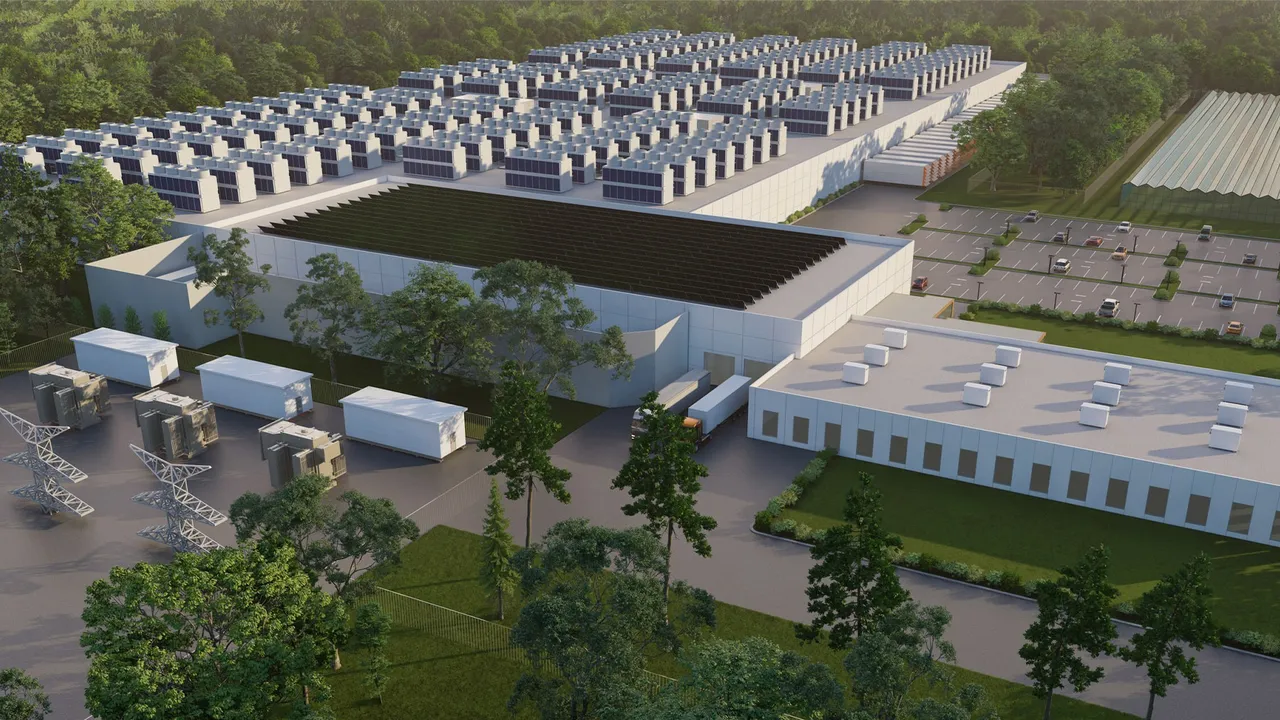
The enterprise AI landscape has fundamentally changed. Organizations across every sector recognize that artificial intelligence capabilities will determine competitive positioning for the next decade. However, a critical bottleneck threatens to derail even the most ambitious AI initiatives: AI infrastructure deployment timelines have stretched to years, not months, leaving enterprises waiting while opportunities pass them by.
This case study examines how SAVRN delivered fully operational, high-density GPU infrastructure to a fintech client in under 12 months—compressing traditional timelines by 50-70% while exceeding performance specifications across every metric.
The Infrastructure Bottleneck: Why Traditional AI Infrastructure Deployment Fails
The primary constraint on data center expansion has decisively shifted from capital and land availability to power procurement and grid interconnection. As a result, enterprises pursuing AI infrastructure deployment face obstacles that no amount of budget can easily overcome.
According to S&P Global’s analysis of US power markets, approximately 85 GW of new data center capacity requests are expected by 2030. While this figure might seem manageable at first glance, the reality proves far more complex. Interconnection wait times in key U.S. markets have ballooned to 7-10 years. Northern Virginia—the country’s largest data center hub—now faces grid connection waitlists of up to seven years according to Dominion Energy filings.
Furthermore, the pace of building new transmission infrastructure has fallen sharply. Only 180 miles of high-voltage transmission were constructed in the U.S. over the past two years, compared to 1,700 miles annually from 2010 to 2014. Consequently, even well-funded AI infrastructure deployment projects face multi-year delays before a single GPU can be energized.
The Fintech Imperative: Speed, Sovereignty, and Scale
For our fintech client, the stakes extended beyond mere competitive positioning. Their AI-powered risk analysis platforms demanded infrastructure capabilities that cloud providers simply could not guarantee. Specifically, their requirements included:
Real-time transaction processing capable of analyzing thousands of transactions per second for fraud detection. Every millisecond of latency directly impacts customer experience and risk exposure. Therefore, infrastructure performance became a business-critical requirement rather than a technical preference.
Millisecond-level inference responses for real-time decision-making across lending, trading, and customer service applications. Traditional cloud deployments introduce variable latency that makes consistent sub-millisecond responses impossible to guarantee.
Complete data sovereignty for regulatory compliance across multiple jurisdictions. Financial services organizations face stringent requirements around data residency, audit trails, and access controls. As a result, shared infrastructure models created unacceptable compliance risks.
Dynamic scalability as model complexity increases with business growth. AI workloads rarely remain static—successful models expand rapidly, demanding infrastructure that can grow without repeating lengthy procurement cycles.
Traditional cloud solutions, while offering flexibility, introduced concerns around data residency and long-term cost predictability. Moreover, the client needed dedicated infrastructure capable of supporting next-generation GPU architectures—but traditional AI infrastructure deployment timelines made this seemingly impossible.
Defining Success: High-Density AI Infrastructure Requirements
To maintain their competitive position, the fintech client established clear infrastructure specifications that would govern the entire AI infrastructure deployment project.
High-Density GPU Cluster Support
Modern AI workloads demand rack densities that traditional facilities simply cannot support. NVIDIA’s Blackwell GB300 racks will require 163 kW per rack in 2025—far exceeding legacy air-cooled data center capabilities that typically max out at 15-20 kW per rack. The client required infrastructure ready for current H100 deployments with clear upgrade paths to next-generation accelerators.
Predictable Energy Economics
With data centers spending an estimated $1.9-2.8 million per megawatt annually according to McKinsey’s analysis of data center economics, efficiency directly impacts operational viability. The client specified Power Usage Effectiveness (PUE) targets below 1.2—significantly better than the 1.4-1.6 typical of air-cooled facilities. Every improvement in PUE translates directly to reduced operating costs and improved sustainability metrics.
Aggressive Timeline Requirements
Most critically, the project needed to achieve full operational status in under 12 months to meet business deadlines tied to product launches and competitive positioning. As industry analysts have noted, time-to-power and time-to-lease matter enormously for AI infrastructure deployment. When interconnection delays push delivery timelines to the right, organizations delay not just construction but their entire revenue trajectory.
These demanding specifications ruled out conventional construction methods entirely. Consequently, the client turned to SAVRN for a fundamentally different approach to AI infrastructure deployment.
The SAVRN Approach: Compressing Years Into Months
SAVRN’s methodology addresses the core bottlenecks that have historically strangled AI infrastructure deployment projects. Rather than following sequential construction timelines where each phase must complete before the next begins, we developed an integrated strategy that compresses traditional 24-48 month builds into under 12 months.
Parallel Fabrication: Manufacturing While Preparing
While preparing the Houston deployment site and securing grid interconnection agreements, SAVRN began manufacturing engineered data center systems in parallel at our Intelliflex facility in Fort Worth. This approach fundamentally differs from traditional construction, where site preparation, permitting, equipment procurement, and installation proceed sequentially—each phase waiting for the previous to complete.
Our manufactured systems include integrated liquid-to-chip cooling capable of supporting rack densities exceeding 130 kW per rack. This cooling capacity proves essential for modern GPU deployments where thermal management determines whether hardware can operate at full performance or must throttle to prevent damage. Additionally, our high-density rack configurations are designed specifically for AI workloads, with power distribution, cable management, and airflow patterns optimized for GPU cluster architectures.
Perhaps most importantly, our systems incorporate on-site power infrastructure that eliminates dependence on lengthy substation construction. Traditional AI infrastructure deployment requires utility-scale electrical infrastructure that can take years to design, permit, and build. Our approach brings power generation and distribution within the deployment envelope, dramatically reducing external dependencies.
All components are manufactured at our Texas facility, ensuring quality control and supply chain transparency that overseas procurement simply cannot match. This parallel fabrication approach compresses traditional construction timelines by months, not weeks.
Overlapping Infrastructure and Site Preparation
Once the Houston site reached readiness, SAVRN delivered and installed engineered units in rapid sequence. By overlapping infrastructure fabrication with physical site preparation, we eliminated the cascading delays that stall most AI infrastructure deployment projects.
Moreover, this modular methodology offers inherent scalability advantages. As the fintech client’s computational needs grow—from initial deployment to full production-scale inference—additional capacity can be brought online without repeating lengthy construction cycles. Each expansion builds on proven designs and established operational procedures, compressing subsequent deployments even further.
Power-First Interconnection Strategy
Perhaps most significantly, SAVRN worked directly with energy providers to secure long-term power access at the source rather than waiting in utility interconnection queues. Traditional grid interconnection can take 5-10 years from initial planning to operational power delivery according to Lawrence Berkeley National Laboratory research. Our power-first strategy eliminates the need for lengthy substation construction and transmission line upgrades that create the longest delays in conventional AI infrastructure deployment.
This approach means AI infrastructure arrives ready for training, fine-tuning, and real-time inference workloads from day one. For fintech applications requiring continuous model updates and millisecond response times, this capability proves essential to maintaining competitive advantage.
Results: Transformative Outcomes Across Every Metric
The AI infrastructure deployment delivered transformative results that exceeded initial expectations across multiple dimensions.
Timeline Performance
The project achieved full operational readiness in under 12 months from contract signing—compared to industry-standard timelines of 24-48 months for comparable deployments. This 50-70% acceleration fundamentally changed the client’s competitive calculus.
Time-to-Market Impact
The accelerated timeline allowed the client to begin model training while competitors were still waiting for infrastructure procurement decisions. This head start translated into faster testing cycles, earlier access to customer feedback, and an accelerated path to revenue generation. In markets where first-mover advantage determines long-term positioning, this time-to-market differential proved invaluable.
Infrastructure Specifications
The deployment supports high-density GPU clusters with liquid cooling infrastructure achieving PUE levels below 1.2—significantly outperforming the 1.4-1.6 typical of air-cooled facilities. This efficiency advantage translates to hundreds of thousands of dollars in annual operating cost savings while supporting the client’s sustainability commitments.
Scalability Pathway
The modular design ensures future capacity additions can proceed without repeating lengthy procurement cycles. As the client’s AI capabilities expand—adding new models, increasing inference volume, or deploying next-generation GPU architectures—infrastructure can scale in weeks rather than years.
The Broader Industry Context: Why Rapid AI Infrastructure Deployment Matters
The implications of accelerated AI infrastructure deployment extend far beyond individual projects. According to Bain & Company research, global data center capacity demand will reach 163 gigawatts by 2030—twice today’s installed capacity. By 2030, U.S. data center electricity demand could double to 409 terawatt-hours, with AI workloads expected to drive most of this increase.
Yet the industry faces a fundamental constraint that budget alone cannot solve. Power availability has transformed from an operational expense to be managed into the gating factor for growth. Hyperscalers are now designing campuses requiring 200 MW to 500 MW, with some connection requests exceeding 1,000 MW—a scale that local grids simply cannot support without years of infrastructure upgrades.
For enterprises seeking AI capabilities, this reality creates a stark choice. Organizations can wait years for traditional AI infrastructure deployment through conventional channels. Alternatively, they can partner with providers who have solved the power and construction challenges that create these delays.
The fintech client’s experience demonstrates that accelerated timelines don’t require compromising on specifications. Rather, they demand fundamentally different approaches to how infrastructure is designed, manufactured, and deployed.
Building Infrastructure That Scales With Your Ambition
Most enterprise AI teams wait for infrastructure to catch up to their models. SAVRN reverses that equation. We build infrastructure that scales from kilowatts to megawatts—aligned with your specific workload requirements, your chosen deployment location, and your business timeline.
Our approach shortens design timelines through standardized yet customizable modular systems. We bypass substation delays through direct power procurement strategies. We deliver enterprise-ready infrastructure on time and built to perform from day one.
Whether supporting initial AI pilots or production-scale deployments processing millions of daily transactions, our methodology ensures capacity grows with your needs. The power bottleneck that constrains traditional AI infrastructure deployment becomes a competitive advantage when you partner with providers who have solved these fundamental challenges.
Frequently Asked Questions
1. Why do traditional data center construction timelines take 24-48 months?
Traditional timelines are driven primarily by grid interconnection delays, which can take 5-10 years in constrained markets. Additionally, sequential construction phases—site preparation, utility work, building construction, equipment installation—compound delays when any single phase encounters obstacles.
2. What makes high-density GPU infrastructure different from standard data centers?
Modern AI GPUs like NVIDIA’s Blackwell series require 130-163 kW per rack—far exceeding the 10-15 kW typical of traditional data centers. This demands liquid cooling systems, enhanced power distribution, and specialized facility design that most existing data centers cannot retrofit.
3. How does liquid cooling improve AI infrastructure performance?
Liquid cooling removes heat directly from GPU components, enabling higher densities and better performance. Facilities using liquid cooling consistently achieve PUE scores below 1.2, compared to 1.4-1.6 for air-cooled facilities, resulting in significant operational savings.
4. What is Power Usage Effectiveness (PUE) and why does it matter?
PUE measures total facility energy versus energy used for computing. A PUE of 1.2 means only 20% of energy goes to cooling and overhead. For large deployments, better PUE translates to millions in annual savings and reduced environmental impact.
5. Why is grid interconnection the biggest bottleneck for AI infrastructure?
U.S. grid operators report 2,600+ GW of proposed generation waiting for connection—more than twice current installed capacity. The combination of surging AI demand, declining transmission construction, and overwhelmed utility planning systems creates multi-year backlogs.
6. How does parallel fabrication compress deployment timelines?
By manufacturing data center components while site preparation proceeds simultaneously, Savrn eliminates months of sequential delays. Components arrive ready for installation when the site is prepared, rather than beginning fabrication after site completion.
7. What infrastructure do AI-powered fintech risk platforms require?
Fintech AI platforms need millisecond-level inference for real-time decisions, high-throughput processing for transaction monitoring, complete data sovereignty for regulatory compliance, and scalable compute for model training and updates.
8. How does on-site power generation bypass grid delays?
On-site generation eliminates dependence on utility substation construction and grid upgrade timelines. Power is available when the facility is ready, rather than when the utility completes multi-year interconnection processes.
9. What cooling technologies support next-generation AI deployments?
Direct-to-chip liquid cooling has become the standard for high-density AI. This includes cold plate systems, liquid-to-liquid heat exchange, and coolant distribution units capable of managing 130+ kW rack densities.
10. How scalable is modular AI infrastructure?
Modular infrastructure scales incrementally—additional capacity units can be deployed without repeating full construction cycles. This allows enterprises to start with current needs and expand as AI workloads grow, avoiding both over-provisioning and capacity constraints.