
The Token Economy is the transformation underway as the global economy moves from the Information Age — defined by storing and retrieving static data — into the Intelligence Age, characterized by the continuous, industrial-scale generation of tokens. The shift is more profound than the arrival of the internet because the underlying transaction is different: enterprises and nations no longer purchase access to data; they purchase the production of intelligence. That redefinition changes how value is created, captured, and infrastructure is built.
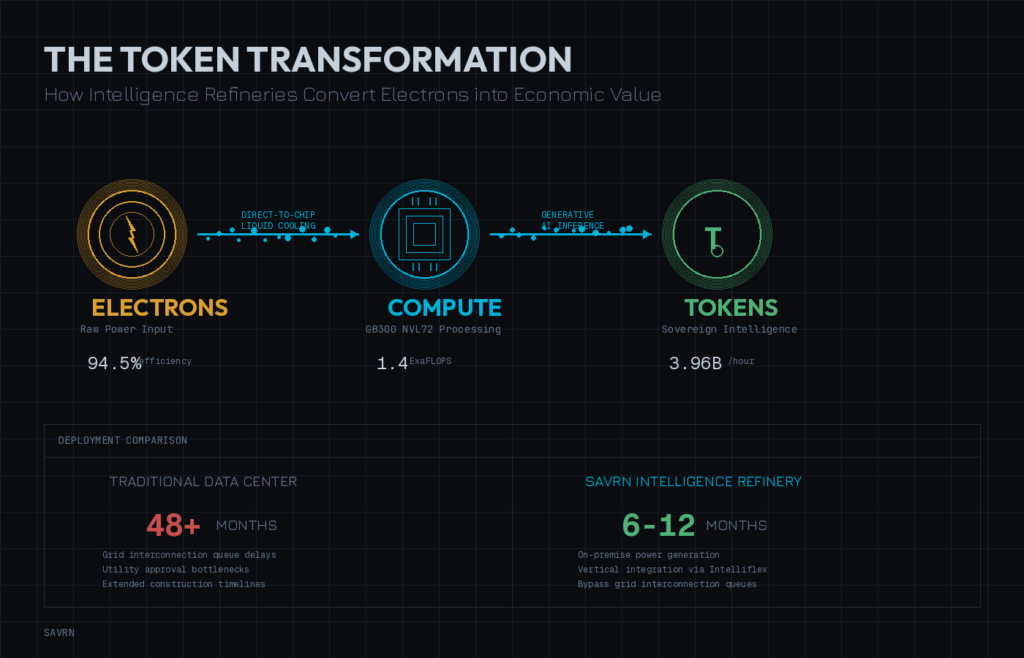
For three decades, computing operated as a retrieval business. You queried a database, and it fetched a record. Today, computing is a generative business. As a result, data centers have evolved from digital warehouses into Intelligence Refineries — industrial systems that convert raw electrons into high-value tokens of artificial intelligence. The cloud-era model priced the warehouse. The Token Economy prices the refinery output. Savrn’s sovereign AI infrastructure is engineered specifically for that second model.
Understanding the Token: The Atomic Unit of the New Economy
To understand the mechanics of the Token Economy, start with the unit of value: the token. In the world of large language models and generative AI, a token is the primary unit of text processing — not exactly a word, but a fragment, roughly four characters or 0.75 words on average. Every interaction with an AI model is an exchange of tokens. Input tokens are the prompts, instructions, and data fed into the model. Output tokens are the generated responses, code, or analysis the model produces.
In the Token Economy, every piece of work AI produces — a financial risk assessment, a line of Python, a medical diagnosis, a mission-planning summary — exists as a sequence of tokens. That creates a direct economic relationship between computational infrastructure and productive output. Unlike the cloud era, where data simply existed and was charged by the byte at rest, the Token Economy generates value with every processing cycle. The refinery model is not a metaphor. It is the unit economics of the business.
Why the United States Faces a Critical Infrastructure Crossroads
Token demand is moving faster than U.S. infrastructure can supply it. Goldman Sachs Research projects global data center power demand will increase 165% by decade’s end. BloombergNEF projects U.S. demand will more than double to 78 GW by 2035. The IEA’s 2024 baseline puts global data center electricity at roughly 415 TWh and projects 945 TWh by 2030 — Japan’s annual demand for one industry. Accelerated computing is the segment growing at roughly 30% per year inside that curve.
The supply side is constrained by three structural problems. First, grid interconnection delays. Median U.S. utility interconnection wait times now exceed five years, and seven-plus in the densest hyperscale corridors. Second, density limits. Most colocation operates at 10–15 kW per rack, while AI workloads now require 60–132 kW (and rising toward 250 kW). Fewer than 5% of existing data centers can support even 50 kW per rack. Third, sovereignty exposure. Enterprise and defense data that the U.S. cannot afford to host on shared commercial infrastructure has nowhere to go inside the cloud-era model. The cloud era was not built for any of these constraints.
Latency compounds the problem. Real-time AI workloads — financial services, healthcare diagnostics, autonomous platforms, defense inference — require compute that is physically close to where the work happens. Routing every token through a distant hyperscale region erodes the value of the application. The geography of the campus matters again, the way it stopped mattering during the cloud era.
The Sovereign Refinery Model
Savrn’s response to the constraint set is not incremental. It is architectural. The campus is a sovereign intelligence refinery: a manufactured industrial system that generates its own electrons, owns its compute layer, and converts raw power into tokens under the customer’s sovereignty boundary. The four phases of value creation are described in the Savrn Doctrine; the short version is that on-site power generation, manufactured compute pods at 235 kW per rack, an air-gappable Sovereign Core, and TGPM-optimized integration produce a campus the cloud era cannot replicate.
The defining outcome is 6–12 month deployment, against an industry standard of 48-plus months. Savrn does this by manufacturing infrastructure in a Texas facility through Intelliflex rather than constructing it on site, and by generating power behind the meter rather than waiting in a utility interconnection queue. That is how sovereign refinery capacity becomes available inside the timeframe the Token Economy is actually demanding it.
Where Savrn Is Deploying Today
Savrn’s active home-market states are California, Colorado, Nevada, and Texas. Each is a state where the permitting posture for industrial-scale on-site generation is workable, where the host-community track record on industrial use is constructive, and where proximity to defense, aerospace, and enterprise AI demand centers shortens the distance from a token’s production to its consumption. Specific parcels and counterparties are disclosed under bilateral confidentiality at the term-sheet stage.
For landowners considering a sovereign campus on their parcel, Savrn’s land evaluation guide describes the five tests every site must pass — land area, on-site power posture, water, fiber, and zoning — and the 48-hour desktop screen that delivers a binary answer. The evaluation criteria are calibrated against the refinery model rather than against the substation-distance test that disqualifies most parcels offered to a hyperscaler.
Cooling for the Refinery: The Density Imperative
An intelligence refinery cannot run on air. Air cooling has a thermodynamic ceiling near 30 kW per rack — above which the volume of air required to remove heat exceeds what can be moved through a standard rack form factor. AI workloads broke through that ceiling years ago. Single-phase liquid immersion cooling is the architecture that scales to 140-plus kW per rack at the current GPU generation, and that supports SAVRN’s manufactured Compute pods at up to 235 kW.
Immersion is not a retrofit. A campus designed for air cooling cannot be converted into one capable of running current-generation Blackwell — and certainly not the next-generation Vera Rubin systems — without rebuilding the heat-rejection architecture. The cooling decision is a campus-architecture decision made before the first GPU is racked. Savrn’s manufactured pods solve it at the factory.
The Economics of Sovereign Token Generation
The cloud-era metric is cost per GPU hour. The Token Economy’s metric is tokens per watt per dollar. The two metrics produce different procurement decisions. Cost per GPU hour optimizes for the cloud vendor’s billing system. Tokens per watt per dollar optimizes for the buyer’s actual yield — the conversion rate from input electrons to output intelligence, normalized for the cost of the conversion. NVIDIA introduced the “tokens per watt” framing; Deloitte named it the emerging 2026 metric. Savrn measures the campus that way because the campus is engineered to win on that measure.
The sub-1.3 PUE Savrn targets, against an industry average of 1.56 per the 2024 Uptime Institute Survey, is not a marketing claim — it is a physics outcome of single-phase immersion cooling at AI rack densities. The dual-revenue economics of co-located ASIC mining inside the same campus footprint reduce the effective cost-per-token even further during periods of low AI utilization. The result is unit economics the commodity cloud cannot match, especially for workloads with sustained high utilization or sovereignty requirements.
Sovereignty as a First-Order Buying Criterion
For defense, intelligence, regulated industries, and enterprise AI buyers with proprietary training corpora, sovereignty is no longer a software feature. It is a physical-layer guarantee. The Department of War’s January 2026 AI strategy committed $13.4 billion in FY2026 to AI and autonomy, and explicitly framed AI as a continuum of compute from datacenters to the tactical edge across every classification level. The infrastructure that satisfies that mandate cannot share a campus shell with commercial workloads.
Savrn’s defense-grade AI infrastructure is the campus designed to that requirement — and the same architectural choices that satisfy IL5, IL6, and IL7 workloads also satisfy the FedRAMP, HIPAA, SOC 2, and GDPR boundaries that regulated commercial buyers depend on. Sovereignty in the Token Economy is not a vertical product. It is a horizontal property of the campus.
The Path Forward: Electrons to Tokens to Outcomes
The Token Economy reframes every infrastructure decision. Power becomes a feedstock, not an operating expense. Compute becomes a manufactured product, not a construction project. Sovereignty becomes a physical-layer guarantee, not a software primitive. The output is measured in tokens — units of intelligence — rather than in megawatts of capacity rented out. The operators who internalize that reframing build the next generation of AI capacity. The operators who do not are running 48-month projects against 12-month markets.
Savrn was built for the Token Economy from the foundation up. Every campus is engineered as an intelligence refinery — sovereign power, manufactured compute, air-gappable core, TGPM-optimized integration — and delivered in the timeframe the market is demanding it. The era of the data center as real estate is ending. The era of the intelligence refinery is operational, and the campuses being designed today are the ones that will define which enterprises and which nations participate in the Token Economy at scale.
Frequently Asked Questions
Related Reading
- The Savrn Doctrine — How the Refinery Is Built
- Sovereign AI Infrastructure: The Operator’s Complete Guide
- Defense-Grade AI Infrastructure: Sovereign, Air-Gap Ready
- Does Your Land Qualify for a Sovereign AI Campus?
- The Compute Module — 235 kW Rack Density
- The Power Module — Sovereign Energy Generation
Sources and References
- International Energy Agency — Energy and AI Report: iea.org/reports/energy-and-ai
- Uptime Institute Global Data Center Survey 2024: uptimeinstitute.com
- Lawrence Berkeley National Laboratory — Queued Up: emp.lbl.gov/queues
- Goldman Sachs Research — AI Power Demand: goldmansachs.com/insights
- BloombergNEF — U.S. Power Demand Outlook
- NVIDIA — Tokens-per-Watt and AI Factory Economics
- Department of War — Artificial Intelligence Strategy (January 2026)