Most data center site selection guides begin with a checklist, know as Data Center Land Requirements They tell a landowner to count acres, measure to the nearest substation, and confirm fiber proximity. They are not wrong — they are incomplete. They were written for a hyperscale model that depends on a regulated utility connecting the land to the grid, on a county already zoned for industrial use, and on a 36-to-84 month timeline that absorbs whatever the host community decides to extract along the way. That model is breaking.
About SAVRN. SAVRN is the operator of an off-grid sovereign AI infrastructure campus model — owned power generation, owned compute, closed-loop liquid cooling — deployed in 6 to 12 months versus the 24-to-48-month industry standard, with active developments in California, Texas, Colorado, Nebraska, Panama, and Barbados.
SAVRN evaluates land for a different model. We build sovereign AI infrastructure with on-site power generation, owned compute, and a deployment timeline measured in months rather than years. The criteria are similar in name and very different in weight. A parcel that is unfit for a hyperscaler is often ideal for a SAVRN campus, because the constraint that disqualifies the hyperscaler — proximity to the grid, water draw at scale, dependency on a regional transmission organization — is a constraint we engineer around. This guide is the standard SAVRN applies. If you control land in the United States and want to know whether it qualifies, read it the way a procurement officer would. We do not soften the criteria, and we do not change them once a parcel is in evaluation.
Why SAVRN Is Evaluating Sites Right Now
The macro condition is unambiguous. AI compute demand is outrunning the U.S. grid by a wider margin every quarter. Hyperscale developers in Northern Virginia, central Washington, and the Phoenix corridor are facing utility interconnection queues exceeding seven years, with local moratoria pausing new connections in jurisdictions that previously welcomed them. The Department of War’s January 2026 AI strategy committed $13.4 billion in FY2026 to AI and autonomy. Enterprise AI capex is on the same trajectory. The land that carries the next wave of capacity has not yet been identified, let alone built. SAVRN is one of the operators identifying it.
SAVRN holds active development positions in California, Texas, Colorado, Nebraska, Panama, and Barbados. As a result, we are not researching a market — we are deploying into one. The next parcels we evaluate will host sovereign campuses inside a 12-to-24-month operational horizon. If your land qualifies, the path from submission to letter of intent is short. If it does not, we will tell you why on the first call rather than after three months of due diligence. Both answers are useful, and both are delivered fast.
The Five Data Center Land Requirements That Decide
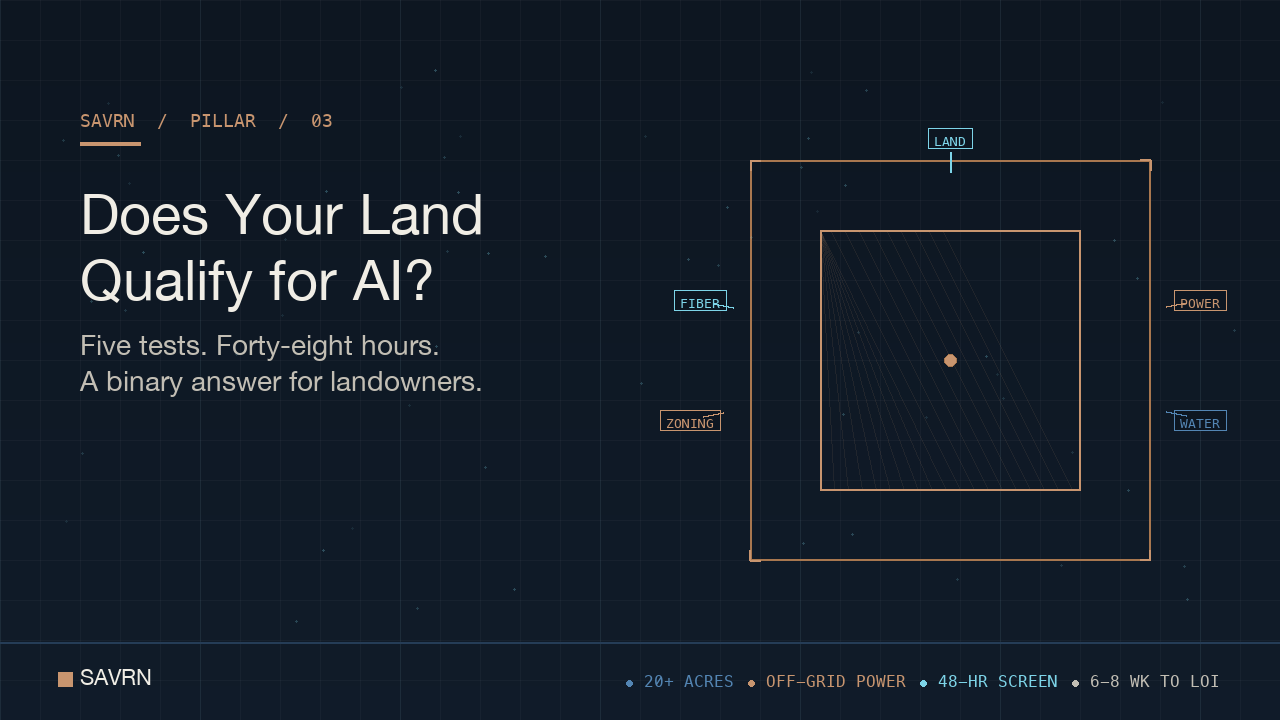
Every parcel SAVRN considers passes through five tests. They are ranked in the order they typically eliminate sites — starting with the variables that cost the most to fix and ending with the ones that cost the least. A parcel that fails any one of them is not viable, although the failure is occasionally curable. Read each test as a binary, not a continuum.
Test One: Land Area and Geometry
SAVRN’s minimum is 30 contiguous acres. That floor supports a starter campus of approximately 200 MW of compute capacity, on-site power generation, and the closed-loop thermal recovery infrastructure that converts waste heat into agricultural and industrial output. The preferred range is 200 acres or larger, which supports campuses well above the starter footprint with room for incremental expansion. The shape of the parcel matters as much as the acreage. A long, narrow strip is not the same as a square. The campus needs interior buildable area that satisfies setbacks from utilities, roads, and any sensitive neighbors. Subdivided parcels under common ownership count as contiguous if no public right-of-way bisects the buildable interior.
Topography is a secondary filter inside the land-area test. Slopes above eight percent across the buildable area drive grading costs that erode the schedule and the budget. Flood-zone designation at FEMA Zone A or V is a hard disqualifier — not because the campus could not be elevated, but because the insurance posture and the regulatory exposure across a 25-year operating life are not worth the marginal land. Wetlands inside the buildable footprint are similarly a stop. Documented wetland delineation around the buildable footprint, by contrast, is a commissioning question rather than a disqualifier.
Test Two: Power Posture
This is the test that disqualifies most parcels offered to a hyperscaler. SAVRN inverts the test, because we generate power on site through SAVRN’s Power module rather than purchasing it from a regulated utility. The relevant question is not “how close is the substation?” The relevant question is whether the parcel can host on-site generation legally, safely, and at the scale a sovereign AI campus requires.
That decomposes into three sub-tests. First, fuel access — whether the site can be supplied with the primary fuel SAVRN’s generation architecture uses, by pipeline, by rail, or by truck. Second, air-permitting posture — whether the local air board, county, and state agencies have a workable path for behind-the-meter generation at industrial scale. Third, the optional grid tie — whether a utility-scale interconnection exists or can be built as a redundant path for export, import, or curtailment. The grid tie is optional. The first two are not. As detailed in our guide to sovereign AI infrastructure, this single architectural choice is what compresses a 36-to-84 month grid-dependency into a 6-to-12 month build cycle.
The practical effect is dramatic. A 200-acre parcel in a county with a constructive air-permitting posture and a viable fuel supply qualifies for a SAVRN campus, even if the nearest substation is twenty miles away and the utility’s interconnection queue is closed. A 200-acre parcel one mile from a transmission line, in a county that has paused new air permits, often does not. The grid is no longer the gating asset. The political and regulatory posture of the host community is.
Test Three: Water
SAVRN cools at 140-plus kW per rack using single-phase liquid immersion cooling, the only thermal architecture that scales to current and next-generation AI rack densities without absurd water consumption. As a result, our water draw is a small fraction of the open-evaporation cooling that hyperscale facilities use. We still need a reliable source, because the campus consumes water for sanitary load, for the closed-loop thermal recovery system that pushes waste heat into aquaculture or agriculture, and for periodic make-up to the cooling fluid system.
The threshold is qualitative rather than gallons-per-day. The parcel must have a documented path to potable or non-potable supply that does not depend on a stressed aquifer or on rights that compete with an existing agricultural community. SAVRN’s Loop module recovers and recirculates water inside the campus footprint, so the marginal draw against the regional balance is small by design. A parcel without water access is disqualified. A parcel with municipal supply, an existing agricultural well, or rights to a non-stressed source qualifies.
Test Four: Fiber and Network Diversity
An AI campus that cannot move tokens cannot earn revenue. SAVRN’s fiber requirement is two diverse routes to a major carrier hotel inside five miles, with at least one of the routes built for low-latency interconnection. Long-haul fiber projects across remote land are deliverable but expensive — every additional mile of dark fiber is capital that the campus has to amortize, and every additional regulatory crossing is a schedule risk.
Parcels along an existing long-haul fiber route, near an Interstate corridor, or adjacent to a railroad right-of-way frequently qualify. Parcels that require more than ten miles of new build to reach diverse fiber are evaluated case by case, because the economics depend on the campus size and the carrier alternatives. A site that is otherwise excellent — power-friendly, water-secure, well-zoned — can occasionally justify a custom fiber build. SAVRN runs that math on a per-parcel basis.
Test Five: Zoning, Entitlements, and Community Posture
Zoning is the cheapest test to fail and the most expensive test to fix. Industrial zoning that explicitly contemplates data-center, energy-generation, or heavy-industrial use is the gold standard. Agricultural zoning is workable in counties that grant conditional use permits efficiently. Residential zoning is a stop. Tribal land is a separate workflow that SAVRN engages directly with the sovereign nation.
Beyond the zoning code, the political posture of the host community is decisive. SAVRN’s doctrine commits the campus to local economic participation: jobs that stay, tax revenue that compounds, and a closed-loop infrastructure model that produces food and industrial output rather than externalities. We do not deploy where the host community does not want the campus. The first sign that they do is the entitlement record. A county that has approved comparable industrial use within the last five years, that has staff with experience moving an industrial permit through to occupancy, and that does not face an active opposition movement targeting data centers, is a constructive host. A county that has paused new development, that has an active community opposition campaign, or that has rejected industrial use repeatedly, is unlikely to be the right fit.
What Disqualifies a Site (And Why)
The single most common reason a parcel fails SAVRN’s evaluation is not size or location. It is the combination of thin community support and no permitting precedent in the host jurisdiction. A 500-acre parcel with rail, water, and fiber, in a county that has never permitted industrial-scale generation, is more expensive to develop than a 200-acre parcel in a county with three operating industrial campuses and a planning department that has done it before. Site quality is not the same as deployment speed.
The other disqualifiers cluster into a short list:
- FEMA Zone A or V flood designation across the buildable area.
- Wetlands inside the buildable footprint that cannot be sited around.
- Sensitive species or habitat within the buildable area requiring federal Section 7 consultation that pushes the schedule beyond the financing horizon.
- No fuel access to the primary generation source — no gas service, no rail, no truck route at industrial scale.
- Active community opposition to data-center or industrial use in the host jurisdiction.
- Closed air-permitting window at the state or local level for industrial generation.
- Disputed title or unresolved heirship that cannot be cleared inside ninety days.
- Slope above eight percent across the buildable area without a feasible grading plan.
None of those are surprises in due diligence. SAVRN identifies them on the first or second call, before either side has spent money. This is the inverse of the hyperscale process, which often discovers a disqualifier at month nine of a twelve-month feasibility study. The reason we screen fast is that we have run the screen several hundred times and the categories of failure are stable.
The Sovereign Difference: Why On-Site Power Expands the Eligible Universe
Every test above is calibrated against SAVRN’s sovereign architecture rather than the hyperscale default. The architectural decision that does the most work is on-site power generation. It changes which parcels qualify, in three concrete ways.
First, it removes the substation distance test. Hyperscalers measure to the nearest substation because their economics depend on getting tens or hundreds of megawatts off the regulated grid. SAVRN measures to the nearest fuel source. The set of parcels with a workable fuel-access path is several multiples larger than the set of parcels with a near-substation grid-tie path.
Second, it removes the interconnection-queue test. A parcel near a transmission line is functionally useless if the local utility’s interconnection queue is closed or measured in years. With on-site generation, the campus’s first kilowatt is produced on site, and the queue is irrelevant. The schedule shifts from “when does the utility connect us?” to “when does the air permit issue?” The latter is faster, more predictable, and inside a state agency rather than a regional transmission organization.
Third, it shifts the political conversation. Hyperscale projects often face community opposition because they are perceived as extractive — large grid loads with little local benefit. SAVRN’s campus is the inverse. The Power module produces electrons that the campus consumes. The Loop captures waste heat that becomes food and industrial output. The District integrates community ownership. The conversation with the host community is not “we are taking power from your grid” — it is “we are bringing generation, jobs, food production, and tax base to your county.” That changes which counties say yes.
The SAVRN Land Evaluation Process
The process is fast by design. SAVRN’s deployment commitment is 6-to-12 months from contract to first operational token. A six-month due-diligence cycle inside that window is not viable, so the evaluation is structured to deliver a binary answer in days rather than quarters.
Stage One: 48-Hour Desktop Screen
From the moment a landowner submits the assessment form, SAVRN runs a 48-hour desktop screen. We pull parcel boundaries from county GIS, FEMA flood designation, USGS topography, satellite imagery for vegetation and topography, and the publicly available record on power, water, and fiber adjacency. We confirm zoning against the host jurisdiction’s posted code and recent permitting history. The output is a green / yellow / red classification on each of the five tests above, plus a single recommendation on whether to proceed to Stage Two.
Most parcels resolve at this stage. A landowner who submits a 30-acre site adjacent to residential zoning, with no fuel access and no fiber within fifteen miles, gets a clear and quick answer. A landowner who submits a 220-acre former industrial site with rail access, in a county that has permitted industrial generation in the last three years, advances to Stage Two within hours.
Stage Two: 2-to-4 Week Assessment
Parcels that clear Stage One enter a 2-to-4-week structured assessment. SAVRN engages the title chain, runs a Phase I environmental review, opens preliminary conversations with the local utility on the optional grid tie, contacts the air board on the permitting path, and sketches a campus layout against the buildable area. The deliverable is a draft term sheet that names the campus configuration, the proposed land transaction structure, the build timeline, and the conditions to proceed. The deliverable is also enough information for the landowner to decide whether SAVRN is the right counterparty.
Stage Three: Site Visit and Letter of Intent
A SAVRN team visits the parcel. We walk the buildable area, meet the local government and the relevant utility, and collect the in-person evidence the desktop cannot generate. The visit either resolves the open conditions in the term sheet or surfaces a disqualifier the desktop missed. If it confirms the parcel, SAVRN issues a letter of intent and the parcel enters formal contracting. The total elapsed time from form submission to LOI is typically six to eight weeks. By comparison, the hyperscale equivalent — from first conversation to a hyperscaler’s site selection committee approval — averages twelve to eighteen months.
The Geographies SAVRN Is Active In Today
SAVRN does not evaluate the entire United States with equal weight. The market selection is deliberate, because each home-market state combines the right industrial-scale land, on-site power feasibility, fiber proximity, and host-community alignment to support a sovereign AI campus. Land in these geographies clears Stage One faster, and the political and regulatory posture is already characterized.
SAVRN’s active development geographies are California, Texas, Colorado, Nebraska, Panama, and Barbados. Each is a state where the permitting posture for industrial-scale on-site generation is workable, where the host-community track record on industrial use is constructive, and where proximity to defense, aerospace, and enterprise AI demand centers shortens the path from a campus to its first customer. Specific parcels, counterparties, and project locations are disclosed under bilateral confidentiality at the term-sheet stage rather than published — site-level information is not the marketing surface, the model is. The defense-grade workloads a sovereign campus is increasingly being built to host reinforce the home-market choice rather than dictate it.
Beyond the four home-market states, SAVRN evaluates parcels in any U.S. jurisdiction whose regulatory and political posture supports the model. The home-market list is not a closed door — it is a description of where SAVRN is currently moving fastest.
How to Submit Your Land
If your parcel passes the five tests above on the face of it — 20-plus contiguous acres, a workable on-site power posture, water access, fiber within reasonable distance, and a host community that does industrial use — SAVRN wants to see it. The Infrastructure Assessment form is the front door. The form asks for parcel address or APN, acreage, ownership documentation, the existing utilities and adjacencies, and any prior environmental or title work the landowner has on hand. None of the inputs are sensitive. None of them require a survey or an engineering report — those come later, on SAVRN’s nickel, after the parcel clears Stage One.
What to have ready before you submit:
- Parcel APN and county.
- Total acreage and a rough map of the buildable boundary.
- Documentation of ownership or, if not the owner, the relationship to the owner.
- Any existing utility data — the nearest electrical infrastructure, gas service, water source, and fiber path.
- Zoning classification and any prior special-use permits.
- Any environmental work already completed (Phase I, wetlands delineation, species surveys).
- The owner’s preferred transaction structure — sale, lease, option, or joint venture.
What you do not need to have ready: a survey, a Phase II environmental, an engineering report, or a power study. SAVRN runs those in Stage Two. What you do not need to do: pay anything. There is no fee to be evaluated. The economic relationship begins, if at all, at the term-sheet stage, after the parcel has cleared the screen.
The fastest path from submission to a real conversation is a clean form with accurate parcel data. The form is reviewed by a SAVRN principal within one business day, and the desktop screen is back to the landowner inside 48 hours. If your land qualifies, you will know inside the week. If it does not, you will also know inside the week — and you will know exactly which of the five tests it failed and what, if anything, would change the answer.
Frequently Asked Questions
What is the minimum land area SAVRN requires for an AI campus?
The minimum is 30 contiguous acres, supporting a starter campus of approximately 200 MW of compute capacity with on-site power generation and closed-loop thermal recovery. The preferred range is 200 acres or larger, supporting campuses well above the starter footprint with room for incremental expansion. Subdivided parcels under common ownership count as contiguous if no public right-of-way bisects the buildable interior.
Does my land need to be near a substation or transmission line?
No. SAVRN generates power on site through the Power module rather than purchasing it from a regulated utility. The relevant question is fuel access and air-permitting posture, not substation distance. A grid tie is optional and is treated as a redundancy path rather than the primary supply. This single architectural choice expands the universe of qualifying parcels several-fold compared to the hyperscale model.
How fast does SAVRN screen a parcel after the form is submitted?
The desktop screen returns a green, yellow, or red classification on each of the five tests within 48 hours of submission. Parcels that clear the screen advance to a 2-to-4-week structured assessment. The total elapsed time from form submission to a letter of intent on a qualifying parcel is typically six to eight weeks.
What disqualifies a parcel from a SAVRN AI campus?
The most common disqualifiers are FEMA Zone A or V flood designation across the buildable area, wetlands inside the buildable footprint, no fuel access at industrial scale, active community opposition to industrial use in the host jurisdiction, residential zoning, and disputed title that cannot be cleared inside ninety days. Site quality and deployment feasibility are not the same — a structurally excellent parcel in a hostile jurisdiction is harder to deliver than a smaller parcel in a constructive one.
Does SAVRN buy the land, lease it, or partner with the landowner?
All three structures are available. SAVRN evaluates outright purchase, long-term ground lease, option-to-purchase, and joint-venture structures depending on the parcel, the landowner’s preferences, and the campus configuration. The transaction structure is decided at the term-sheet stage, after the parcel clears Stage One and the desktop screen confirms viability.
Where is SAVRN actively evaluating sites today?
SAVRN’s active development geographies are California, Texas, Colorado, Nebraska, Panama, and Barbados. Each combines a workable on-site power posture, a constructive permitting and community track record on industrial use, and proximity to defense, aerospace, and enterprise AI demand. Specific parcels and counterparties are disclosed under bilateral confidentiality at the term-sheet stage. Parcels in any U.S. jurisdiction with a constructive regulatory posture and a workable on-site power path are evaluated, but these geographies are where SAVRN is moving fastest in 2026.
How much water does a SAVRN AI campus consume?
Far less than a comparable hyperscale facility. SAVRN cools at 140-plus kW per rack using single-phase liquid immersion cooling, which avoids the open-evaporation water consumption that hyperscale air-cooled facilities depend on. The campus uses water for sanitary load, periodic make-up to the cooling fluid system, and the closed-loop thermal recovery system that pushes waste heat into aquaculture and agriculture. The marginal draw against the regional water balance is small by design.
Is there a fee to be evaluated?
No. There is no fee to submit a parcel through the Infrastructure Assessment form, and there is no fee for SAVRN’s desktop screen or structured assessment. The economic relationship begins at the term-sheet stage, after the parcel has cleared Stage One and the structured assessment confirms viability. SAVRN absorbs the cost of evaluation as part of the deployment model.
What if my parcel is in a state SAVRN has not announced as a home market?
Submit it. The current development list — California, Texas, Colorado, Nebraska, Panama, and Barbados — is a description of where SAVRN is currently moving fastest, not a closed door on other geographies. The five tests apply nationally. A parcel in a state with a constructive industrial-permitting posture, a workable fuel supply, and host-community alignment qualifies regardless of whether SAVRN has previously announced a project in that state.
How does SAVRN’s land evaluation differ from a hyperscaler’s site selection?
The two processes test different variables in different orders. A hyperscaler optimizes for proximity to a substation, an interconnection queue position, and a tax-incentive package. SAVRN optimizes for fuel access, air-permitting posture, host-community alignment, and the buildability of an integrated campus that includes power generation, immersion-cooled compute, closed-loop thermal recovery, and community participation. The result is that parcels disqualified by the hyperscale process are often qualified by SAVRN’s, and vice versa. The processes are not graded on the same curve.
Sources & Citations
Every quantitative claim in this piece traces to a named, verified primary source. URLs verified at time of publication. The full audit-grade citation record, with claim-by-claim source mapping and “cite this article” snippets, is maintained on the dedicated SAVRN sources page for this piece.
Primary research cited in this data center land requirements brief
- ASHRAE TC 9.9 — Mission Critical Facilities, Data Centers, Technology Spaces. ASHRAE Technical Committee 9.9 thermal guidance for high-density data center computing — defines air-cooling cliff (50-60 kW/rack) and liquid-cooling thresholds that shape footprint and acreage requirements.
- Uptime Institute Global Data Center Survey 2024. Uptime Institute Global Data Center Survey on rack density distribution — confirms approximately 8 kW average typical density and ~1% of operators above 100 kW/rack.
Supporting frameworks, regulators, and industry data
- U.S. Energy Information Administration — Electric Power Monthly. U.S. Energy Information Administration Electric Power Monthly — publicly tracked retail commercial-industrial power tariffs by state and utility, used as the baseline for site-by-site cost modeling.
- LBNL — “Queued Up: 2024 Edition”. Lawrence Berkeley National Laboratory ‘Queued Up: 2024 Edition’ — 5-year median U.S. interconnection wait, ~2,600 GW in queue, drives the site-selection emphasis on behind-the-meter generation.