Defense-grade AI infrastructure is not a marketing tier above commercial AI infrastructure. It is a different architecture. Specifically, it is AI compute that survives the loss of the public internet, the loss of the regional power grid, and the loss of a commercial cloud vendor’s cooperation. Above all, it withstands the disclosure of an adversary’s interest — without losing availability, integrity, or the data inside it. Everything else is enterprise AI with a security wrapper.
About SAVRN. SAVRN is the operator of an off-grid sovereign AI infrastructure campus model — owned power generation, owned compute, closed-loop liquid cooling — deployed in 6 to 12 months versus the 24-to-48-month industry standard, with active developments in California, Texas, Colorado, Nebraska, Panama, and Barbados.
That distinction matters because the Department of War (formerly Department of Defense) has just made it the procurement standard. On January 12, 2026, Secretary Hegseth published the Department’s Artificial Intelligence Strategy, a document that frames AI as the first major proving ground of an “AI-first” acquisition model operating at “wartime speed.” The FY2026 budget request includes $13.4 billion for AI and autonomy, the largest single-year AI investment in U.S. defense history. By May 2026, the Department had cleared eight commercial AI vendors — SpaceX, OpenAI, Google, NVIDIA, Microsoft, Amazon Web Services, Reflection, and Oracle — to deploy models inside Impact Level 6 and Impact Level 7 networks, the classified environments where the United States stores Secret and Top Secret data. None of those eight vendors operate the underlying physical infrastructure on which classified AI compute will run at scale. The May 2026 awards also impose a 30-day deployment requirement: cleared vendors must run the latest publicly released models within 30 days, a sharp departure from the 18-month Azure Government Top Secret lag for GPT-4 reported by AlphaPilot. The May 2026 awards also impose a 30-day deployment requirement: cleared vendors must run the latest publicly released models within 30 days, a sharp departure from the 18-month Azure Government Top Secret lag for GPT-4 reported by AlphaPilot.
By contrast, that gap — between the model layer and the campus layer — is where SAVRN operates. This guide is for the defense prime, the program office, the cleared integrator, and the policy analyst who needs to understand what defense-grade AI infrastructure actually requires and why no public cloud, however accredited, satisfies the sovereignty mandate the Department has now made explicit.
The DoD’s 2026 AI Mandate in Compute Terms
By contrast, the 2026 strategy is short on slogans and long on infrastructure. Specifically, it instructs the Department to invest in expanding access to AI compute “from datacenters to the edge,” to run training and inference at every classification level, and to do so by leveraging the hundreds of billions of private capital flowing into the United States AI sector. Translated to procurement, that means three concrete obligations on contractors and infrastructure operators.
Obligation One: Compute Across All Classification Levels
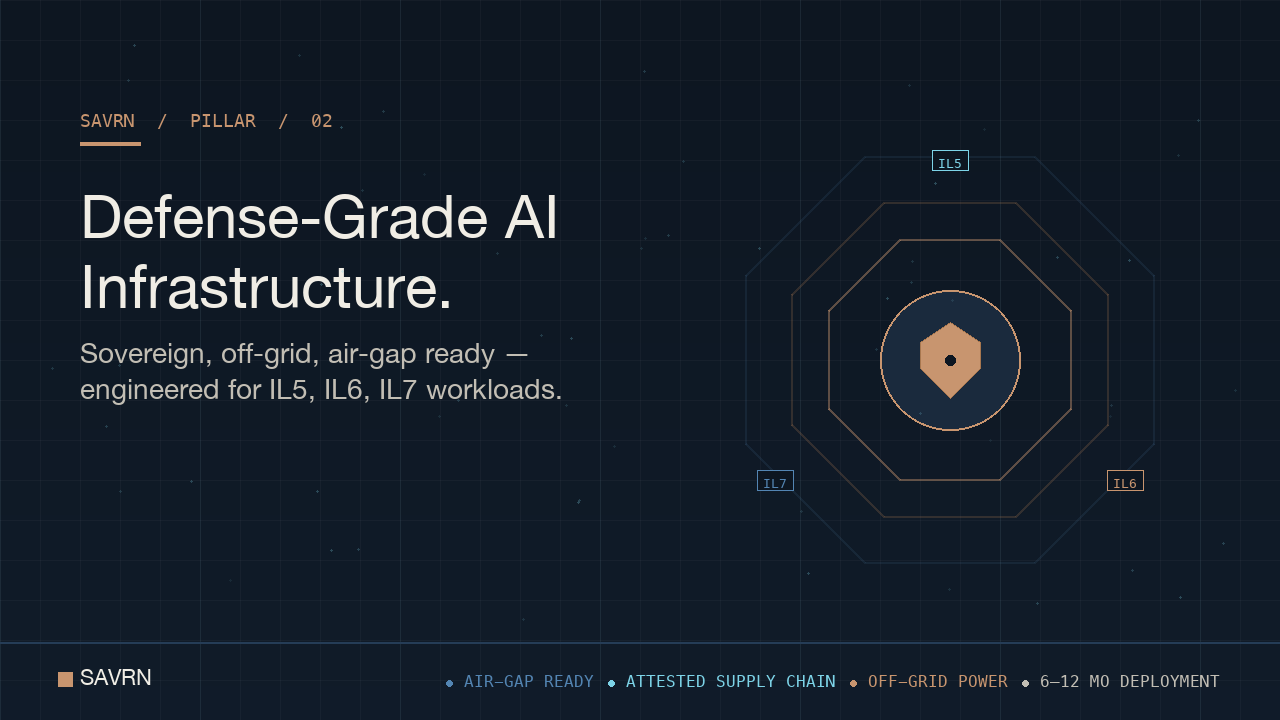
First, contractors must operate AI workloads across the full impact-level spectrum. Impact Level 2 (IL2) covers public-release information. At Impact Level 4 (IL4), the scope widens to Controlled Unclassified Information — the CUI that sits at the center of the CMMC framework. IL5 covers higher-risk CUI and unclassified National Security Systems. From there, IL6 handles Secret-classified information. And IL7 covers Top Secret and SCI workloads. Each level imposes progressively tighter requirements on personnel, network architecture, physical security, and the supply chain that produced the hardware.
In short, the strategy requires the same model — or successive variants of the same model — to be runnable on infrastructure that satisfies any of these tiers, with the data that flows into and out of each tier kept inside its boundary. That is not a feature you toggle in a hyperscaler region. It is an infrastructure architecture decision made before the first GPU is racked.
Obligation Two: Air-Gap From the Commercial Internet
Second, and equally non-negotiable, AI deployed inside IL5/IL6/IL7 must be air-gapped from the commercial internet. The May 2026 awards to the eight cleared vendors made this requirement explicit: each vendor must demonstrate AI operating inside classified networks that are physically isolated from the commercial backbone. Crucially, that requirement extends beyond network configuration. The hardware must be delivered through a clean supply chain. The operations staff must be cleared to the classification of the data handled. Personnel inside the security boundary apply updates directly, rather than pulling them from a vendor’s update server. And the physical facility must satisfy SCIF or equivalent requirements when handling data at IL6 and IL7.
For most commercial cloud regions, the air-gap takes the form of logical separation on top of shared physical infrastructure. For defense-grade workloads, that is not a sufficient guarantee. The strategy implicitly raises the bar to physical isolation — which means dedicated buildings, dedicated substations, dedicated fiber, and dedicated GPUs that have never carried a commercial workload.
Obligation Three: From Datacenter to Tactical Edge
Third, and most architecturally consequential, the strategy frames AI as a continuum of compute — from main-effort datacenters running training jobs on tens of thousands of GPUs, to forward-deployed inference clusters running on a few racks inside a hangar or a vehicle, to single-board AI inside an autonomous platform. The same model lifecycle has to traverse all three. As a result, the supporting infrastructure has to be deployable in modular form and operable without the assumption of grid power, commercial fiber, or vendor-managed support.
That is a sovereign-infrastructure problem before it is a software problem. The training campus and the forward-deployed pod must share the same security architecture, the same hardware lineage, and the same supply chain. Otherwise the model that was trained inside the air-gap cannot be safely operated outside it.
Why Existing Cloud Infrastructure Cannot Satisfy Defense Sovereignty
The Joint Warfighting Cloud Capability — JWCC — is the Department’s $9 billion enterprise cloud vehicle, awarded in late 2022 to AWS, Microsoft, Google, and Oracle. JWCC is the workhorse for unclassified, IL4, and most IL5 cloud workloads. For mature SaaS and standard analytics, it works. For defense-grade AI infrastructure at the scale the 2026 strategy now calls for, it has three structural limits that operators and program officers should understand before they architect around it.
Limit One: The Underlying Power Is Not Sovereign
To begin with, JWCC regions sit on the U.S. power grid. Regulated utilities operate the grid under regional transmission organizations. Hyperscalers in Northern Virginia, central Washington, and the Phoenix corridor now face interconnection queues exceeding seven years, plus local moratoria that pause new connections altogether. A defense AI training campus that depends on grid power inherits the queue, the moratorium, and the political volatility of the local utility commission. Notably, that is not a posture the Department can plan around when the strategy explicitly demands wartime-speed deployment.
The sovereign substitute is on-site generation. SAVRN’s Power module generates electrons behind the meter, on land the campus controls, with a permitting path that runs through state air boards and county authorities rather than regional transmission operators. As detailed in our guide to sovereign AI infrastructure, this single architectural choice converts a 36-to-84 month grid-dependency into a 6-to-12 month build cycle. For defense buyers, the build cycle is the difference between a capability that exists this fiscal year and a capability that exists in two administrations.
Limit Two: Shared Physical Infrastructure Is a Sovereignty Compromise
In practice, hyperscale regions that hold IL5 and IL6 accreditations achieve them through logical isolation on top of fundamentally shared infrastructure. The substation, the cooling plant, the building shell, and in many cases the network fabric are shared with commercial workloads. Accreditation is a statement that the controls in place make this acceptable for a given workload. It does not state that the workload runs on physically distinct hardware.
For routine classified workloads, that compromise is the correct trade. For the most sensitive AI workloads — frontier model training on classified corpora, autonomous targeting models, intelligence fusion at SCI — the trade does not hold. The risks of shared infrastructure are not theoretical: a misconfigured update on a commercial workload can affect classified neighbors. Above all, an adversary’s interest in the commercial workload becomes an indirect interest in the classified one. By contrast, defense-grade AI infrastructure starts from a different point. Specifically: physically distinct facilities, distinct hardware, distinct power, and distinct cleared operators.
Limit Three: The Supply Chain and the Roadmap Are Not Sovereign
Hyperscalers procure GPUs at scale and allocate them across a global commercial workload. A defense customer is one tenant among thousands. When NVIDIA Vera Rubin NVL144 ships in late 2026, the hyperscalers’ largest commercial customers will receive the first allocation. Defense workloads will be served from older platforms or smaller allocations until the commercial wave is fed. Specifically, this is a roadmap-control problem. A sovereign infrastructure operator owns its hardware order book and aligns it to the buyers’ programs, not to a hyperscaler’s quarterly capacity plan.
Furthermore, the supply chain itself is a defense concern. Hardware sourced through commercial channels moves through global logistics networks that resist end-to-end attestation. Defense AI infrastructure, by contrast, requires an attested supply chain. Components are sourced, transported, and integrated under documented chain of custody, by cleared personnel. Hyperscale procurement does not center on that requirement. A purpose-built sovereign campus does.
The SAVRN Architecture for Defense-Grade AI Infrastructure
By design, SAVRN’s architecture is built from the electron up. Each layer of the campus is owned by the operator, isolatable from every other workload on the site, and designed to satisfy the sovereignty requirements of the most sensitive defense AI workloads. The architecture is not specific to defense — the same campus serves enterprise and sovereign-nation buyers — but the architecture is what makes defense workloads supportable without retrofit.
Sovereign Power, Behind the Meter
Specifically, every SAVRN campus generates its own power on site. The substation energizes before crews pour the foundation of the compute hall. SAVRN selects generation technology to fit the geography: combined-cycle natural gas in markets where pipeline capacity exists, geothermal in the Imperial Valley and parts of Nevada, solar plus storage in the Southwest, and behind-the-meter nuclear on the long-term roadmap for the largest campuses. In every case, the campus is grid-independent by design. As a result, the regional outage profile, the utility curtailment regime, and the local resource adequacy study are not part of the uptime equation.
For defense buyers in particular, that property is decisive. A grid-tied facility cannot underwrite a service-level agreement against the loss of the upstream grid. A sovereign facility owns the entire power path and can underwrite uptime against threats that include grid instability, deliberate grid attack, and regional emergency. Every defense use case from continuity-of-operations training to forward inference depends on that guarantee.
Owned Compute, Clean Supply Chain
For the compute layer specifically, SAVRN deploys NVIDIA’s enterprise AI factory hardware as the standard compute layer of every campus. Today that is the GB200 NVL72 rack-scale system on the Blackwell architecture. Vera Rubin NVL144 is the next-generation upgrade path through 2026 and 2027, supported by the same campus power and cooling footprint without architectural rework. The operator or the customer owns the hardware outright, rather than renting from a commercial cloud. Networking centers on InfiniBand and high-radix Ethernet fabrics that isolate at the campus boundary. Storage is on-campus and air-gappable.
Crucially, operators can procure hardware for a defense workload through a chain-of-custody process that satisfies an attested supply chain. Components arrive at a controlled receiving facility, where cleared personnel integrate them and rack them inside a campus that has never hosted a commercial workload. By contrast, hyperscale procurement is built for volume and velocity. The defense-grade procurement is built for attestation. The two cannot be retrofitted to each other after the fact. Read more about how the Compute module integrates into the broader SAVRN campus architecture.
Single-Phase Immersion Cooling at AI Density
To put the cooling problem in perspective, modern AI racks dissipate 120 kW or more. Vera Rubin NVL144 will exceed that. Air cooling cannot remove heat at those densities economically, and direct-to-chip cooling becomes operationally fragile beyond the 100 kW threshold. SAVRN standardizes on single-phase immersion cooling — racks fully submerged in dielectric fluid, with heat removed through closed-loop heat exchangers. The result is a sub-1.1 PUE that holds across the full range of AI workloads, including the spikiest training runs.
The defense relevance of immersion cooling extends past efficiency. A sealed immersion tank reduces thermal acoustic signature, eliminates the airflow paths through which physical-access intrusions become possible, and improves the resilience of compute to ambient temperature swings — a property that matters at remote campuses and in tactical-edge deployments alike. In addition, immersion enables waste-heat recovery for adjacent facilities, which the SAVRN campus design exploits through the circular-economy adjacencies described in the doctrine.
Network Architecture Built for Air-Gap Operation
Likewise, every SAVRN campus lets operators physically sever the network path from the rack to the public internet at the campus boundary. Owned dark fiber connects the campus to defense and intelligence-community network drops where applicable. Crucially, the campus operates fully without reaching the commercial internet for updates, monitoring, or model artifact transfer. Update artifacts arrive on physical media or through accredited transfer mechanisms. Monitoring is internal. Model weights, when they need to traverse the boundary, do so on the customer’s terms.
That property is not bolted on after a security review. It is the consequence of an architectural decision made at site selection — the campus owns its fiber path, controls its routers, and operates its own DNS. Hyperscale regions cannot match this without reconstructing fundamental network economics that are built around shared egress to the public internet.
Compliance Architecture: How a Sovereign Campus Aligns to CMMC, IL, and the New AI Framework
In total, compliance for defense AI infrastructure has three live frameworks the buyer should understand. None of them is a check the operator passes once and forgets. All three are continuous obligations that the campus architecture either supports or fights against.
CMMC 2.0 and the November 10, 2026 Deadline
The Cybersecurity Maturity Model Certification program, in its 2.0 form, becomes a default contractual condition on November 10, 2026. From that date, contracting officers will require third-party-certified Level 2 status by default for contracts that involve Controlled Unclassified Information. Level 2 corresponds to the 110 controls in NIST SP 800-171. Level 3, required for the most sensitive CUI, adds a subset of NIST SP 800-172 controls and government-led assessment. CMMC compliance must remain current for the life of the contract, and the requirement can now appear directly in solicitations.
For an AI workload in particular, CMMC creates a sharp dividing line. AI tools that touch CUI must operate inside an environment governed by the same controls. A commercial AI service that ingests CUI for training, fine-tuning, or retrieval is bringing CUI into a non-compliant boundary unless the service itself is accredited. A sovereign campus eliminates this trap. Specifically, the AI workload runs inside a campus where every layer — power, compute, network, storage, operations — is contained within the same compliance boundary, and the boundary is owned by the customer or by SAVRN under the customer’s contract.
The NDAA Section 1513 AI Security Framework
The National Defense Authorization Act for Fiscal Year 2026 directs the Department to develop a cybersecurity and physical security framework specifically for AI and machine-learning systems acquired by the Pentagon. Notably, Section 1513 instructs the Department to incorporate this framework into the DFARS and into the CMMC program, applying stringent requirements that align with the protections used for national security systems. A status report on the framework’s implementation timeline is due to Congress on June 16, 2026.
Although the framework is not yet codified, the direction of travel is unambiguous. AI hardware, AI training pipelines, AI inference systems, and the data they handle will be protected at a level comparable to NSS. As a result, the operating posture for defense AI infrastructure will converge on what sovereign campuses already implement: physical security at the perimeter, attested supply chain, cleared operators, and air-gappable network architecture. Operators that build to this standard now will be ready when the regulatory text catches up.
Impact Levels and the Architecture Behind Them
To clarify the terminology, Impact Levels are the Defense Information Systems Agency‘s classification of the data sensitivity that a cloud or compute environment may handle. IL2 through IL4 are commercial workloads. IL5 covers higher-risk CUI and unclassified NSS. IL6 covers Secret. IL7 covers Top Secret. Each level imposes additive requirements on facility, personnel, network, and supply chain. SAVRN does not claim certifications it has not earned. What SAVRN claims is that the campus architecture is built so that a customer can operate inside the highest of these tiers without retrofitting the underlying infrastructure.
In practical terms: the fence line, the buildings, the substations, and the operations centers at a SAVRN campus are architected to satisfy SCIF or equivalent physical-security requirements when the customer’s program demands it. Cleared-personnel staffing is contracted on a per-program basis. Network paths are isolatable at the campus boundary. The hardware lineage is documented from procurement through commissioning. The customer’s accreditation effort starts inside a facility designed for the destination, not inside a facility designed for a different purpose.
Deployment Timeline: From Site Selection to Operational AI Campus
By comparison, the hyperscale industry standard for an AI training campus is 36 to 48 months from site selection to first token. SAVRN delivers a sovereign campus in 6 to 12 months. The compression is not marketing. It is the consequence of three architectural decisions that defense buyers should evaluate alongside the technical specifications.
Decision One: Power First, Compute Second
First and foremost, the Power module energizes before the compute hall is sealed. As a result, the regional grid interconnection queue is not on the critical path. For defense programs operating on Continuing Resolution timelines and on classified-program acquisition windows, this single decision is the difference between a capability that exists during the relevant program of record and a capability that exists after.
Decision Two: Modular Compute Pods, Not Stick-Built Halls
Second, SAVRN delivers compute capacity in pre-integrated modular pods that arrive at the campus already wired, plumbed, and tested. On-site work shrinks to anchor-and-connect. By contrast, the conventional stick-built hyperscale model assembles every layer in sequence under a single permit. Modular construction parallelizes that work and converts a serial schedule into a parallel one. For defense workloads, modularity also enables surge capacity expansion under accelerated procurement timelines without re-permitting the campus.
Decision Three: Pre-Integrated Power, Cooling, and Compute
Third, SAVRN engineers power, cooling, and compute together, factory-integrates them, and commissions them as a single system. There is no integration phase between three vendor scopes. The single-vendor accountability across the stack compresses commissioning from months to weeks and removes the inter-vendor finger-pointing that delays conventional builds. For defense customers that must accredit the campus end-to-end, this property simplifies the assessment package and the resulting Authority to Operate.
A Realistic Phase Map
For planning purposes, phases on a sovereign defense campus run roughly as follows. Weeks 1 to 8 cover site finalization, power infrastructure assessment, permit pre-application, and program-specific compliance scoping with the customer’s accreditation team. From there, weeks 9 to 20 carry foundation work, power infrastructure deployment, and cooling system installation. Then weeks 21 to 32 handle compute pod arrival, NVL72 commissioning, network buildout, and security architecture installation at the perimeter. Finally, weeks 33 to 48 close out systems integration, security accreditation, cleared-personnel staffing, and first operational token. Customers operating inside the higher impact levels run the accreditation in parallel with the build, which is feasible because the architecture was designed to the destination from the start.
Above all, SAVRN contractually underwrites the schedule. The 6-to-12 month range covers the full envelope of campus types from a 20 MW first module to a 100 MW multi-module campus. A customer operating under wartime-speed procurement is not buying an aspiration. The customer is buying a delivery commitment with a known phase map.
SAVRN’s Active Markets and Their Defense Relevance
Today, SAVRN is actively evaluating and developing campuses in three market regions, each chosen for the combination of land availability, on-site power feasibility, fiber connectivity, and proximity to defense and intelligence-community concentration.
Las Vegas and Southern Nevada
First, Southern Nevada combines industrial land at scale, a permitting environment that supports rapid build, and proximity to Nellis Air Force Base, the Nevada Test and Training Range, and the broader Air Force testing community. Furthermore, the local labor pool includes the construction trades and operations talent required for an immersion-cooled campus. Power is increasingly stressed at the regional level, which makes the sovereign on-site generation model a fit rather than a constraint.
Imperial Valley, California
Second, Imperial Valley is California’s energy corridor — geothermal capacity at the Salton Sea, solar capacity across the valley floor, and a brownfield land base zoned for industrial development. SAVRN is evaluating campuses up to 1.8 GW of cumulative capacity in the region. Crucially, while a competing project pursues a grid-connected hyperscale model that has drawn community opposition, SAVRN’s off-grid sovereign architecture sidesteps the exact objections — water use, grid load, regulatory exposure — that drive that opposition. The geography also sits within reach of Naval Air Station Lemoore, MCAS Yuma, and the broader southwestern defense footprint.
PuebloPlex, Colorado
Third, PuebloPlex is a former Army depot site with industrial-grade infrastructure, a large land base, and a development authority oriented toward defense-relevant tenants. Specifically, the location offers proximity to the Colorado defense and aerospace cluster — Buckley Space Force Base, Schriever, Peterson, and the broader Front Range concentration of national security organizations. Industrial-friendly permitting and a community familiar with classified and defense work reduce friction at the program level.
Why Geography Matters for Defense AI Workloads
Notably, defense AI infrastructure has location dependencies that commercial AI does not. Latency to the customer’s mission-system tenants matters when inference is part of an operational kill chain. Personnel commute distance matters when cleared operators are scarce. Local political alignment with defense workloads matters when the campus needs years of operational stability. SAVRN’s market selection accounts for all three. As a result, defense customers can engage on a campus that is already in the right place — they are not the customer that funds the geographic move.
The $13.4 Billion Opportunity and Why Now Is the Moment to Build
For context, the Department’s FY2026 AI and autonomy request is $13.4 billion. The first half of FY2026 saw $32 billion in contract ceiling committed to artificial intelligence, cloud computing, cybersecurity, and data analytics, including $200 million each to xAI, OpenAI, Google, and Anthropic for agentic AI development inside classified environments. Notably, the May 2026 expansion to eight cleared vendors moved AI workloads onto IL6 and IL7 networks. The dollar volume is real, the contracting vehicles are live, and the procurement signal is unambiguous.
Yet what is missing from the picture is the underlying physical infrastructure that this volume of AI compute will require. Hyperscale capacity is fully booked for commercial AI through 2028 in the major U.S. markets. Grid interconnection queues exceed seven years. Hardware allocations from NVIDIA are commercially constrained. As a result, defense programs that depend on the existing hyperscale footprint will compete for capacity against the largest commercial buyers in the world — and lose, or be served from older platforms, or be served on timelines that do not match the strategy’s wartime-speed framing.
Therefore, sovereign campuses change that equation. By contrast, a defense customer engaging with a sovereign operator is not bidding into a commercial allocation. The customer is contracting purpose-built capacity on a 6-to-12 month delivery curve, with hardware procured for the program, on land controlled by the operator, with power generated on site, in a market chosen for its defense relevance. The economics of that arrangement are competitive with hyperscale capacity at sustained utilization. The strategic value — independence from commercial allocation politics, sovereignty of the underlying stack, deployability inside the program’s classification envelope — is unique to the sovereign-campus model.
Three Buyer Profiles, Three Engagement Paths
In practice, defense AI infrastructure buyers fall into three profiles, each with a distinct engagement with SAVRN.
Profile one: defense primes and large integrators. Lockheed Martin, Northrop Grumman, RTX, General Dynamics, L3Harris, Booz Allen, Leidos, Palantir, and the broader prime tier. These buyers operate AI workloads on behalf of program offices and need infrastructure that can host the workloads under the customer’s accreditation envelope. SAVRN engages through a campus-as-a-service model: the prime contracts capacity and brings the cleared workforce; SAVRN delivers and operates the underlying campus to the program’s sovereignty requirements.
Profile two: program offices and the services directly. The Office of the Secretary of Defense, the service AI offices, intelligence-community organizations, and the combatant commands. These buyers acquire infrastructure capacity directly under the FY2026 budget lines. SAVRN engages through direct campus development, with the customer holding land control or partnering with SAVRN’s existing markets, and operating the campus under the customer’s authority to operate.
Profile three: allied sovereign customers and defense industrial partners. Five Eyes partners, NATO programs, and allied defense industrial bases acquiring AI compute that needs to satisfy both U.S. export-control posture and the partner nation’s sovereignty requirements. SAVRN engages on a case-by-case basis, with campus geography and operating model matched to the bilateral framework.
A Closing Argument for the Decision Maker
Ultimately, the Department’s 2026 AI strategy is the clearest statement of intent the defense AI market has had in a decade. It commits real money. It names real timelines. And it draws an explicit line between AI that runs on the commercial backbone and AI that runs on sovereign infrastructure inside the classification envelope. Decision makers in the program offices, in the primes, and in the integrator tier now have to choose: build the AI stack on capacity owned by the four hyperscalers, or build it on capacity owned by an operator whose architecture was designed for the destination.
In short, sovereignty is not a feature that can be retrofitted to a commercial platform. It is the starting point of an architecture or it is missing from one. SAVRN’s campuses are sovereign by construction. The power is generated on site. The hardware is owned and supply-chain attested. The cooling enables the next generation of AI workloads without replatforming. The network is air-gappable at the campus boundary. The geography is matched to defense relevance. And the build cycle compresses to a timeline a defense program can underwrite.
SAVRN designs, builds, and operates sovereign AI infrastructure for defense, intelligence, and sovereign-nation customers. Off-grid power, owned hardware, single-phase immersion cooling, deployed in 6 to 12 months — architected from the electron up to satisfy IL5, IL6, and IL7 sovereignty requirements. Engage with the SAVRN defense team or submit a site for evaluation.
Frequently Asked Questions: Defense-Grade AI Infrastructure
What is defense-grade AI infrastructure?
Defense-grade AI infrastructure is AI compute capacity purpose-built to satisfy Department of War sovereignty, security, and supply-chain requirements at Impact Levels 5, 6, and 7. It is physically isolated from commercial workloads, operated by cleared personnel, supplied by an attested hardware chain, powered by on-site generation, and architected so the network is air-gappable at the campus boundary. Commercial cloud capacity with sovereignty branding does not satisfy the same requirements.
What does the DoD’s 2026 AI strategy require for compute infrastructure?
The January 12, 2026 strategy commits the Department to expanding access to AI compute from datacenters to the tactical edge across all classification levels. It implicitly requires AI workloads to run on infrastructure that is air-gapped from the commercial internet at IL5 and above. The hardware must come through an attested supply chain. And the deployment timeline must match wartime-speed acquisition. The FY2026 request includes $13.4 billion for AI and autonomy.
How does CMMC 2.0 affect AI workloads after November 10, 2026?
Specifically, from November 10, 2026, third-party-certified Level 2 status becomes the default contractual requirement for contracts that involve Controlled Unclassified Information. AI tools that touch CUI must operate inside an environment governed by the same controls as the CUI itself. A commercial AI service that ingests CUI for training, fine-tuning, or retrieval brings the CUI into a non-compliant boundary unless the service is itself accredited. A sovereign campus contains the AI workload inside a single compliance boundary owned by the customer or by the campus operator under the customer’s contract.
What is the NDAA Section 1513 AI security framework?
Section 1513 of the FY2026 NDAA directs the Department of War to develop a cybersecurity and physical-security framework for AI and machine-learning systems acquired by the Pentagon. The framework must then flow into the DFARS and the CMMC program. A status report on implementation is due to Congress on June 16, 2026. The framework is expected to apply protections comparable to those used for national security systems, especially for highly capable AI systems most likely to attract adversary interest.
Why is air-gap from the commercial internet a hard requirement for IL6 and IL7?
By rule, information classified at the Secret level or above cannot share a network path with unclassified or commercial workloads, and AI systems operating on classified data inherit the same constraint. Air-gap combines physically isolated network paths, accredited transfer mechanisms for any inbound or outbound data, and operational controls that prevent inadvertent connection. The May 2026 expansion of eight cleared vendors onto IL6 and IL7 networks made this requirement the explicit baseline for defense AI deployment.
Can a hyperscale cloud satisfy defense-grade AI sovereignty requirements?
For routine IL2, IL4, and many IL5 workloads, hyperscale cloud is the correct deployment target. For the most sensitive AI workloads — frontier-model training on classified corpora, autonomous targeting systems, intelligence fusion at the SCI level — the shared underlying infrastructure of a hyperscale region is a sovereignty compromise. Power, building shell, and supply chain are all shared with commercial workloads. A sovereign campus eliminates that shared exposure by physical design.
How long does it take to build a defense-grade sovereign AI campus?
In practice, SAVRN delivers a sovereign campus in 6 to 12 months from contract to first operational token. The hyperscale industry standard is 36 to 48 months. The compression comes from on-site power generation that bypasses the utility interconnection queue, factory-integrated modular compute pods that parallelize on-site work, and pre-integrated power, cooling, and compute that compresses commissioning. Customer accreditation work runs in parallel with the build because the architecture is designed to the destination from the start.
Where does SAVRN currently operate, and why those locations?
Today, SAVRN is actively evaluating and developing campuses in Las Vegas and Southern Nevada, the Imperial Valley in California, and PuebloPlex in Colorado. Each market combines industrial-scale land, on-site power feasibility, fiber connectivity, and proximity to a major U.S. defense and intelligence concentration. Imperial Valley alone supports up to 1.8 GW of cumulative campus capacity under SAVRN’s pipeline. The market selection accounts for the geography of defense workloads, the cleared personnel pool, and the long-horizon political alignment of the host community with defense activity.
Does SAVRN hold IL5, IL6, IL7, or CMMC certifications today?
To be clear, SAVRN does not claim certifications it has not earned. The campus architecture is designed to satisfy the physical, supply-chain, and network requirements of those tiers, so a customer operating inside the highest of these envelopes can pursue accreditation against a facility built for the destination rather than retrofitted to it. Certification at the campus and at the workload level is pursued under the customer’s program when contracted, with cleared-personnel staffing and accreditation engagement matched to the program’s timeline.
How does a sovereign campus serve forward-deployed and tactical-edge AI?
Crucially, the same architecture that powers a main-effort training campus scales down to a forward-deployed inference pod. The modular construction model, the immersion cooling system, the owned-hardware lineage, and the air-gappable network all translate to smaller footprints. A model trained inside a sovereign campus can be operated outside it without leaving the security envelope, because the supply chain, the hardware lineage, and the operating posture are continuous from the training campus to the edge.
Sources & Citations
Every quantitative claim in this piece traces to a named, verified primary source. URLs verified at time of publication. The full audit-grade citation record, with claim-by-claim source mapping and “cite this article” snippets, is maintained on the dedicated SAVRN sources page for this piece.
Primary research cited in this defense ai infrastructure brief
- U.S. Department of Defense — Artificial Intelligence Strategy. Department of Defense Artificial Intelligence Strategy (January 2026) as the canonical policy framework for DoD AI deployment.
- U.S. Congress — H.R. 2670, NDAA FY2026. National Defense Authorization Act for Fiscal Year 2026 — Congressional authorization text governing DoD AI procurement.
- NIST SP 800-171 Rev 3. NIST Special Publication 800-171 Revision 3 — protecting controlled unclassified information in nonfederal systems.
- DoD Office of the Chief Information Officer — CMMC. Cybersecurity Maturity Model Certification (CMMC) framework governing DoD contractor security posture.
Supporting frameworks, regulators, and industry data
- Defense Information Systems Agency (DISA). Defense Information Systems Agency as the lead authorization authority for DoD computing infrastructure.
- DISA — Joint Warfighting Cloud Capability. Joint Warfighting Cloud Capability (JWCC) as the multi-vendor DoD cloud framework that defense-grade AI infrastructure must interoperate with.
- Breaking Defense — “Pentagon Clears 7 Tech Firms to Deploy Their AI on Its Classified Networks” (May 2026). By May 2026, the Department of Defense had cleared eight commercial AI vendors to deploy AI on classified networks.
- NVIDIA GB200 NVL72. NVIDIA’s enterprise AI factory hardware platform (GB200 NVL72) as the silicon baseline for high-density AI compute.