Build vs buy AI infrastructure has become the largest capex call of 2026. The decision faces every enterprise CIO, sovereign buyer, and defense integrator. Cloud GPU spend is now a permanent line item rather than an experiment. Colocation rents have re-priced upward as AI rack densities outpace conventional halls. Meanwhile, buyers running AI workloads at sustained utilization have started to ask a sharper question. Should we own the campus instead?
About SAVRN. SAVRN is the operator of an off-grid sovereign AI infrastructure campus model — owned power generation, owned compute, closed-loop liquid cooling — deployed in 6 to 12 months versus the 24-to-48-month industry standard, with active developments in California, Texas, Colorado, Nebraska, Panama, and Barbados.
This guide answers that question directly. The framing is a 5-year capex problem, not a monthly cloud bill. Hidden costs that distort the math come next. After that, the workloads where ownership wins, and where renting still makes sense. Finally, the guide lays out how SAVRN compresses the sovereign build path to 6 to 12 months. The compression comes from behind-the-meter power, liquid cooling, and Intelliflex integrated manufacturing.
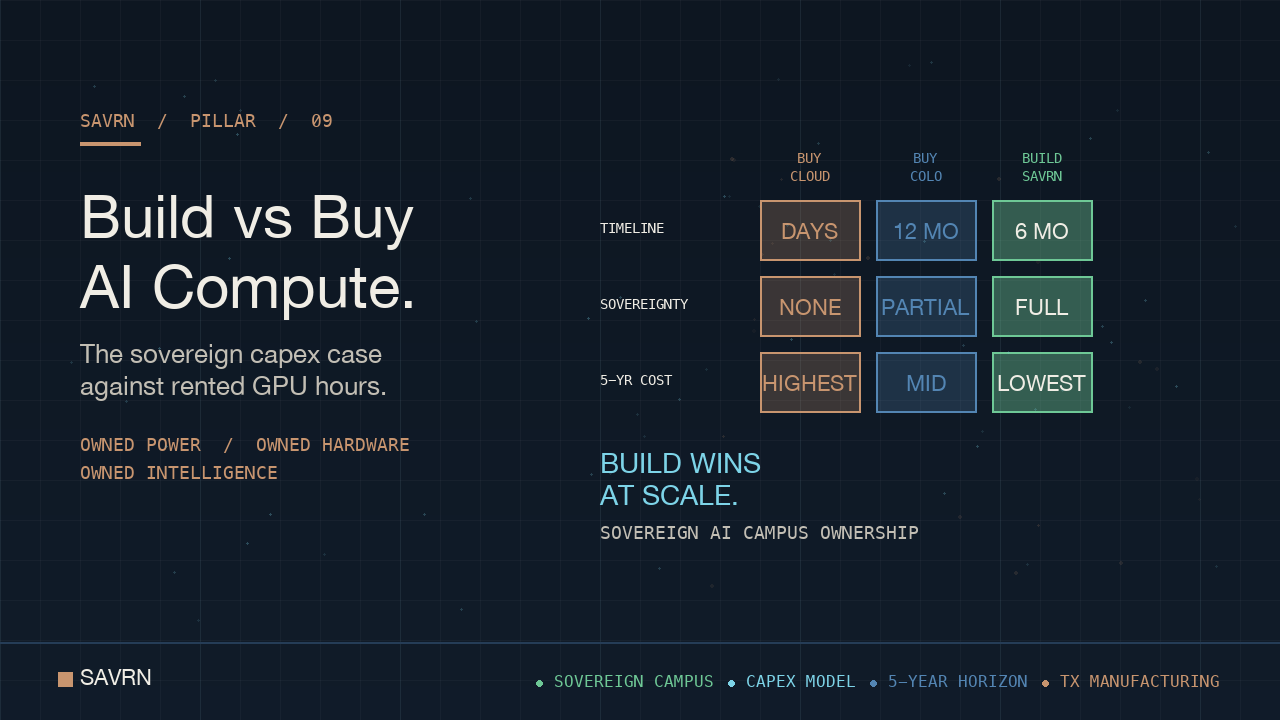
The takeaway up front. Buying compute makes sense for short-horizon experimentation, low utilization, and proof-of-value pilots. Building makes sense the moment a workload becomes a product. It also makes sense once data sovereignty becomes a board issue. And it makes sense when grid interconnection windows throttle scale. SAVRN exists for the third case. Specifically, this article argues that the build vs buy AI infrastructure question is no longer an academic finance exercise. It is a 2026 procurement decision that determines who controls the next decade of intelligence supply.
Why the build vs buy AI infrastructure question defines 2026 capex
Three forces have collided to push this question to the front of the boardroom agenda. First, AI workload economics have stopped looking like cloud workload economics. AI inference now consumes 70 to 90 percent of enterprise AI compute spend, per Deloitte’s 2026 Tech Trends report — flipping the cost basis from one-time capex to a recurring operational line that compounds the build-vs-buy math. Second, grid-tied capacity has stopped scaling at AI velocity. Third, a measurable share of enterprise AI spend now flows through a single vendor stack. Buyers can no longer audit, mirror, or move that stack. Together, these forces have made this a strategic control problem, not a unit-economics one.
The cloud GPU signal that started the build vs buy AI infrastructure conversation
Goldman Sachs Research projects data center power demand will rise roughly 165% by 2030. AI training and inference drive that curve. As a result, the cost of every kilowatt that ships intelligence has become the line item every operator now watches. Cloud GPU pricing has tracked that demand. On-demand H100-class instances are frequently quoted at $3 to $6 per GPU-hour for sustained reservations. Furthermore, at 70% sustained utilization, annual rented compute often passes the 3-year amortized cost of the same hardware owned outright.
That is the signal. Cloud was an opex story when AI was a pilot. AI at production utilization rewrites that story into a capex story. Consequently, every team running AI as a real product line has been forced to model the alternative.
What “build” and “buy” actually mean in AI infrastructure
“Buy” covers three deployment patterns. First, pure cloud GPU consumption through hyperscalers. Second, rack-rental colocation where the buyer owns the hardware but rents floor space, power, and cooling. Third, GPU-as-a-service tenancies that bundle owned compute on someone else’s site. Each option trades capital for variable cost, and each leaves at least one critical dependency outside the buyer’s control.
“Build” means owning the campus. Specifically, it means owning the land, the power generation, the cooling system, the racks, the GPUs, and the operational runbook. Notably, the SAVRN definition extends one layer deeper. The build path includes domestic manufacturing of the modular pods, through Intelliflex in Fort Worth, Texas. In short, the build vs buy decision is not a binary capex toggle. It is a question of how many layers of the stack the buyer wants to own.
Where sovereignty enters the build vs buy AI infrastructure debate
Sovereignty changes the math the moment an AI workload touches regulated data, classified workloads, or strategically sensitive intellectual property. The U.S. Department of Defense has formalized this view in its 2026 AI strategy. The strategy mandates compute pathways from data center to tactical edge under sovereign control. By contrast, public cloud cannot match air-gap, tenancy isolation, and supply-chain visibility at the level a buyer-owned campus delivers. As a result, sovereignty has stopped being a checkbox. It has become a determining factor in the capex call.
The buy side: cloud GPUs, colocation, and rented compute
The buy path is not wrong. For a great many workloads it remains the correct call. However, the buyer should understand exactly what each variant trades away. The three buy patterns differ less in cost than in control. That difference eventually decides whether ownership pays back.
Cloud-only AI: lowest friction, highest variable cost
Cloud-only is the right answer when a team needs GPUs in days, not months. Furthermore, cloud wins for spiky workloads. It also wins when teams are still selecting models. And it wins when annual GPU-hours fall below the breakeven for owned hardware. The Uptime Institute’s 2024 Global Data Center Survey confirms a similar pattern. Operators who run intermittent or experimental pipelines extract more value from public cloud than from owned capacity. Specifically, the cloud floor breaks down at sustained training. It also breaks down at large-scale inference, and at any workload subject to data residency rules.
Egress is the cost line buyers most often miss. Moreover, model weights, training datasets, and embedding stores all carry exit costs that compound quietly across multi-year programs. By the time a workload becomes strategic, the cost of leaving is often higher than the cost of running.
Colocation: a partial answer to the build vs buy AI infrastructure question
Colocation answers half the question. The buyer owns the GPUs, which captures the largest chunk of capital. However, the buyer rents the floor, the power feed, and the cooling system. That tradeoff worked when racks consumed 5 to 10 kilowatts. It strains badly when AI racks demand 130 to 250 kilowatts of liquid cooling. Consequently, traditional colo halls have started either retrofitting at premium prices or rejecting AI tenants altogether. As a result, colocation has slid from a clean middle path to a contested compromise.
Why rented compute caps long-horizon AI strategy
Rented compute caps strategy in three ways. First, it caps the GPU roadmap to whatever the landlord supports. Second, it caps the cooling architecture to whatever the landlord installed. Third, it caps the power envelope to whatever the local utility delivered. In short, every rented layer is a future dependency. By contrast, an owner controls the full stack and can re-architect each layer on its own schedule. That difference compounds across a 5-year horizon. It is exactly where the build path starts to favor owners.
The build side: sovereign AI campus ownership
Building means absorbing capital up front for a multi-decade asset. Furthermore, it means accepting the operational responsibility that comes with that asset. SAVRN’s experience suggests that buyers who choose this path share three traits. They run AI as a sustained product. They treat data control as non-negotiable. And they take a 7 to 10 year view of compute capacity rather than a quarterly one. For those buyers, the build path is not a luxury. It is the only path that scales.
What “build” looks like at industrial scale
Industrial-scale build means a campus, not a server room. Specifically, it means a site sized to ingest tens to hundreds of megawatts of behind-the-meter generation. Rack-level power and cooling are sized for high-density AI workloads. SAVRN’s reference architecture stacks four layers under one operator: power generation, liquid cooling, compute pods, and integrated manufacturing. Notably, every layer connects to the next without a vendor seam. That removes the supply-chain coordination overhead that drags conventional builds past 24 months.
Why the build vs buy AI infrastructure equation favors owners at sustained utilization
At low utilization, ownership is wasteful. At sustained utilization, ownership is decisive. Lawrence Berkeley National Laboratory’s 2024 U.S. data center energy report makes the point clearly. AI workloads now drive utilization profiles that look more like industrial process loads than traditional enterprise computing. Consequently, the cost-per-token math at 70% to 90% sustained utilization tilts hard toward owned infrastructure. Specifically, owners avoid the cloud retail margin, the colocation rent stack, and the egress trap, all at the same time.
The control surface only build delivers
Control surface is the unmeasured advantage of the build path. Owners control the GPU refresh schedule. Moreover, owners control the cooling fluid, the network fabric, the security boundary, and the audit posture. By contrast, every rented stack hands one or more of those decisions to a counterparty. For regulated buyers, that counterparty risk is itself a regulatory exposure. Therefore, in regulated industries, the build vs buy conversation often resolves at the audit committee, not the CFO’s desk.
The five hidden costs that distort the build vs buy AI infrastructure calculation
Most internal models of this question understate the cost of buying. Five items get omitted. They appear nowhere on a cloud invoice and rarely on a colocation contract summary. Each one shifts the breakeven point materially. In each case, the cost is structural rather than negotiable.
Hidden cost one: egress and data exit
Cloud egress fees are the most visible of the five. The deeper exit cost is migration time, not transfer charges. Specifically, moving a multi-petabyte training corpus, a fine-tuned model registry, and a live inference endpoint takes engineering quarters. Furthermore, sovereign buyers cannot rely on any third-party network for that migration. Together, these costs effectively lock workloads in once they reach scale.
Hidden cost two: GPU roadmap exposure
Renting compute means renting a GPU roadmap that the buyer does not control. NVIDIA’s enterprise AI factory roadmap continues to telegraph rising rack densities and tighter cooling requirements. Consequently, every rented stack must wait for its landlord to upgrade. By contrast, an owner can synchronize cooling, power, and rack design with the next hardware generation on its own clock. Therefore, the build vs buy decision is in part a decision about whose clock the buyer wants to live on.
Hidden cost three: power surcharges and grid uplifts
Grid-tied capacity is no longer cheap, predictable, or fast. The International Energy Agency’s analysis of data center electricity demand projects sharp regional capacity constraints through the late 2020s. As a result, utilities have started passing through demand-driven surcharges, capacity payments, and grid-upgrade contributions. These were rare a decade ago. Notably, those costs apply to colocation tenants and to grid-tied owned campuses alike. By contrast, behind-the-meter generation under owner control sidesteps all three.
Hidden cost four: compliance overhead in shared environments
Shared infrastructure carries shared audit responsibilities. For example, take a buyer running CMMC-aligned workloads on a multi-tenant cloud. Each cycle, that buyer must reconcile the cloud provider’s audit reports, its own internal controls, and customer-flowed-down requirements. Furthermore, that reconciliation overhead grows as the number of cloud regions, services, and account boundaries grows. Owned infrastructure collapses that surface area into a single operator, a single audit boundary, and a single set of controls.
Hidden cost five: opportunity cost of waiting
The fifth hidden cost is the cost of capacity that does not arrive on time. Conventional grid-interconnection queues now stretch past 36 months in most U.S. markets. Stick-built campuses commonly require 24 to 48 months from groundbreaking to first power. Consequently, every quarter without compute is a quarter of foregone product velocity. By contrast, SAVRN’s sovereign campus can be operational in 6 to 12 months. That difference compounds in opportunity cost faster than most CFO models capture.
How SAVRN compresses the build vs buy AI infrastructure timeline
The build path historically lost on schedule. SAVRN re-engineered that schedule. Specifically, the SAVRN doctrine eliminates three long pole tents. The utility interconnection wait, the multi-vendor coordination overhead, and the on-site stick-built construction cycle all collapse. As a result, the sovereign campus has moved from a 48-month asset to a 6 to 12 month asset.
Sovereign on-premise power generation
Behind-the-meter generation is the unlock. Specifically, generating power on-site removes the dependency on utility interconnection queues that throttle every grid-tied build. Furthermore, it removes exposure to the regional capacity surcharges that the IEA has flagged across U.S. and international markets. SAVRN’s sovereign generation model carries the campus through the AI rack-density curve without waiting for a substation upgrade.
Intelliflex integrated manufacturing in Fort Worth, Texas
Intelliflex sits inside SAVRN, not alongside it. The Fort Worth, Texas manufacturing facility builds the modular pods that ship to active sites. The Intelliflex Customer Experience Center showcases the integrated stack to incoming buyers. Notably, this domestic manufacturing footprint removes the supply-chain coordination drag that pushes conventional builds past two years. As a result, an enterprise buyer can walk a working pod before a single line of capital is committed.
Six to twelve month deployment windows
Six to twelve months is the SAVRN delivery commitment. Furthermore, the window holds at industrial scale. The architecture front-loads factory build and back-loads on-site assembly. Pods leave Fort Worth pre-tested. Cooling lines arrive pre-fitted. Power generation is sized for first-day load. Consequently, the build path no longer pays the multi-year penalty that once made the buy path the default.
Modular incremental capex ramp
Capex pacing is the second SAVRN advantage. Specifically, the modular architecture lets a buyer commission megawatts in tranches rather than as a single hyperscale slug. As a result, the buyer absorbs capital in step with revenue or program funding. The alternative is carrying a 200-megawatt loan against a workload that will not fully ramp for two years. By contrast, hyperscale stick-built campuses commit nearly all capital up front. That difference flips the NPV at a far lower utilization threshold than buyers expect.
A 5-year build vs buy AI infrastructure cost model
Every responsible model of this question runs five years, not three. AI hardware lifecycles, depreciation schedules, and workload roadmaps all stretch beyond a 36-month horizon. The model below is directional, not prescriptive. Any buyer can plug in their own utilization curve and arrive at the right answer for their situation.
Scenario A: cloud-only at sustained AI workloads
Scenario A assumes 1,000 H100-class GPU equivalents at 70% utilization across 5 years on public cloud reservations. Blended pricing runs roughly $3 to $4 per GPU-hour for committed reservations. The run-rate exceeds $200 million across the horizon. Furthermore, that figure excludes egress, premium support, and the engineering overhead of multi-region resilience. As a result, cloud-only Scenario A runs hot at any utilization above the experimentation threshold.
Scenario B: colocation with rented racks
Scenario B assumes the same 1,000-GPU envelope, owned outright, hosted in a high-density colocation facility. The buyer absorbs hardware capex, then pays a multi-year rack-rental contract for floor, power, and cooling. Notably, the colo path saves materially against cloud Scenario A at sustained utilization. However, it introduces three constraints. Those constraints are power-uplift exposure, density caps tied to the host facility, and a contract structure that complicates GPU refresh cycles. Therefore, Scenario B is a partial win that re-introduces dependencies the buyer originally meant to remove.
Scenario C: SAVRN sovereign campus ownership
Scenario C absorbs hardware capex and campus capex up front. After that, it runs at the marginal cost of behind-the-meter generation, cooling, and a small operations team. Furthermore, the modular ramp lets the buyer phase capital across the first 12 to 24 months. At sustained 70% utilization, Scenario C produces the lowest 5-year all-in cost of the three. As a result, the cost-per-token differential at scale is large. It is large enough to fund the next campus expansion from operating cash flow alone.
Where the crossover lands for most enterprise buyers
Crossover analysis is the most important output of any build vs buy AI infrastructure model. McKinsey’s analysis places the breakeven between rented and owned compute at sustained utilization in the 60% to 75% range. Below that band, renting wins on capital efficiency. Above it, ownership wins on cost-per-token and on control. Notably, sovereign and defense workloads cross over far earlier. Their non-cost criteria push owners over the line regardless of utilization.
Who should build, who should buy, and the build vs buy AI infrastructure decision matrix
No single answer fits every buyer. However, a small set of attributes reliably predicts the right side of the line for any given organization. The matrix below is not a scorecard for one quarter. It is a strategic posture that holds across the next compute cycle.
Build candidates: defense, sovereign nations, regulated enterprise
Defense primes, federal mission owners, sovereign nations, and heavily regulated enterprise verticals all share the same profile. They run AI workloads on data that cannot leave a controlled boundary. Furthermore, they answer to audit regimes that prefer single-operator infrastructure over multi-vendor stacks. As a result, the build path is not optional for these buyers. It is the only path that satisfies the regulatory baseline. SAVRN serves this profile through sovereign campus delivery in markets that include California, Texas, Colorado, Nebraska, Panama, and Barbados.
Buy candidates: short horizon, low utilization, model evaluators
Buy candidates run experiments, not products. Specifically, they evaluate model providers, prototype features, and serve workloads that have not yet reached sustained utilization. For these buyers, cloud GPU consumption is the right answer. It stays the right answer until the workload becomes a product or hits a regulatory ceiling. By contrast, the moment either threshold trips, the build conversation begins.
Hybrid: anchor and burst patterns split the build vs buy AI infrastructure mix
Many enterprise teams will land on a hybrid posture. Specifically, an owned sovereign campus carries the steady-state production workload, and bursty experimental workloads continue to run on cloud. As a result, the buyer captures the cost-per-token advantage on the bulk of the workload. Elastic cloud capacity still serves the long tail. Notably, this matches how mature enterprises run other industrial assets. Owned baseload pairs naturally with rented peak capacity.
The decision matrix in nine criteria
Nine criteria reliably score this decision in either direction. Those criteria are utilization profile, sovereignty requirement, and time-to-first-token tolerance. They also include capex availability, GPU refresh cadence, power exposure, audit posture, vendor concentration risk, and 5-year roadmap visibility. Furthermore, a buyer who scores “high” on any five criteria is almost always a build candidate. The cost model alone need not close the case. By contrast, a buyer who scores “low” on six or more is almost always a buy candidate.
The build vs buy AI infrastructure question after Intelliflex and SAVRN
The build path used to be a 48-month commitment, a multi-vendor integration headache, and a regulatory marathon. None of those conditions still hold. The combination of behind-the-meter generation, integrated manufacturing, and modular pod delivery changes that. The build path is now a procurement decision, not a construction project. Consequently, the build vs buy question is no longer a defensive finance debate. It has become an offensive strategy lever.
Domestic manufacturing as the build accelerator
Domestic manufacturing is the lever that flipped the timeline. Specifically, Intelliflex builds modular pods in Fort Worth, Texas. It ships them pre-tested to active campuses. The same factory floor handles capacity refreshes. Furthermore, the Customer Experience Center in Fort Worth lets buyers walk a live integrated stack. They can do this before any capital is committed. As a result, the supply-chain coordination overhead has collapsed. Historically that overhead defined the build path; now it sits inside one integrated operator.
The build vs buy AI infrastructure shift from procurement to partnership
Buyers used to think of the build path as a procurement event followed by a 48-month silence. SAVRN’s delivery model replaces that pattern with an active partnership across power, manufacturing, deployment, and operate. Specifically, the operate layer provides ongoing capacity assurance once the campus is live. That removes the staffing burden that once made build paths heavy on internal headcount. Therefore, the question now resolves into a partner selection, not a contractor selection.
What 2027 looks like for sovereign AI campus buyers
Buyers who commit to the build path in 2026 will run more capable AI organizations in 2027. Specifically, they will operate at lower cost-per-token than competitors locked to cloud retail margins. Furthermore, they will execute hardware refreshes on their own clock rather than waiting for landlord upgrade cycles. As a result, the sovereign builders will compound their AI advantage at a pace cloud-anchored competitors cannot match. SAVRN’s view is that the next generation of intelligence supply will be owned, not rented.
FAQs about build vs buy AI infrastructure
When does build vs buy AI infrastructure tip toward build?
The decision tips toward build at three thresholds. First, when sustained GPU utilization passes roughly 60% to 75%. Second, when the workload becomes a product rather than an experiment. Third, when sovereignty and audit requirements outweigh capex flexibility. Furthermore, defense, sovereign nation, and heavily regulated enterprise buyers usually cross the line earlier. Non-cost criteria push them past the threshold regardless of utilization or 5-year cost.
How long does it take SAVRN to deliver a sovereign AI campus?
SAVRN delivers a sovereign AI campus in 6 to 12 months from site selection to first power. Specifically, behind-the-meter generation removes the 36-month grid interconnection queue. Intelliflex pre-tests pods in Fort Worth, Texas. Modular assembly compresses on-site construction to weeks rather than years. Conventional grid-tied stick-built campuses typically require 24 to 48 months under the same scope.
Is colocation a substitute for owning AI infrastructure?
Colocation is a partial substitute. The buyer owns the GPUs but rents the floor, the power, and the cooling. Notably, that arrangement strains at AI rack densities of 130 to 250 kilowatts. Most colocation halls were not engineered for liquid cooling at those densities. Therefore, colocation rarely satisfies sovereignty, density, or roadmap criteria for buyers running AI as a sustained product line.
What is the 5-year cost difference between cloud and owned AI infrastructure?
At sustained 70% utilization, owned sovereign infrastructure typically wins on 5-year all-in cost. The margin against committed cloud reservations is material. The exact differential depends on power cost, capital structure, and utilization curve. However, McKinsey and other industry analysts place crossover between 60% and 75% sustained utilization. Above that, ownership wins on cost-per-token, control, and supply-chain visibility.
Can a buyer phase the capex of a sovereign AI campus?
Yes. SAVRN’s modular architecture lets a buyer commission megawatts in tranches rather than as a single hyperscale slug. Specifically, the campus expands by adding pre-tested pods, which lets capital flow in step with revenue or program funding. As a result, the build vs buy decision does not require a single up-front commitment, the kind hyperscale stick-built campuses traditionally demanded.
How does sovereign AI campus ownership compare to private cloud?
Private cloud abstracts hardware behind a software-defined sovereignty layer. By contrast, a sovereign AI campus owns the physical layer end-to-end: power generation, cooling, racks, and operations. Furthermore, the sovereign campus removes grid dependency. Private cloud cannot match this because it still relies on whatever utility serves the underlying facility. As a result, sovereign campus ownership delivers a control surface that private cloud structurally cannot match.
What workloads still belong on cloud after building a sovereign AI campus?
Bursty experimentation, model evaluation, low-utilization pilots, and short-horizon prototypes all still belong on cloud. The sovereign campus carries the production workload, while cloud absorbs spiky experimental load. Notably, this anchor-and-burst pattern is how most mature enterprises will resolve the question, rather than choosing one model exclusively.
Does building AI infrastructure require utility power?
No. SAVRN’s sovereign campus model uses behind-the-meter generation rather than grid-tied utility power. Specifically, on-site generation removes the 36-month grid interconnection queue. It also removes the demand-driven surcharges flagged by the International Energy Agency. Furthermore, the same model carries the campus through future rack-density growth without waiting for substation upgrades.
What role does Intelliflex play in the build vs buy AI infrastructure decision?
Intelliflex is the integrated manufacturing layer inside SAVRN. The Fort Worth, Texas facility builds the modular pods that ship to active campuses. The Customer Experience Center showcases the integrated stack to incoming buyers. As a result, the build path sheds its old multi-vendor coordination drag. Historically that drag pushed conventional builds past 24 months.
How does sovereignty affect the build vs buy AI infrastructure model?
Sovereignty changes the model the moment workloads touch regulated data, classified missions, or strategically sensitive intellectual property. For these workloads, public cloud and shared colocation fall short. They cannot match air-gap, tenancy isolation, or supply-chain visibility at the level a buyer-owned campus delivers. Therefore, sovereignty pushes the buyer over the build line regardless of utilization-driven cost analysis.
Where does SAVRN currently deliver sovereign AI infrastructure?
SAVRN delivers sovereign AI campus capacity across markets that include California, Texas, Colorado, Nebraska, Panama, and Barbados. Furthermore, the Intelliflex Customer Experience Center in Fort Worth, Texas anchors the integrated manufacturing footprint. The factory supplies modular pods to all active sites. As a result, buyers across the Americas can reach a SAVRN sovereign campus on a 6 to 12 month delivery clock.
Continue exploring SAVRN sovereign AI infrastructure
The build vs buy AI infrastructure decision sits inside a wider doctrine. SAVRN has been documenting that doctrine across the pillar series. Readers who want to go deeper on specific layers of the decision should follow the related pieces below.
- The pillar overview lives at SAVRN sovereign AI infrastructure, which lays out the full doctrine that anchors every campus decision.
- For buyers who want the deployment timeline detail, the SAVRN AI infrastructure deployment timeline walks the 6 to 12 month build sequence end to end.
- Readers comparing modular delivery to hyperscale builds should read the modular AI campus pillar for the architectural contrast.
- Anyone evaluating colocation alongside the build path should review AI campus colocation, which defines the integrated category.
- Landowners exploring a SAVRN partnership can start with the SAVRN overview and the infrastructure assessment intake.
Sources cited in this analysis include the Uptime Institute 2024 Global Data Center Survey. They also include the Goldman Sachs Research projection on AI-driven data center power demand. The IEA Electricity 2024 outlook on data center demand rounds out the power picture. So does the Lawrence Berkeley National Laboratory 2024 U.S. Data Center Energy Usage Report. McKinsey analysis of AI data center capacity expansion closes the set. Together, these sources frame the structural shift behind this question.
Sources & Citations
Every quantitative claim in this piece traces to a named, verified primary source. URLs verified at time of publication. The full audit-grade citation record, with claim-by-claim source mapping and “cite this article” snippets, is maintained on the dedicated SAVRN sources page for this piece.
Primary research cited in this build vs buy ai infrastructure brief
- Goldman Sachs Research — “AI poised to drive 160% increase in power demand” (now superseded by the 165% by 2030 update). Goldman Sachs Research projection on AI-driven data center power demand — anchor for the buy-side capital deployment forecast.
- McKinsey — AI Power: Expanding data center capacity to meet growing demand. McKinsey analysis of AI data center capacity expansion to meet growing demand.
Supporting frameworks, regulators, and industry data
- IEA — Electricity 2024. IEA Electricity 2024 outlook on data center electricity demand — the canonical international agency baseline for the buy-side demand projection.
- LBNL — 2024 United States Data Center Energy Usage Report (Shehabi et al.). Lawrence Berkeley National Laboratory 2024 U.S. Data Center Energy Usage Report — canonical federal study on data center energy intensity, used as the TCO modeling anchor.
- Uptime Institute Global Data Center Survey 2024. Uptime Institute 2024 Global Data Center Survey — industry baseline for operator-side decision-making patterns, build-vs-lease, and PUE expectations.