The AI infrastructure deployment timeline has become the deciding constraint of every enterprise AI strategy in 2026. Plan it around grid-tied capacity and the strategy is already lost. The median U.S. interconnection wait now exceeds five years. Data center applicants in the largest queues face wait times up to twelve years. Eighty percent of generation projects in the queue eventually withdraw rather than absorb the cost and the delay. The compute hardware running today’s frontier models will be three or four generations obsolete by the time a grid-dependent campus comes online. Industry-standard hyperscale construction takes 24 to 48 months on top of that, per IEEE Spectrum’s 2025 modular vs stick-built analysis. The buyer who needs AI capacity in 2026 cannot wait until 2031.
About SAVRN. SAVRN is the operator of an off-grid sovereign AI infrastructure campus model — owned power generation, owned compute, closed-loop liquid cooling — deployed in 6 to 12 months versus the 24-to-48-month industry standard, with active developments in California, Texas, Colorado, Nebraska, Panama, and Barbados.
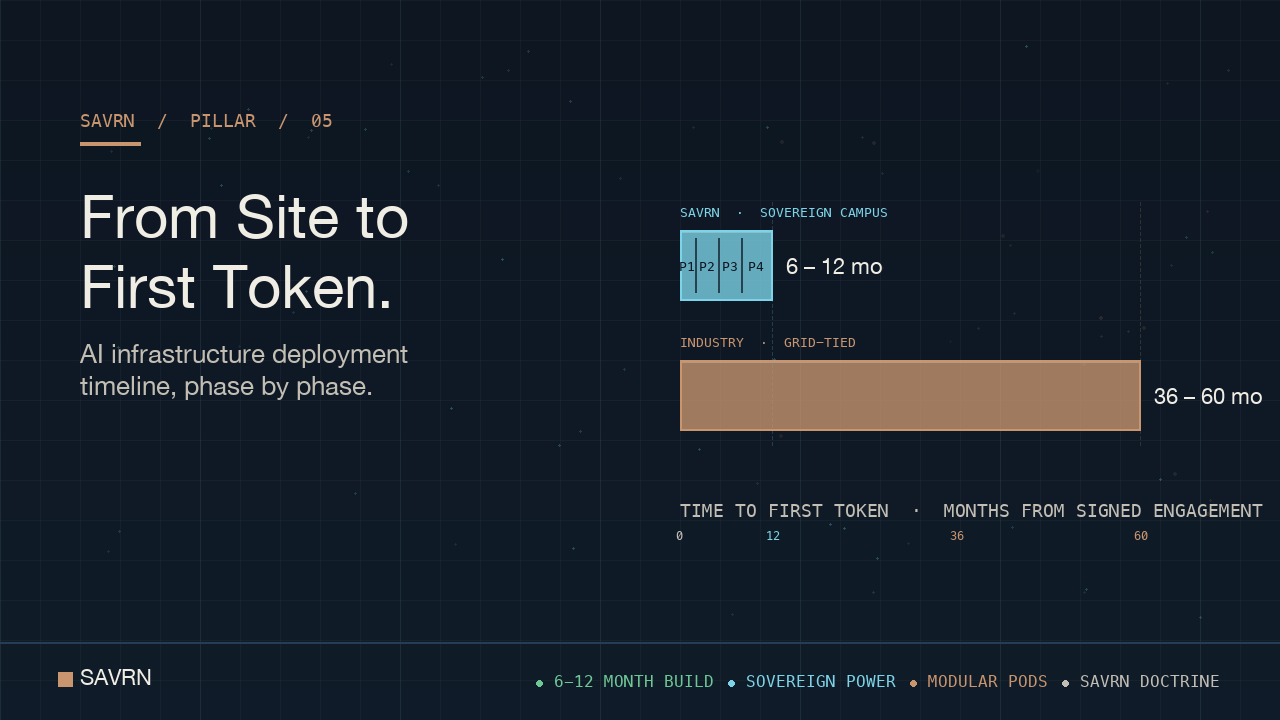
SAVRN’s sovereign campus model delivers first token in 6 to 12 months from site finalization. Not because we move faster than physics. Because we removed the three constraints that move the industry slowly: grid interconnection, stick-built construction, and serial permitting. This guide is the phase-by-phase, week-by-week breakdown of what happens between a signed engagement and a rack producing tokens. Read it as an operator’s procurement spec, not a marketing claim.
Why the AI Infrastructure Deployment Timeline Takes 24 to 48 Months
Three blockers, in order of severity. Each one is structural to the way hyperscale infrastructure was built for the cloud era — and each one is now incompatible with AI’s compute timeline.
Blocker 1: Grid Interconnection Stalls the AI Infrastructure Deployment Timeline
The single largest delay in modern data center construction is the queue to connect to the grid. As of 2026, the U.S. interconnection backlog stands at approximately 2,600 gigawatts of waiting projects — nearly double the installed generation on the grid today, per RMI’s analysis. The average time from interconnection request to commercial operation has stretched from under two years in 2008 to nearly five years today. System impact studies alone now run 12 to 24 months.
Hyperscalers signing power purchase agreements today are accepting deliveries in 2029, 2030, or later. The release cycle for frontier models is 12 to 18 months. The arithmetic of AI competitiveness — measured in tokens per watt per dollar over a five-year window — does not survive a five-year wait for the watts.
Blocker 2: Stick-Built Construction Drags the AI Infrastructure Deployment Timeline
Hyperscale data centers are still built the way warehouses were built in 1995: pour the foundation, raise the steel, install MEP, commission systems, run cable, accept the rack. Every trade waits on the prior trade. Weather delays the foundation. Foundation delays the steel. Steel delays roofing. Roofing delays interior fit-out. The critical path is serial, and the critical path is on-site.
The result is a construction window of 18 to 36 months for the building shell alone, before compute or power even arrives. The industry has known this is the bottleneck for a decade. The fix — modular prefabrication of cooling, power, and compute pods in a factory while site work runs in parallel — has finally hit production scale. IEEE Spectrum reports modular data center modules now install in 2 to 3 weeks, against 15 weeks for the equivalent stick-built work. Industry analysts cite total deployment timelines compressing from 2 to 3 years down to roughly 6 months when every component is modularized.
Blocker 3: Serial Permitting Stretches the AI Infrastructure Deployment Timeline
Permitting is rarely cited as a multi-year delay because each individual permit feels small. The aggregate is what kills the schedule. A grid-tied hyperscale campus typically requires: utility interconnection studies, transmission upgrades, substation siting, regional transmission operator approval, state utility commission review, county zoning, conditional use permit, building permits, fire marshal review, environmental impact assessment, water permits if evaporative cooling is used, air permits if backup generation is large enough, and operator licensing. Each runs in series, and many depend on the prior step’s approval.
The total is 18 to 30 months of permit work for a project that has already secured land and capital. Most of that time is the utility-side permits — the substation, the transmission upgrade, the resource-adequacy review. Sovereign on-site generation collapses that branch entirely.
How SAVRN Compresses the AI Infrastructure Deployment Timeline
The 6-to-12-month claim is the engineering consequence of three architectural decisions made before the first site is selected. Each one removes a category of delay rather than accelerating work inside it.
Sovereign On-Site Power: First Cut to the AI Infrastructure Deployment Timeline
The interconnection queue is irrelevant when the campus generates its own electrons. SAVRN’s power architecture places generation behind the meter — combined-cycle natural gas, reciprocating gas engines, solar plus storage, geothermal, or distributed renewable mixes depending on geography. Behind-the-meter generation typically clears state and county air permits in 90 to 180 days. The regional transmission operator never enters the conversation. The substation upgrade schedule never enters the conversation. The five-year median wait collapses to the time required to commission a generation asset SAVRN owns.
The economic consequence is sharper than most buyers expect. Combined-cycle natural gas at the campus level delivers electrons at lower cost per MWh than retail rates in many high-cost U.S. markets. The sovereign architecture does not pay a premium for speed — it captures a structural cost advantage that grid-dependent operators cannot.
Modular Prefabricated Pods Compress the AI Infrastructure Deployment Timeline
SAVRN does not build the cooling system, the power distribution, or the compute racks on site. They are factory-built and shipped pre-commissioned. Single-phase immersion tanks arrive plumbed and pressure-tested. Power distribution skids arrive switchgear-installed and load-tested. Compute pods — including the rack, the immersion fluid, the cooling distribution unit, and the network spine — arrive ready to connect.
The on-site work shrinks to foundations, electrical interconnect to the generation asset, fluid line tie-ins, and network backhaul. A pod that would take 15 weeks to build stick-style installs in 2 to 3 weeks because most of the build already happened in a controlled factory environment. The factory work runs in parallel with site work, not after it.
Pre-Vetted Sites Front-Load the AI Infrastructure Deployment Timeline
SAVRN does not start the timeline at site search. By the time a buyer engages, SAVRN already has active developments that have cleared the five evaluation criteria — land, power, water, fiber, zoning — and have been pre-screened against industrial-friendly jurisdictions with predictable permitting posture. SAVRN currently has developments underway in California, Texas, Colorado, Nebraska, Panama, and Barbados, each pre-vetted at a depth that consumes 9 to 18 months when started from scratch. Buyers select from a portfolio rather than wait for one to be assembled.
For buyers bringing their own land, the SAVRN site assessment process compresses pre-vetting into 2 to 4 weeks because the criteria, the sourcing relationships, and the permitting frameworks are already standardized.
The Phase-by-Phase AI Infrastructure Deployment Timeline
What follows is the operator’s view of the AI infrastructure deployment timeline — the 6-to-12-month window from signed engagement to first token. The lower end of the range applies to a 20 to 50 MW first module on a SAVRN-portfolio site. The upper end applies to a buyer-supplied site with non-standard power or zoning conditions. Multi-module 200+ MW campuses extend the timeline only on the modules added beyond the first; the first module’s schedule is the same.
Phase 1 — Weeks 1 to 8: Site Finalization and Pre-Application
The first eight weeks lock the site, the power architecture, and the permit posture. Three workstreams run in parallel.
- Site finalization (weeks 1–4). Land control documents, fiber path verification, water rights confirmation, and geotechnical survey. For SAVRN-portfolio sites, this is a paperwork exercise. For buyer-supplied sites, the infrastructure assessment escalates from screen to site visit to engineering survey.
- Power architecture lock (weeks 2–6). Generation technology selection — gas, solar plus storage, geothermal, or hybrid — sized to the buyer’s load profile and the site’s fuel resource. Generation contractor selection. Long-lead equipment ordering: turbines, reciprocating engines, switchgear, transformers.
- Permit pre-application (weeks 4–8). County zoning confirmation, conditional-use permit pre-application meetings, state air permit pre-filing, environmental review scoping. The on-site generation is the long pole; immersion-cooled compute requires no water permits and minimal air permits.
By week 8, the site is locked, generation is on order, foundation engineering is complete, and the permit applications are filed. The factory build of cooling and compute pods begins in week 6.
Phase 2 — Weeks 9 to 20: Foundation and Power Deployment
Phase 2 is the on-site civil work, executed in parallel with factory pod fabrication. The defining feature is that nothing on site has to wait for the grid.
- Foundations (weeks 9–14). Pad pours for the generation block, the cooling skids, the compute hall, and the network meet-me-room. Foundations are sized for modular pod loads, not the column-and-roof loads of a stick-built hall, which simplifies the structural engineering.
- Generation installation (weeks 12–20). Turbines, reciprocating engines, or solar-plus-storage installed and commissioned. Fuel infrastructure tie-ins where applicable — gas service is the typical long-lead utility item, and the engagement model with the local utility is a fuel supply contract, not an interconnection study.
- Medium-voltage distribution (weeks 14–20). Switchgear, transformers, and distribution to the compute hall positions. Pre-engineered modular switchgear cuts traditional substation construction from 12 months to 6 to 8 weeks.
- Cooling fluid systems (weeks 16–20). Heat-rejection skids, fluid distribution piping, and the closed-loop water makeup system installed at the pad. The closed-loop architecture is documented in the water mirage analysis — the practical effect is that the entire campus needs less than 1% of the water an evaporative-cooled facility would consume.
By week 20, the campus has on-site power, distribution to the rack positions, and the cooling backbone. The compute pods are arriving from the factory.
Phase 3 — Weeks 21 to 32: Compute Installation and Commissioning
Phase 3 is the highest-velocity phase. Pre-commissioned pods arrive on flatbed and install in days, not weeks. The work is connect, test, integrate.
- Pod installation (weeks 21–26). Compute pods staged, lowered onto pads, electrical and fluid tie-ins completed. A 10 MW pod typically lands and connects in 5 to 7 days. Multiple pods install in parallel.
- Rack-level commissioning (weeks 23–28). Each pod’s NVIDIA rack-scale AI system undergoes power-on, fluid-fill, leak-test, and burn-in. NVIDIA’s reference architecture and the modular pod design align so that rack commissioning is the same procedure regardless of campus generation.
- Network buildout (weeks 24–30). InfiniBand or high-radix Ethernet fabric installed, including spine switches, pod-level top-of-rack, and the meet-me-room handoff to fiber backhaul. Optical patching to the carrier handoff completes by week 28 in most deployments.
- Storage and data path (weeks 26–32). On-campus storage installed and integrated. For sovereign and air-gap workloads, the data path is verified against isolation requirements before any production traffic.
By week 32, the campus has compute, fabric, storage, and a tested power-and-cooling envelope. What remains is integration, security, and acceptance testing.
Phase 4 — Weeks 33 to 48: Integration, Security, and First Token
Phase 4 is the soft commissioning. The hardware works. The systems integration, the security architecture, and the operational hand-off determine when production tokens flow.
- Systems integration (weeks 33–38). Orchestration layer — Kubernetes or the buyer’s preferred AI platform — installed, configured, and integrated against the buyer’s identity, observability, and CI/CD systems. Model-weight ingestion paths verified.
- Security architecture (weeks 35–42). Perimeter physical security, badging, surveillance, and cleared-personnel onboarding for sovereign and defense workloads. Network isolation verified against the buyer’s compliance regime — for defense buyers, this is the IL5/IL6 readiness pass; for regulated enterprise, the SOC 2 / HIPAA / PCI alignment.
- Acceptance testing (weeks 40–46). Sustained-load tests at full pod density, thermal envelope verification, fault-injection tests on power and cooling, fail-over confirmation. The acceptance test is the buyer’s signal to begin production load.
- First token (weeks 44–48). Production AI workload begins. For most buyers, the first production training run lands inside the 12-month window from signed engagement; for buyers on SAVRN-portfolio sites with standard power architectures, the first token lands closer to month 6.
The 6-to-12-month range captures the realistic spread between best-case and complex-case engagements. SAVRN does not promise a uniform timeline; we publish a schedule that buyers can audit phase by phase.
What This Beats: A Side-by-Side
The AI infrastructure deployment timeline only matters in comparison to the alternatives. Three deployment models, normalized to first-token-from-signed-engagement.
- Hyperscale grid-tied campus. 36 to 60 months. Five-year median interconnection wait plus 18 to 24 months of stick-built construction plus 6 to 12 months of commissioning. The buyer pays cash to a developer and waits for the substation.
- Cloud GPU rental. Days to weeks for capacity allocation, but no sovereignty, no hardware control, exposure to vendor roadmap, and a cost-per-token that loses to owned infrastructure at sustained utilization. Cloud is fast and not equivalent.
- Colocation. 12 to 24 months for new colo halls; immediate for available capacity. Sovereign requirements unmet for most regulated and defense workloads. Power density caps below AI rack requirements at most operators.
- SAVRN sovereign campus. 6 to 12 months. Owned hardware, owned power, owned site. Cost per token competitive with cloud at moderate utilization and decisively better at high utilization.
The buyer who needs a thousand H100-equivalents next quarter rents from a hyperscaler. The buyer who needs sustained AI capacity through 2030, with sovereignty, hardware control, and a cost structure that survives the next three GPU generations, builds a sovereign campus. The 6-to-12-month timeline is what makes the second option actually viable for buyers planning on AI’s actual timeline.
What Buyers Need Ready to Start
The AI infrastructure deployment timeline depends on a prepared buyer. The engagement does not start at site evaluation; it starts with a buyer who has clarity on five questions. The buyer who can answer them in writing on day one runs against the 6-month case. The buyer who needs to discover the answers during engagement runs longer.
- Capacity target. Initial MW, target MW at 36 months, and the workload mix — training, inference, fine-tuning, reasoning, agentic — that the capacity will serve.
- Sovereignty requirements. Air-gap, IL5/IL6, FedRAMP High, CMMC level, SOC 2, HIPAA, PCI, GDPR — whichever apply. The compliance regime drives security architecture, network isolation, and personnel posture.
- Geographic constraints. Latency to the buyer’s user base, jurisdictional requirements (U.S. soil, specific states, defense-relevant proximity), and any disaster-recovery geography spread.
- Land posture. Buyer-supplied land, SAVRN-portfolio site, or open. Buyer-supplied land routes through the SAVRN land evaluation criteria and the site assessment process.
- Capital structure. Capex on the buyer’s balance sheet, project finance, off-balance-sheet via SAVRN-financed capacity, or hybrid. The capital structure determines how the timeline maps to invoicing milestones.
Buyers without answers to all five do not need to wait — the SAVRN engagement includes a structured discovery phase that resolves them in the first 4 to 6 weeks. But buyers who arrive prepared compress weeks 1 through 8 by half and are running against the lower end of the timeline range from day one.
The Speed Argument Is the Sovereignty Argument
The 6-to-12-month AI infrastructure deployment timeline is not a marketing differentiator. It is the engineering consequence of the sovereign architecture. Off-grid generation collapses interconnection. Modular pods collapse construction. Pre-vetted sites collapse permitting. Each mechanism that produces speed is the same mechanism that produces sovereignty — the buyer owns the power, owns the hardware, and operates on land that does not depend on a regional utility’s resource adequacy assumption.
The 36-to-60-month industry timeline is not a problem of insufficient effort. It is what happens when an architecture designed for the cloud era — grid-tied, stick-built, hyperscale — is asked to deliver AI compute on AI’s clock. The buyer who insists on that architecture is choosing to wait. The buyer who chooses sovereignty gets the speed as a consequence.
Hyperscalers and NVIDIA Cloud Partners offer next-generation rack-scale capacity on rental terms — credible options for buyers willing to lease. None are sovereign campus deployments. Each is a tenancy on someone else’s infrastructure, on someone else’s roadmap, with someone else’s cost-per-token. The sovereign campus is the only model where the buyer controls all three.
Engage the SAVRN Team
If you are evaluating AI infrastructure on a horizon longer than 18 months and need a defensible AI infrastructure deployment timeline — with sovereignty, hardware control, and a cost structure that survives the next GPU generation — the SAVRN engagement starts with a structured assessment. For buyers with land, submit through the infrastructure assessment. For enterprise and defense buyers without land, the engagement begins with a SAVRN-portfolio site selection. Either path lands in the same 6-to-12-month window from signed engagement to first token.
The doctrine is the schedule. Own the power, own the compute, own the outcome. Read the doctrine for the full architecture, or the sovereign AI infrastructure pillar for the operator’s complete reference.
Frequently Asked Questions
How long does it actually take to build an AI data center?
The AI infrastructure deployment timeline for industry-standard hyperscale construction runs 36 to 60 months end-to-end, dominated by a 5-year median grid interconnection wait and 18-to-24-month stick-built construction. SAVRN’s sovereign campus model delivers first token in 6 to 12 months by replacing grid interconnection with on-site generation, stick-built construction with modular prefabricated pods, and serial site search with a pre-vetted site portfolio.
What is the longest pole in a SAVRN deployment timeline?
Generation equipment lead time drives the AI infrastructure deployment timeline. Combined-cycle gas turbines and reciprocating gas engines have 16-to-24-week order-to-delivery windows depending on manufacturer queue. SAVRN orders generation in week 2 of the engagement so that delivery aligns with foundation completion in week 14. Compute hardware on NVIDIA’s enterprise AI roadmap is a secondary lead-time risk and is sequenced against pod fabrication.
Does the timeline change for defense or air-gap workloads?
The hardware timeline is identical. The integration and security phase (Phase 4) extends by 2 to 6 weeks for IL5/IL6, CMMC, or air-gap operating modes because of personnel onboarding, network isolation verification, and compliance documentation requirements. Total engagement window for defense workloads is typically 9 to 14 months versus 6 to 12 for commercial enterprise.
Can SAVRN run faster than 6 months?
Yes, on a SAVRN-portfolio site with standard power architecture, prepared buyers, and modest first-module capacity (20 to 30 MW), first-token windows of 4 to 5 months are achievable. The 6-month figure is the conservative operator commitment for a typical engagement; the 12-month figure covers complex sites, non-standard generation mixes, or large first-module capacity.
How does SAVRN’s timeline compare to leasing from a hyperscaler?
Hyperscaler GPU rental allocates capacity in days to weeks, far faster than any new build. The trade-off is no sovereignty, no hardware ownership, no roadmap control, and a cost-per-token that loses to owned infrastructure at sustained utilization. The 6-to-12-month sovereign campus is the right comparison for buyers planning on a 5-year-or-longer horizon; cloud rental is the right answer for short-term capacity bridging.
How does SAVRN handle the NVIDIA hardware roadmap?
SAVRN’s pod architecture is designed to support NVIDIA’s enterprise AI factory roadmap without campus-level rework. Power and cooling envelopes are sized for the next-generation rack densities NVIDIA has telegraphed. Buyers signing in 2026 can elect current-generation hardware for near-term delivery, with successor platforms slotting into the same campus footprint as they become generally available through NVIDIA’s partner channel.
What is the smallest SAVRN deployment?
A 20 MW first module, single pod, on a buyer-supplied or SAVRN-portfolio site. This typically lands in the lower half of the 6-to-12-month window because long-lead generation equipment is smaller-frame and faster to deliver. Multi-module 200 MW+ campuses use the same first-module timeline; subsequent modules add capacity on a parallelized schedule.
How does the 6-to-12-month timeline survive permitting variability across states?
SAVRN’s active developments are concentrated in jurisdictions with industrial-friendly permitting posture — California, Texas, Colorado, Nebraska, Panama, and Barbados — where conditional-use permits and air permits for behind-the-meter generation typically clear in 90 to 180 days. Buyers requiring deployment in jurisdictions with longer permit timelines move toward the upper end of the range or shift to a SAVRN-portfolio site nearby.
Does modular construction limit campus performance?
No. Modular prefabricated pods now match or exceed stick-built hyperscale on every relevant metric: rack-level power and cooling sized for high-density AI workloads, reliability (factory commissioning produces fewer field defects than on-site assembly), and density per acre. The performance trade-off that existed a decade ago has been engineered out as modular suppliers reached production maturity.
What happens if the buyer’s site fails infrastructure assessment?
SAVRN provides a written disqualification report identifying the specific failure mode — flood zone, no fiber path within 5 miles, unworkable zoning, insufficient land area, or fuel resource gap — and offers the buyer two paths: re-engage with a different parcel from the buyer’s holdings, or move to a SAVRN-portfolio site. The infrastructure assessment runs in 48 hours for screen and 2 to 4 weeks for full evaluation. Disqualification at the screen stage costs the buyer no project time.
Sources & Citations
Every quantitative claim in this piece traces to a named, verified primary source. URLs verified at time of publication. The full audit-grade citation record, with claim-by-claim source mapping and “cite this article” snippets, is maintained on the dedicated SAVRN sources page for this piece.
Primary research cited in this ai infrastructure deployment timeline brief
- RMI — Interconnection reform for AI data centers and generator queues. RMI analysis of interconnection reform for AI data centers and generator queues — the canonical industry-policy framing of why interconnection wait times stretch deployment timelines.
- IEEE Spectrum — Modular Data Center reporting. IEEE Spectrum coverage of modular and prefabricated data center deployment — independent technical reporting on the build-speed advantage of modular pods over stick-built construction.
Supporting frameworks, regulators, and industry data
- LBNL — “Queued Up: 2024 Edition”. LBNL ‘Queued Up: 2024 Edition’ — median 5-year interconnection wait for U.S. projects built in 2023 quantifies the wait-state cost that the sovereign campus model is designed to eliminate.