Benefits of Immersion Cooling for AI Workloads in 2026
Immersion cooling reaches a partial PUE of 1.02 to 1.03, cuts fan power 10 to 11 percent, and runs water-free with dry coolers, but NVIDIA's rack-scale GPUs ship direct-to-chip, not immersion.
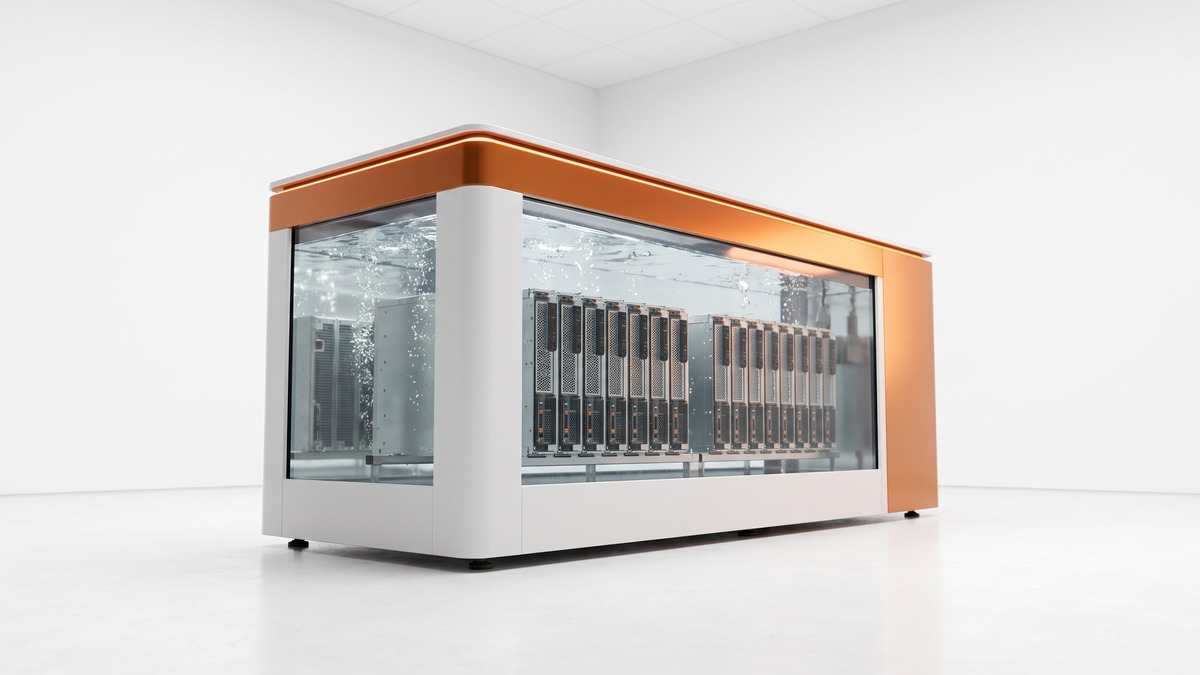
The benefits of immersion cooling for AI workloads are measurable: partial PUE of 1.02 to 1.03 in shipping single-phase systems, a 10 to 11 percent reduction in server power from fan removal, zero evaporative water use when paired with dry coolers, and 100 to 360 kW of heat rejection per tank. Notably, the constraint is equally measurable: NVIDIA’s GB200 NVL72, GB300 NVL72, and Vera Rubin NVL72 racks are direct-to-chip reference designs, and no NVIDIA rack-scale system ships as an immersion design. Specifically, this article quantifies both sides and states which cooling architecture is standard practice at each rack density in 2026.
Why cooling is now the gating constraint for GPU density
Uptime Institute’s 2025 survey reports a weighted-average PUE of 1.54, the sixth consecutive year the figure has virtually stood still, with most operators adopting racks in the 10 to 30 kW range and few exceeding 30 kW ([1]; [2]).
AI racks sit far outside that band. In particular, NVIDIA states that hyperscale AI racks now exceed 135 kW compared with roughly 20 kW for a traditional rack, and that cooling has historically consumed up to 40 percent of data center electricity ([3]). For example, a single DGX GB200 NVL72 rack draws about 120 kW, weighs roughly 1.36 metric tons, and packs 18 1U compute nodes at 5.4 to 5.7 kW each ([4]).
Google’s OCP EMEA presentation states that machine learning will require more than 500 kW per IT rack before 2030 and describes a ±400 VDC architecture for 1 MW racks ([5]). NVIDIA’s Rubin Ultra NVL576 “Kyber” rack is expected to draw about 600 kW when it ships in the second half of 2027 ([6]). Importantly, air cannot carry that heat: water moves roughly 4,000 times more heat per unit volume than air for the same temperature change ([5]).
What immersion cooling is, and the two ways it is done
Immersion cooling submerges the entire server in a non-conductive dielectric fluid. As a result, the fluid contacts every component, so server fans are removed or disabled, and heat leaves the tank through a coolant distribution unit and a liquid-to-liquid heat exchanger to a facility water loop ([7]).
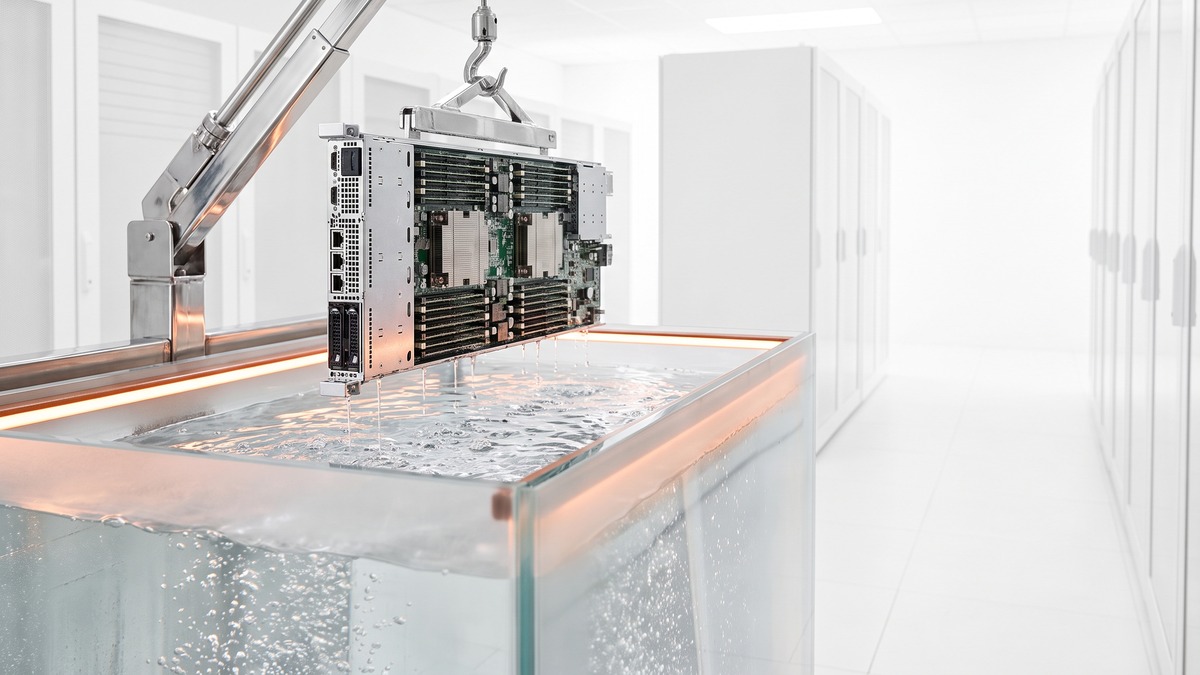
Single-phase immersion uses a hydrocarbon or synthetic fluid that stays liquid; pumps circulate it past the electronics and through the heat exchanger. By contrast, two-phase immersion uses a fluorinated fluid with a low boiling point, typically around 50°C, which boils on hot components; the vapor condenses on coils at the top of a sealed tank and drips back ([8]; [9]).
OCP’s immersion design guidelines list volumetric specific heat of roughly 4,182 J/L·K for water, 1,855 J/L·K for hydrocarbon fluids, 1,831 J/L·K for fluorocarbons, and 1.3 J/L·K for air ([10]). In addition, dielectric fluids carry over 1,400 times more heat per liter than air but less than half as much as water, which is why water-glycol cold plates reach higher heat flux than a bath.
The benefits of immersion cooling for AI workloads, quantified
Partial PUE of 1.02 to 1.03 in production systems
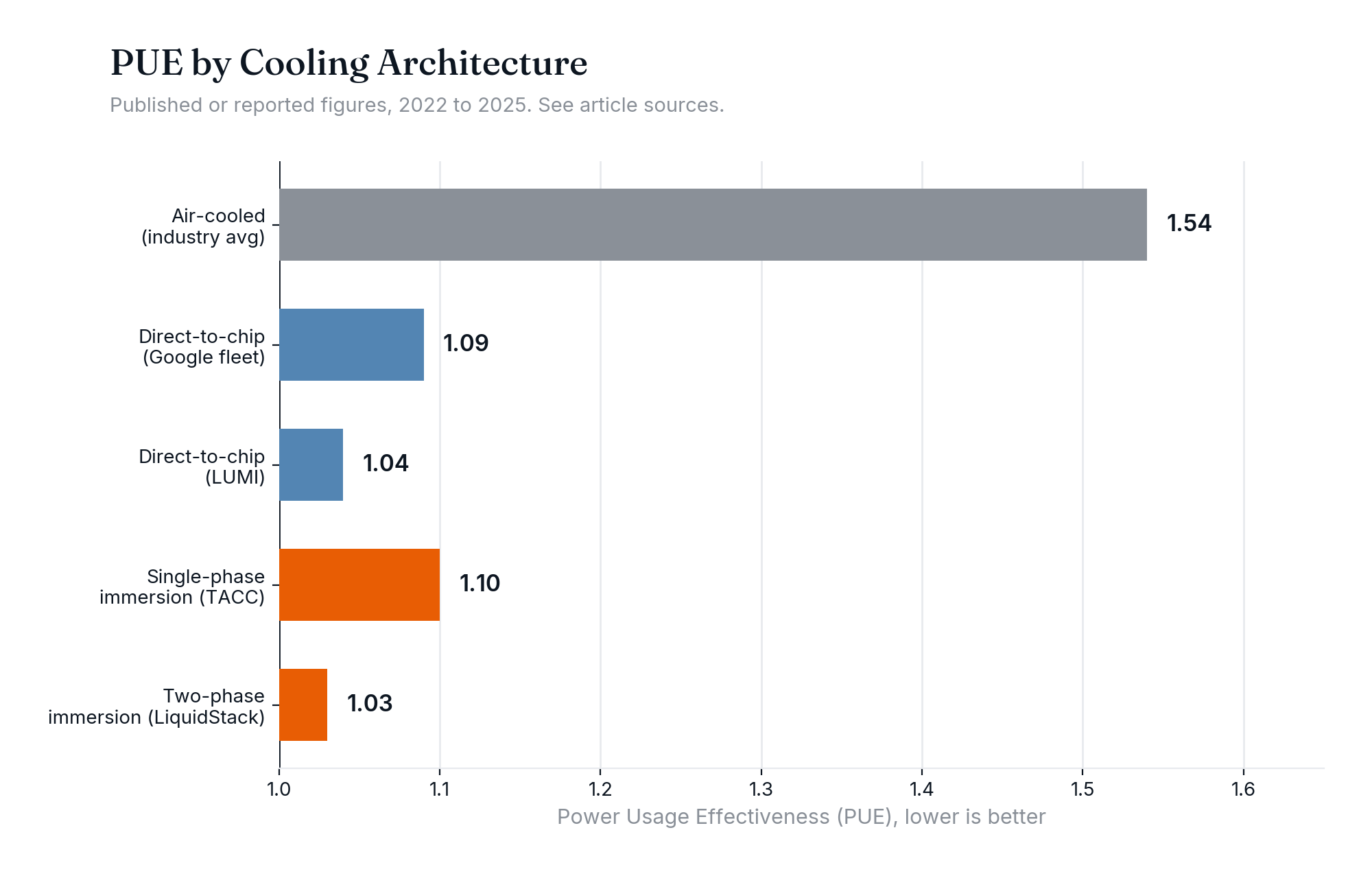
GRC’s ICEraQ Series 10 datasheet specifies a partial PUE below 1.03, 200 kW of capacity per system with 32°C chiller-free water, and 368 kW with 13°C water ([11]). For instance, at the Texas Advanced Computing Center, the Lonestar6 immersion deployment ran 280 kW across four tanks at 70 kW per rack with a 2 percent cooling overhead, for a pPUE of 1.02 ([12]).
LiquidStack’s two-phase DataTank 48U is rated for up to 252 kW with a pPUE of 1.02 to 1.03 and zero IT fan power ([13]). Similarly, Submer’s SmartPod platform lists a mechanical PUE of 1.015 with CDU power of 750 W per 50 kW tank ([7]). Notably, Alibaba’s large-scale immersion deployment reported a stabilized PUE of about 1.07 against 1.5 for its air-cooled facilities ([14]).
Facility-level numbers are higher because pPUE excludes distribution losses and the heat-rejection plant. Specifically, GRC’s TACC case study reports a facility PUE of about 1.1 for Lonestar6 ([15]). Firmus reports a facility PUE of 1.10 for its immersion-cooled H100 cloud and a design PUE below 1.05 for its 300 kW Cube300 containers ([16]; [17]).
Fan power eliminated: 10 to 11 percent of server power
Fan removal is the benefit that lands inside the IT load, where PUE does not count it. In particular, GRC’s datasheet states an industry-average 11 percent reduction in server power draw from fan removal, and the TACC deployment measured a 10 percent reduction ([11]; [12]). For example, microsoft’s two-phase pilot at Quincy, Washington reported a 5 to 15 percent server power reduction ([8]).
For GPU servers the effect is larger. Firmus measured an immersed H100 HGX system at 6.58 kW against 9 to 11 kW for the same platform air-cooled, a roughly 30 percent server-level saving, in its June 2024 MLPerf power submission ([16]). Importantly, that figure is vendor-published and includes power capping, not an independent audit.
Water: immersion is compatible with zero evaporative water, but so is direct-to-chip
Immersion tanks reject heat to a closed facility water loop; whether the site consumes water depends on what sits on the roof. As a result, GRC and Submer both specify chiller-free operation with inlet water up to 32°C, which lets a dry cooler do the job in most climates without evaporation ([11]; [7]). By contrast, Submer’s EXO tank accepts hot water up to 60°C ([18]).
US data centers directly consumed about 66 billion liters of water in 2023 at a site WUE of just over 0.36 L/kWh, and LBNL projects hyperscale direct water use of 60 to 124 billion liters in 2028 ([19]). In addition, NVIDIA states that evaporative cooling consumes millions of gallons of water per megawatt annually ([3]).
Immersion does not hold this advantage alone. Microsoft’s zero-water-for-cooling design, standard for all new sites since August 2024, uses chip-level liquid cooling in a closed loop and avoids more than 125 million liters per year per data center ([20]). For instance, the lever is warm-water liquid cooling plus dry coolers, and both immersion and direct-to-chip pull it.
Density per tank
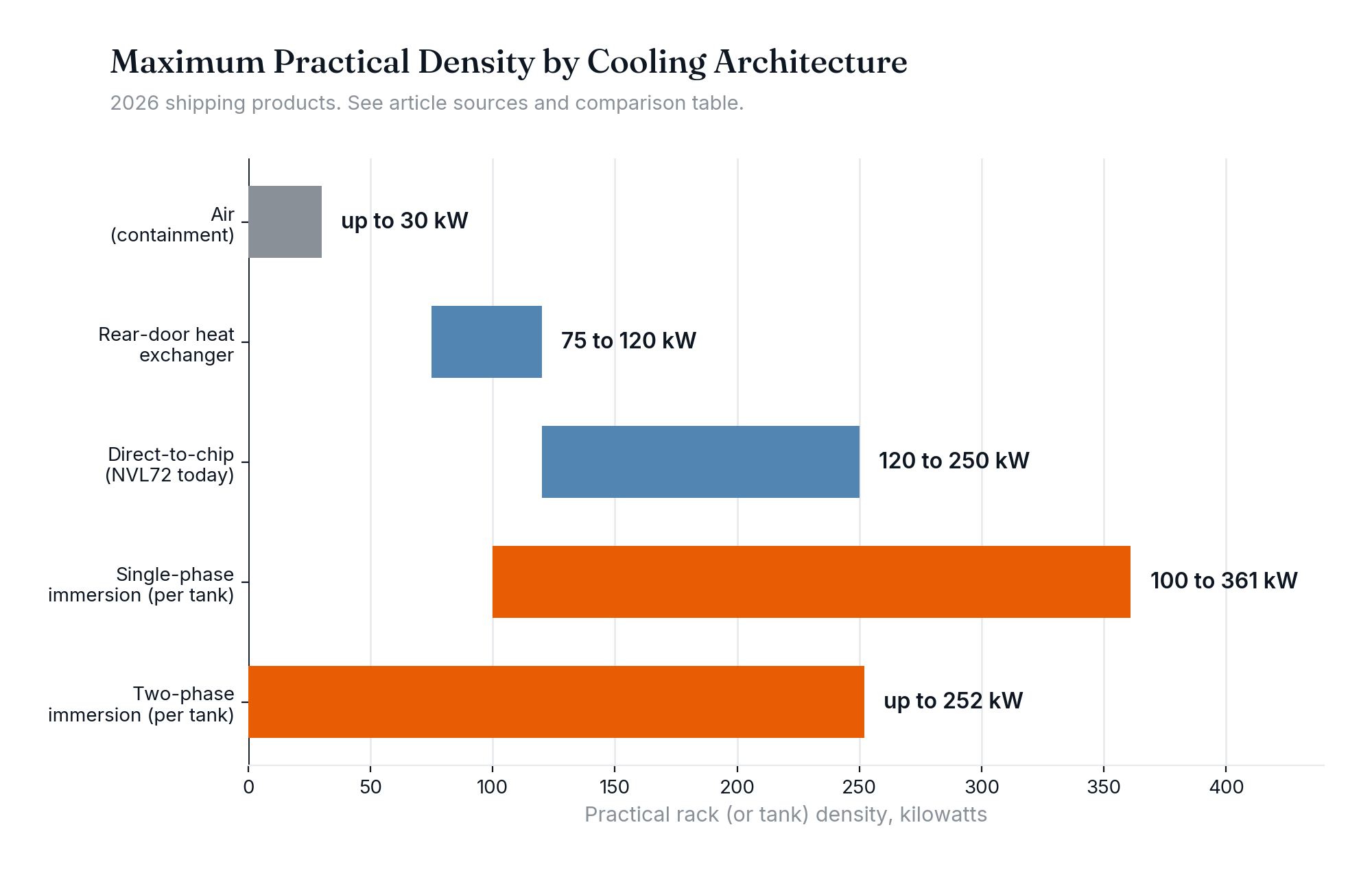
Shipping single-phase tanks are rated at 100 kW per rack-equivalent for GRC’s ICEraQ SX, 140 kW and up for Submer’s EVO, over 110 kW with ASHRAE W3 water for LiquidStack’s single-phase system, and up to 361 kW for Submer’s EXO with 50 RU of capacity ([21]; [22]; [23]; [18]). Similarly, Vertiv’s CoolCenter Immersion, launched in EMEA in November 2025, spans 25 to 240 kW ([24]).
A tank is not a rack. Notably, LiquidStack’s single-phase tank occupies the footprint of four standard racks, so density per square meter is lower than the per-tank kW suggests ([23]).
Hardware reliability: one sourced figure
Vendors routinely claim lower failure rates; almost none publish data. Specifically, the one large operator figure comes from Alibaba, which reported a 50 percent lower failure rate for hard disk drives in its immersion-cooled storage compared with air cooling ([14]). In particular, iceotope’s chassis-level immersion trial with Meta held a 72-drive JBOD to a 3°C temperature spread at 40°C inlet water with cooling power below 5 percent of IT power ([25]). For example, no published, controlled GPU failure-rate comparison between immersion and direct-to-chip exists as of September 2026.
Immersion cooling benefits and challenges: the constraints operators actually hit
NVIDIA’s rack-scale systems are direct-to-chip designs
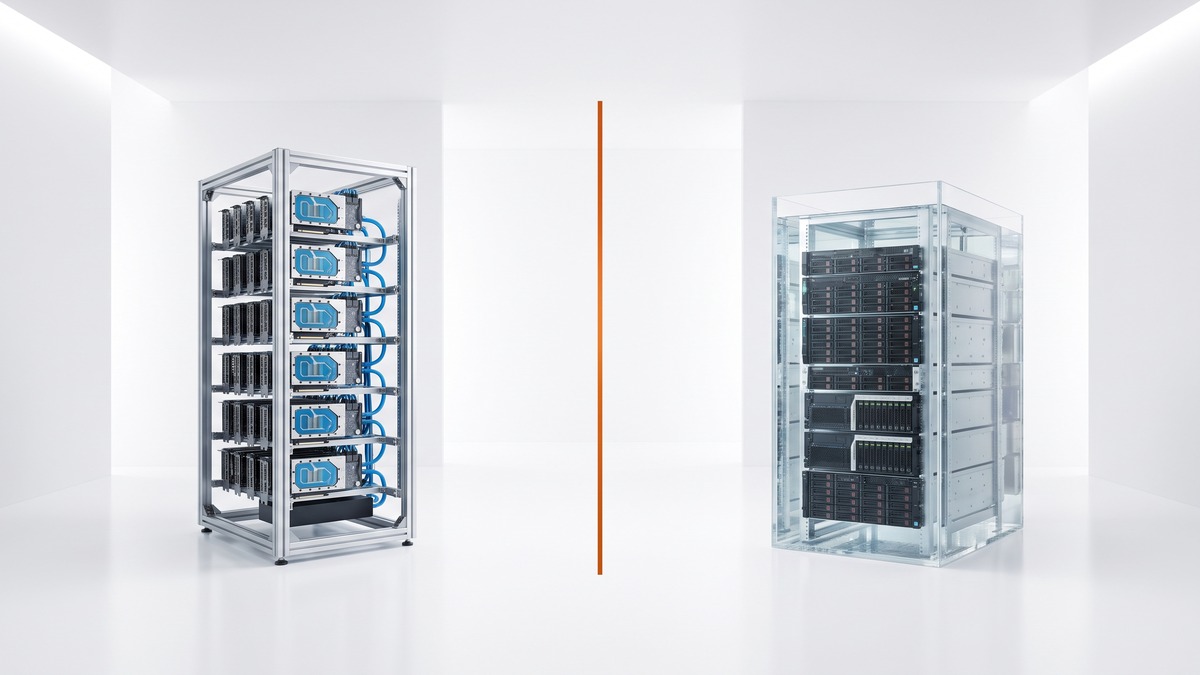
GB200 NVL72 is a liquid-cooled rack-scale system connecting 36 Grace CPUs and 72 Blackwell GPUs, and GB300 NVL72 is fully liquid-cooled ([26]). Importantly, the liquid is water-glycol on cold plates. The DGX GB200 NVL72 takes 25°C coolant at about 2 liters per second with a 20°C rise, while NICs and storage remain air-cooled by 40 mm fans ([4]).
NVIDIA’s Vera Rubin NVL72 MGX compute tray is 100 percent liquid-cooled and designed for 45°C liquid, with a liquid-cooled busbar and 800 VDC power; the same MGX rack footprint carries GB300 NVL72 and Vera Rubin NVL72, and Kyber is designed for 576 Rubin Ultra GPUs by 2027 ([27]). As a result, the ecosystem reference designs are direct-to-chip as well: Vertiv’s 7 MW GB200 NVL72 blueprint supports up to 132 kW per rack with XDU coolant distribution units, and CoolIT’s CHx2000 CDU serves 12 GB300 NVL72 racks at 2 MW ([28]; [29]).
Immersing an NVL72 rack is not a supported configuration. By contrast, immersion for NVIDIA GPUs in 2026 means HGX-form-factor servers rebuilt for tanks, such as the Dell XE9680-IR with eight 700 W H100 or H200 SXM5 GPUs, or Hypertec’s TRIDENT servers ([21]; [30]). In addition, SAVRN’s comparison of direct-to-chip and immersion covers the architectural split in more depth.
Warranty and support posture
OCP’s warranty guidelines state that coolants should be specified as compatible by the IT equipment manufacturer before testing so the warranty remains intact, that typical hardware warranties run 1 to 7 years, and that long-term public information on immersion product viability is “extraordinarily limited” ([31]).
Where explicit coverage exists, it is narrow and named. For instance, Intel introduced an immersion warranty rider for Xeon processors in 2022 and now certifies specific fluid-tank-server combinations for 4th and 5th Gen Xeon, including Shell fluids in Submer tanks with Supermicro servers, and ExxonMobil fluids in Baltimore Aircoil tanks with Hypertec servers ([32]; [33]; [34]). Dell has provided warranty coverage for Dell servers in GRC immersion systems under an OEM agreement since 2020 ([35]).
NVIDIA publishes no equivalent immersion warranty rider for data center GPUs, and its public liquid-cooling statements describe direct-to-chip cold plates, CDUs, and warm-water loops ([3]). Similarly, operators immersing GPUs rely on the server OEM or integrator to carry the warranty.
3M’s PFAS exit and the two-phase market
3M announced in December 2022 that it would exit all PFAS manufacturing, including the fluorinated fluids sold as Novec and Fluorinert, by the end of 2025; the business represented about $1.3 billion in annual sales ([36]). Notably, the exit completed on schedule at the end of 2025 ([37]).
Two-phase immersion depended on those fluids. LiquidStack, ZutaCore, and Wiwynn referenced Novec, while single-phase vendors such as GRC, Submer, and Iceotope were unaffected ([38]). Specifically, replacements such as Halocarbon’s HFMOP, boiling at 50°C, remain fluorinated chemistries, and Halocarbon estimates Novec held about 80 percent of the two-phase market ([39]). In particular, Asperitas rates the regulatory risk of two-phase fluids as high and single-phase hydrocarbons as low ([9]). For example, LiquidStack launched a single-phase product in November 2023 ([23]).
Fluid cost, tank weight, and floor loading
Shell Immersion Cooling Fluid S5 X lists at $3,365.72 per 208-liter drum from a US distributor as of August 2025, about $16 per liter or $61 per gallon ([40]). Importantly, a Submer SmartPodXL holds 1,186 liters of coolant, so filling one 50 kW tank at that list price is roughly $19,000 in fluid, or about $380 per kW before IT displacement is credited ([7]). As a result, fluid life offsets this: Hypertec lists a 15-year coolant life for single-phase against 2 years for two-phase ([30]).
Weight follows volume. By contrast, the SmartPodXL weighs 671 kg empty and 1,691 kg full before servers; the SmartPodX weighs 411 kg empty and 872 kg full ([7]). In addition, LiquidStack’s 48U two-phase DataTank weighs 2,500 kg ([13]). For instance, GRC specifies a floor loading of 822 kg/m², or 168 lb/ft², excluding IT equipment ([11]). Similarly, Castrol notes that immersion baths impose greater structural floor loading than air-cooled racks ([41]), which is why immersion retrofits gravitate to slab-on-grade halls.
Serviceability, optics, and material compatibility
Servicing a tank means lifting a wet server on a hoist and letting it drain. Notably, Submer specifies 2N pump and CDU redundancy so a tank keeps running during service ([18]). Specifically, Alibaba reports about 30 minutes of thermal inertia in a bath if cooling is lost, roughly 1,000 times that of air ([14]).
Optics are the sharpest compatibility problem for AI clusters. In particular, when an optical transceiver is immersed, fluid replaces the air gap between fiber ferrules and the changed refractive index causes reflection loss; OCP’s guidance is to use direct-attach copper, sealed transceivers, or port extenders that keep optics above the fluid line ([10]). For example, the same document warns that thermal pastes can dissolve and should be replaced with indium foil, that cable plasticizers leach into the fluid, that heat-shrink degrades above 60°C, and that spinning drives must be helium-sealed. NVIDIA’s NVL72 uses copper NVLink cabling partly because optics would add about 20 kW per rack, so the optics budget is already tight before immersion enters ([4]).
How do data centers cool 100kW+ AI racks without going full immersion?
The 2026 answer is direct-to-chip liquid cooling fed by coolant distribution units, with room air or a rear-door heat exchanger handling the residual heat. Importantly, Supermicro’s DLC-2 racks capture up to 98 percent of system heat on cold plates covering CPUs, GPUs, PCIe switches, DIMMs, VRMs, and power supplies, support up to 250 kW per rack, and run 45°C warm water to eliminate chillers ([42]).
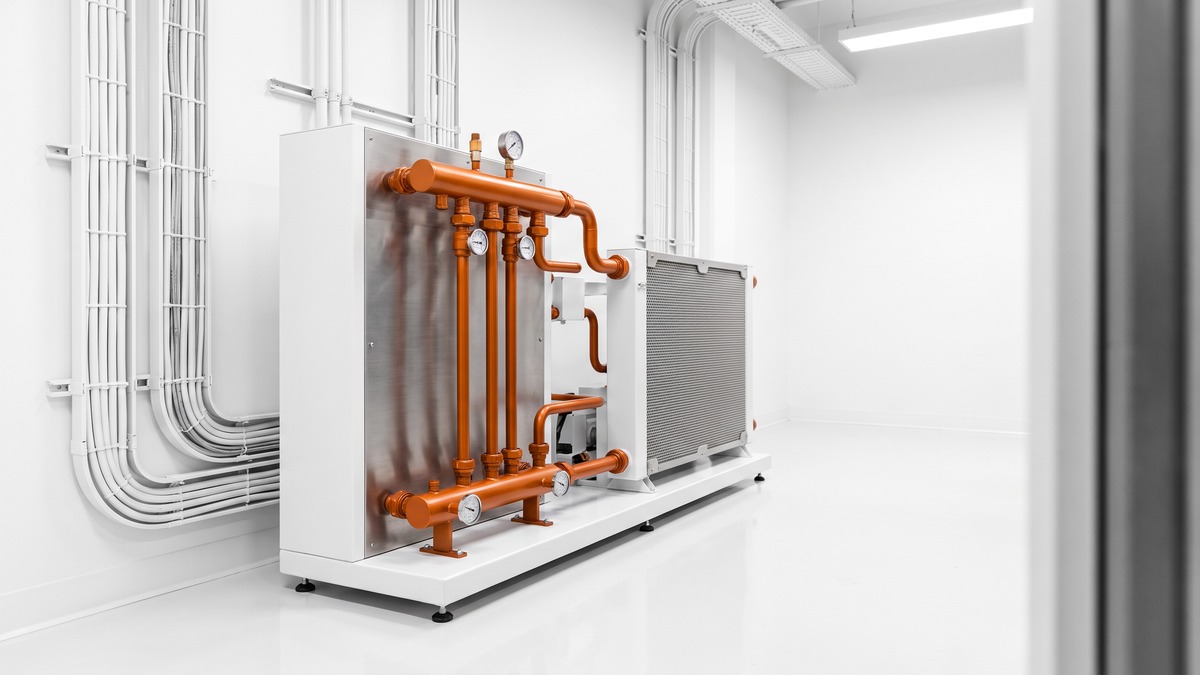
Motivair’s MCDU-70, announced in January 2026, delivers 2.5 MW at 1.5 liters per minute per kW ([43]); Schneider Electric closed its 75 percent acquisition of Motivair in February 2025 at a Reuters-reported value of about $850 million ([44]; [45]). Google has run direct-to-chip cooling across more than 2,000 TPU pods over seven years at roughly 99.999 percent CDU availability since 2020 ([5]).
Motivair’s ChilledDoor rear-door heat exchanger is rated to 75 kW per rack and Supermicro’s RDHx to 120 kW, both neutralizing server exhaust with facility water without touching the server ([46]; [42]). As a result, aSHRAE’s liquid-cooling classes now embed the facility water upper limit in the class name, W17 through W45 and W+, replacing the old W1 through W5 scheme whose upper limits were 17, 27, 32, 45, and above 45°C ([47]; [48]).
Cooling architecture comparison
Table 1 Cooling architecture comparison, 2026
Air (containment, CRAH)
Max practical rack kW (2026)About 30 kW; few racks exceed this ([1])
Typical pPUE or PUEIndustry average PUE 1.54 ([1])
Water useHigh with evaporative towers; US avg WUE 0.36 L/kWh ([19])
Facility retrofit burdenNone
NVIDIA reference-design alignmentLegacy only; NVL72 is liquid-cooled ([26])
ServiceabilityStandard hot-swap
Fluid / consumable costNone
Rear-door heat exchanger
Max practical rack kW (2026)75 to 120 kW ([46]; [42])
Typical pPUE or PUEDepends on plant; no vendor pPUE published
Water useFacility loop; can be dry-cooled
Facility retrofit burdenWater to rack rear
NVIDIA reference-design alignmentResidual-heat role in DLC designs ([28])
ServiceabilityStandard; server untouched
Fluid / consumable costWater-glycol only
Direct-to-chip (cold plates + CDU)
Max practical rack kW (2026)120 to 132 kW for NVL72 today; 250 kW rack products; 600 kW Kyber in 2027 ([4]; [42]; [6])
Typical pPUE or PUELUMI PUE 1.04 ([49]); Google fleet TTM PUE 1.09 in 2025 ([50])
Water useZero evaporative with 45°C water and dry coolers ([20])
Facility retrofit burdenCDUs, manifolds, leak detection; standard racks and floors
NVIDIA reference-design alignmentNative: GB200, GB300, Vera Rubin NVL72 ([27])
ServiceabilityQuick-disconnects; 80 to 98 percent of heat in liquid, rest in air
Fluid / consumable costWater-glycol; cold plates per SKU
Single-phase immersion
Max practical rack kW (2026)100 to 361 kW per tank ([21]; [18])
Typical pPUE or PUEpPUE 1.02 to 1.03 ([12]); facility PUE about 1.1 ([15])
Water useZero evaporative with 32 to 60°C water and dry coolers ([18])
Facility retrofit burdenFloor loading 822 kg/m² excluding IT; hoists; fluid handling ([11])
NVIDIA reference-design alignmentNone for NVL72; HGX servers rebuilt for tanks ([21])
ServiceabilityHoist and drain; optics must stay above fluid ([10])
Fluid / consumable costAbout $16/L; 1,186 L per 50 kW tank ([40]; [7])
Two-phase immersion
Max practical rack kW (2026)Up to 252 kW per tank ([13])
Typical pPUE or PUEpPUE 1.02 to 1.03 ([13])
Water useZero evaporative with dry coolers ([8])
Facility retrofit burdenSealed tanks; 2,500 kg per tank; vapor management
NVIDIA reference-design alignmentNone
ServiceabilitySealed lid must be opened; vapor loss on service
Fluid / consumable costFluorinated fluid; 3M supply ended 2025 ([36])
What are the key differences between single-phase and two-phase immersion cooling for AI GPU clusters?
Single-phase moves heat by pumping a stable hydrocarbon past the components; two-phase moves heat by boiling a fluorinated fluid on the components and condensing the vapor. The second mechanism carries more heat per unit of fluid and needs no pump, which is why two-phase tanks reached 252 kW earlier than single-phase tanks ([13]). By contrast, the cost is a hermetically sealed tank, vapor loss on every service event, and a fluid supply chain that lost its dominant producer at the end of 2025.
Table 2 Single-phase versus two-phase immersion
Is immersion cooling actually practical for GPU clusters exceeding 100kW per rack, or are CDUs the better path?
Both paths are practical at 100 kW; only one is the reference design. For NVIDIA rack-scale systems, CDUs feeding cold plates are the only supported path, because the NVL72 rack arrives built for 25 to 45°C water ([4]; [27]). In addition, for HGX-class 8-GPU servers, immersion is a working alternative with server-OEM warranty coverage, and it captures the fan power that cold plates leave behind ([21]).
The framework below states standard practice by density band as of 2026; SAVRN’s review of liquid cooling for AI covers the plant-side choices behind each row.
Table 3 Standard practice by rack density band, 2026
Below 40 kW
Standard practice in 2026Air with hot-aisle containment; RDHx above about 25 kW
WhyUptime reports most racks at 10 to 30 kW and average PUE 1.54; RDHx reaches 75 to 120 kW without touching servers ([1]; [46])
Where immersion fitsRetrofit of legacy halls where floor loading allows; GRC states benefits from 15 kW per rack ([51])
40 to 130 kW
Standard practice in 2026Direct-to-chip with in-row or in-rack CDUs; RDHx or room air for residual heat
WhyGB200 NVL72 at 120 kW and Vertiv's 132 kW reference design define this band ([4]; [28])
Where immersion fitsHGX 8-GPU servers in single-phase tanks (GRC 100 kW, LiquidStack over 110 kW, Firmus H100 clusters) with OEM warranty ([21]; [23]; [16])
130 to 250 kW
Standard practice in 2026Direct-to-chip with 45°C water, up to 98 percent heat capture, MW-class CDUs
WhySupermicro DLC-2 supports 250 kW per rack; CoolIT and Motivair CDUs serve 2 to 2.5 MW per unit ([42]; [29]; [43])
Where immersion fitsTanks rated 240 to 361 kW exist (Vertiv CoolCenter, Submer EXO, LiquidStack two-phase), but no NVIDIA rack-scale SKU is qualified for them ([24]; [18])
250 kW and above (Kyber era)
Standard practice in 2026Direct-to-chip with 800 VDC power, liquid-cooled busbars, sidecar power racks
WhyKyber targets about 600 kW and 576 GPUs per rack in 2027; Google plans 1 MW racks ([6]; [27]; [5])
Where immersion fitsNot in any published reference design; tank volume and weight at 600 kW exceed shipping products
PUE 1.1 achievable: what does it actually take?
PUE 1.1 is achievable with any liquid architecture, and several operators publish it. For instance, LUMI in Finland runs at 1.04 on direct-to-chip cooling with heat sold to a district heating network ([49]). Similarly, google’s fleet trailing-twelve-month PUE was 1.09 through 2025 ([50]). TACC’s immersion deployment sits near 1.1, and Firmus reports 1.10 ([15]; [16]).
Three conditions recur at those sites. First, more than 80 percent of IT heat leaves in liquid, so CRAH fan energy collapses. Second, facility water runs warm enough, 32 to 45°C, that dry coolers or free cooling replace compressors for most hours ([11]; [27]). Third, electrical losses are minimized, which is where 800 VDC and eliminated 200 kg copper busbars enter the calculation ([27]).
PUE also misses the fan saving inside the servers: a site can hold 1.1 while immersion cuts IT load by 10 percent or more, which is why PUE alone is an incomplete metric for AI facilities. Notably, microsoft’s zero-water design is the mirror case, accepting a nominal PUE increase from mechanical cooling for a WUE near zero ([20]).
Water-free operation: immersion, direct-to-chip, and dry coolers
Neither immersion nor direct-to-chip consumes water by itself; the question is whether the facility loop terminates in an evaporative tower, a chiller, or a dry cooler. Specifically, dry coolers use no water but require IT equipment that tolerates warm water, which NVIDIA identifies as the condition for water-free AI factories ([3]).
GRC accepts inlet water from 5 to 32°C, Submer recommends inlet up to 32°C with a 37°C outlet, and Submer’s EXO handles up to 60°C ([11]; [7]; [18]). In particular, direct-to-chip has caught up: Vera Rubin NVL72 is designed for 45°C liquid, and Supermicro’s DLC-2 runs 45°C warm water with no chillers ([27]; [42]). LBNL’s modeling confirms the trade: air-cooled chillers and dry coolers use no water but more energy, while evaporative systems use less energy and more water ([19]).
The exception is hot climates. For example, a dry cooler cannot reject heat to 45°C ambient air with 45°C supply water, so W45 designs in Phoenix-class climates need trim chillers or adiabatic assist at peak hours, which reintroduces some water ([19]). Importantly, higher tank outlet temperatures widen the dry-cooler window, which is immersion’s remaining structural advantage on water.
How SAVRN builds for this
SAVRN’s Atom compute block is a factory-built, liquid-cooled unit designed around the direct-to-chip architecture that NVIDIA’s GB300 NVL72 and Vera Rubin NVL72 racks require, because that is the only path with a supported warranty and a published 45°C liquid specification ([27]). As a result, heat rejection is closed-loop to dry coolers, which is what makes the water-free AI data center design possible without evaporative towers.
Warm facility water is the design choice that ties the pieces together. Running the loop in the ASHRAE W45 class lets the same block serve cold-plate racks today and single-phase immersion tanks for HGX-class servers where an operator wants the fan-power saving and holds OEM warranty coverage, since both GRC and Submer accept 32°C water and Submer’s EXO accepts 60°C ([11]; [18]). Structural design follows tank-class loads rather than standard rack loads, because GRC’s published 822 kg/m² requirement excludes IT equipment and exceeds typical raised-floor ratings.
Power comes from SAVRN’s Electron family of on-site generation, so the block is self-powered and does not depend on grid interconnection timelines, and its distribution follows the 800 VDC direction NVIDIA and its MGX partners set at OCP 2025. Cooling, power, and structure are sized for the 130 to 600 kW band before the first rack arrives.
Chad Harris, Founder, SAVRN
Frequently asked questions
What are the benefits of immersion cooling for AI workloads?
Sourced benefits are partial PUE of 1.02 to 1.03, a 10 to 11 percent reduction in server power from fan removal, water-free heat rejection with dry coolers at 32 to 60°C water, up to 361 kW per tank, and Alibaba’s reported 50 percent lower HDD failure rate. By contrast, facility PUE at immersion sites is about 1.1, and vendor server-level savings for H100 systems reach 30 percent.
Does immersion cooling use water?
The tank itself uses no water; servers sit in a dielectric hydrocarbon or fluorinated fluid. In addition, heat moves through a heat exchanger to a closed facility water loop that is filled once. For instance, whether the site consumes water depends on the heat-rejection plant: dry coolers consume none, evaporative towers consume millions of gallons per megawatt per year. Similarly, immersion’s warm-water tolerance makes dry coolers practical in most climates.
What are the key differences between single-phase and two-phase immersion cooling for AI GPU clusters?
Single-phase pumps a stable hydrocarbon fluid that never boils; two-phase boils a fluorinated fluid at about 50°C and condenses the vapor in a sealed tank. Notably, two-phase reached 252 kW per tank earlier and needs no pumps, but its fluids are PFAS chemistries whose largest producer, 3M, exited at the end of 2025. Specifically, single-phase fluids cost about $16 per liter and are PFAS-free.
Is immersion cooling actually practical for GPU clusters exceeding 100kW per rack, or are CDUs the better path?
Both work at 100 kW. For NVIDIA GB200, GB300, or Vera Rubin NVL72 racks, CDUs feeding cold plates are the only supported path, because the rack ships as a direct-to-chip design. In particular, for HGX 8-GPU servers, single-phase immersion at 100 to 140 kW per tank is practical with OEM warranty coverage from Dell, Supermicro, or Hypertec, and captures fan power that cold plates leave behind.
How do data centers cool 100kW+ AI racks without going full immersion?
Direct-to-chip cold plates on GPUs, CPUs, memory, and power stages capture 80 to 98 percent of heat into 25 to 45°C water; coolant distribution units of 2 to 2.5 MW serve rows of racks, and rear-door heat exchangers rated to 75 to 120 kW or room air remove the remainder. For example, this is the architecture NVIDIA, Vertiv, CoolIT, Motivair, and Supermicro publish for 120 to 250 kW racks.
Is immersion cooling supported by NVIDIA?
NVIDIA’s rack-scale systems and public liquid-cooling statements describe direct-to-chip cold plates, CDUs, and warm-water loops. Importantly, NVIDIA publishes no immersion warranty rider for data center GPUs. As a result, GPUs are immersed in 2026 through server OEMs and integrators such as Dell, Supermicro, and Hypertec, which build immersion-ready HGX servers and carry the warranty. By contrast, OCP guidance requires the equipment manufacturer to specify fluid compatibility.
How does cooling affect high-density GPU deployment efficiency?
Cooling sets three limits: rack density, because air stops near 30 kW while liquid supports 120 to 600 kW; facility overhead, because liquid enables PUE near 1.04 to 1.1 against an industry average of 1.54; and IT load, because immersion removes fans worth 10 percent or more of server power. In addition, warmer water also lets dry coolers replace chillers, which cuts both energy and water.
PUE 1.1 achievable: what does it actually take?
Move more than 80 percent of IT heat into liquid by cold plate or tank, run facility water at 32 to 45°C so dry coolers or free cooling replace compressors, and minimize electrical distribution losses. For instance, LUMI reports 1.04, Google 1.09, and TACC’s immersion site about 1.1. Similarly, hot climates need trim chillers or adiabatic assist at peak, which raises either PUE or water use.
What is a partial PUE (pPUE) and how does it differ from facility PUE?
Partial PUE measures only the cooling system directly serving the IT load, such as pumps and heat exchangers inside a tank or a cold-plate loop, and it excludes distribution losses and the central heat-rejection plant. Notably, shipping single-phase and two-phase immersion systems document pPUE of 1.02 to 1.03 ([11]; [13]). Facility PUE is higher because it adds those excluded losses back in: GRC reports a facility PUE near 1.1 for the same Lonestar6 deployment that measured a pPUE of 1.02 ([15]).
What is the difference between immersion cooling and direct-to-chip liquid cooling?
Immersion submerges the entire server in a dielectric fluid that contacts every component, so fans are removed and heat leaves through a tank-level heat exchanger. Direct-to-chip attaches cold plates to individual components such as GPUs and CPUs and circulates water-glycol through a coolant distribution unit, while NICs and storage often remain air-cooled by small fans ([4]). Specifically, NVIDIA’s GB200, GB300, and Vera Rubin NVL72 racks are direct-to-chip reference designs, and no NVIDIA rack-scale system ships as an immersion design ([26]).
How much does immersion cooling fluid cost?
Shell’s Immersion Cooling Fluid S5 X lists at about $16 per liter, or $3,365.72 per 208-liter drum, from a US distributor as of August 2025 ([40]). In particular, filling a 50 kW Submer SmartPodXL tank, which holds 1,186 liters, costs roughly $19,000 in fluid, or about $380 per kW, before crediting IT displacement ([7]). For example, Hypertec lists a 15-year coolant life for single-phase fluid against 2 years for two-phase fluid, so the upfront cost is offset over the equipment lifecycle ([30]).
Does 3M's exit from PFAS manufacturing affect single-phase immersion cooling?
Not directly. Importantly, 3M’s PFAS exit, completed at the end of 2025, applied to the fluorinated Novec and Fluorinert fluids that two-phase immersion depends on, and Halocarbon estimates Novec held about 80 percent of the two-phase market ([36]; [39]). Single-phase vendors such as GRC, Submer, and Iceotope use hydrocarbon or synthetic dielectric fluids instead of PFAS chemistries, so they were unaffected by the exit ([38]). As a result, Asperitas rates the regulatory risk of single-phase hydrocarbons as low and two-phase fluids as high ([9]).
Sources
- Uptime Institute Global Data Center Survey 2025
- Uptime Institute press release, July 30, 2025
- NVIDIA blog, “Blackwell platform water efficiency and liquid cooling,” April 22, 2025
- The Register, “A closer look at Nvidia’s 120kW DGX GB200 NVL72,” March 21, 2024
- Google Cloud blog, “Enabling 1 MW IT racks and liquid cooling at OCP EMEA Summit,” April 29, 2025
- DCD, “Nvidia’s Rubin Ultra NVL576 rack expected to be 600kW, coming second half of 2027”
- 2CRSi/Submer immersion cooling brochure, April 2023
- Microsoft, “To cool datacenter servers, Microsoft turns to boiling liquid,” April 2021
- Asperitas, “Single-phase vs two-phase immersion cooling”
- OCP, Design Guidelines for Immersion-Cooled IT Equipment, Rev 1.01, December 2020
- GRC ICEraQ Series 10 datasheet, 2023
- GRC press release, “GRC cools Lonestar6 supercomputer,” January 31, 2022
- LiquidStack DataTank 48U datasheet, August 2021
- Alibaba Group, “A large-scale deployment experience using immersion cooling in datacenters,” 2019
- GRC press release, “GRC releases TACC Lonestar6 case study,” May 2023
- Firmus / Sustainable Metal Cloud, MLPerf training power results, June 2024
- DCD, “Australia’s Firmus launches immersion-cooled bare metal AI cloud with STT GDC”
- Submer SmartPod EXO
- LBNL, 2024 United States Data Center Energy Usage Report, December 2024
- Microsoft, “Sustainable by design: next-generation datacenters consume zero water for cooling,” December 9, 2024
- UNICOM Engineering and GRC, immersion-ready XE9680-IR announcement, December 12, 2024
- Submer SmartPod EVO
- LiquidStack, “LiquidStack unveils single-phase immersion cooling offering,” November 7, 2023
- Vertiv, “Vertiv expands liquid cooling portfolio with immersion cooling solution for AI and HPC in EMEA,” November 6, 2025
- Iceotope, “Iceotope and Meta liquid cooling storage,” November 30, 2022
- NVIDIA GB200 NVL72 product page
- NVIDIA blog, “Gigawatt AI factories, OCP, Vera Rubin,” October 13, 2025
- Vertiv, “Vertiv co-develops with NVIDIA complete power and cooling blueprint for NVIDIA GB200 NVL72 platform,” October 15, 2024
- CoolIT Systems CHx2000 CDU
- Hypertec immersion servers
- OCP, Warranty Guidelines for Immersion Cooled Technology Components, Rev 1.0, April 26, 2024
- Intel, “Intel dives into the future of cooling,” April 19, 2023
- Intel / Shell / Submer / Supermicro case study, 2025
- ExxonMobil and Intel, warranty-backed immersion cooling announcement, November 17, 2025
- GRC / Business Wire, OEM agreement with Dell, July 15, 2020
- 3M, “3M to exit PFAS manufacturing by the end of 2025,” December 20, 2022
- Star Tribune, 3M completes PFAS manufacturing exit, January 22, 2026
- DCD, “Two-phase cooling will be hit by EPA rules and 3M’s exit from PFAS,” February 2, 2023
- Halocarbon HFMOP product page
- Evolube Supply, Shell Immersion Cooling Fluid S5 X 208 L drum listing, 2025
- Castrol immersion cooling fluids
- Supermicro liquid cooling solutions
- Motivair by Schneider Electric, MCDU-70 announcement, January 21, 2026
- Schneider Electric, completion of Motivair acquisition, February 28, 2025
- Reuters, “Schneider Electric to buy data centre cooling firm Motivair for $850 million,” October 17, 2024
- Motivair ChilledDoor rear door heat exchanger
- Upsite, “Major changes to ASHRAE’s fifth edition of Thermal Guidelines, Part 3: liquid cooling,” July 31, 2024
- ASHRAE AI Data Center Energy Framework, introduction
- DCD, “LUMI: the supercomputer named after snow,” July 2022
- Google data center efficiency (fleet PUE)
- GRC / Business Wire, ICEraQ Series 10 announcement, May 18, 2021
Want the next one?
When a new piece publishes on SAVRN Insights, you get one email with what it covers and a link to read it. No digests, no promotions.
Also send me
One email when it publishes. Unsubscribe in one click. Privacy