Skip to page content
SAVRN
Search Plan a project
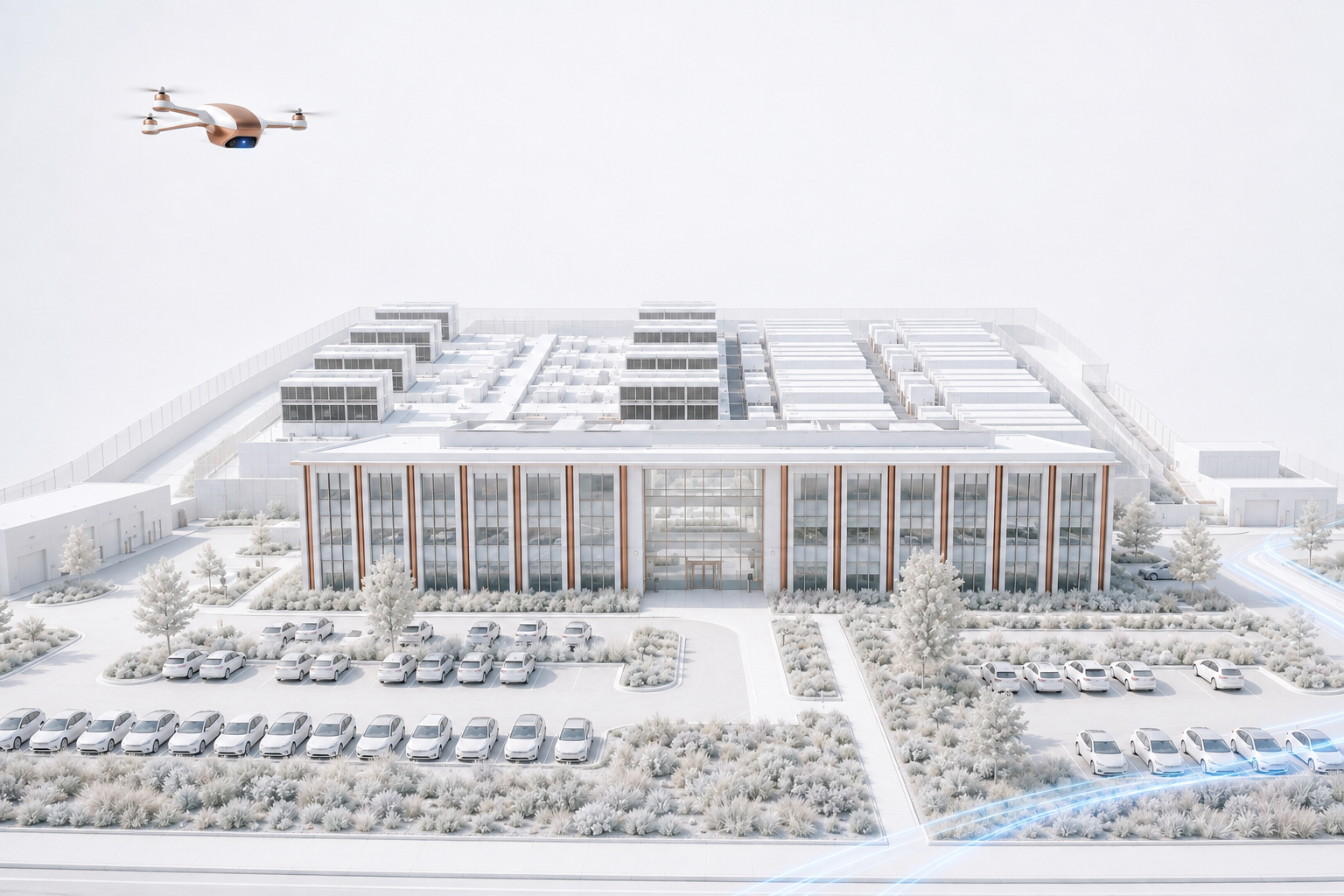
A white and copper SAVRN Sentinel aircraft patrolling a crisp architectural rendering of the SAVRN ATOM AI Factory campus.
08 SAVRN SECURITY

Sentinel Guard — the site that watches itself.

Sentinel Guard is the governed aerial-intelligence layer of a SAVRN site. Docked industrial drones run approved patrols while operators, policies, and evidence stay connected through the SAVRN platform.

01 WHAT SENTINEL GUARD DOES

Four watches, one platform.

A SAVRN site is a working AI factory — kilovolts of switchgear, kilometers of fence line, hundreds of racks under thermal load. Sentinel Guard is what keeps eyes on all of it, on a schedule, without stationing a small army.

Thermal patrols

Long-wave infrared sweeps of switchgear, transformers, and distribution. Hotspots are flagged before they become failures, with panel-level heat maps written back to the asset record.

Perimeter integrity

The fence line, reviewed from the air. Suspected gaps, cuts, gate anomalies, and unauthorized approaches are presented to an operator against a consistent patrol baseline.

Safety watch

Spills, obstructions, blocked egress, and unsafe conditions spotted from the air. A governed alert can enter the operations queue with the supporting imagery attached for human review.

Detection-first

Sentinel Guard observes and alerts; people decide what happens next. Every flight is logged, every alert is receipted, and no autonomous action is taken against a human.

02 AUTONOMY, GROUNDED

A drone that puts itself away.

Sentinel Guard is more than remote piloting. Approved missions can be scheduled, executed, and closed out automatically under a named operator. The aircraft returns to its weather-sealed dock to charge and report readiness for the next authorized window.
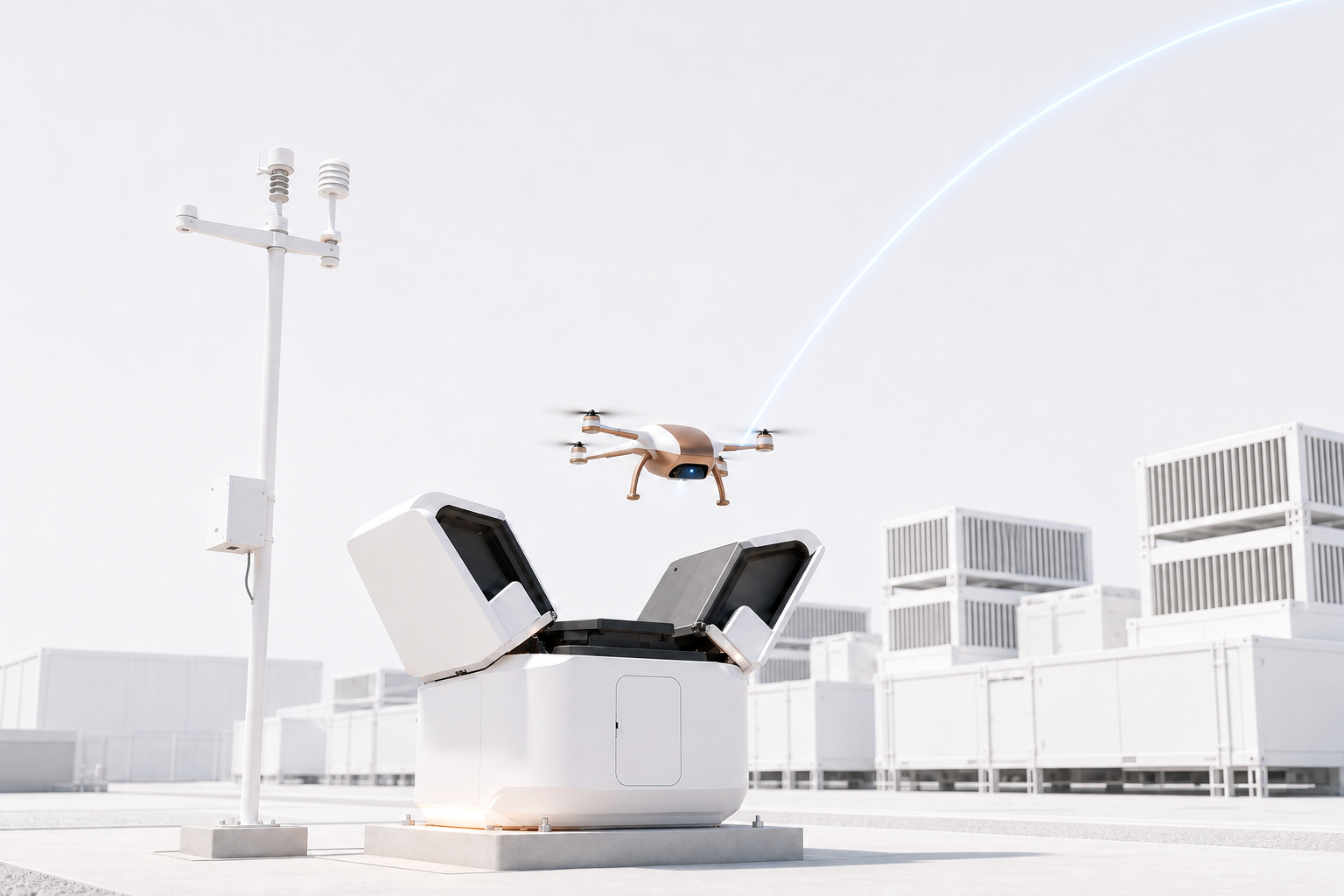
The white and copper SAVRN Sentinel aircraft lifting off from an autonomous dock in the SAVRN ATOM service zone.
DOCK  ·  MISSION  ·  RETURN

The routine runs itself.

The dock is an all-weather enclosure with charging, dry storage, a co-located weather station, and a hardened uplink. A mission is a schedule and a flight plan — the software handles takeoff, waypoints, payload capture, geofencing, and the return.

  • 01Scheduled — hourly, daily, or on trigger. Weather-gated by the on-dock station and a forecast API.
  • 02Executed — waypoints and payload actions run on the aircraft. Ground link is command and telemetry, not steering.
  • 03Closed out — imagery, thermal, and telemetry land in the site evidence store. A mission report is filed automatically.
  • 04Recovered — the dock captures the aircraft, charges it, and confirms readiness before the next window.
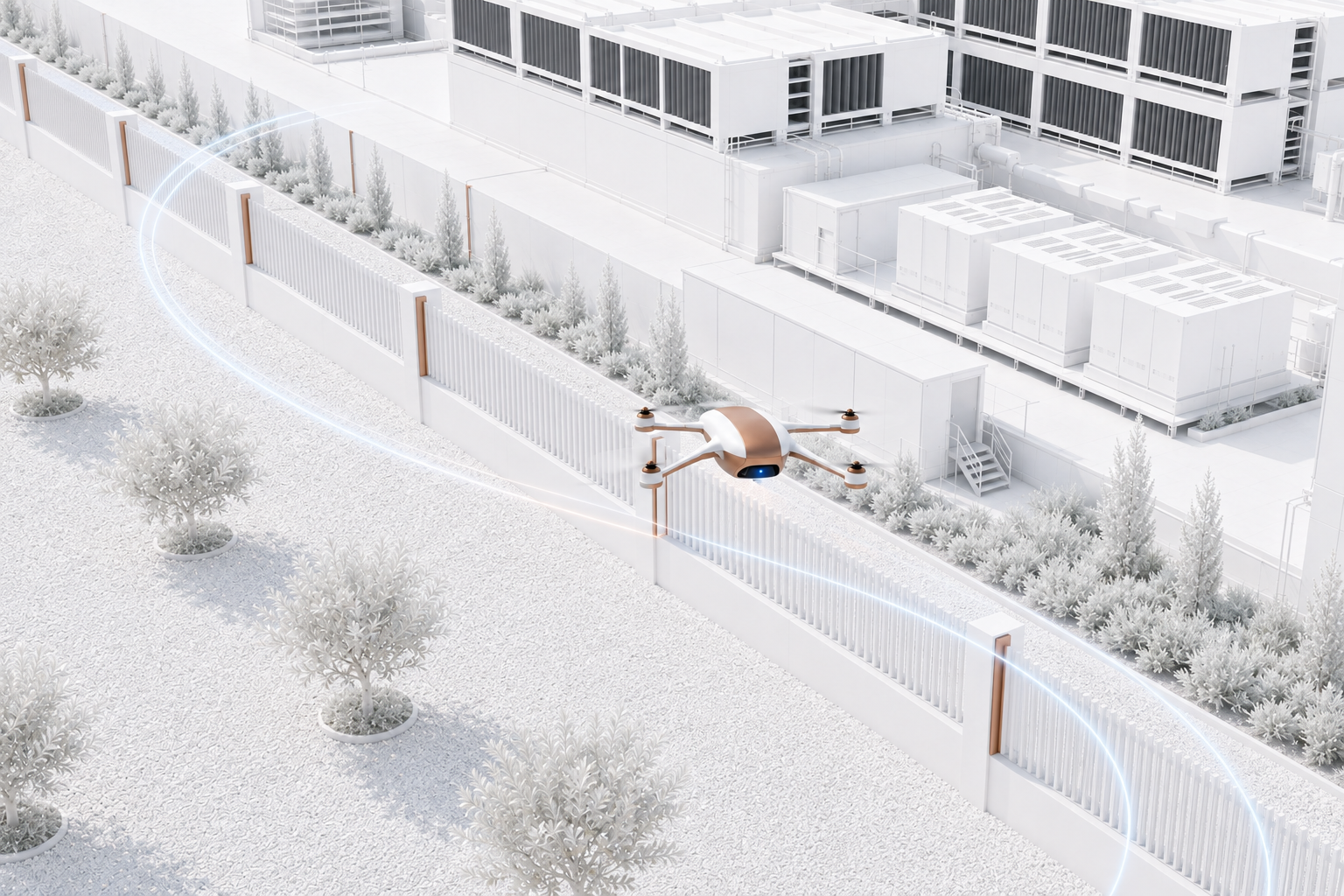
The white and copper SAVRN Sentinel aircraft patrolling the clean white perimeter of the modular SAVRN ATOM AI Factory.
●  PERIMETER  ·  DETECTION-FIRST

The fence line, walked from the air.

Repeatable routes hold the same standoff and camera geometry across patrols, making changes easier to compare against an approved baseline.

The aircraft flags the anomaly. A person adjudicates it. The receipt — flight ID, waypoint, imagery, decision, actor — lands in the compliance ledger. That is the entire loop.

  • △Change detection against the last clean pass — fence, gate, and access-road baselines updated per patrol.
  • △Standoff by policy — no closer than the RoE allows, with hard geofences enforced onboard.
  • △No pursuit — Sentinel Guard does not chase and does not engage. Escalations route to a human on the platform.
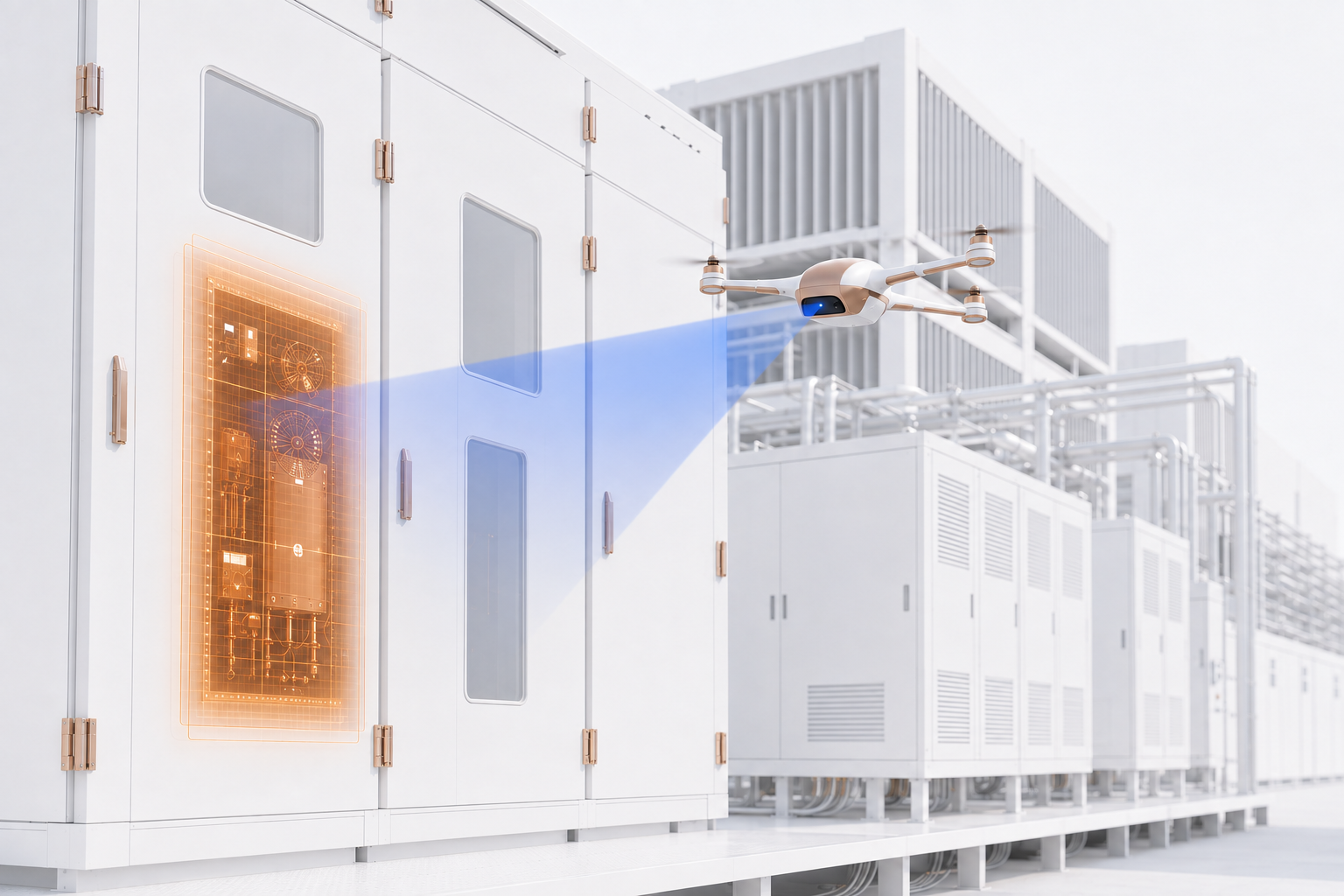
The white and copper SAVRN Sentinel aircraft thermally inspecting an external SAVRN ATOM cooling and power cabinet.
●  THERMAL  ·  PREDICTIVE

See failures before they fail.

Most equipment failures announce themselves in heat well before they become an outage. A configured radiometric thermal payload can capture repeatable, geo-tagged temperature maps of approved assets on route.

The delta from the last flight tells you what is changing. The trend across weeks tells you what is failing. Both feed the asset record — so maintenance is scheduled against real evidence, not a laminated matrix.

  • °CRadiometric imagery is geo-referenced and retained according to the site's evidence policy and any applicable hold.
  • °CDelta & trend per asset — hotspots and drift promoted to work orders in Command ERP.
  • °CReviewed by an operator before a call becomes an action. No autonomous shutdowns.
03 REFERENCE STACK

Off-the-shelf hardware, SAVRN control plane.

Sentinel Guard composes industrial aircraft, docks, edge compute, and the SAVRN control plane into one governed operating model. Final equipment, communications, and authority are confirmed for each site before deployment.

L1
Aircraft
Industrial quadcopter configured for EO / thermal inspection. Final airframe, payload, endurance, and supply-chain posture are verified at the SKU level.
Astro Max class
L2
Dock
Weather-sealed contact-charge dock with co-located weather sensing and a hardened telemetry uplink.
Heisha DNEST
L3
Onboard compute
NVIDIA Jetson Orin NX / AGX for detection, thermal analytics, and on-aircraft policy enforcement (geofence, no-fly, RoE).
Jetson Orin
L4
Autonomy runtime
ROS 2 with PX4 flight controller. Mission graph, health monitors, and payload nodes swappable per site.
ROS 2 · PX4
L5
Site edge
On-site device management, evidence storage, and mission scheduling. A disconnected variant is available as a separately engineered configuration.
SAVRN Edge
L6
Platform control plane
Policy Registry, Evidence Catalog, Agent Desks, Work Credits, Command ERP, Client Portal — the same platform every SAVRN site runs on.
SAVRN Platform
04 RULES OF ENGAGEMENT

Autonomous, but never unattended.

Autonomy in the sky requires more governance, not less. Sentinel Guard operates under a fixed rules-of-engagement contract that is published, versioned, approved by the site owner, and enforced onboard the aircraft.

01
One human accountable, always.
Every mission has a named remote pilot on record. Every alert has a named adjudicator. There is no anonymous action on a SAVRN site.
02
Detection-first, by policy.
Sentinel Guard observes and reports. It does not pursue, engage, disable, or act against a person. Response is routed to trained personnel and, where warranted, local authorities.
03
Everything logged, nothing quiet.
Every flight, every image capture, every alert, every human decision — recorded, hashed, and retained under the site's compliance ledger. Discoverable on demand.
05 PLATFORM INTEGRATION

Wired into everything SAVRN already runs.

Sentinel Guard is not a bolt-on. Every observation, every alert, every mission report flows through the same platform surfaces the rest of the SAVRN operation runs on — which is what makes it governable, auditable, and commercially settled.

Policy RegistryPR-SEC-04
Flight plans, geofences, altitude ceilings, RoE, retention, and privacy controls are all first-class policies. Change requires named approval, is versioned, and takes effect only after the next mission window opens.
Evidence CatalogEC-DRONE
Triaged evidence, telemetry, and mission reports follow defined retention, integrity, and chain-of-custody controls. Case material can be placed under legal hold.
Agent DesksAGT-SENTINEL
Sentinel Guard's triage, dispatch, and reporting run as Agent Desks — model-backed workers with named human supervisors, guardrails, and decision logs. No agent action ships without an accountable operator.
Command ERPASSET-OPS
Anomalies become work orders against the affected asset with imagery attached. Parts, labor, and MRO are tracked against the same asset record — no separate maintenance island for the security stack.
Work CreditsWC-SEC
Missions, alerts, thermal analyses, and human review are metered in Work Credits — the same prepaid unit used across the platform. Consumption is transparent to the site owner and auditable line-by-line.
Client PortalPORTAL-SEC
The site owner sees the schedule, the imagery, the alerts, the decisions, and the ledger — with role-based access and every action attributable. One login. Everything logged. Humans approve.
24/7
Operating objective with fleet and dock redundancy sized per site.
N+1
Coverage architecture sized around charge, transit, weather, and maintenance windows.
EO + IR
Configured visual and thermal payloads matched to each approved mission.
100%
Logged missions, alerts, and human decisions — receipted in the ledger.
06 DEPLOYMENT PATH

From site walk to an authorized operating plan.

Sentinel Guard is packaged as a scale-based system — a single dock covers a compact campus; multiple docks stitch together for larger sites. Every deployment follows the same sequence, because governance is set up before the first sortie.

STEP 01
Site survey & airspace review
Perimeter, obstructions, egress, RF environment, and applicable regulatory environment (Part 107, waivers, tribal, municipal).
Gate 01
STEP 02
RoE & policy pack
Draft rules of engagement, geofences, altitude ceilings, retention, and privacy zones. Executed by the site owner. Loaded into the Policy Registry.
Gate 02
STEP 03
Dock siting & install
Concrete pad, power, uplink, weather station. Airframe commissioned. Baseline patrol flown and reviewed.
Gate 03
STEP 04
Operations handover
Named pilot(s), named adjudicator(s), schedule live, alerts wired into Command ERP and Client Portal. First formal audit at 30 days.
Gate 04
08 · SAVRN SECURITY

Give the site a set of eyes that never blink.

Sentinel Guard is scoped site by site. Airspace, RF coverage, privacy zones, weather, insurance, evidence policy, and the final equipment bill are reviewed before an operating commitment.