Proton makes the factory's power on site, without burning anything.
Proton is the fuel cell in the Electron family. It converts fuel to electricity electrochemically rather than by combustion, so the campus makes its own baseload at the point of use, quietly, and never joins an interconnection queue.
Updated
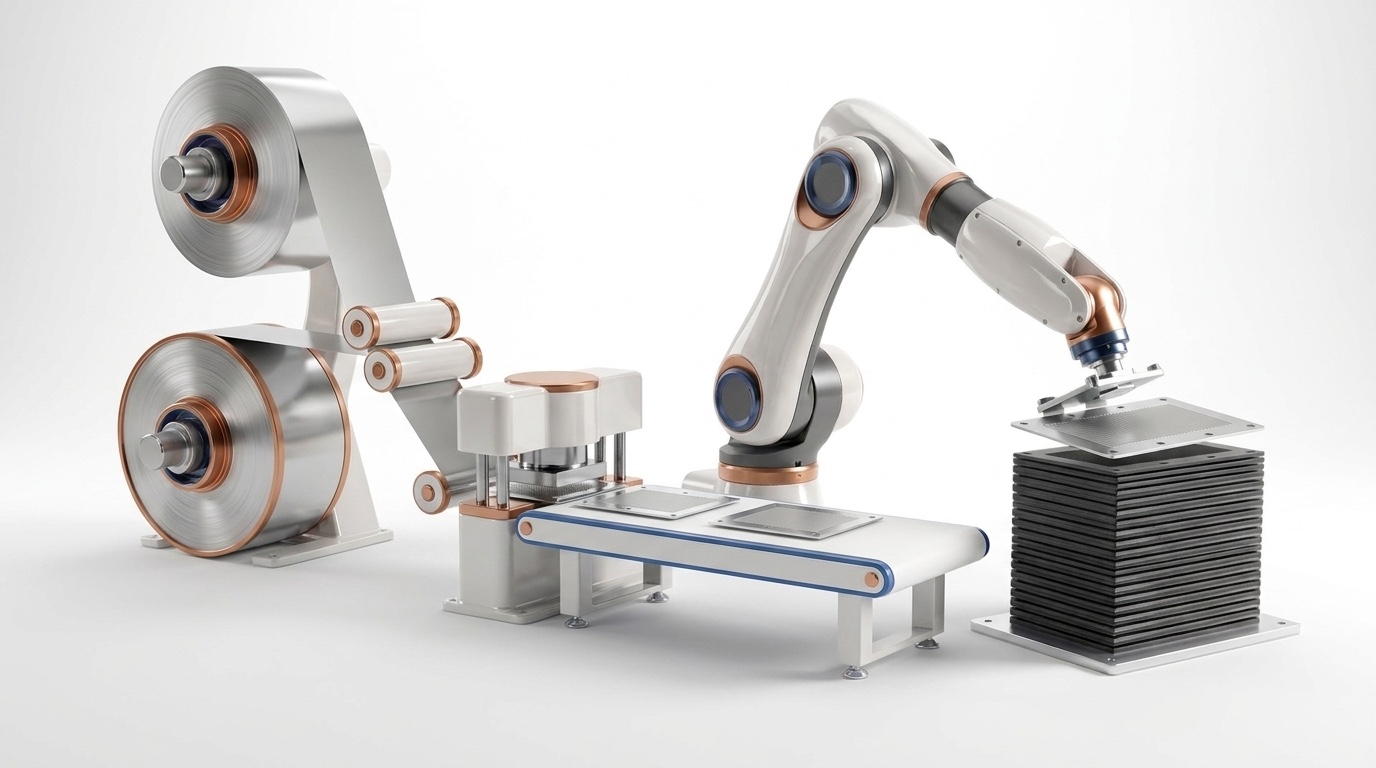
How Proton works
A fuel cell separates a fuel into ions and electrons and recombines them across a membrane, producing electricity, heat and water. There is no combustion, which is why the plant is quiet, why it has no combustion emissions profile, and why it can sit next to the building it powers.
In a SAVRN block, Proton runs as grid-following baseload. It supplies the steady load of the factory and is not asked to chase the fast swings of a GPU cluster. That job belongs to Ion, the grid-forming battery, which sets voltage and frequency and rides the load steps.
- Electrochemical conversion, not combustion.
- Baseload duty: steady output, high availability.
- Paired with Ion storage for transients, islanding and black start.
The reference design for one Atom
SAVRN's power specification is written vendor-neutral so any qualified fuel-cell manufacturer can bid it. For a single 13.2 MW Atom, the reference design is six fuel-cell blocks of 3 MW each, five active and one spare, for 18 MW installed and 15 MW firm, so a block can be serviced without touching the factory's output.
Distribution is medium-voltage main-tie-main switchgear feeding the block, with the same protection philosophy whether the plant is tied to a utility or islanded.
- Six blocks of 3 MW; five active plus one spare (N+1), 18 MW installed and 15 MW firm.
- Medium-voltage main-tie-main distribution.
- Open to any qualified manufacturer; performance class specified, not a brand.
The incentive that makes it the obvious choice
Fuel cells qualify for the federal clean electricity investment credit under section 48E at a flat 30 percent, regardless of fuel, for projects that begin construction after December 31, 2025. The credit is transferable for cash, and direct pay is generally available to tax-exempt and governmental owners.
For fuel cells the 30 percent is the full rate: there is no prevailing-wage or apprenticeship condition and no bonus adder. A combustion turbine earns no credit under 48E at all.
- Section 48E: 30 percent investment credit for fuel cells, any fuel.
- Transferable; direct pay for tax-exempt and governmental owners.
- Flat 30 percent: no prevailing-wage or apprenticeship condition, no bonus adders.
Key details
- No combustion, so no combustion emissions profile and a quiet plant.
- Baseload at the point of use; the campus does not join an interconnection queue.
- Runs on pipeline natural gas or renewable gas, and is hydrogen-ready.
- Sized per Atom at N+1 so maintenance never touches the factory's output.
- Qualifies for the 30 percent federal investment credit under section 48E.
- Heat from the stack is captured for the campus loop.
A community gets the jobs and the tax base without the stack. There is no combustion at the fence line, the plant is quiet, and it takes nothing from the residential grid or the ratepayers who fund it.
How it is delivered
Fuel and permits
Gas supply, air permits and any hydrogen or renewable-gas pathway are settled with the site plan.
Specification
The vendor-neutral performance spec goes to qualified manufacturers; the design basis is fixed before bids.
Manufacture
Fuel-cell blocks are built and factory-tested in parallel with the Atom.
Commissioning
Blocks are set, tied to the switchgear and commissioned with Ion storage as one plant.
Operate
The plant is monitored on the SAVRN platform, with the spare block rotated through service.
Questions people ask
Is a fuel cell the same as a generator?
No. A generator burns fuel in an engine or turbine. A fuel cell converts fuel electrochemically, with no flame, so it is quiet, has no combustion emissions profile, and qualifies for the federal investment credit that turbines do not.
What fuel does Proton run on?
Pipeline natural gas or renewable gas today, with a hydrogen-ready pathway. The fuel choice is settled with the site plan and the air permit.
Does the fuel cell follow the GPU load?
No. Proton runs as steady baseload. Ion, the grid-forming battery, sets voltage and frequency and rides the fast load steps of the compute.
Which manufacturer does SAVRN use?
The specification is vendor-neutral and open to any qualified fuel-cell manufacturer. SAVRN does not name suppliers on public pages; the team can walk through the design basis.
See Proton fuel-cell power in the whole system.
Every piece here is rendered and narrated on the System page, and the platform that runs it has a guided walkthrough.