Who Pays for Data Center Power? Three Fights From One Day
In 48 hours, Congress and FERC left the grid bill unpaid, Amazon bought the power it could not build next to, and towns paused projects nobody had proposed.
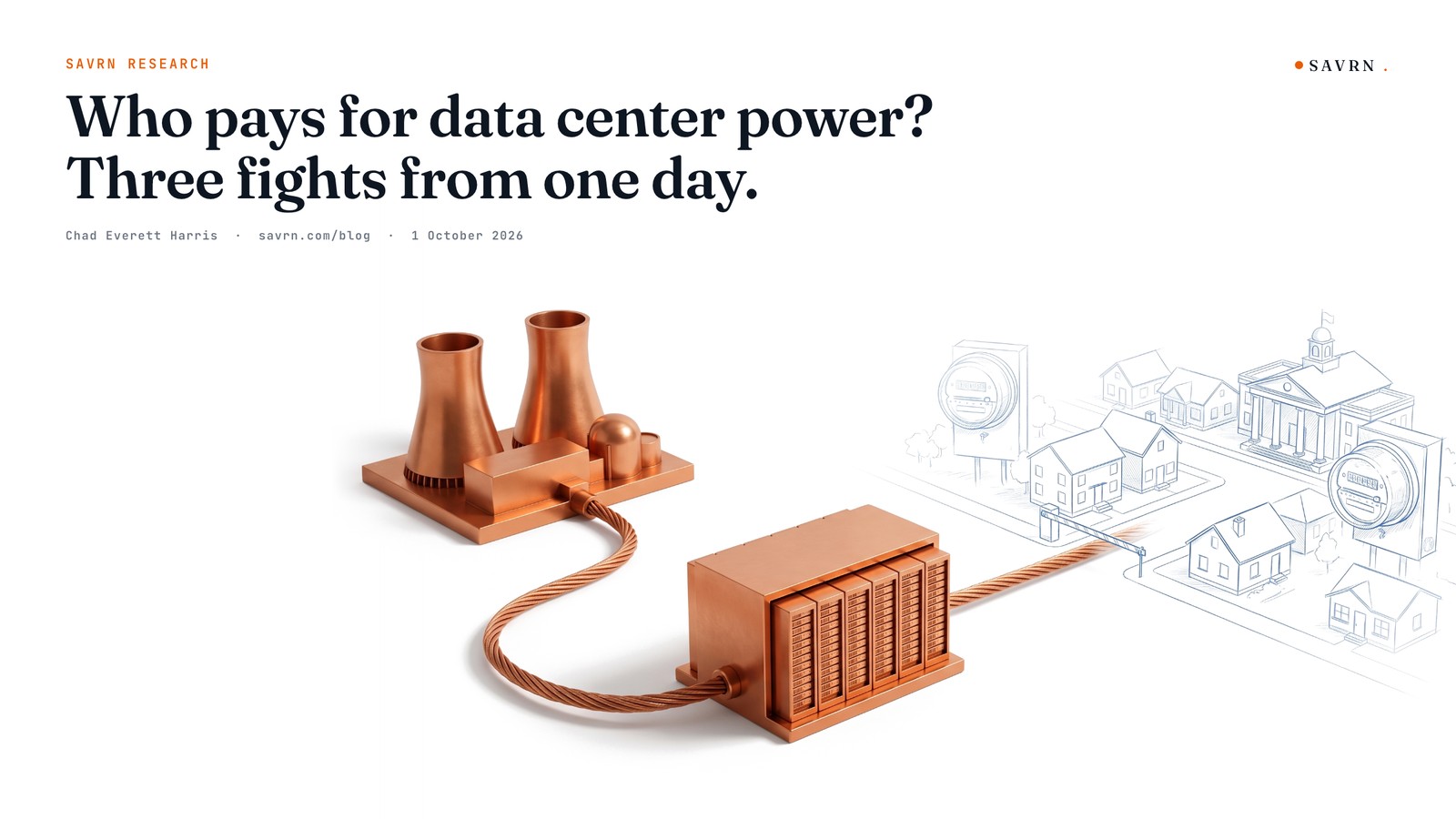
Who pays for data center power was the real question on Wednesday, 30 September 2026, because that afternoon the Senate failed to advance the bill meant to answer it, by 57 votes to 43 1. Meanwhile, the day before, federal regulators froze the emergency auction that the country’s largest grid had planned to open that same morning 2. In addition, Amazon signed a 20-year deal for 690 MW from a Maryland nuclear plant it had walked away from building next to two months earlier 3, 4. Finally, towns kept saying no, since our tracker added nine blocked or delayed projects in one refresh, and most of the new moratoriums cover places where no developer has asked for anything 5, 6, 7. Because I run the SAVRN Capital Atlas, these are the three fights that stood out in today’s data.
What to take from this
- The Senate fell three votes short on the Ratepayer Protection Act, and FERC suspended PJM's 6,831.3 MW emergency auction to 28 February 2027, so the question of who pays for data center grid costs is still open.
- Amazon withdrew its campus next to Calvert Cliffs in August, then contracted 690 MW of the plant's output for 20 years on 30 September.
- South Korea is funding a 6,472 MW, $22.3 billion gas plant for AI data centers in Texas, and three hyperscalers sold $82 billion of dollar notes from February to May.
- Most of this week's new moratoriums, in places like Dixon, Mesa County and Dover-Foxcroft, cover towns with no data center proposal at all.
- Approvals still happen, such as Kline Township's unanimous vote for Amazon, but they now come with long lists of conditions.
The numbers behind the three fights
Table 1 holds the figures this post relies on. In particular, each one comes from the vote record, filing, order or report listed at the end, while each one is also in the Capital Atlas.
Table 1 Key figures from 28 September to 1 October 2026, with the source for each
Fight one: Washington left the power bill unpaid
The Senate vote on H.R. 9340
At first, the Ratepayer Protection Act looked like the easy vote of the season, since the House passed it 417 to 3 on 16 September 2026 8. In short, it amends a 1978 utility law so that state utility commissions must consider standards making data centers and other large loads cover the cost of the grid upgrades they need 9. However, the key word is “consider,” because the bill does not require any state to adopt those standards.
As a result, that word is where the Senate split. On 17 September, Senator Martin Heinrich objected to passing the bill by unanimous consent, because it only asks states to consider cost recovery 10. Consequently, the bill needed a floor vote. On 30 September, cloture on the motion to proceed failed 57 to 43, three votes short of the 60 required 1. In fact, four Democrats voted yes: Maggie Hassan, Amy Klobuchar, Jon Ossoff and Raphael Warnock 11. Most Senate Democrats, however, called the bill toothless 11.
In other words, both sides say data centers should pay their own way. Nevertheless, the result is the same as doing nothing, since Congress has passed no new federal protection on data center grid costs before the election recess.
FERC and PJM’s emergency auction
Meanwhile, the second half of the story sits with PJM, the grid operator for 13 states and the District of Columbia. Specifically, its 2028/2029 capacity auction cleared 6,831.3 MW short of its reliability target, at the $325/MW-day price cap 12. Similarly, the auction before that cleared 6,623 MW short 12. In PJM’s own words, new supply has not kept pace with rapid large load demand growth 12.
Therefore PJM proposed a one-time backstop auction to buy up to that shortfall. Under the plan, offers would be capped at $555/MW-day, and every resource would have to be online by 1 June 2032 13. In addition, PJM proposed that new large loads without their own capacity could connect but would be curtailed first in an emergency 13.
However, on 29 September, FERC accepted the backstop but suspended it for five months, to 28 February 2027 2. Specifically, FERC found that the cost allocation, the exit rules for transmission owners and the collateral rules for load-serving entities may be unjust and unreasonable 14. In addition, Chairman Laura Swett wrote that the commission “will not be forced into accepting a deeply flawed, eleventh-hour procurement mechanism with billion-dollar implications for consumers” 14. Consequently, PJM did not open the auction on 30 September, and it says the timing is to be determined 2.
Put the two decisions together. In 48 hours, Congress declined to tell states how data centers should pay for the grid. Meanwhile, the federal regulator declined to let the largest grid buy emergency power under the cost split it had proposed. Both bodies said the question of who pays was not settled, although neither one settled it.
Fight two: the people building data centers are buying the power plants
Amazon and Calvert Cliffs
Calvert Cliffs sits on the Chesapeake Bay near Lusby, Maryland. In 2025 it produced 38% of the state’s electricity, while Maryland still uses about five times more power than it generates 3.
First, in May 2026, Amazon applied to build a data center campus next to the plant, about 2.4 million square feet and roughly 500 MW. Second, on 4 August 2026, it withdrew the application 4. Subsequently, Calvert County commissioners passed a six-month data center moratorium on 18 August 15. Likewise, two days later, the town of Chesapeake Beach voted 4 to 0 to ban data centers in every zone 16. In fact, in June’s primary, voters had removed all three county commissioners who opposed a moratorium 3.
Then, on 30 September, Amazon came back for the power instead, because it signed a 20-year purchase agreement for 690 MW of the plant’s 1,790 MW 3. Constellation, the owner, says the deal lets it spend $3 billion on upgrades and seek a 20-year license renewal, since the reactor licenses expire in 2034 and 2036 3. In addition, it expects to add about 190 MW between 2030 and 2032 3. However, the price is confidential.
The deal cuts both ways, and both sides are true. On one hand, the power still flows onto the PJM grid for every customer, and the plant gets more output and a longer life 3. On the other hand, a single company has now contracted more than a third of the state’s largest power plant for two decades. That happened in the same week Congress failed to settle who pays for grid upgrades. In short, the county said no to the building, while the would-be builder bought the electricity anyway.
Governments and bond markets are paying for the rest
However, Amazon is not alone. On 1 October, South Korea’s industry ministry said Seoul and Washington had formally selected Project Star as the first project under Korea’s $350 billion US investment commitment 17. Specifically, it is a 6,472 MW gas-fired plant in Encinal, Texas, built for AI data centers, at a cost of $22.3 billion 17. In addition, Related Companies and NextEra Energy lead it, with first power in 2029 and full operation targeted for 2032 17. For scale, that one Texas plant, on a different grid, is nearly the size of PJM’s entire 6,831.3 MW shortfall.
Moreover, the money behind data center growth is not scarce. While going back through SEC filings this week, we added nine hyperscaler bond offerings from February to June 2026 that were missing from the atlas. For example, Amazon sold $37 billion of notes in eleven tranches in March, with maturities out to 2076 18. Similarly, Alphabet sold $20 billion in February 19, while Meta sold $25 billion in May 20. As a result, those three dollar offerings alone come to $82 billion, before counting the euro, sterling, Canadian dollar and yen issues the same companies sold.
The pattern is clear, because capital is easy to find. Therefore the scarce things are power and permission, and buyers are going around the grid and the town hall to get the first one.
Fight three: towns are saying no before anyone asks
The count
First, the count. On 19 September 2026, the atlas held 756 blocked or delayed projects, 495 of them moratoriums. By 1 October, by contrast, it held 837, with 545 moratoriums, across 49 states. However, that growth is partly new action and partly older actions we only now documented, so it is a record of what is on the books, not a weekly rate. In particular, Ohio has the most moratorium rows at 39, followed by Michigan and Florida at 33 each, while Maryland has 19.
This week’s moratoriums
What stands out in this week’s additions is how few of them answer an actual project.
- Dixon, California: On 30 September, the council voted unanimously for a 45-day urgency moratorium on data centers and battery storage. However, there is no data center proposed or operating in the city 5, 21.
- Palm Springs, California: The same night, the city extended its 45-day pause through 25 August 2028, nearly two years 22.
- Mesa County, Colorado: On 29 September, commissioners approved a 12-month moratorium. The county has no pending data center applications 7.
- Winneshiek County, Iowa: On 28 September, supervisors voted unanimously for 12 months in rural, unincorporated areas 23.
- Dover-Foxcroft, Maine: On 28 September, the select board paused data centers for 180 days. Its chair said no proposal is pending 6.
- Warren County, Ohio: Commissioners approved six months, although no developer has asked to build in the unincorporated areas, and two townships there already have yearlong pauses 24.
- Pontiac, Michigan: The city is in its second six-month moratorium, which runs to January 2027, with no known data center plans 25.
- Washington County, Maryland: A 12-month moratorium has been in force since 30 June 2026. In addition, its draft rules include a 1,000-foot setback from homes, a 50 dBA noise limit and a possible ban on gas turbines 26.
In short, local governments are writing the rules first and inviting projects later, if at all. In addition, the new standards look alike from place to place: setbacks, noise caps, water studies and limits on on-site gas.
Where the fight moves up a level
When a town cannot say no, the fight moves to the state. For example, in Archer County, Texas, Google’s proposed Project Raptor would cover about 2,500 acres near Wichita Falls 27. On 28 September, the commissioners court passed two resolutions opposing its wastewater permits, although the county judge said the county has no authority to stop them 27. However, the state has paused those permits anyway. On 21 September, Governor Greg Abbott directed Texas environmental regulators to halt all permits sought by data centers until the grid operator finishes its audit, with a compliance report due 19 October 28.
Similarly, money can be stopped. On 25 September, the Wayne County executive in Michigan vetoed $125 million in local tax incentives for Google’s Project Cannoli, a campus of about 1 GW 29. As a result, overriding the veto takes two-thirds of the 10-member commission.
Finally, projects also fade out quietly. In Hamilton, Ohio, Logistix asked the city to study 240 MW of power for a campus on city land. However, the city found it would take at least 24 months to deliver 45 MW, and the study was paused in January 30. Then, on 28 September, the Cincinnati Enquirer reported under the headline “How a $1 billion data center fell apart in Ohio” that the project is not moving forward 31.
The other side of the ledger
Not every vote goes one way, however. On 30 September, Kline Township supervisors in Pennsylvania unanimously approved Amazon’s nine-building, 390-acre campus, with a nine-page list of conditions 32. Meanwhile, in Mississippi, Eagle Rock Partners held a public hearing on 29 September for an estimated $6 billion campus on 800 acres in Jefferson Davis County. Residents raised water, power rates, noise and traffic, while some asked for a public vote 33. In short, approvals now arrive with conditions attached, while hearings now arrive with a fight attached.
How the three fights connect
In fact, these are one fight seen at three levels. First, at the top, nobody has decided who pays for the grid that data centers need. Because of that, utilities and grid operators cannot price the risk, and FERC sent PJM’s attempt back. Second, in the middle, the largest buyers are signing for power directly, through 20-year contracts and foreign-funded plants. Third, at the bottom, towns that see rising bills and no answer from Washington are pausing everything.
As a result, each level pushes the others. For example, a town that says no sends the developer to a power contract. In turn, a power contract that skips the local fight leaves the cost question with the grid. Finally, a grid that cannot settle costs gives the next town one more reason to say no.
How we track this
The Capital Atlas records who is funding data center capacity in North America and what has been stopped. It refreshes three times a week, while every value links to a filing, order or report. In particular, today’s changes are in the 1 October update note. In addition, local pauses are tracked in the moratorium tracker, and stalled projects in the delay tracker.
Frequently asked questions
What did the Senate vote on data center power costs on 30 September 2026?
What would the Ratepayer Protection Act have done?
Why did FERC suspend PJM's backstop auction?
How large is PJM's capacity shortfall?
The 2028/2029 auction cleared 6,831.3 MW short of the reliability requirement, while the 2027/2028 auction cleared 6,623 MW short 12.
What did Amazon buy from Calvert Cliffs?
Amazon signed a 20-year agreement for 690 MW of the plant’s 1,790 MW. In return, Constellation plans $3 billion of upgrades and about 190 MW of added output from 2030 to 2032 3. However, the price is confidential.
Does Calvert Cliffs power go straight to Amazon data centers?
No, because Constellation says all of the plant’s output still flows onto the PJM grid for every customer 3. Instead, Amazon gets a fixed contract for its share.
What is Project Star?
It is a 6,472 MW gas-fired power plant in Encinal, Texas, built for AI data centers at a cost of $22.3 billion. In addition, it is the first project under South Korea’s $350 billion US investment commitment 17.
How many data center moratoriums are in the Capital Atlas?
As of 1 October 2026, the atlas holds 545 moratoriums among 837 blocked or delayed projects across 49 states. Some are recent, while others are older actions documented this month.
Why do towns adopt moratoriums with no project pending?
Are data centers still being approved?
Yes. On 30 September, Kline Township, Pennsylvania, unanimously approved Amazon’s 390-acre campus with a nine-page list of conditions 32. However, approvals increasingly come with long condition lists.
Sources
- Roll Call Vote 254, cloture on the motion to proceed to HR 9340, U.S. Senate, US Senate, 2026; Vote of 30 September 2026; 57 yeas, 43 nays; three-fifths required
- FERC Accepts PJM Reliability Backstop Proposal, PJM Interconnection, PJM Inside Lines, 2026; Grid operator statement of 30 September 2026 on the FERC order of 29 September
- Large upgrade planned at Calvert Cliffs after power deal signed with Amazon, Maryland Matters, Maryland Matters, 2026; 690 MW, 20 years, $3 billion of upgrades, about 190 MW added from 2030 to 2032
- Amazon withdraws Calvert Technology Center application, Calvert County Government, Calvert County, 2026; County notice of the 4 August 2026 withdrawal
- Dixon approves temporary data center moratorium, FOX40 KTXL, FOX40, 2026; Unanimous 45-day urgency moratorium of 30 September 2026
- Dover-Foxcroft temporarily pauses data centers, Piscataquis Observer, Piscataquis Observer, 2026; 180-day resolution of 28 September 2026; no proposal pending
- Commissioners approve data center moratorium, Mesa County, Mesa County, 2026; 12-month moratorium of 29 September 2026; no pending applications
- Bill aimed at voter anger over data centers passes House, Roll Call, Roll Call, 2026; House vote of 417 to 3 on 16 September 2026
- HR 9340, Ratepayer Protection Act: all actions, Library of Congress, Congress, 2026; Official action history, including House passage and Senate calendar placement
- Senate Democrat blocks data center electricity costs bill, FOX 9, FOX 9 Minneapolis, 2026; Senator Martin Heinrich objects to unanimous consent on 17 September 2026
- Senate Democrats block datacenter energy bill, saying toothless legislation misses the mark, The Guardian, The Guardian, 2026; Reports the 57 to 43 vote and the four Democrats who voted yes
- PJM widens data center response as capacity shortfalls deepen, POWER Magazine, POWER, 2026; 2028/2029 auction cleared 6,831 MW short; 2027/2028 cleared 6,623 MW short
- PJM board proposes backstop capacity auction, data center curtailment plans, Utility Dive, Utility Dive, 2026; Offer cap of $555/MW-day; resources online by 1 June 2032; curtailment of new large loads
- FERC chair slams PJM mess as largest grid operator delays power auction, Utility Dive (via Yahoo News), Utility Dive, 2026; Chairman Laura Swett concurring statement; issues FERC found may be unjust and unreasonable
- Commissioners approve six-month data center moratorium, Calvert County Government, Calvert County, 2026; Passed 18 August 2026, effective 28 August 2026
- Town council bans data centers, Southern Maryland News, Southern Maryland News, 2026; Chesapeake Beach vote of 4 to 0 on 20 August 2026
- Korea, US formally select Texas power plant as first investment project, Yonhap News Agency, Yonhap, 2026; Project Star: 6,472 MW for AI data centers at $22,300 million, first phase 2029
- Amazon final prospectus supplement, Form 424(b)(5), Amazon, SEC EDGAR, 2026; $37 billion of senior notes in eleven tranches, priced 10 March 2026
- Alphabet final prospectus supplement, Form 424(b)(2), Alphabet Inc., SEC EDGAR, 2026; $20 billion of senior notes in seven tranches, February 2026
- Meta Platforms final prospectus supplement, Form 424(b)(2), Meta Platforms, SEC EDGAR, 2026; $25 billion of senior notes in six tranches, May 2026
- Dixon City Council approves 45-day ban for data center development, KCRA 3, KCRA, 2026; Unanimous vote of Wednesday 30 September 2026
- Palm Springs extends data center moratorium to 2028, The Palm Springs Post, The Palm Springs Post, 2026; Extension of 30 September 2026 through 25 August 2028
- Supervisors unanimously approve one-year moratorium on data centers, Decorah Leader, Decorah Leader, 2026; Winneshiek County vote of 28 September 2026
- Warren County enacts 6-month moratorium on new data centers, Journal-News, Journal-News, 2026; No developer requests in unincorporated areas
- Pontiac data center moratorium expires in January, WXYZ 7 News Detroit, WXYZ, 2026; Second six-month term; no known data center plans in the city
- Statement on temporary moratorium for data centers, Washington County, Maryland, Washington County, 2026; 12-month moratorium approved 30 June 2026 and draft siting standards
- Representative James Frank joins Archer County residents opposing proposed data center, KAUZ News Channel 6, KAUZ, 2026; Project Raptor, about 2,500 acres; county resolutions of 28 September 2026
- Governor Abbott directs TCEQ to halt data center permits, Office of the Texas Governor, Texas Governor, 2026; Directive of 21 September 2026; compliance report due 19 October 2026
- Wayne County executive vetoes Van Buren Township data center tax break, The Detroit News (via MSN), The Detroit News, 2026; Veto of 25 September 2026 of $125 million in incentives for Project Cannoli
- Hamilton data center study paused, WOSU Public Media, WOSU, 2026; 240 MW requested; 24 months to deliver 45 MW
- How a $1 billion data center fell apart in Ohio, The Cincinnati Enquirer, The Cincinnati Enquirer (subscriber), 2026; Report of 28 September 2026 that the Hamilton project is not moving forward
- Kline Township supervisors approve Amazon data center proposal with conditions, FOX56 WOLF, FOX56, 2026; Unanimous approval of 30 September 2026 with a nine-page list of conditions
- Community voices concerns ahead of new AI data center in Jefferson Davis County, WDAM, WDAM, 2026; Eagle Rock Partners, 800 acres, estimated $6 billion; hearing of 29 September 2026
Want the next one?
When a new piece publishes on SAVRN Insights, you get one email with what it covers and a link to read it. Choose the research that interests you.
Also send me
Receive a short introduction on days 3, 7 and 14, plus the updates you select. Unsubscribe in one click. Privacy
Who Pays for Data Center Power? Three Fights From One Day
Get new SAVRN Insights by email
A short introduction on days 3, 7 and 14, plus new SAVRN research articles. Unsubscribe at any time.
We use your address to send the introduction and updates described above. See our Privacy Policy.