An athlete is a trajectory
Each athlete is compared with their own history first. Age group is context, never a verdict.
Search public pages, research tools, and SAVRN solutions.
Design case
Better data before bigger promises.
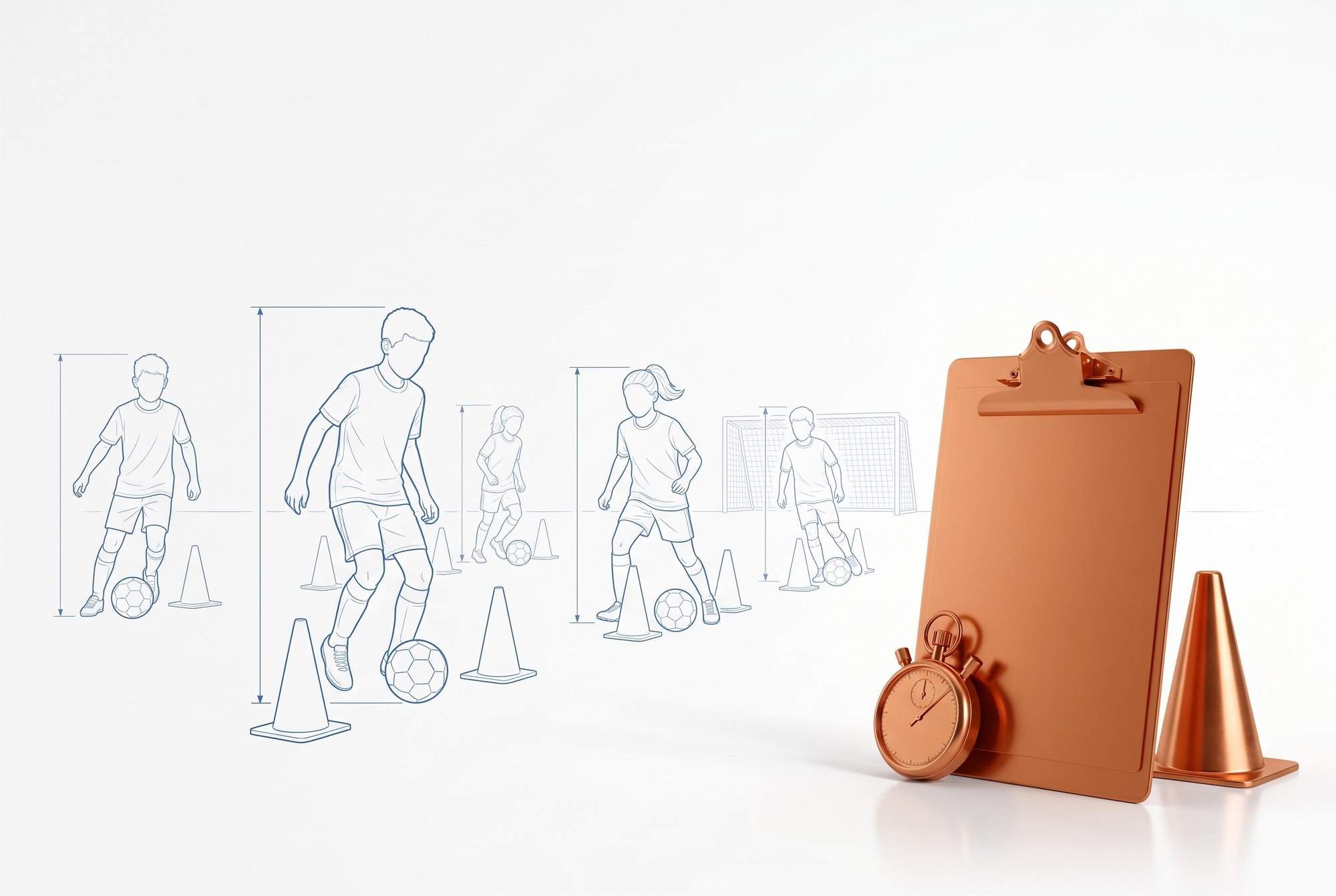
This design case applies the SAVRN data principle to youth and team sport. It describes a system SAVRN has designed. It reports no performance or injury results, because none have been measured yet.
Each athlete is compared with their own history first. Age group is context, never a verdict.
The system prepares the facts. Qualified coaches and medical staff make the decision.
Recruiters, sponsors and marketing systems never receive pain reports, recovery data or medical history.
The gap
Teams collect more readings every season. The published research behind training and injury decisions is still small, mostly male and rarely tested on a second group.
Share of 842 athlete studies in sports medicine journals, 2017 to 2021.
Six sport and exercise science journals, 2014 to 2020: 5,261 publications. Team sport AI: 58 studies.
One square per published model. A filled square would be a model tested on a separate group of athletes.
The record
The record connects six things for every athlete, so a later reader can tell an athlete who received a change in training from one who only had a similar reading.
What most datasets hold
What a model needs to learn which actions work
Age, training history, sport, position, level of play and growth stage, recorded by trained staff with permission.
The session the coach approved: its purpose, exercises, intended duration and restrictions.
Minutes completed, session type and participation status for every practice and game, including the ones with no injury.
The athlete's own report of soreness, fatigue and sleep, kept beside any device data.
What the coach or clinician decided, who approved it and the reason.
Later test results, availability and health, with lost follow-up marked as unknown.
Illustrative workflow
A player reports new knee discomfort before practice.
A short check-in records new knee discomfort. Recent records show more match minutes than usual.
The assigned staff see the report, the minutes and their dates. The training plan is marked as awaiting review. No diagnosis is generated.
A professional assesses the player. The coach receives only the approved participation instruction, and the modified session is logged.
What happened next is recorded over the agreed period. Recruiting and sponsor systems receive none of the health detail.
Scope
The system supports coaches and medical staff. It does not replace their judgment, and it does not rank a young athlete's future.
A short check-in and a clear explanation of the approved plan.
The roster's changes and missing information, in priority order, before practice.
A restricted queue of symptoms and assessments, separate from recruiting and marketing.
A progress view, permitted game video and control over optional sharing.
Dated assessments and approved footage, each with the name of the person who verified it.
The means to revoke access and trace every later use of a record.
The evidence
Each study below supports one part of the design. None of them shows that software by itself improves development or prevents injury.
Evidence 01
Four pooled trials of one warm-up program found 39% fewer injuries in recreational and subelite soccer, a rate ratio of 0.61.
Evidence 02
A meta-analysis of 43 studies found moderate gains in strength and jump height, and smaller gains in sprint, agility and sport-specific tests.
Evidence 03
A review of 56 studies found athletes' own reports tracked training load with better sensitivity and consistency than objective measures.
Evidence 04
A review of 30 studies found growth-related injuries peaked during the adolescent growth spurt, and called for more research in female athletes and in more sports.
Evidence 05
The International Olympic Committee describes adolescence as non-linear, with physical, psychological and social development moving at different speeds.
Evidence 06
A review of 38 machine learning studies found that small datasets and inconsistent injury definitions hold the models back. A review of 204 models found none tested on outside athletes.
Evidence 07
A randomized trial assigned 18 of 34 elite youth soccer teams to plan training by a common workload ratio for a 10-month season. Health problems did not fall compared with teams that trained as normal, with a relative risk of 1.01.
Evidence 08
A review of 11 school studies found that video feedback with verbal feedback seemed to teach movement better than verbal feedback alone. It said class size, time, equipment and data protection must be weighed first.
The minimum dataset
Ten groups of records make up the minimum dataset. Each one has a control that protects the athlete or the quality of the data.
Athlete, guardian relationship, team, permitted purposes and their dates.
The operating ID is kept apart from the research ID.
Age, training history, sport, position and approved growth observations.
No public body ranking. Growth is assessed by trained staff only.
Session purpose, approved exercises, intended duration and restrictions.
The plan is saved before anyone edits it.
Minutes, participation status, session type and perceived effort.
Missing data never counts as an injury-free session.
Approved questions on symptoms and well-being, suited to the athlete's age.
The wording, the scale and the version are kept.
Chosen sprint, jump, endurance and skill tests.
The same equipment and protocol each time, with measurement error recorded.
Review, diagnosis where qualified, onset, recurrence, time lost and clearance.
Medical access only. Clinicians own the labels.
The alert reviewed, the decision, the approver, the reason and any override.
The record shows what people did, not only what a model said.
Game, source footage, timestamps, roster mapping, review and rights.
A clip inherits the permissions of the recording it came from.
Participation, the outcome window, transfers and dropouts.
Lost to follow-up is kept separate from healthy.
Measures
A pilot tests whether the system works. It does not show an effect on development or injury, and the two are measured apart.
Proposed pilot targets
Required session and exposure records complete in the final four pilot weeks
Target: 90%
Staff time preparing weekly reports, against a time study run before the pilot
Target: 25% less, against the time before the pilot
Safety alerts routed to the assigned staff and acknowledged within the agreed service level
Target: 100%
Opted-in families that receive a progress summary each reporting cycle
Target: 90%
New injuries divided by athlete exposure hours, times 1,000. Training and competition are reported apart.
Days lost divided by athlete exposure hours, times 1,000, with symptoms and modified participation beside it.
Fully available athlete days divided by observed athlete days. Unknown is reported apart from available.
Change within each athlete on tests chosen in advance, with the same protocol each time.
Completeness by source and by group, duplicate rate, unresolved identity matches and delay.
Reporting time, review time for each athlete, and alerts acted on against alerts dismissed.
Injury definitions, exposure recording and the split between incidence and burden follow the International Olympic Committee recording standard.
Planning sequence
Each phase ends at a gate. The next one does not start until the gate is passed.
Weeks 1 to 12 are drawn to scale. The last two phases have no fixed end.
Confirm the scope, map the workflow and select the pilot teams and measures.
Sign-off from the sporting, clinical and privacy leads.
Set up identity, consent, roster, exposure and check-ins. Run the baseline time study and test protocols.
Imports reconcile, access tests pass and baseline records are complete.
Two to four teams, about 60 to 120 athletes. Coach workspace, development record and family reports.
Operating measures met, with no open safety or security finding.
Development and health are tracked forward. Any model runs in shadow.
Enough follow-up and events, and a locked independent evaluation.
More teams, more video and the models that passed.
Separate scientific, commercial and capacity approval.
Privacy and safeguarding
Enrolling in a program is not permission for everything. Service, research, model training, recruiting, media and marketing each need their own.
In the United States, covered online services need verifiable parental consent, and separate consent before a child's data goes to a third party. The rule limits how long data is kept and counts biometric identifiers as personal information.
Federal Trade Commission, January 16, 2025Federal guidance places the student health records a campus clinic keeps, at most colleges, under the student privacy law known as FERPA. They are excluded from the health privacy law known as HIPAA.
US Department of Health and Human Services and US Department of Education, 2019Sponsors receive permitted audience information. They never receive an individual athlete's injury, readiness, growth or recovery data, and health records are never sold.
A young athlete should never have to choose between describing a problem and protecting a recruiting profile. Nothing in the system rewards playing through pain.
Where SAVRN fits
Athlete records are small. Video is not. One open smartphone motion capture system needed 31 hours of computing to process sessions for 100 people. Uhlrich et al, PLoS Computational Biology, 2023
Permissions, approvals and audit
SAVRN provides the ingestion, the records and the documented path from a recommendation to a human decision.
Capacity sized from measured work
Capacity is sized from camera hours and processing hours measured in the pilot, not from the number of athletes.
Nine steps
No model reaches a coach until it has run in shadow and passed a test on outside data.
A practical first conversation
Bring one sport, the teams you would start with and the decisions you want to support. We will map the record, the permissions and the measures for a pilot.
No. It is a design case. It describes the record, the rules and the measures SAVRN would use. It reports no performance or injury results.
No. Published reviews found that injury prediction models are limited by small datasets and have not been tested on outside athletes. Prediction stays in research until a model passes an outside test.
Authorized medical staff only. Coaches receive the approved participation instruction. Recruiters, sponsors and marketing systems receive none of it.
The core coaching service stays available. Optional monitoring and research use are separate choices, and declining them carries no penalty.
A guardian gives permission and the athlete gives assent in terms suited to their age. In the United States, services covered by the children's privacy rule need verifiable parental consent for children under 13.
A pilot of about 12 weeks can show that records arrive, permissions hold and staff can act. An effect on development or injury needs at least a full season and a comparison group.