Data Center Capital Atlas Update: October 8, 2026
98 capital providers, 453 named sites, 593 financing transactions and 1059 blocked or delayed projects, each linked to its source.
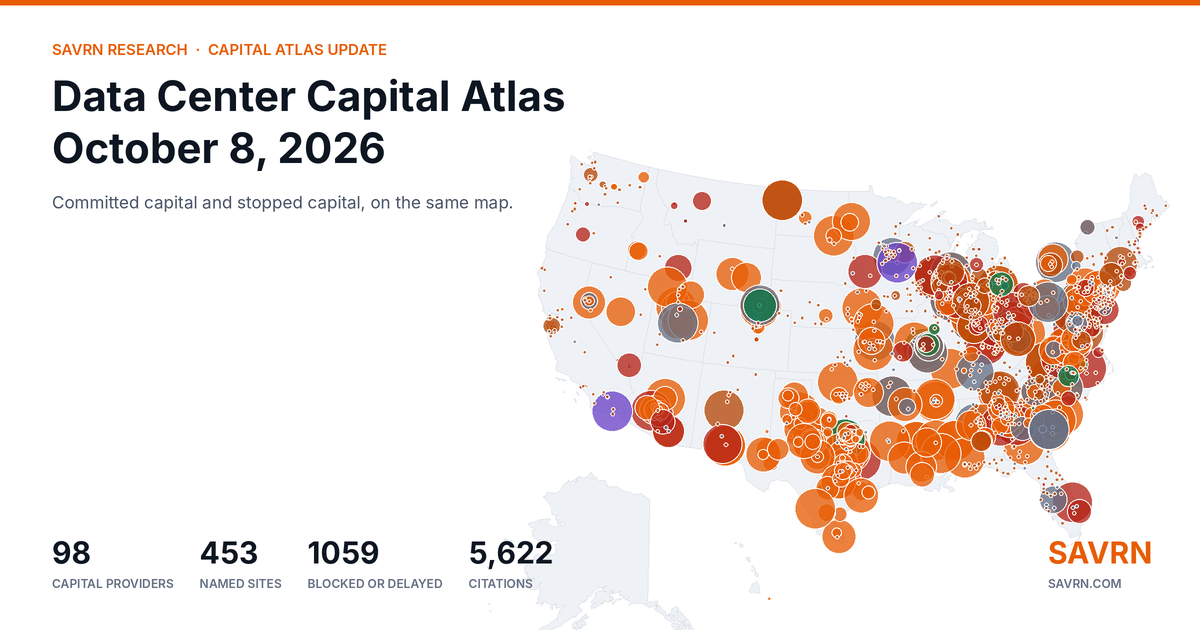
This data center capital atlas update records what changed in the North American Data Center Capital Atlas, SAVRN’s primary-sourced record of who is funding data center capacity in North America, in what structure, at which site, and how much of that capital has been stopped. The atlas is refreshed every Tuesday, Thursday, and Saturday, and each refresh publishes a note like this one recording exactly what changed.
Where the record stands
| Measure | Previous | Current | Change |
|---|---|---|---|
| Capital providers | 98 | 98 | no change |
| Named sites | 438 | 453 | up 15 |
| Financing transactions | 578 | 593 | up 15 |
| Blocked or delayed projects | 1027 | 1059 | up 32 |
| Source citations | 5,477 | 5,622 | up 145 |
| States with a blocked or delayed project | 49 | 49 | no change |
Announced capital across the tracked cohort is reported as disclosed and is never summed into a single deployment figure: site commitments overlap one another and overlap reported capital expenditure. Blocked-and-delayed totals from different trackers cover different windows and definitions and are shown side by side rather than added.
Capital at risk, added this period
- Newburyport ban on water-cooled data centers, City of Newburyport (MA). Citywide prohibition on data centers that use water for cooling, regardless of size or water source. The Newburyport City Council on Monday 5 October 2026 unanimously approved an ordinance banning data centers that obtain water for cooling purposes, regardless of size and regardless of water source. Sponsor Councilor Ben Harman cited Governor Healey’s September 2026 executive order giving local boards a say over data centers. No specific project was pending. (The Daily News of Newburyport)
- Kennesaw six-month data center moratorium, City of Kennesaw (GA). Citywide temporary moratorium on data centers. The Kennesaw City Council unanimously approved a six-month moratorium on data centers while staff develop definitions, land use and zoning standards for the facilities; a public hearing is planned later. The city attorney recommended six months rather than a year as easier to justify legally. No project or developer was named. (Marietta Daily Journal)
- Bitdeer Shalersville data center (Turnpike Commerce Center), Shalersville Township (OH). 15 modular buildings on 257 acres; 150 MW first phase plus 600 MW second phase, 750 MW total. Bitdeer proposes a 750 MW data center (non-mining) in 15 modular buildings on 257 acres at State Route 44 and Beck Road. The township has a data center moratorium that is scheduled to expire in November 2026, and trustees say the application was never accepted. On 6 October 2026 trustees unanimously adopted a zoning amendment classifying uses of 25 MW or more as heavy industry, a zone no township property carries; developer counsel called it unlawful and said the application was filed under the old rules. Further hearings are set for 14, 15 and 20 October 2026. (Record-Courier via Yahoo)
- Lakeshore one-year interim control bylaw on AI data centres, Municipality of Lakeshore (Ontario). Municipality-wide one-year prohibition on new AI data centres. Lakeshore council approved a one-year interim control bylaw prohibiting new AI data centres while the County of Essex studies the issue and develops planning recommendations for local municipalities. The measure passed at council’s final meeting of the 2022 to 2026 term on Tuesday night. Mayor Tracey Bailey cited electricity, water, infrastructure, noise and land use concerns. No project was named. (CTV News Windsor)
- Amazon data center campus on former GWU Virginia Science and Technology Campus (Bridgefield Tech Center), Loudoun County (VA). Four data center buildings with 84 backup generators; up to 217.4 MW of electricity per county documents; campus bought for about $427 million. Amazon filed a by-right data center application for the former George Washington University campus, which falls under the 1972 zoning ordinance through the Route 28 Tax District. On 6 October 2026 Loudoun Zoning Administrator Teresa Miller told supervisors that, under her 30 July 2026 advisory opinion, a data center is not a permitted use of the property and Amazon must obtain Board of Supervisors approval; staff will say so in comments on the application. Covenants restrict three of the 10 parcels to higher education use, the tax district expires 5 December 2026, and a pending resolution of intent to amend the zoning would make approval very difficult, per the county attorney. (Loudoun Times-Mirror)
- Humboldt County 45-day data center moratorium (unincorporated areas), Humboldt County (CA). Countywide pause on new data center applications; exemption for facilities under 15 MW on 100% renewable power with closed-loop cooling. The Humboldt County Board of Supervisors approved a 45-day urgency moratorium on new data center developments in unincorporated areas by a 4-1 vote on Tuesday 6 October 2026, with Supervisor Rex Bohn dissenting. The motion was amended to exempt facilities using less than 15 MW sourced from 100% renewable energy and operating a closed-loop system. The moratorium took effect immediately and can be extended up to two years while staff draft zoning standards; the county has received no data center applications. (Lost Coast Outpost)
- San Francisco 45-day citywide data center moratorium, City and County of San Francisco (CA). Citywide pause on new data centers and expansions; covers the NOVVA 400 Paul Avenue expansion (9 MW to 36 MW by 2028) and a permitted 160,000 sq ft data center at 1215 Michigan Street. The San Francisco Board of Supervisors voted unanimously on Tuesday 6 October 2026 to pass a 45-day moratorium on new data centers citywide, including permit applications to expand existing facilities, effective immediately. The measure was introduced by District 10 Supervisor Shamann Walton. It pauses the planned expansion of NOVVA’s 400 Paul Avenue data center in Bayview from 9 MW to 36 MW and a proposed 160,000 sq ft data center at 1215 Michigan Street in Dogpatch. It can be extended for up to 22 months while permanent controls are considered. (Mission Local)
- Oakland 45-day data center moratorium, City of Oakland (CA). Citywide pause on new data center approvals. The Oakland City Council unanimously approved a 45-day moratorium on new data centers on the night of Tuesday 6 October 2026, sponsored by Councilmember Carroll Fife. The pause gives the city time to study effects on water supply, the power grid and air quality and to draft a regulatory framework; it can be extended after 45 days. (East Bay Times)
- Northeast Brighton data center campus rezoning (County Road 4 and 50th Avenue), City of Brighton (CO). 2.5 million sq ft campus of eight two-story data centers of about 315,000 sq ft each. Developers withdrew the rezoning application for a 2.5 million sq ft, eight-building data center campus near County Road 4 and 50th Avenue after residents learned of the plans through open records requests and opposition grew. Denver7 reports the application was pulled on Monday 5 October 2026 and announced at the Tuesday 6 October council meeting; the city says it has no indication of a resubmission. The same night the City Council gave initial approval to a one-year moratorium on new data centers while it drafts zoning rules. (Denver7)
- Raleigh six-month large-scale data center moratorium, City of Raleigh (NC). Citywide pause on approvals for larger data centers; exempts small standalone facilities of 10,000 sq ft or less with peak demand of 5 MW or less and no on-site staff. The Raleigh City Council voted 7-1 on Tuesday 6 October 2026, with Councilmember Christina Jones opposed, to impose a six-month moratorium on approvals for certain large-scale data centers while the city studies effects on utilities, the environment and neighborhoods. Small standalone facilities with no on-site personnel, a footprint of 10,000 sq ft or less and peak demand of 5 MW or less are exempt, as are qualifying internal server facilities. Advocates had sought a 32-month pause. As drafted, the moratorium runs through 6 April 2027. (WUNC)
- Columbus County 120-day data center moratorium, Columbus County (NC). Countywide pause on data centers and similar high-intensity data processing facilities outside municipal planning areas. Columbus County commissioners unanimously approved a 120-day moratorium on certain data center development on Monday 5 October 2026 after a public hearing. The pause applies to data centers and similar high-intensity data processing facilities outside municipal limits and municipal extraterritorial planning areas, while the county studies effects on utilities, natural resources and nearby properties. (The News Reporter (Whiteville))
- Baldwin County 180-day moratorium on rezonings, data centers and renewable energy projects, Baldwin County Commission (AL). Countywide 180-day pause on zoning change requests, renewable energy projects and data center development. The Baldwin County Commission unanimously passed a resolution enacting a 180-day moratorium on zoning change requests, renewable energy projects and the development of data centers throughout the county; Commissioner Skip Gruber was absent. The commission had earlier asked the Alabama Attorney General’s Office whether it could impose such a pause. (Lagniappe)
- Charleston (Illinois) one-year moratorium on data centers and battery energy storage systems, City of Charleston (IL). Citywide pause on data centers, battery energy storage systems and related battery uses. The Charleston City Council approved 5-0 on Tuesday 6 October 2026 an ordinance establishing a temporary moratorium on data centers and battery energy storage systems while the city researches and updates its Unified Development Code, which has no data center rules. The Board of Zoning Appeals and Planning recommended it after a 24 September 2026 hearing. WAND reports the moratorium lasts through October 2027. (WCIA)
- Blaine County 182-day emergency data center moratorium, Blaine County Board of Commissioners (ID). Countywide pause on receipt, processing and approval of data center construction permits. The Blaine County Board of Commissioners voted 3-0 on Tuesday 6 October 2026 to enact a 182-day emergency moratorium on the receipt, processing and approval of development permits for data centers, the maximum period allowed by law, finding that data centers could pose an imminent threat to residents’ health, safety and welfare. The county has received no data center applications; planning staff are drafting zoning amendments. (Idaho Mountain Express)
- Ellensburg six-month emergency data center moratorium, City of Ellensburg (WA). Citywide pause on new data center proposals, including AI computing and cryptocurrency mining facilities. The Ellensburg City Council voted unanimously to establish a six-month emergency moratorium on new data center proposals within city limits, effective immediately and in place until 5 April 2027, while staff evaluate zoning, permitting and environmental review rules. It follows six-month moratoriums in Cle Elum and Kittitas County. (Ellensburg Daily Record)
- Clean Cloud Energy data center campus proposal (Mahomet), Village of Mahomet (IL). Proposed data center campus in a rural area west of Champaign; no MW or dollar figure stated. On Monday 5 October 2026 Mahomet officials announced they had ended discussions with Clean Cloud Energy about a data center campus, one week after disclosing the developer’s approach; talks had run since December 2025. Mayor Jason Tompkins cited overwhelming resident opposition and said data centers do not align with community priorities. The Champaign County data center task force is moving forward on a county ordinance. (WCIA)
- Project Rock Forge data center campus, Rockdale County Board of Commissioners (GA). Data center campus on nearly 300 acres of mostly residentially designated land; no MW or dollar figure in fetched sources. The Rockdale County Board of Commissioners voted on Tuesday 6 October 2026 to deny four land-use and rezoning applications tied to Project Rock Forge, a proposed data center campus on nearly 300 acres of mostly residentially designated land that drew months of resident opposition. Commissioner Doreen Williams recused herself on all four items. A 24 September 2026 zoning hearing had ended without a decision. (Rockdale Citizen)
- Skybox Wichita Falls data center, City of Wichita Falls (TX). No MW or dollar figure in fetched source. Skybox told the Wichita Falls City Council on Tuesday 6 October 2026 that groundbreaking on its planned data center, originally expected by the end of 2026, is pushed back to the first quarter of 2027 following the statewide data center audits ordered by Gov. Greg Abbott. Skybox said the project meets the state’s requirements and that it was submitting the last tranche of audit information that day. (KAUZ News Channel 6)
- Mandan large-scale data center ban (citizen petition, special election), City of Mandan (ND). Citizen-petitioned measure to ban large-scale data centers. Following a citizen petition, Mandan voters will decide in a special election on Tuesday 15 December 2026 whether to ban large-scale data centers, City Administrator Jim Neubauer said; the measure cannot share a date with a separate special election for a vacant City Commission seat. (KFYR-TV)
- Niles Charter Township 12-month data center moratorium, Niles Charter Township Board of Trustees (MI). Township-wide 12-month pause on data center permits. On Monday 5 October 2026 the Niles Charter Township Board of Trustees approved an amendment to the township zoning ordinance establishing a 12-month data center moratorium. An earlier Herald-Palladium report says trustees had approved a 12-month moratorium on data center permits on 1 June and the planning commission began the zoning amendment on 9 June (year not shown on that page). (The Herald-Palladium)
- Coventry Mall data center (85,987 sq ft), North Coventry Township (PA). 85,987 sq ft data center in part of the former Coventry Mall. The developers withdrew their application to redevelop part of the former Coventry Mall with an 85,987 sq ft data center by a letter dated 6 October 2026, and the township cancelled the 22 October 2026 zoning hearing. The application, filed 13 August 2026, claimed the use was a public service facility allowed by special exception; the zoning officer found the use not permitted in the C-1 district. In February 2026 township supervisors had voted 3-2 against a separate 120,000 sq ft data center proposed off Route 724 before any application was filed. (The Mercury)
- Rose Hill citizen initiative banning data centers and battery energy storage (kept off ballot), City of Rose Hill (KS). Petitioned ordinance banning certain data centers and battery energy storage systems; 230 signatures. On Monday 5 October 2026 the Rose Hill City Council passed Resolution 719 declaring that a citizen petition (230 signatures, almost 100 more than required) for an ordinance banning certain data centers and battery energy storage systems is administrative rather than legislative and so exempt from the initiative process, keeping it off the ballot. The council authorized the city attorney to defend the decision in court, distinguishing the El Dorado ruling that sent a similar initiative to the ballot. (KSN Wichita)
Capital at risk, added this period, newly verified from earlier periods
These entries were added in this cycle but their own dates fall before the current month. They are documentation catching up, not new activity.
- Roxbury Technology Park (Diode Ventures), Charles City County (VA). Data center campus on about 515 acres; no MW or dollar figure confirmed from a fetched page. Kansas-based Diode Ventures withdrew its application to rezone about 515 acres for the Roxbury Technology Park data center campus, notifying the Board of Supervisors on 18 August 2025, after months of resident opposition. The Planning Commission had recommended approval in May 2025 and supervisors deferred a decision in June 2025. Diode said it has no plans to resubmit on the site or elsewhere in the county. (Richmond BizSense)
- Topeka 12-month data center and battery storage moratorium, City of Topeka (KS). Citywide one-year moratorium on data centers and battery storage facilities, later extended to utility connections inside and outside city limits. The Topeka City Council unanimously approved a 12-month moratorium on data centers within the city on Tuesday 14 July 2026, amending it before the vote to include battery storage facilities. On 11 August 2026 the council amended the moratorium to restrict city utility connections for data centers inside and outside city limits, preventing staff from extending service to a data center outside the city. The measure followed Compass Datacenters’ proposed 10-building campus southwest of Topeka in Shawnee County, which has its own moratorium (row 574). (KSNT 27 News (14 July 2026))
- Cloverleaf Infrastructure data center proposal (Village of Greenleaf), Village of Greenleaf (WI). Described by the village board president as a multi-billion-dollar project; no MW, acreage or dollar figure confirmed from a fetched page. On Monday 12 January 2026 Cloverleaf told Village Board President Bonnie Crossman that the Village of Greenleaf was no longer being considered for its data center project, a decision she said was due mostly to community opposition. A Facebook group opposing the project had about 3,000 members in a village of about 900 residents. (WFRV Local 5)
- Rowan County one-year data center moratorium, Rowan County Board of Commissioners (NC). Countywide moratorium on zoning or rezoning for data center purposes; does not apply to the Long Ferry Road data center development already in process. Rowan County commissioners passed a one-year data center moratorium on Monday 20 April 2026 that prohibits any zoning or rezoning for data center purposes; because one commissioner left before the vote it required a second approval. The moratorium runs to 4 May 2027, with planning board recommendations due by 8 February 2027. Under North Carolina law it does not apply to the Long Ferry Road data center development already in process. (Salisbury Post)
- Hillsborough two-month data center moratorium, Town of Hillsborough (NC). Townwide two-month (60-day) moratorium; no data center requests had been received. The Town of Hillsborough passed a two-month moratorium on data centers to allow time to adopt planning ordinances that specifically define them, although the town had received no data center requests. Mayor Mark Bell said the town’s constrained water and sewer capacity could not support a hyperscale data center. (Carolina Public Press)
- Boiling Spring Lakes one-year data center moratorium, City of Boiling Spring Lakes (NC). Citywide one-year moratorium; no prior proposals from developers. The coastal town of Boiling Spring Lakes in Brunswick County adopted a year-long data center moratorium despite having no prior proposals from developers, as reported by Carolina Public Press. A moratorium had been proposed in May 2026. (Carolina Public Press)
- LightEdge data center on city-owned land near the Ames airport, City of Ames (IA). 100,000 sq ft colocation data center; no MW or dollar figure disclosed. Des Moines-based LightEdge proposed a 100,000 sq ft data center on city-owned land near the Ames airport. After weeks of review and significant public opposition, the Ames City Council voted to delay a decision until 1 May 2027 and created a study committee on environmental impacts, with meetings from late September through December 2026. LightEdge then signed a letter of intent, announced 10 September 2026, to buy 10 acres in the Boone Business Park instead. (KCCI)
- Johnson County (Iowa) data center moratorium, Johnson County Board of Supervisors (IA). Pause on rezoning, subdivision and site plan approvals and building permits for data centers in unincorporated Johnson County. The Johnson County Board of Supervisors first approved a moratorium on 6 November 2025 that prevents approval of rezoning, subdivision and site plan applications and issuance of building permits related to data centers in unincorporated areas, while staff draft a data center ordinance. It is scheduled to expire 8 November 2026. The Planning and Zoning Commission voted 5-0 on 14 September 2026 to recommend a nine-month extension to 8 August 2027, which supervisors are weighing. (KGAN CBS2 Iowa)
- Colfax County one-year data center moratorium, Colfax County Commission (NM). One-year pause on data centers in unincorporated Colfax County. The Colfax County Commission voted in August 2026 to adopt a one-year moratorium on data centers in unincorporated parts of the county, the fourth New Mexico county to do so after Santa Fe, Sierra and Socorro counties. The City of Raton, the county seat, voted 3-2 on 22 September 2026 against its own one-year moratorium. (Santa Fe New Mexican via Yahoo News)
- Middleburg Heights data center moratorium (Ordinance 2026-42), City of Middleburg Heights (OH). Citywide moratorium on accepting, considering or issuing zoning or occupancy permits for any building, structure or use involving data centers. Middleburg Heights Ordinance No. 2026-42, introduced by Mayor Matthew J. Castelli, establishes a moratorium of up to 12 months on accepting for filing, considering or issuing zoning or occupancy permits for any building, structure, use or change of use involving data centers, and declares an emergency. The city lists it among its approved legislation, dated 23 June 2026. (City of Middleburg Heights)
Sites added this period
- Scale Datacenter campus (former Chesapeake Energy campus) (Oklahoma City, OK). operating. Scale Datacenter, launched about two years earlier, is reusing buildings on the former Chesapeake Energy campus in Oklahoma City for its data center operations. CEO Trevor Francis told an Oklahoma legislative interim study in late September 2026 that the company is building a 100 MW power plant in the heart of Oklahoma City designed to be inconspicuous, and that it employs 450 people and is also building a facility in southeast Oklahoma. Oklahoma’s Senate Bill 480 authorizes large loads to build their own generation. (KGOU / StateImpact Oklahoma, 6 October 2026)
- Prometheus Hyperscale data center campus (Falls Ranch, south of Interstate 25) (near Evansville, WY). 1500 MW, proposed. Prometheus Hyperscale founder Trenton Thornock pitched a 1.5 GW data center campus on about 940 acres of the Falls Ranch, owned by Russell Gordy, south of Interstate 25 with access planned from a new I-25 interchange west of Big Muddy Creek, and asked Natrona County for an industrial park zoning designation that would bypass review by the Wyoming Industrial Siting Council. On Tuesday 6 October 2026 commissioners reviewed 15 draft conditional use permit conditions modeled on Uinta County, where Prometheus has a permitted campus; Commissioner Peter Nicolaysen said he will recuse himself because the site borders family property. Residents and conservation groups have objected to generator noise, air pollution, water use and the bypass of state review. No vote has been taken. (Oil City News, 6 October 2026)
- Lost Cabin data center (67 Lost Cabin Road, Lysite area) (Lysite (Lost Cabin), WY). under_construction. A small prototype data center has been built at Lost Cabin in Fremont County, on a parcel listed to Contango Resources, whose Wyoming assets Aethel Energy acquired in 2025. County Planning Director Steve Baumann toured the building, which has state fire marshal approval and a Wyoming DEQ air quality approval for its backup generators, and said the developer hopes to build several buildings in phased campuses powered by about 500 MW of on-site gas generation, which would likely require Industrial Siting Council approval. Commission Chair Larry Allen said the planned project would total $66 billion. Fremont County has no zoning and limited control over the project; commissioners discussed whether to adopt regulations. (Riverton Ranger via Wyoming Tribune Eagle, 7 October 2026)
- 5C MEM01 data center (former Fred’s headquarters, 4300 Getwell Road) (Memphis, TN). $575M, under_construction. Ohio-based AI infrastructure developer 5C Group, through 5C MEM01, bought the former Fred’s Inc. corporate headquarters at 4300 Getwell Road in Memphis to convert it into a data center. On Monday 5 October 2026 5C MEM01 filed a $575 million permit with the Memphis and Shelby County Division of Planning and Development for the fourth phase, one day before the City Council was to vote on a data center moratorium (the vote was postponed to 20 October 2026). In 2025 an official said the project would create more than 250 jobs with an investment of more than $500 million. The company did not seek tax incentives, per the Daily Memphian. (WATN Local Memphis (ABC24))
- Childersburg Industrial Park data center (former Alabama Ordnance Works site) (Childersburg, AL). $6.0B, 500 MW, proposed. In January 2026 the Childersburg City Council unanimously approved a zoning change allowing data centers in a planned unit development, and Mayor Ken Wesson described a $6 billion project with a 500 MW data center on industrial park land, with a purchase service agreement for 486 acres at about $17 million (agreement in principle). On 6 October 2026, acting as the Childersburg Land Redevelopment Authority, the council voted to surplus 1,337.10 acres in the Industrial Park to Old Town #109, LLC under a purchase and sale agreement (Resolution 2025-26). WHP’s Wes Self said the company has invested over $2 million in due diligence and $6 million with Alabama Power; less than 10 percent of the land will house the data center, with about 1,000 construction jobs and more than 300 permanent jobs. The developer name WHP has not been publicly expanded by the company. (Sylacauga News)
- Flexential Henderson Grove Church Road data center (Salisbury, NC). 55 MW, approved. The Salisbury City Council unanimously approved the conditional district rezoning for a 296,000 sq ft data storage facility at 1477 Henderson Grove Church Road on about 95 acres on Tuesday 6 October 2026. Trammell Crow owns the property and Flexential is the developer; the multi-tenant facility requests 55 MW, which would be the largest in Flexential’s published portfolio. Conditions cap power at 60 MW and set noise (65 dB, quarterly inspections), setback and cooling limits. The rezoning application was filed 30 April 2026 after a June 2026 text amendment creating data storage facility standards. The developers said it is not a hyperscale AI data center. (Salisbury Post)
Sites added this period, newly verified from earlier periods
These entries were added in this cycle but their own dates fall before the current month. They are documentation catching up, not new activity.
- Project Indo (218 Industrial Park Road) (Cartersville, GA). $2.4B, 200 MW, proposed. The City of Cartersville filed a Development of Regional Impact for Project Indo, developer DataBank Holdings Ltd, on 19 June 2026: a data center of about 200 MW of critical IT load with about 1.1 million sq ft of floor area on about 69 acres at 218 Industrial Park Road (parcel C059-0001-001). The filing estimates a build-out value of $2.4 billion, about $23 million a year in local tax revenue and about 60 full-time jobs. The Coosa Valley Regional Commission issued its finding on 15 July 2026 and the DRI review is marked completed. The filing does not state the local approval sought or a schedule. (Georgia DCA DRI application summary (DRI 4761))
- Wallace Jackson Data Center Campus (I-75) (Spalding County, GA). $3.6B, approved. Spalding County filed a Development of Regional Impact (DRI 4599) on 6 January 2026 for the Wallace Jackson Data Center Campus: 10 data center buildings totaling 4,986,000 sq ft on about 189.64 acres in Land Lots 25 and 40 of the 2nd District, with an estimated build-out value of $3.65 billion and about $51.7 million a year in estimated local tax revenue. On Thursday 22 January 2026 the Spalding County Board of Commissioners unanimously approved the campus along Interstate 75, which FOX 5 Atlanta reported as a $3.9 billion project, over residents’ objections about pollution and the loss of farmland. (Georgia DCA DRI application summary (DRI 4599))
- ATL2 East (west of Veterans Parkway) (Fayetteville, GA). $3.0B, proposed. The City of Fayetteville filed a Development of Regional Impact (DRI 4603) on 13 January 2026 for ATL2 East, developer QTS Eastwood, LLC: an approximately 2 million sq ft data center west of Veterans Parkway on about 313 acres, with an estimated build-out value of $3 billion, about $29 million a year in local tax revenue and about 100 jobs. The Atlanta Regional Commission review was completed with a projected completion date of 24 April 2026. The filing does not state a power load (TBD, dependent on customer usage). It is separate from the existing QTS Fayetteville campus record (qts-fayetteville-ga, Project Odyssey buildings DC1-2); the filing does not say whether it is an expansion of that campus. (Georgia DCA DRI application summary (DRI 4603))
- Project Arrowhead data center campus (Irwin County, GA). $6.0B, 1250 MW, proposed. Irwin County filed a Development of Regional Impact (DRI 4689) on 10 April 2026 for Project Arrowhead, developer Premier Data Center Development, LLC: a data center campus on five properties totaling about 1,066 acres with about 4.22 million sq ft, an estimated peak connected load of 1,250 MW served by Georgia Power, an estimated build-out value of $6 billion, about $20 million a year in local tax revenue and about 200 jobs. The South Georgia Regional Commission review is marked completed (projected completion 20 May 2026). No local approval is recorded in the filing. (Georgia DCA DRI application summary (DRI 4689))
- Project Azelea (Randall Hunt Road) (Thomson, GA). $1.0B, 400 MW, proposed. McDuffie County filed a Development of Regional Impact (DRI 4602) on 10 January 2026 for Project Azelea, a six-building data center on about 200 acres at 2660 to 2358 Randall Hunt Road, Thomson. The filing lists an estimated peak connected load of 400 MW from Jefferson Energy, an estimated build-out value of $1 billion, about $25 million a year in local tax revenue and about 125 jobs. The Central Savannah River Area Regional Commission review is marked completed (projected completion 26 February 2026). The applicant is listed as an individual; no corporate developer is named. (Georgia DCA DRI application summary (DRI 4602))
- Prometheus Hyperscale flagship campus near Evanston (near Evanston, WY). 1250 MW, approved. The Uinta County Board of Commissioners unanimously approved a conditional use permit on 16 June 2026 for Prometheus Hyperscale’s flagship data center campus near Evanston, a 506-acre site designed for 1.25 GW of initial capacity with a path to 5 GW. On 15 September 2026 the commissioners approved a separate conditional use permit for the independent power production facility, which the June permit did not cover, and rezoned a 644-acre subdivision with access from County Road 180 from agricultural to business industrial. Bernard Looney was named Prometheus Hyperscale chief executive in March 2026. (Prometheus Hyperscale release via PR Newswire (Yahoo Finance), 17 June 2026)
- Telus sovereign AI data centre cluster (Kamloops expansion; former Hootsuite HQ, Mount Pleasant; 150 West Georgia Street) (Vancouver and Kamloops, British Columbia). 150 MW, under_construction. On 11 May 2026 federal AI Minister Evan Solomon and Telus announced a sovereign AI data centre cluster that expands Telus’s existing Kamloops facility and adds two Vancouver data centres: one at the former Hootsuite headquarters in Mount Pleasant and a second at 150 West Georgia Street planned for 2029. Telus said the Kamloops expansion and the Mount Pleasant site would come online later in 2026, starting at 85 MW and scaling to 150 MW by 2032, with 90 percent less water use than a conventional data centre. A Vancouver council motion for a regulatory framework covering the Telus downtown and Mount Pleasant sites was defeated on 15 July 2026 (at_risk 486). (CBC News, 11 May 2026)
- Cook Inlet Subsea-Compute and Infrastructure Hub (East Foreland corridor) (Offshore Nikiski (landing in the Nikiski industrial corridor), AK). 100 MW, proposed. DeepGreen Cook Inlet SPV LLC applied to FERC for a preliminary permit on 11 February 2026 (supplemented 26 June 2026) to study a tidal energy and underwater computing development in Upper Cook Inlet; FERC published notice accepting the application on 4 September 2026, opening public comment and competing applications. The plan places about 330 to 350 marine hydrokinetic turbines alongside 66 modular data center pods cooled passively by seawater. The Alaska Energy Authority said it would intervene and oppose, and fishing and wildlife groups have raised concerns. A preliminary permit does not authorize construction. DeepGreen’s separate Western Passage project in Maine is at_risk row 141. (Peninsula Clarion)
- Project Catalyst data center (across from Osawatomie State Hospital) (Osawatomie, KS). $10.0B, 500 MW, proposed. Alcove Development proposes Project Catalyst, a data center in Osawatomie that has grown from 115 acres to 283 acres, directly across the street from the state-run Osawatomie State Hospital. The city amended its pre-development agreement to cut expected water use from 1 million to 800,000 gallons a day, reduce city-supplied power from 50 to 150 MW to 0 MW, and remove Industrial Revenue Bonds and a property tax abatement of up to 50 percent. MDH Partners said the project could use 500 MW and yield the city about $30 million a year. Miami County’s three-year moratorium in unincorporated areas (row 727) excludes the in-city site. KDADS has said there is no plan to close or relocate the hospital. (KCUR)
Financing transactions added this period
- Applied Digital and Base Electron Corporation. ppa, No dollar value disclosed; covers capacity and energy from an approximately 1,200 MW natural gas-fired plant; 15-year delivery term with fixed monthly payments based on target contract capacity. On 4 October 2026 Applied Digital entered into a Power Purchase Agreement and a related credit support agreement with Base Electron for capacity and energy from an approximately 1,200 MW natural gas-fired generation facility Base Electron is to develop in Center, North Dakota, as dedicated generation for the Polaris Forge 3 campus. The agreement has a 15-year delivery term and may be terminated by Base Electron if financial close for the plant has not occurred by 31 March 2027. Base Electron is a related party: Applied Digital owns about 10% and it is owned and managed by certain Applied Digital officers and directors, including Wes Cummins; Applied Digital also holds a demand promissory note from Base Electron of up to $100 million ($59.3 million outstanding at 31 August 2026). (SEC EDGAR (Applied Digital Form 10-Q, quarter ended 31 August 2026))
- Black Hills Corp. and Google. power supply agreement, $1.8 billion Black Hills capital investment in 2027 to 2029 for 564 MW (nameplate) of company-owned natural gas generation; the value of the Google contracts was not disclosed. Black Hills signed a Large Power Contract Services Agreement and a Generation Facilities Agreement, effective 30 September 2026 with terms through 2048, to serve a planned Google data center in Cheyenne, Wyoming. The project is to be served by a total resource mix of 2.7 GW including reserve margins: up to 590 MW of grid-connected service from 564 MW of new gas generation that a non-regulated Black Hills affiliate will build at the Cheyenne Prairie Generating Station plus market energy, and about 2.1 GW of Wyoming-based third-party contracted resources managed through a private microgrid under Black Hills’ Large Power Contract Service tariff. Energy service is planned to begin in late 2027 and ramp to peak load in 2030. Black Hills says Google bears all costs of serving the data center and expects the project to contribute about $150 million of net income in 2030. The release does not name the Google campus; the atlas tracks Google’s 2.7 GW Project Tembo south of Cheyenne (google-project-tembo-laramie-wy). (SEC EDGAR (Black Hills Corp. Ex. 99.1, 6 October 2026))
- New Era Energy & Digital (TCDC PowerCo LLC, Texas Critical Data Centers LLC), Macquarie Bank Limited and Macquarie Equipment Capital Inc.. debt facility, $116.0 million standby letter of credit in favor of Luminant; cash collateralized at 102% (about $118.3 million), of which $60.0 million came from Term Loan A-2 and A-3 draws under TCDC’s April 2026 Macquarie term loan and about $58.3 million from cash on hand. Do not add the $60.0 million draw to the letter of credit amount. On 7 October 2026 New Era subsidiaries TCDC PowerCo LLC and Texas Critical Data Centers LLC entered a Letter of Credit Reimbursement Agreement with Macquarie Bank Limited, which caused a $116.0 million standby letter of credit to be issued to Luminant ET Services to secure PowerCo’s obligations under the 20-year Luminant PPA for the Texas Critical Data Centers project. Drawings bear 12% interest; fees are a 1.00% fronting fee and 2.00% a year. The collateral was funded partly by a $60.0 million draw under TCDC’s existing Macquarie term loan, for which New Era issued the lender warrants for 413,055 shares at about $7.26; New Era expects to refinance the term loan borrowings soon. The filing also says New Era has begun pursuing leases with hyperscale tenants for the project. (SEC EDGAR (New Era Energy & Digital Form 8-K, event 7 October 2026))
- BKV Corporation, Undisclosed Tier 1 equipment supplier and Undisclosed investment-grade hyperscaler. equipment order, Contract value not disclosed; about 1,200 MW of gas-fired generation equipment, deliveries from September 2028; hyperscaler backstop covers about 90% of BKV’s payments due through 31 March 2027. A BKV subsidiary signed an equipment supply contract with an unnamed Tier 1 supplier for about 1,200 MW of natural gas-fired power generation equipment (gas turbines, reheat steam turbines, heat recovery steam generators and a distributed control system) for BKV’s prospective power generation project in Texas, with deliveries beginning September 2028. An unnamed investment-grade hyperscaler, which is also the intended off-taker, agreed to reimburse a portion of BKV’s costs, covering about 90% of payments owed through 31 March 2027. If BKV and the hyperscaler have not agreed offtake terms by 31 March 2027, BKV may terminate the supply contract with no further payment obligations. (SEC EDGAR (BKV Corporation Ex. 99.1, 7 October 2026))
- Zelestra, Meta (PPA offtaker), Canadian Imperial Bank of Commerce, BBVA and Societe Generale. debt facility, US$350 million green credit facility for the 203 MW Reclamation Solar project. Independent power producer Zelestra closed a US$350 million green credit facility from CIBC, BBVA and Societe Generale for the 203 MW Reclamation Solar project on former coal mining land in Gibson County, Indiana, which will fulfil a power purchase agreement with Meta. The project is under construction with commercial operation expected at the end of 2027. Zelestra said the financing brings its 2026 US project financing to US$1.14 billion; it has seven US PPAs with Meta. (PV Tech)
Financing transactions added this period, newly verified from earlier periods
These entries were added in this cycle but their own dates fall before the current month. They are documentation catching up, not new activity.
- HD Hyundai Heavy Industries and Corban Energy Group. equipment order, Contract value $673.8 million for power generation systems totaling 1,000 MW of 9.6 MW HiMSEN engines. HD Hyundai Heavy Industries signed a $673.8 million contract with US energy infrastructure developer Corban Energy Group to supply power generation systems built on its 9.6 MW HiMSEN medium-speed engines, totaling 1,000 MW, to power data centers operated by a major US technology company, which was not named. It is the company’s largest-ever power generation engine order. HD Hyundai said it had earlier signed a $425 million agreement in April 2026 with US developer AEG to supply data center power generation equipment. (HD Hyundai release via PR Newswire (Morningstar), 9 August 2026)
- Google and Voltus. power supply agreement, Contract value not disclosed; up to 100 MW of distributed flexible capacity in PJM. Google became the first named customer of Voltus’s bring-your-own-capacity program, under which a hyperscaler finances a virtual power plant of batteries, demand response and other distributed resources in the region where it needs data center power, and Voltus delivers the contracted capacity to the load-serving entity. Voltus will procure up to 100 MW of distributed flexible capacity for Google’s data centers in PJM; the companies called it the first instance of a hyperscaler directly funding a VPP. Voltus launched the program in September 2025 with Cloverleaf Infrastructure and said its VPPs come online in 2027. (Latitude Media, 2 June 2026)
- Stark Power, Alpha Opportunities Fund, Harel Insurance, Phoenix Insurance Company, More Investment House, Noked Capital and Arkin Capital. equity raise, About NIS 140 million (about $45 million) of ordinary shares at NIS 7.50; warrants could add about NIS 290 million (about $95 million) more, for about NIS 430 million (about $140 million) if fully exercised; warrant proceeds not counted. Tel Aviv-listed Stark Power, a US-focused energy infrastructure and data center development company, secured commitments of about NIS 215 million (about $70 million) in its inaugural equity raise from Israeli institutions, comprising about NIS 140 million of shares plus short-term warrants at NIS 7.50 that expired at the start of the fourth quarter of 2026, and long-term warrants at NIS 10.00 through 1 October 2029. Proceeds go to its US strategy at the intersection of power infrastructure and large-scale data center development. (Stark Power release via PR Newswire, 7 April 2026)
- Stark Power, Migdal Insurance, Mor Investment House and Harel Insurance. equity raise, Upfront proceeds about NIS 65 million (about $21 million) at an effective NIS 10.50 per share; three-year options at NIS 13 could add about NIS 80 million (about $27 million), not counted; up to about NIS 146 million (about $48 million) in total. Stark Power announced an equity raise of up to about NIS 146 million (about $48 million) anchored by Migdal Insurance (about NIS 40 million), with existing holders participating. Proceeds follow its acquisition of Sagebrush Infrastructure Partners, which is advancing five hyperscale data center campuses in the US Midwest totaling about 5.6 GW with co-located generation, and are expected to be used primarily to fund power generation assets complementary to that data center portfolio. (Stark Power release via PR Newswire, 15 July 2026)
- Z Squared Inc., Paradox Infrastructure LLC and Paradox Energy LLC. acquisition, Closing consideration of 5,000 shares of Series A Preferred Stock with a stated value of $5 million; up to $20 million more in preferred stock milestone payments, for up to $25 million in total; milestone payments not counted. Nasdaq-listed Z Squared completed its acquisition of Paradox Data LLC, whose principal asset is the Union County Campus in El Dorado, Arkansas: about three acres with an existing building, a contract to buy about 10 adjacent acres, and rights under a Power Access Agreement to an interruptible Entergy Arkansas service agreement of up to about 8 MW (assignment requires Entergy’s consent, not yet obtained). Z Squared plans up to about 150 MW of AI-ready colocation capacity over time from utility power and on-site generation, subject to new power arrangements, customers, financing and permits. The seller’s bitcoin mining continues temporarily under a lease. Z Squared’s CTO holds an indirect minority interest in the seller, so the deal was approved as a related person transaction. (Z Squared Form 8-K (SEC), filed 14 September 2026)
- Virtus Solis Technologies and Brae Systems. ppa, Contract value not disclosed; 100 MW of 24/7 orbital solar power (over 875,000 MWh a year), with an option to rise to 250 MW within three years of initial commercial operation. Michigan-based Virtus Solis Technologies signed a 20-year power purchase agreement to supply startup Brae Systems with 100 MW of space-based solar power beamed by radio waves to a receiver station in Illinois, where Brae plans to submerge its first data centers in the cooling ponds of a retiring coal-fired power plant and use the power behind the meter. Virtus Solis expects first power around 2030; the agreement carries technical and financial milestones on both sides, including a 100 kW pilot in orbit within 24 months and project financing for the first 100 MW plant. Neither company has demonstrated the technology at commercial scale. Some outlets reported the deal as 250 MW, which is the option ceiling. (Latitude Media, 30 September 2026)
- HIVE Digital Technologies, BUZZ HPC, Bell AI Fabric (Bell Canada) and Cohere. compute lease, Total contract value about US$220 million over three years. HIVE’s subsidiary BUZZ HPC executed a three-year GPU cloud contract worth about US$220 million in a sovereign AI deal with Bell Canada and Cohere. BUZZ HPC procured 2,304 NVIDIA Grace Blackwell GPUs in GB200 NVL72 rack-scale systems and will deploy them at Bell AI Fabric’s purpose-built facility in Merritt, British Columbia, providing the compute on which Cohere runs its models for Canadian government and enterprise customers. A separate five-year, $350 million BUZZ HPC contract at the same Merritt facility followed in August 2026 (hive-buzz-hpc-350m-cloud-contract-2026). (HIVE release via Newsfile (The Globe and Mail), 18 June 2026)
- BCE (Bell Canada). capex guidance, BCE expects 2026 capital expenditures to rise by about $1.3 billion from 2025, mainly for the 300 MW Bell AI Fabric data center in Saskatchewan, taking capital intensity to about 20%; BCE reports in Canadian dollars and the source does not give a US$ figure, so no US$ amount is recorded. BCE said 2026 capex will increase by about $1.3 billion over 2025, primarily because of construction of Bell AI Fabric’s 300 MW data center in Saskatchewan, and guided free cash flow of $2.1 billion to $2.3 billion. Q2 2026 capex rose 41.5% year over year to $1.08 billion, reflecting Bell AI Fabric data center investment in Canada plus $163 million of US investment in Ziply Fiber. BCE also cited progress on the Bell AI Fabric expansion in Merritt, British Columbia. (Pulse 2.0, 9 August 2026)
- Goldman Sachs Alternatives (Infrastructure), QScale and QScale founders and management. acquisition, Purchase price not disclosed. Infrastructure at Goldman Sachs Alternatives completed its acquisition of QScale, a Quebec developer and operator of AI-ready data centers, with the founders and management reinvesting alongside it and continuing to run the business from Quebec. QScale’s flagship Q01 campus in Lévis runs on Hydro-Québec’s low-carbon grid with free cooling, and the company is expanding additional campuses across Canada. Former CoreSite and EdgeCore chief executive Tom Ray joined the board. Macquarie Capital and National Bank Capital Markets advised Goldman Sachs Alternatives; Scotiabank and TD Securities advised QScale. (Pulse 2.0, 14 May 2026)
- Scale Datacenter. other, No dollar figure disclosed; 100 MW natural gas behind-the-meter power plant. Scale Datacenter CEO Trevor Francis told Oklahoma lawmakers in late September 2026 that the company is building a 100 MW power plant in the heart of Oklahoma City to run its data center facilities behind the meter, using generators imported from decommissioned power plants in Bulgaria. The company submitted air quality permit applications for the natural gas units to the Oklahoma DEQ in September 2026, which is conducting a technical review. Francis said the company employs 450 people and is also building a facility in southeast Oklahoma. (KGOU / StateImpact Oklahoma)
Status changes
- Aligned Data Centers Pataskala campus. rejected, now under appeal. Pataskala City Council voted at its 25 August 2026 meeting to accept the Planning and Zoning Commission’s recommendation and deny the site plan for a 200 MW, three-building campus. Council President Brandon Galik cited unresolved power questions and incomplete design. A citizen petition carrying more than 500 signatures places a potential data center ban before Pataskala voters at the November 2026 election. Separately, the Pataskala City Council voted on 3 August 2026 to place a citizen-petitioned charter amendment banning data centers larger than 25 megawatts on the 3 November 2026 ballot, and the Licking County Board of Elections certified it on 17 August 2026. Aligned Data Centers has filed court documents seeking judicial review of the City Council’s unanimous 25 August 2026 denial of the 200 MW center on 89 acres at Broad and Mink streets, asking the city to file transcripts and records of meetings from December 2025 through August 2026 (reported 8 October 2026; filing date not stated).
- San Joaquin County data center study and proposed 45-day moratorium. other, now moratorium. At its Tuesday 1 September 2026 meeting the San Joaquin County Board of Supervisors directed the Community Development Department to study large-scale AI data centers and research a possible moratorium, with a vote on an initial 45-day pause expected in October 2026. The county code has no definition of a data center, and staff said they need at least six months. Supervisor Robert Rickman said the county has no active applications and should set policy first. The board could formalize the 45-day pause in October after staff share initial findings. On Tuesday 6 October 2026 the Board of Supervisors approved an interim urgency ordinance establishing a 45-day moratorium on land use approvals for new data center development in unincorporated San Joaquin County, while staff study whether the General Plan, zoning and infrastructure standards address large-scale AI data centers (vote count not reported).
Capital at risk, records updated
Same status as before; the record gained a new development or source.
- Sedgwick County campus (1,000+ acres) (moratorium). Moratorium active, extended twice. The county’s interim development control on hyperscale data centers, in place since 14 January 2026, was extended for a third time on Wednesday 2 September 2026, by three months to at least 25 December 2026; proposed zoning rules were to be released 24 September 2026 and commissioners plan to consider continuing the pause into 2027 on 2 December 2026.
- Imperial Valley Computer Manufacturing campus (court halt). The project would be the largest data center in California at roughly 950,000 square feet, with a power draw that KPBS reports as approaching double Imperial County’s entire 2024 electricity consumption, its own substation, a large battery system and a natural gas generator bank for backup, and a water demand of 750,000 gallons per day. It was promoted as producing 2,500 construction jobs and $28.7M a year in tax revenue, and the developer states the county’s economic study found $100 million a year in county-directed public benefits. The developer, Imperial Valley Computer Manufacturing LLC of Huntington Beach, sought to avoid environmental review under the California Environmental Quality Act in order to begin construction quickly. On 7 April 2026 the Board of Supervisors approved a lot merger for the project by 4-1, with Supervisor Martha Cardenas-Singh dissenting. County planners described the lot merger as the only step where the county has discretion over whether the project moves forward, and stated that the project cannot receive a certificate of occupancy until the developer secures confirmed power and water supplies. County officials restricted residents from entering the hearing citing fire safety limits, and deputies removed at least three protesters. Opponents raised grid strain, water depletion, air quality and the absence of environmental analysis; the group NIMBY Imperial began a recall effort against Supervisor Peggy Price and collected signatures for a November ballot measure to ban data centers on unincorporated county land. The City of Imperial sought an emergency court order to halt the April vote and is suing the county. Supervisors had earlier approved a parcel merger and then imposed a moratorium after public outcry. The developer has separately sued the City of Imperial in federal court. On 1 September 2026 Imperial County Superior Court Judge L. Brooks Anderholt issued a tentative decision finding that the county prejudicially abused its discretion by approving the lot merger without first completing the CEQA review required for the whole project, writing that the grading, lot merger, road vacation, electrical facilities, water systems and related infrastructure serve one objective, the construction and operation of the data center campus. County planners must restart the approval process and complete a full Environmental Impact Report addressing energy demand, water supply and drainage, the battery system, and the pollution and greenhouse gas potential of the natural gas generators. The decision is tentative and both parties may comment before a final ruling. The developer said it would seek a hearing to contest the findings. Alene Taber, counsel for the City of Imperial, said the decision vindicates residents’ concerns. Separately, Judge Jeffrey Jones issued a preliminary decision in August 2026 indicating he would strike down the county’s emergency data center moratorium for want of evidence of an immediate threat to public health or safety, and the county has confirmed it was directed to set the moratorium aside. KPBS notes that Anderholt’s documentation of environmental risk may strengthen the county’s case for reimposing moratorium protections. On 9 September 2026 the ruling became final: Judge Anderholt set aside the lot merger approval granted by the Imperial County Board of Supervisors in April 2026, and county planners must restart the approval process and complete a full CEQA environmental review before the project can proceed. The suit was brought by the City of Imperial and the San Diego and Imperial Counties chapter of the Sierra Club. KPBS reports the developer, identified as Sebastian Rucci of Huntington Beach, said he plans to appeal the decision and to explore alternative project locations further from residential areas. On Tuesday 6 October 2026 the Board of Supervisors adopted an urgency ordinance repealing and setting aside moratorium Ordinances 1616 (adopted 16 June 2026) and 1618 (adopted 14 July 2026), complying with the peremptory writ of mandate issued 11 September 2026 after Superior Court Judge Jeffrey B. Jones ruled on 4 September 2026 for Imperial Valley Computer Manufacturing that the county had not made the findings state law requires for an urgency ordinance. At the same meeting the board held a hearing and adopted a new interim moratorium on data center approvals in unincorporated areas under Government Code section 65858, replacing the old one (term not stated in the fetched report), and discussed placing a data center measure before voters; a special election would cost about $500,000. The separate CEQA case still requires a full environmental impact report.
- NorthMark / Valara computing center (litigation). $2.8B conversion of a former Kohler kitchen/bath plant (also a longtime bitcoin-mining site) into a computing center. State regulators initially approved ~50MW; company sought to expand to 450MW (five 17MW plus six 54MW natural gas turbines, atop 24 existing 2MW generators). On 27 August 2026 the South Carolina Public Service Commission ruled unanimously, with Commissioner David Britt recused, that the Utility Facility Siting and Environmental Protection Act does not apply to NorthMark’s 457 MW on-site power station on Pine Street in Spartanburg because it generates power for internal use rather than export to the grid, and that only the Office of Regulatory Staff can enforce the Act. The Southern Environmental Law Center opposed the ruling and may seek reconsideration or appeal. Concerned Citizens of Spartanburg County filed a further suit in the Seventh Judicial Circuit Court asking the court to require the county to apply its land development ordinance and to make Valara obtain a major land development permit before the full planning commission; a hearing was held Thursday 17 September 2026. The South Carolina Department of Environmental Services granted NorthMark and Valara an air permit on 18 September 2026 to build 11 natural gas turbines at the Pine Street data center in Spartanburg, adding 408 MW to the 48 MW already permitted, for 457 MW in total. The permit sets rolling 12-month limits of 250 tons for volatile organic compounds, 250 tons for nitrogen oxides and 25 tons for hazardous air pollutants, with no single hazardous pollutant above 10 tons, and requires quarterly reporting in the first year of operation. The Southern Environmental Law Center criticized the permit. The separate lawsuit over the county land development permit remains pending. SELC, for Concerned Citizens of Spartanburg County and the Southern Alliance for Clean Energy, has asked the Public Service Commission to reconsider its August decision not to review the power plant under the Siting Act; SELC says the commission has 30 days to decide (Herald-Journal, 24 September 2026). The Southern Environmental Law Center is challenging the South Carolina Department of Environmental Services air permit approved on 18 September 2026, arguing that SCDES relied on new information and a revised formaldehyde emissions calculation (potential controlled emissions raised from 9.39 tons a year in the draft to 10.58 tons in the final permit) that came after the public comment period closed; SELC has demanded that SCDES publish the information and reopen public comment. SCDES says the figure assumes continuous operation and that the permit requires formaldehyde testing on the new turbines at different loads (WYFF, 6 October 2026). FOX Carolina reports the SELC letter asking SCDES to reopen the public comment period on the air permit was sent on 1 October 2026; SCDES says it reviewed the application, supplemental information and public comments before issuing the 18 September 2026 permit and that it must issue a permit when an application shows compliance. On Tuesday 6 October 2026 a judge dismissed the Southern Environmental Law Center’s suit on behalf of Concerned Citizens of Spartanburg County, which argued the $3 billion, 270-acre Valara project on the former Kohler plant site should have been reviewed as a Major Land Development, and denied the requested injunction. The court found the group had not exhausted administrative remedies such as an appeal to the Board of Zoning Appeals and lacked standing. The SELC challenge to the air permit continues.
- T5 @ Chicago IV (Grayslake) (litigation). Up to 472 acres within the $750M, 641-acre Cornerstone mixed-use development; ~1.55GW electrical demand from ComEd. Village Board approved between Sept 2024-May 2025. The Lake County Data Center Opposition Coalition’s lawsuit seeking to block the T5 project, alleging residents were not given a chance to comment, is due to be heard in November 2026; the village cancelled a 6 October 2026 meeting at which residents planned to speak. T5 cites an estimated $18 billion of private investment on 473 acres over seven to ten years.
- Revity Energy business park and data center, Hanton City (litigation). Revity Energy proposed a business park including a data center at Hanton City in March 2026. After public opposition, Smithfield’s planning board and town council voted to ban such development in early May 2026, the first municipal data center ban in Rhode Island. Single-sourced from a secondary account in the Charlestown reporting; the Smithfield record has not been confirmed from a Smithfield source. Developers Hanton City Investments LLC and ROK LLC are appealing the town administrative officer’s 11 June 2026 decision that their major land development application for the Smithfield Corporate Complex at 364 George Washington Highway was incomplete. The application was filed a day before the Town Council adopted a data center ban. The Zoning Board of Review hearing on the appeal, postponed from 2 September 2026, was rescheduled for 7 October 2026, according to a Town Council member. The Smithfield record is now confirmed from local sources: the Town Council adopted the zoning amendment listing data centers as not permitted in every district 4-1 on 5 May 2026, effective 4 June 2026, and described it as a precautionary interim control. Hanton City Investments LLC and ROK LLC say they filed a substantially complete application on 4 May 2026; the town issued certificates of incompleteness on 29 May and 11 June 2026. The developers have filed two Superior Court lawsuits, one submitted 15 September 2026, arguing that the ban is inconsistent with the comprehensive plan, amounts to an unlawful moratorium, and that the application was wrongly found incomplete. The town says it will defend the ban. The zoning board appeal remains set for 7 October 2026. The Zoning Board of Review did not hear the developer’s appeal of the town planner’s incomplete-application ruling on 7 October 2026; the agenda moved it to January 2027, and the developer’s counsel said the postponement was due to two pending lawsuits against the town.
- DC Blox Nashville Zoo-area data center (litigation). Metro Nashville adopted a temporary data center moratorium and new regulations in July 2026, and DC Blox’s permits were put on hold. On 5 August 2026 Metro Council authorized the city to negotiate for or potentially acquire the property through eminent domain. DC Blox filed a federal lawsuit on 11 August 2026 alleging the moratorium is a targeted attack that violates due process, equal protection and takings protections, and seeks to block enforcement plus damages. U.S. District Judge Eli Richardson dismissed DC BLOX’s federal lawsuit against Metro Nashville over the data center permit moratorium (in effect until 1 December 2026), and with it the request for an injunction, in a ruling reported 7 October 2026. The court gave DC BLOX 21 days to amend three claims, saying the company had not clearly pleaded protected property interests. DC BLOX paid $23 million for the zoo-area property in late July 2026, and Metro has advanced eminent domain legislation for the site.
- Western Newspaper Union building data center tower (denied). Miami-based Revitalization Unlimited proposed a 384-foot, 20-story data center on the historic Western Newspaper Union building in Quality Hill. The Kansas City Plan Commission voted 6-0 to deny it on 5 August 2026. The developer could ask City Council to override, but Mayor Quinton Lucas said reversal was highly unlikely. The developer had placed a preservation easement on the building on December 31 before proposing its demolition in March 2026. TechRadar Pro reported on 7 October 2026, via Data Center Knowledge, that the tower, designed by Skidmore, Owings and Merrill, would provide 24 MW of IT capacity on about 0.23 acres, with only two of its 20 floors holding servers, at a total development cost of $183 million (about $167 million of hard costs), and would rely on 30 MW of Bloom fuel cells for primary power. A related development ordinance was listed as pending at the City Council until 13 October 2026.
- Project Patriot (Knox Ranch) (litigation). Granbury annexed the roughly 2,000-acre Knox Ranch from Hood County and rezoned it for Bilateral Energy’s power generation and data center plan known as Project Patriot. Four Hood County property owners sued, alleging a Texas Open Meetings Act violation through a walking quorum during a data center tour, and the suit remained unresolved as of July 2026. On 8 July 2026 residents presented a no-confidence petition with more than 800 signatures against the city manager and city attorney. On 17 August 2026 Granbury residents petitioned the Second Court of Appeals in Fort Worth for a writ of mandamus ordering the city to validate five recall petitions against the mayor, mayor pro tem and three council members, citing Project Patriot approvals. The city had verified only 26 of more than 5,000 signatures. The court set an expedited schedule that could put recalls on the November 2026 ballot. On Tuesday 6 October 2026 Mayor Jim Jarratt, Mayor Pro Tem Bruce Wadley and Councilman Skip Overdier, all subject to the recall, filed a lawsuit against the city through Houston attorney Andy Taylor alleging fraud, forgery and other defects in the recall petition; the suit put scheduling of the recall election on hold.
- Indio data center moratorium extension (moratorium). The Indio City Council voted unanimously to extend its temporary moratorium on new data center developments, first adopted as a 45-day urgency ordinance the previous month. The city is reviewing land use, infrastructure, water, energy demand and community compatibility before deciding whether a permanent ban is appropriate. On Wednesday 7 October 2026 the City Council unanimously approved a final one-year extension of the moratorium on new data center development applications, keeping it in effect through 16 October 2027. The original 45-day urgency ordinance was adopted unanimously on 3 June 2026 and extended for 90 days in July 2026.
- Mendocino County data center urgency moratorium (moratorium). The Mendocino County Board of Supervisors voted 5-0 on 1 September 2026 to adopt an urgency ordinance barring new data centers in unincorporated areas. It runs 45 days, through 16 October 2026, and can be extended up to two years under state law. It applies to use, variance, grading and building permits, with exemptions for server closets, office computers and utility facilities. On Tuesday 6 October 2026 supervisors voted 4-1 (Supervisor Maureen Mulheren opposed) to extend the moratorium by 22 months and 15 days, to 21 August 2028, the longest period state law allows, and to exempt facilities drawing less than 3 MW.
- Green Chile gas pipeline route for Project Jupiter (Oracle, Doña Ana County) (denied). New Mexico Land Commissioner Stephanie Garcia Richard denied, in a letter dated 14 July 2026, Energy Transfer’s renewed request to route 0.6 miles of the 17-mile pipeline serving Project Jupiter across state trust lands, after first rejecting applications in March 2026. She said the request was not in the best interest of the state trust. Energy Transfer’s Transwestern unit then told federal regulators the Green Chile Project’s in-service date had moved from 15 August 2026 to 1 February 2027. Oracle’s 8 September 2026 release said its commitments assume the air permit and pipeline are approved as originally planned. In a filing with FERC on Monday 5 October 2026, New Mexico Attorney General Raul Torrez called the commission’s environmental review of the Green Chile Project inadequate because it excludes the emissions of Project Jupiter itself, arguing the pipeline has no purpose other than fueling the campus and that NEPA requires a full environmental impact statement rather than an environmental assessment.
- Nebius Independence AI factory (Bly Road) (litigation). Four residents affiliated with the Independence Guard Alliance filed a lawsuit on 13 August 2026 asking a Jackson County judge to halt construction of the Nebius data center on Bly Road. The suit names Missouri ADC Holdings LLC and challenges City Council actions before its 2 March 2026 vote approving more than $6 billion in tax breaks and other funding mechanisms. Plaintiffs allege violations of the Independence City Charter and the Missouri Sunshine Law. Nebius broke ground in May 2026 and construction was continuing when the suit was filed. A motion hearing on a temporary restraining order to halt construction, sought by the Independence GUARD Alliance and residents who allege permit violations, is set for Thursday 22 October 2026 in the Eastern Jackson County Courthouse.
- Vulcan County AI data centre campus rezoning near Travers Reservoir (litigation). Vulcan County council rezoned about 340 hectares from rural general to rural industrial in June 2026 to allow an AI data centre campus. A group of residents, the Little Bow AI Data Centre Committee, then sought a judicial review of the decision in the Alberta Court of King’s Bench, citing the reservoir’s environmental significance, irrigation use and proximity to a resort community and bible camp. The county reeve said the municipality would answer the challenge in court. The applicant said he would continue working on the project. CTV News reported on 5 October 2026 that the group of Vulcan County residents had been awarded a judicial review of the rezoning; residents want the rezoning rescinded and a more transparent process for major industrial projects. CTV describes the rezoned area as 238 hectares for a 400 MW build. The Little Bow AI Data Centre Committee announced it has been awarded a judicial review of Vulcan County’s June 2026 redesignation of about 595 acres near Travers Reservoir from Rural General to Rural Industrial; the committee expects the one-day Special Chambers hearing to be scheduled in 2027 (HighRiverOnline, 7 October 2026).
- Quantica Broadview data center and power plant (Yellowstone County initiative lawsuit) (litigation). Yellowstone County filed a lawsuit on Wednesday 8 July 2026 challenging the legality of a proposed citizen initiative that would let voters approve or deny data center projects before they develop. The initiative was prompted by Quantica’s plan for a data center and power plant near the Broadview substation. The county asked a court to rule before signature gathering. The Billings Gazette later reported the county said the signature deadline had passed weeks earlier. The first initiative missed its signature deadline after volunteers collected 14,980 signatures. On Tuesday 6 October 2026 commissioners voted 3-0 to file a new validity lawsuit in District Court against Kassi Solberg’s revised initiative aimed at a spring 2027 vote, which would require two-thirds voter approval before any data center in the county starts or resumes operations, require interim zoning that would pause the Broadview project, and require disclosure of county communications with the data center industry. The county argues counties lack authority to condition permits on an election.
- Lexington (Fayette County) data center moratorium (moratorium). Lexington (Fayette County), Kentucky, enacted a local data center moratorium or ban, recorded in SAVRN’s moratorium tracker as dated June 2026. Moratorium on permits, development plans, and zone changes, unanimous. Expires Oct 31; Planning Division drafting Zoning Ordinance Text Amendment proposals. The measure runs to 31 October 2026. On Tuesday 6 October 2026, after a nearly four-hour hearing, the Urban County Council voted unanimously to move forward an extension of the moratorium to October 2027 and to send the data center zoning text amendments back to the Planning Commission; the extension still needs a first reading and a final vote later in October 2026. The moratorium has put on hold DartPoints’ data center on the Lexmark property.
- Benton County data center moratorium (moratorium). The Benton County, Missouri, Commission signed a six-month data center moratorium on 10 August 2026, running to 10 February 2027. Developer Trent Overhue, through NSI6 LLC, challenged it in court; he testified he chose the county because it has no planning and zoning. A temporary restraining order was granted on 8 September 2026, Overhue closed on a roughly 12-acre site on old Highway 65 on 9 September and began clearing it, and on 21 September 2026 the judge extended the restraining order while considering a preliminary injunction (see the separate litigation row). A preliminary injunction granted on 6 October 2026 in the NSI 6 lawsuit (row 767) bars the county from enforcing the moratorium until a final judgment.
- Los Angeles County ban on large-scale data centers (unincorporated areas) (moratorium). Regional Planning Director Amy Bodek used her authority on 17 September 2026 to immediately prohibit large-scale data centers in unincorporated areas while a permanent zoning amendment, to be brought by Supervisor Hilda Solis, proceeds. On Tuesday 6 October 2026 Supervisor Hilda Solis’ motion directing Regional Planning to draft the permanent zoning amendment prohibiting large-scale data centers in unincorporated areas was referred back to her office, with no date set for its return to the board.
- Benton County data center moratorium lawsuit (NSI6 LLC) (litigation). Developer Trent Overhue’s NSI6 LLC sued the Benton County, Missouri, commissioners over the county’s six-month data center moratorium signed 10 August 2026. A temporary restraining order was granted on 8 September 2026, and Overhue closed on the roughly 12-acre site on 9 September and began clearing land. At a hearing on Monday 21 September 2026 on a preliminary injunction to keep the county from enforcing the moratorium, the judge extended the temporary restraining order and urged caution about construction until a final decision. The county argues the moratorium is valid because the company was not formed until 13 August 2026, three days after the moratorium. On Tuesday 6 October 2026 Senior Judge Jacqueline Cook granted a preliminary injunction barring the Benton County Commission from enforcing the moratorium until final judgment, finding the ordinance relied on no findings or data that data centers pose a health risk and that NSI 6 has a sufficient probability of success. NSI 6 plans a data center on a 12-acre site at U.S. Route 65 and Dam Access Road in Warsaw. No further hearings were scheduled.
- Urbana Technology Hub data center (Thor Equities) (litigation). Urbana City Council passed an emergency 12-month moratorium on new data centers in March 2026 and in June 2026 repealed the zoning amendment that had allowed data centers on the site. Thor Equities then sued the city, the council and the Building and Zoning Appeals Board in federal court (reported 19 June 2026), saying it had invested over $19 million and filed a site plan in February. On 4 August 2026 the council sent a citizen-initiated charter amendment banning data center construction (with an exemption under 7.5 MW for single-organization facilities) to the 3 November 2026 ballot. Court-ordered mediation sessions on 21 and 25 September 2026 produced a settlement proposal from Thor that must be approved by the city council and the court; the next council meeting is 6 October 2026. On 5 October 2026 Mayor Bill Bean released the terms of the mediated proposal, set out in a memorandum of understanding that is not final and needs City Council approval of a settlement agreement and consent decree plus federal court sign-off; council was to review it in executive session on 6 October 2026. Thor would waive damages claims the city estimates at over $115 million, pay the city up to $50 million over the life of the project (starting at the Phase One building permit, then tied to each certificate of occupancy), forgo a Community Reinvestment Area tax abatement, fund an independent environmental study including impacts on Cedar Bog and water and sewer capacity before construction, subsidize needed water and wastewater upgrades, and provide emergency management and decommissioning plans. The project would still go through site plan review, and any expansion beyond the proposal would need council’s written agreement. At the 6 October 2026 meeting, attended by roughly 100 residents urging ‘no deal’, the City Council took no action on the proposed settlement.
- AWS Wilmington data center emergency rezoning (Cosler Farm) (litigation). On Thursday 3 September 2026 the Wilmington City Council passed ordinances as emergency measures rezoning the 471-acre Cosler Farm parcel to light industrial for a proposed $4 billion Amazon Web Services data center; emergency ordinances take effect immediately and are not subject to referendum under Ohio law. The vote was a redo after a federal judge found the city had violated open meeting rules. Resident Rachel Mary Brooks sued the city in Clinton County Common Pleas Court, arguing the declared emergency is illusory and was used to prevent a referendum; at a temporary restraining order hearing on 4 September the city agreed not to act on the rezoning for a week and not to interfere with signature gathering, and the local judge recused himself. WLWT reported that the case was set for trial at 1 p.m. on Friday 2 October 2026, and that Clinton County Citizens for Responsible Development announced on 1 October that it had gathered enough signatures for a referendum, whose fate depends on the court. No ruling was found. In a ruling issued Sunday 4 October 2026, Clinton County Judge Jonathan Hein held that the emergency clauses in the two replacement ordinances (data centers as a permitted use in light industrial zones, and the rezoning of more than 470 acres of Amazon-owned farmland) gave sufficient reasons, found the ordinances legally valid and dismissed Rachel Brooks’ lawsuit. The ruling clears a legal hurdle for the $4 billion AWS project and is a setback for the referendum effort; Brooks’ attorneys said they plan to appeal.
Sites updated
- Applied Digital Polaris Forge 3. Applied Digital’s Form 10-Q filed 7 October 2026 places Polaris Forge 3 in Center, Oliver County, North Dakota, and discloses a 4 October 2026 PPA with Base Electron for an approximately 1,200 MW gas-fired plant in Center as dedicated generation for the campus (see apld-base-electron-ppa-2026)
- Bell AI Fabric Saskatchewan hub (R.M. of Sherwood). Documents filed with the R.M. of Sherwood and shared 6 October 2026 show Bell holds conditional agreements to buy six parcels totaling about 895 acres around its existing 160-acre site, east and south to the Highway 1 Bypass, for a total footprint of about 1,055 acres; the purchase is conditional on Farm Land Security Board approval and rezoning, and the expansion also needs a development agreement with the R.M. and a provincial environmental impact assessment. Bell’s application describes up to nine more single-storey data halls from 2027 through 2030 or later, on top of the six already approved, for 1.2 GW in total, with the natural gas plant to be built further from Regina; two of the six approved halls are due online in the first half of 2027. At a virtual-only special meeting on Wednesday 7 October 2026 council passed first reading of the bylaws rezoning the land from agricultural to light industrial; a public notice period follows before final readings. Land titles show deputy reeve Kevin Chekay and former reeve Kevin Eberle among the sellers; Chekay recused himself. About 40 opponents attended online without speaking rights and a dozen protested outside the R.M. office
- Project Zodiac, Google Fort Wayne data center campus. Google told WANE 15 on Tuesday 6 October 2026 that it is pursuing voluntary purchases of homes adjoining its southeast Fort Wayne data center in Allen County to serve as a buffer for the surrounding area, not for site expansion, and is onboarding a local real estate partner to contact owners within weeks. No purchase price or property list was disclosed
- Bridgefield Tech Center (former George Washington University Virginia Science and Technology Campus) (figures now 217.4 MW). On 6 October 2026 the county zoning administrator told supervisors that a data center is not a permitted use under the 1972 ordinance governing the campus and that Amazon needs Board of Supervisors approval (see the new at_risk row)
- EdgeConneX Cedar Creek campus (AUS02) (figures now $5.8B). Community Impact reported on 7 October 2026 that TDLR filings registered 11 and 14 September 2026 for EDCAUS15 and EDCAUS16 (591,400 sq ft each at 6402 FM 535, $600 million each, construction 2 November 2026 to 15 May 2028) bring Campus No. 2 to six buildings and $4 billion, and that nine filings across EdgeConneX’s three Cedar Creek campuses total about 5.83 million sq ft and $5.84 billion. As of 7 October 2026 the Texas Comptroller data center registry lists ECX AUS11-16 with EdgeConnex MCN Austin Property 5 LLC as owner
- Delta Forge 2 AI Factory campus. On Tuesday 6 October 2026 the Brookwood City Council voted to support a resolution backing the Tuscaloosa County Economic Development Authority’s agreement with Applied Digital for Delta Forge 2 (Project Highlands). The Alabama Public Service Commission is still to vote on the power agreement between Applied Digital and Alabama Power
Financing transactions updated
- Lambda and Mubadala Capital. $350 million pre-IPO round reportedly in talks, Mubadala Capital to lead; reported, not closed. reported; IPO targeted H2 2026
- Riot Platforms and Undisclosed frontier AI lab. Approximately $9.1 billion base-term contract revenue; $16.1 billion including two optional five-year extensions. Executed after 30 June 2026; announced 10 August 2026
- Digital Realty and Digital Constellation B.V.. CHF 510.0 million total (CHF 225.0 million 1.6803% due 2029, CHF 185.0 million 2.0600% due 2032, CHF 100.0 million 2.4150% due 2036); net proceeds about CHF 508.4 million; no USD figure in the filing. Priced 28 September 2026; closed 6 October 2026 (Form 8-K and closing release filed 6 October 2026)
- Digital Realty and Digital Euro Finco, LLC. EUR 1 billion of 5.125% Guaranteed Notes due 9 October 2036, priced at 99.289% of principal; no USD figure in the filing. Offering commenced and priced 6 October 2026 (Form 8-K filed 6 October 2026); closing expected 9 October 2026
How to read this
Every figure in the atlas links to the page that states it. Where a value could not be confirmed from a fetched source, the entry reads n.a. rather than an estimate, and roughly two-thirds of the capital-at-risk rows carry either a dollar figure or a megawatt figure but not both, because local rezoning dockets disclose acreage and square footage while investment figures come from economic-development announcements that a withdrawn project never makes. The dollar total of the rows that do disclose a figure is therefore a floor, not a census.
The atlas sits alongside two companion references: the Nationwide Data Center Delay Watchlist, which tracks project-level slippage, queues, and securities filings, and the U.S. Data Center Moratorium Tracker, which maps state and local policy measures. All citations behind this atlas are listed on one page.
Would you like the atlas update?
The atlas is re-verified and republished on Tuesday, Thursday and Saturday. You get one email when it goes out, with what changed.
Also send me
Receive a short introduction on days 3, 7 and 14, plus the updates you select. Unsubscribe in one click. Privacy
Data Center Capital Atlas Update: October 8, 2026
Get new SAVRN Insights by email
A short introduction on days 3, 7 and 14, plus new SAVRN research articles. Unsubscribe at any time.
We use your address to send the introduction and updates described above. See our Privacy Policy.