Data Center Delay Tracker Update: October 5, 2026
Texas froze permits, a federal order put the largest grid's backstop auction on hold, and courts in five states ruled on who decides.
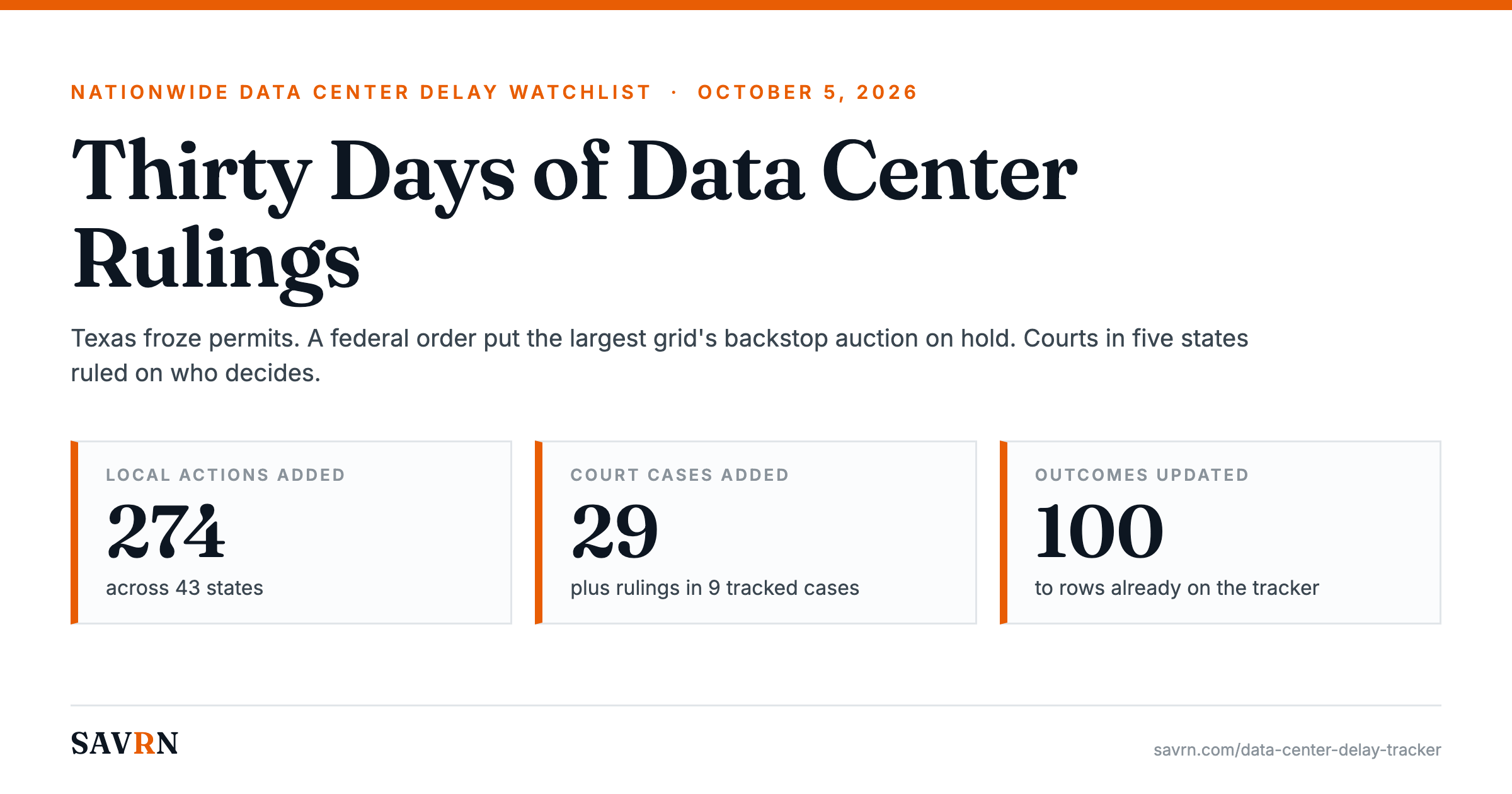
This data center delay tracker update covers the October 5, 2026 edition of the Nationwide Data Center Delay Watchlist. In fact, the record grew more in this edition than in any before it. Specifically, 376 entries were added and 100 existing entries were updated with a vote, a ruling or an order. Local restrictions now stand at 1,037 across 47 states, up from 763. Lawsuits stand at 83, up from 54.
Rather than list every row, this update picks five developments from the last 30 days and reports each one with its source. Meanwhile, every other entry is on the tracker, where each row links to the record behind it.
1. Texas halted state permits for data centers
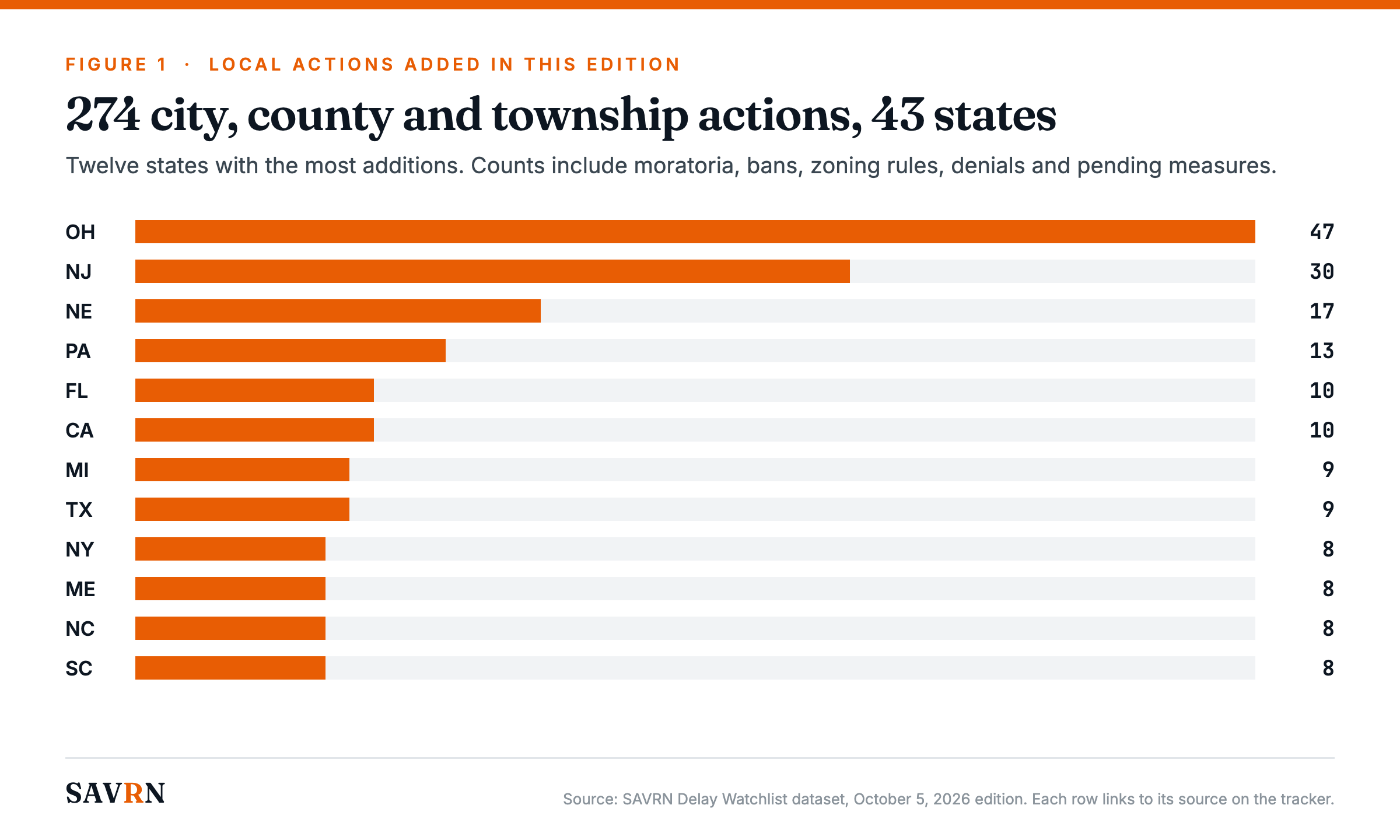
On September 21, Governor Greg Abbott directed the Texas Commission on Environmental Quality to halt all permits sought by data center projects. The halt lasts until ERCOT completes its audit of data centers in the interconnection process. In addition, the directive ties the end of the halt to audits by the Public Utility Commission of Texas and the Texas Water Development Board. Notably, it sets no end date.
The order follows two earlier directives. First, on August 3, the Governor ordered the interconnection audit. Then, on September 14, he ordered enforcement of water use reporting. Accordingly, TCEQ must report on compliance by October 19.
Meanwhile, ERCOT has paused energization of new data center and crypto mining loads of 75 MW or more. Its September board update gave the conditional Batch Zero classifications issued on September 3. Specifically, 204 projects totaling 66.4 GW were conditionally included as base load. Another 158 projects totaling 127.9 GW were classified as studied load. However, 373 projects totaling 302.2 GW were excluded. Ultimately, ERCOT will file its verification and community impact reports with the PUCT by December 10.
Separately, two administrative law judges issued a recommendation on September 23 in El Paso Electric’s request to build a 366 MW gas plant for Meta’s El Paso data center. They recommended approval only if other customers are protected from the plant’s costs for its full life. Otherwise, they said, they would recommend denial. Therefore the decision now rests with the five commissioners, and a final PUCT order is expected by December 7.
2. FERC put the largest grid’s backstop auction on hold
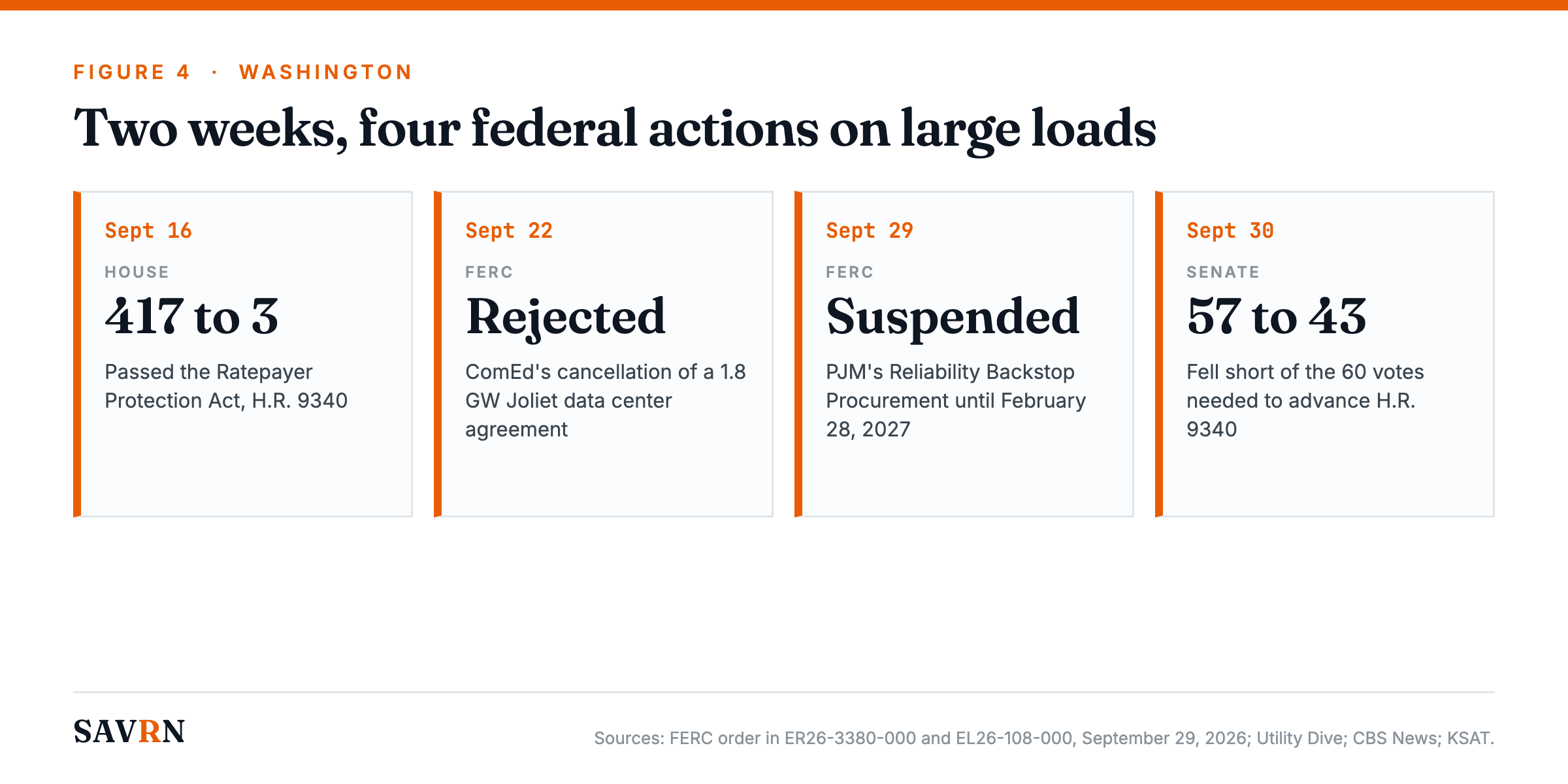
PJM had planned to open its Reliability Backstop Procurement on September 30. Specifically, the procurement is a one-time purchase of new capacity. According to the order, it is needed mainly because of an influx of large loads. On September 29, however, FERC accepted the filing and suspended it for five months, to February 28, 2027.
Furthermore, FERC opened a separate proceeding on three issues: cost allocation, transmission owner exit rules and collateral requirements for load-serving entities. Accordingly, initial briefs are due 45 days from the order. Alternatively, PJM may submit a new filing within 30 days, which the commission encouraged.
Congress moved in the same two weeks. First, the House passed the Ratepayer Protection Act, H.R. 9340, by 417 to 3. In particular, the bill would require utility regulators to consider standards that recover grid costs from large loads such as data centers. Then, on September 30, the Senate fell short of the 60 votes needed to advance it. The vote was 57 to 43. Meanwhile, on the same day, S. 5658 was introduced to prohibit data center construction on federal land.
In addition, FERC rejected Commonwealth Edison’s cancellation of a transmission security agreement for a 1.8 GW data center planned in Joliet, Illinois. However, the commission declined jurisdiction over the underlying dispute, which is before a federal court.
3. Courts ruled six times on who decides
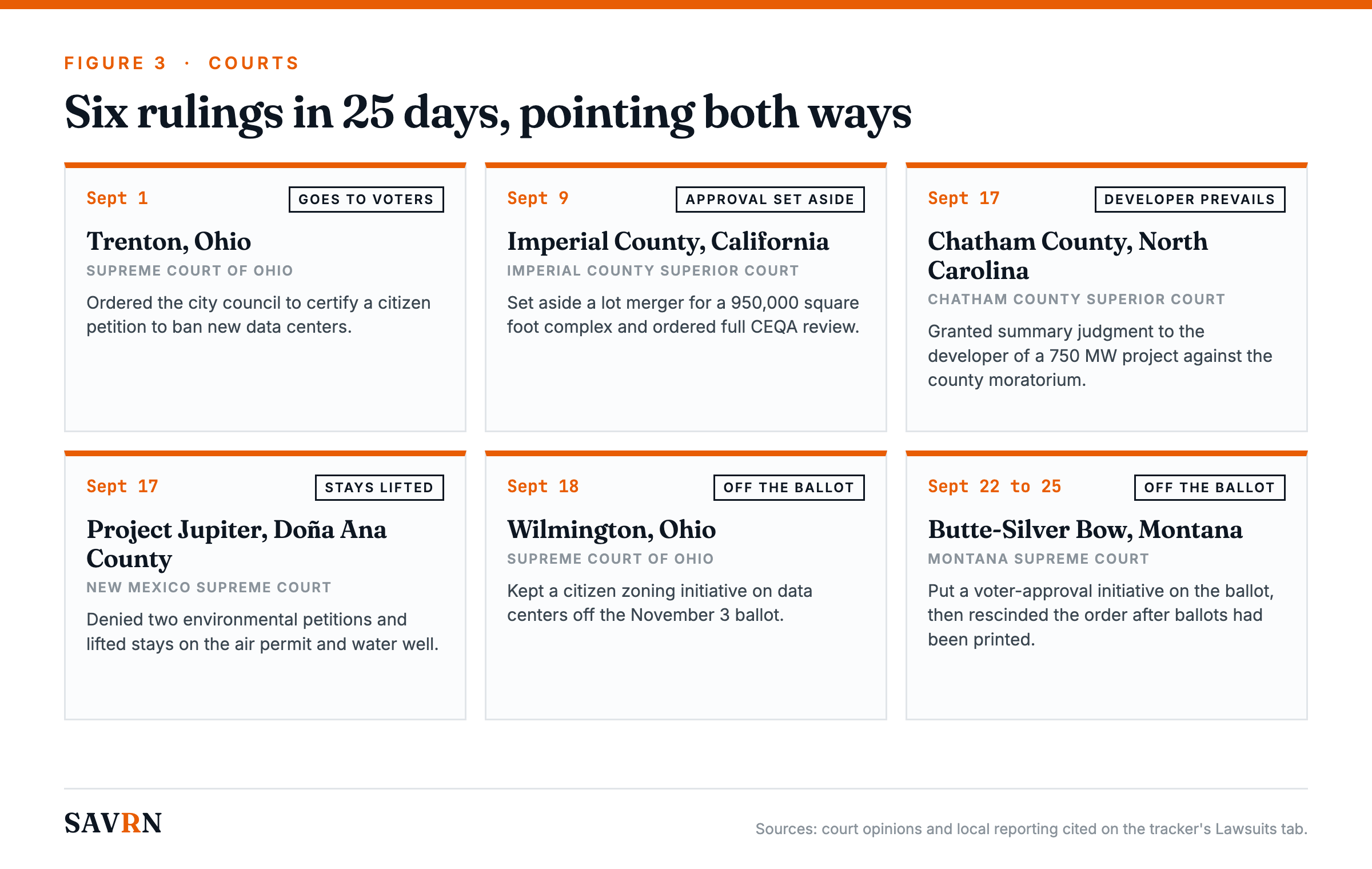
Six rulings in 25 days addressed the same question, although from different directions. Who decides whether a data center gets built: a county board, the voters, or a judge?
In North Carolina, a superior court judge granted summary judgment on September 17 to the developer of a roughly 750 MW project. Specifically, the developer had challenged Chatham County’s 12-month moratorium as applied to its site. As a result, the project can proceed while damages are decided. However, the county has not said whether it will appeal.
In California, by contrast, the result ran the other way. On September 9 an Imperial County judge set aside a lot merger for a complex of about 950,000 square feet. The court held that the county approved it without completing environmental review of the whole project. Nevertheless, the developer said he will seek a new trial.
Ohio’s high court ruled twice. First, it ordered the Trenton City Council to certify a citizen petition to ban new data centers, so the measure goes to voters. Later, on September 18, it kept a Wilmington initiative off the ballot. Specifically, the court held that a clause letting private citizens sue data centers exceeded the city’s power.
In New Mexico, the Supreme Court denied two environmental petitions against Project Jupiter on September 17 and lifted its stays. Consequently, the air permit proceeding resumes, with a state deadline of November 23. Finally, the Montana Supreme Court ordered a Butte initiative onto the ballot on September 22. Two days later it rescinded that order, because ballots had already been printed.
4. Counties moved from pauses to removal
Most local actions are still temporary pauses. However, several large jurisdictions went further in September.
Frederick County, Virginia voted 6 to 1 on September 23 to remove data centers as a permitted or conditional use. The Winchester Star reports it is the first Virginia locality to restrict them this way. Two pending proposals were grandfathered, while the rest of the ordinance took effect. Still, both must reach a public hearing by October 28.
Similarly, Prince William County unanimously reduced its data center overlay district on September 22. Consequently, most future projects there will need a special use permit. Meanwhile, Loudoun County advanced a 12-month pause on new applications, with a final vote expected October 13.
Moreover, the pattern repeated at scale elsewhere:
- Los Angeles County. The planning director ordered an immediate prohibition on large-scale data centers in unincorporated areas on September 17.
- Palm Beach County, Florida. Commissioners gave final approval, 6 to 0, to a one-year moratorium on September 24.
- Pima County, Arizona. Supervisors approved a 120-day moratorium, 3 to 2, on September 22. Since then, the Goldwater Institute has asked the county to rescind it.
- Baltimore County, Maryland. The council unanimously extended its moratorium through December 31, 2027.
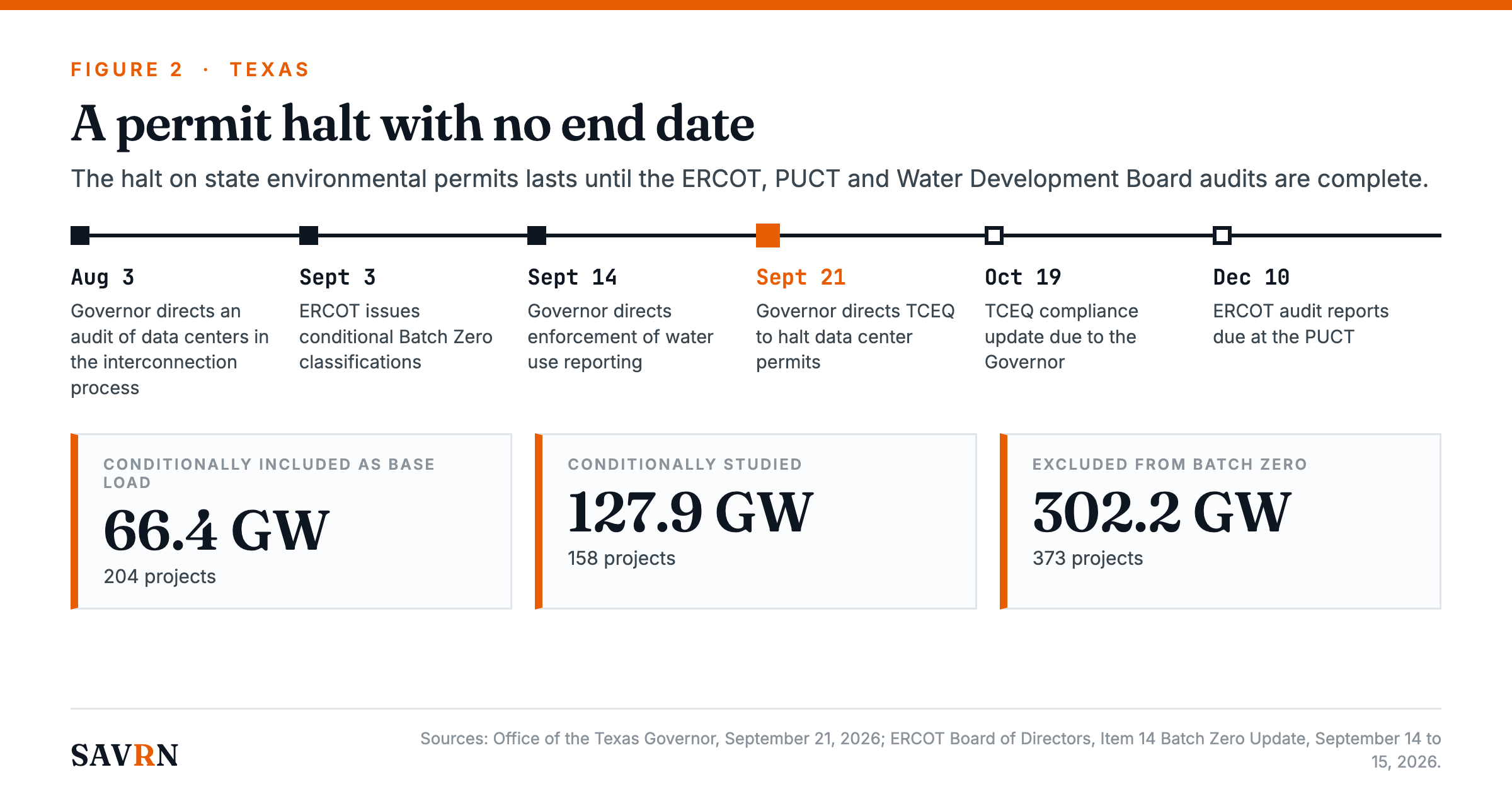
- Ohio, New Jersey and Nebraska. These three states account for 94 of the 274 local actions added in this edition.
States acted as well. For example, California’s governor signed seven data center bills on September 21, including one that removes categorical environmental exemptions. Likewise, in Massachusetts, an executive order now blocks state permits for data centers above 25 MW that lack a community benefits agreement.
5. Two commissions answered the same question differently
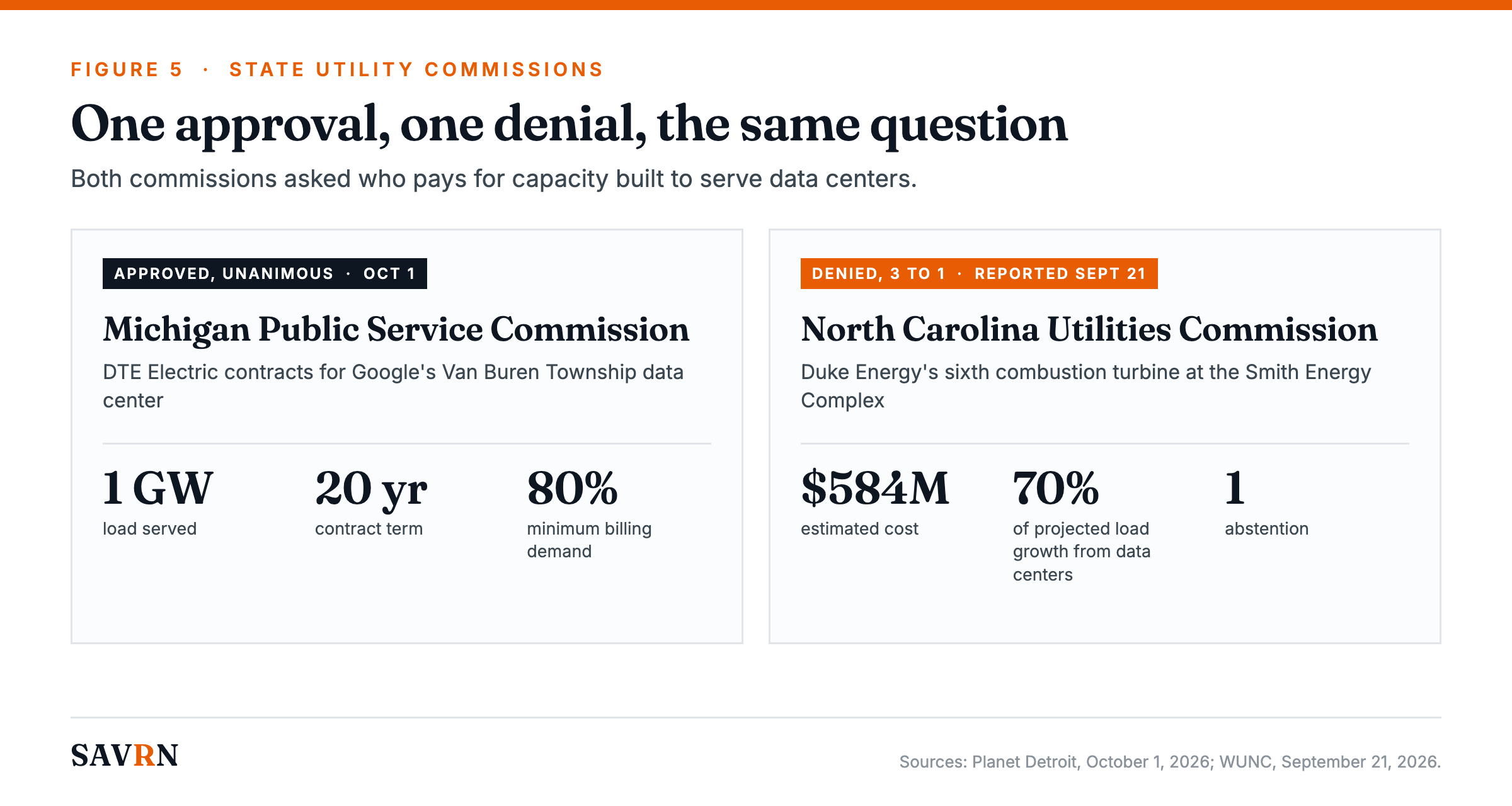
State utility commissions are being asked who pays for capacity built to serve data centers. Notably, two of them answered within ten days.
On October 1, the Michigan Public Service Commission unanimously approved DTE Electric’s contracts for Google’s 1 GW data center in Van Buren Township. The contracts run 20 years, with an 80 percent minimum billing demand. In addition, Google must fund 1,600 MW of renewable energy and 480 MW of storage. Meanwhile, on the same day, the Wayne County Commission overrode a veto of a tax incentive valued at about $125 million.
By contrast, the North Carolina Utilities Commission denied Duke Energy a certificate for a $584 million combustion turbine. The vote was 3 to 1, with one abstention. Specifically, commissioners said about 70 percent of projected load growth comes from data centers. Moreover, they said Duke had not shown how much of the plant would serve those customers or who would bear the cost. However, Duke may resubmit.
Dates to watch
- October 6. Oakland’s council takes up a 45-day moratorium. Enid, Oklahoma votes on three rezonings.
- October 13. Loudoun County’s final vote on a 12-month application pause.
- October 19. TCEQ’s compliance update to the Texas Governor.
- October 28. Deadline for two grandfathered proposals in Frederick County, Virginia.
- November 3. Ballot measures in Boulder City, Nevada and Defiance, Ohio.
- November 23. New Mexico’s deadline to decide the Project Jupiter air permit.
- December 7 and 10. The expected PUCT order on the El Paso plant, then ERCOT’s audit reports.
The count
The October 5 edition holds 286 projects, 161 state and jurisdictional actions, 1,037 local restrictions, 83 lawsuits, 41 federal actions and 264 utility actions. Finally, every entry can be searched on the tracker, and every citation is listed on the sources page. In addition, the companion Data Center Moratorium Tracker maps the policy measures by state.
Frequently asked questions
What changed in the October 5, 2026 data center delay tracker update?
The edition added 376 entries and updated 100 existing ones. Specifically, local restrictions rose from 763 to 1,037, and lawsuits rose from 54 to 83.
Did Texas impose a data center moratorium?
Not by statute. Instead, on September 21 the Governor directed TCEQ to halt permits sought by data center projects until state audits are complete. In addition, ERCOT has paused energization of new data center loads of 75 MW or more.
When does the Texas permit halt end?
The directive sets no end date. Instead, it ends when the ERCOT, PUCT and Texas Water Development Board audits are complete. ERCOT’s reports are due at the PUCT by December 10, 2026.
What did FERC decide about PJM's backstop procurement?
FERC accepted PJM’s filing on September 29 but suspended it until February 28, 2027. In addition, it opened a proceeding on cost allocation, exit rules and collateral.
Did Congress pass a data center electricity bill?
No. The House passed the Ratepayer Protection Act by 417 to 3. However, the Senate vote on September 30 was 57 to 43, short of the 60 needed.
Can a court override a local data center moratorium?
It depends on the facts. For example, in Chatham County, North Carolina, a judge ruled for a developer against the county’s moratorium as applied to its project. By contrast, other courts in this edition ruled for local governments or objectors.
Which states added the most local actions in this edition?
Ohio added 47, New Jersey 30 and Nebraska 17. Meanwhile, Pennsylvania followed with 13, then Florida and California with 10 each.
Which Virginia county removed data centers as an allowed use?
Frederick County. Its Board of Supervisors voted 6 to 1 on September 23, 2026. However, two pending proposals were grandfathered and must reach a public hearing by October 28.
Are regulators approving power for data centers?
Some are, with conditions. For example, Michigan approved 20-year contracts for a 1 GW Google data center. By contrast, North Carolina denied a $584 million Duke turbine over unanswered cost questions.
Where does the tracker's information come from?
From primary records and local reporting: ordinances, meeting minutes, commission orders, court opinions and agency releases. Therefore each row on the tracker links to its source.
Would you like the weekly update?
Every week we re-verify every project on this watchlist and publish what moved. You get one email when it goes out.
Also send me
Receive a short introduction on days 3, 7 and 14, plus the updates you select. Unsubscribe in one click. Privacy
Data Center Delay Tracker Update: October 5, 2026
Get new SAVRN Insights by email
A short introduction on days 3, 7 and 14, plus new SAVRN research articles. Unsubscribe at any time.
We use your address to send the introduction and updates described above. See our Privacy Policy.