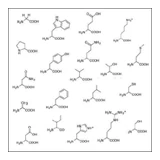
Coley Research Group and ms-pred contributors. ICEBERG 2.1 MassSpecGym-trained msgall checkpoint bundle. Upstream checkpoint documentation. No NIST-derived checkpoints are included. The computational-metabolomics maintainers record MIT based on the upstream software licence; upstream describes these weights as open-source without a separate checkpoint licence statement. This recorded choice does not establish additional upstream permission. The software license is reported separately; it does not replace the model/data license. These are byte-identical upstream files. No model conversion was performed.
SAVRN Model Hub
Open-Weight Models
An open-weight model is an AI model whose trained weights are published for anyone to download. The weights are what the model learned in training. With a copy of them you can run the model on hardware you control and train it further on your own data.
Open weights are not the same as open source. Many publishers release the weights without the training data or code, and the license sets what you may do with the model. This library puts each model's full card, architecture, files, license and published evaluations on one page.
2,760Models
859Datasets
254Papers
1,692Publishers
5,040Sourced relationships
Updated 2026-09-18 · How the library is built
2,760 models, sorted by most downloaded.
Public artifacts for the iclr-debug branch of HazyResearch/MsTok. This repository currently establishes the experiment namespace and contains a training-budget audit. No new model weights or final benchmark claims are implied. Future selected checkpoints and evaluations will be organized by unique run ID and optimizer step. Training budgets must report raw token positions per component, dataset size, global batch, optimizer updates, and LR horizons. Generation reports must label supplied-level-zero versus unconditional sampling and record the reference model precision, entropy, scored-token counts, and per-seed results. See NCM-BUDGET-AUDIT.md for historical budget provenance and…
The Mistral-7B-Instruct-v0.3 Large Language Model (LLM) is an instruct fine-tuned version of the Mistral-7B-v0.3. Mistral-7B-v0.3 has the following changes compared to Mistral-7B-v0.2 It is recommended to use mistralai/Mistral-7B-Instruct-v0.3 with mistral-inference. For HF transformers code snippets, please keep scrolling. After installing mistralinference, a mistral-chat CLI command should be available in your environment. You can chat with the model using If you want to use Hugging Face transformers to generate text, you can do something like this. To use this example, you'll need transformers version 4.42.0 or higher. Please see the in the transformers docs for more information. Note…

This model is a fine-tuned version of GeorgeUwaifo/iviegpt2new01cresults on an unknown dataset. It achieves the following results on the evaluation set: The following hyperparameters were used during training: - learningrate: 5e-05 - trainbatchsize: 4 - evalbatchsize: 8 - gradientaccumulationsteps: 4 - totaltrainbatchsize: 16 - lrschedulertype: linear - lrschedulerwarmupsteps: 387 - numepochs: 5 - mixedprecisiontraining: Native AMP - Transformers 5.16.1 - Pytorch 2.11.0+cu128 - Datasets 4.8.5 - Tokenizers 0.23.1


This model was finetuned and converted to GGUF format using Unsloth. - Meta-Llama-3.1-8B-Instruct.Q4KM.gguf An Ollama Modelfile is included for easy deployment. The model's BOS token behavior was adjusted for GGUF compatibility. This was trained 2x faster with Unsloth


A from-scratch hybrid OCR pipeline for the saeidseyfi/khattat dataset, built by saeidseyfi from 100% free, offline components — no training required, no paid APIs. 1. OpenCV preprocessing — upscale, Otsu/adaptive binarization, deskew, morphology 2. EasyOCR (fa+ar+en) — CRAFT detection + CRNN recognition 3. Tesseract 5 (tessdatabest: fas / ara / eng) — LSTM models with word confidences 4. Confidence ensemble — script detection + weighted candidate selection + language normalization 5. pix2tex (LaTeX-OCR) for math formulas — ViT -> LaTeX + math-token candidate scoring 6. OpenCV contour classification for hand-drawn shapes (10 classes) 7. Caption OCR — first ink cluster below the shape -> en…
Handwritten line recognizer for Persian / Arabic / English text plus math symbols, fine-tuned on the saeidseyfi/khattat dataset (line crops, input 32x256, max 88 label chars). CPU (2-core) budget fine-tune; decoder+head trained, STR backbone frozen The training pipeline is time-budgeted and fully resumable — continuing on a GPU with the same script converges substantially further. - best.pt -- model checkpoint (state dict + vocab) - vocab.txt -- 176-char vocabulary (fa / ar / en / digits / math) - demokhattatparseq.mp4 -- demo: test lines, ground truth vs prediction - evalreport.json, log.txt, worstsamples.json -- metrics
English grapheme-to-phoneme resources for KittenTTS and Kokoro TTS. Downloaded automatically by mlx-audio-swift when using KittenTTS or Kokoro TTS with English voices. Ported from Misaki G2P engine (MIT license).

Automated multi-class knee cartilage segmentation on magnetic resonance imaging (MRI) scans from the Osteoarthritis Initiative (OAI / OAIZIB-CM). This repository provides a deep learning testbed for benchmarking and evaluating 2D, 2.5D, and 3D segmentation architectures on femoral cartilage (FC), medial tibial cartilage (MTC), and lateral tibial cartilage (LTC). - UNet (2D Slice baseline) - Pseudo3D (2.5D Triplet channel-stacking) - nnUNet (2D residual blocks with deep supervision) - TransUNet (Hybrid CNN-Transformer encoder with ViT bottleneck) - UNet3D (Volumetric 3D U-Net with attention gates) 1. Install dependencies: 2. Generate an experiment notebook

local, typed decisions from qwen3.5-2b. one shared state is prefetched once, each question is isolated, every allowed answer is scored as a complete token sequence, and python returns validated choice, score, and noul results. this is an inference system, not rlcd training and not a clone of typesafe jev. it never calls typesafe. the published qwen checkpoint is unchanged; fp8 changes execution precision only. probabilities are normalized support over the candidates you provide, not calibrated correctness probabilities. unlike ordinary autoregressive json generation, the model does not write a response token by token. it scores only the values supplied by the caller. complete-sequence…
Krea 2 model (covering both the Krea 2 Raw and Krea 2 Turbo variants) is released under a custom Krea 2 Community License Agreement for its weights, alongside an Apache-2.0 license for the inference code repository itself. For removal please contact me directly. All rights remain with their respective creators. By downloading or using any model from this repository, you acknowledge that: - You are solely responsible for how the model is used. - The repository maintainer assumes no responsibility or liability for any content generated by these models. - Krea AI, the original model authors (when applicable), and the repository maintainer cannot be held liable for misuse, illegal activities…

Full training-run archive for Kuza (East Africa agricultural assistant), fine-tuned from unsloth/Qwen3.5-4B. Weights, logs, checkpoints, GGUFs, and provenance are stored with the same layout as $KUZAWORKDIR/kuza-qwen-3.5-4b/. This derivative is subject to the Apache 2.0 license of the Qwen base model. - 100% English train from kuzaai/kuzasftenglish - 35% Swahili from kuzaai/kuzasftswahili - 8% HuggingFaceH4/norobots - 5% adversarial from kuzaai/kuzasftadversarial - all multiturn from kuzaai/kuzasftmultiturn Sequence length 1024, 2 epochs, LR 0.0002. Thinking is off (--reasoning off when llama.cpp supports it). GGUFs are text-only (MTP/nextn kept; vision/audio dropped). ssmout is Q6K on…
Model Collections
Hand-picked starting points, each with the reason it exists.
Collection · 4 entries
Embedding models for retrieval
Sentence and document embedding models used to build retrieval systems. Dimension and sequence length matter more than size here, and both come from the publisher.
Collection · 4 entries
Models that fit on one accelerator
Models whose publisher-reported parameter count puts them within reach of a single accelerator at common precisions. Memory needed depends on precision and serving configuration, so treat the parameter count as the starting point, not the answer.
Collection · 6 entries
Open-weight text models worth knowing
Widely used open-weight language models, chosen because each one is a distinct family rather than a variant of the one above it. Selection, not a ranking.
Collection · 3 entries
Speech and audio models
Recognition and synthesis models, grouped so the two directions are easy to compare.
Open-Weight Models Explained
What is an open-weight model?
An AI model whose trained weights are published for anyone to download, so it can be run, tested and fine-tuned on hardware the user controls.
Is an open-weight model the same as open source?
Not always. Open weights means the trained model can be downloaded. Open source usually also means the training code and data are available and the license allows broad reuse. Many open-weight models release the weights only.
Can I use an open-weight model commercially?
It depends on the license. Apache 2.0 and MIT allow commercial use. Other licenses limit it, for example to non-commercial use or below a set number of users. Every model page here shows its license.
How much memory does an open-weight model need?
About two bytes per parameter at 16-bit precision, so a 7-billion-parameter model needs roughly 14 GB for its weights, plus memory for the context it processes. Each model page lists its parameter count and the size of its files.
Related SAVRN Research
The hub sits beside SAVRN's market data and infrastructure research: what models cost to run, and what it takes to run them.
SAVRN Index
What open models cost to run
The same open-weight model priced by every host that serves it, per million tokens.
Research Hub
Data center trackers and maps
Moratoriums, permits, power, water and capital behind the facilities that run these models.
Method
How the Model Hub is built
Sources, evidence labels, refresh behaviour, and the limits of every comparison here.