AI Data Center Construction Cost: The 2026 Capex Math Guide
What a megawatt costs in 2026, where the dollars go, and why the schedule is the biggest line item on the budget.
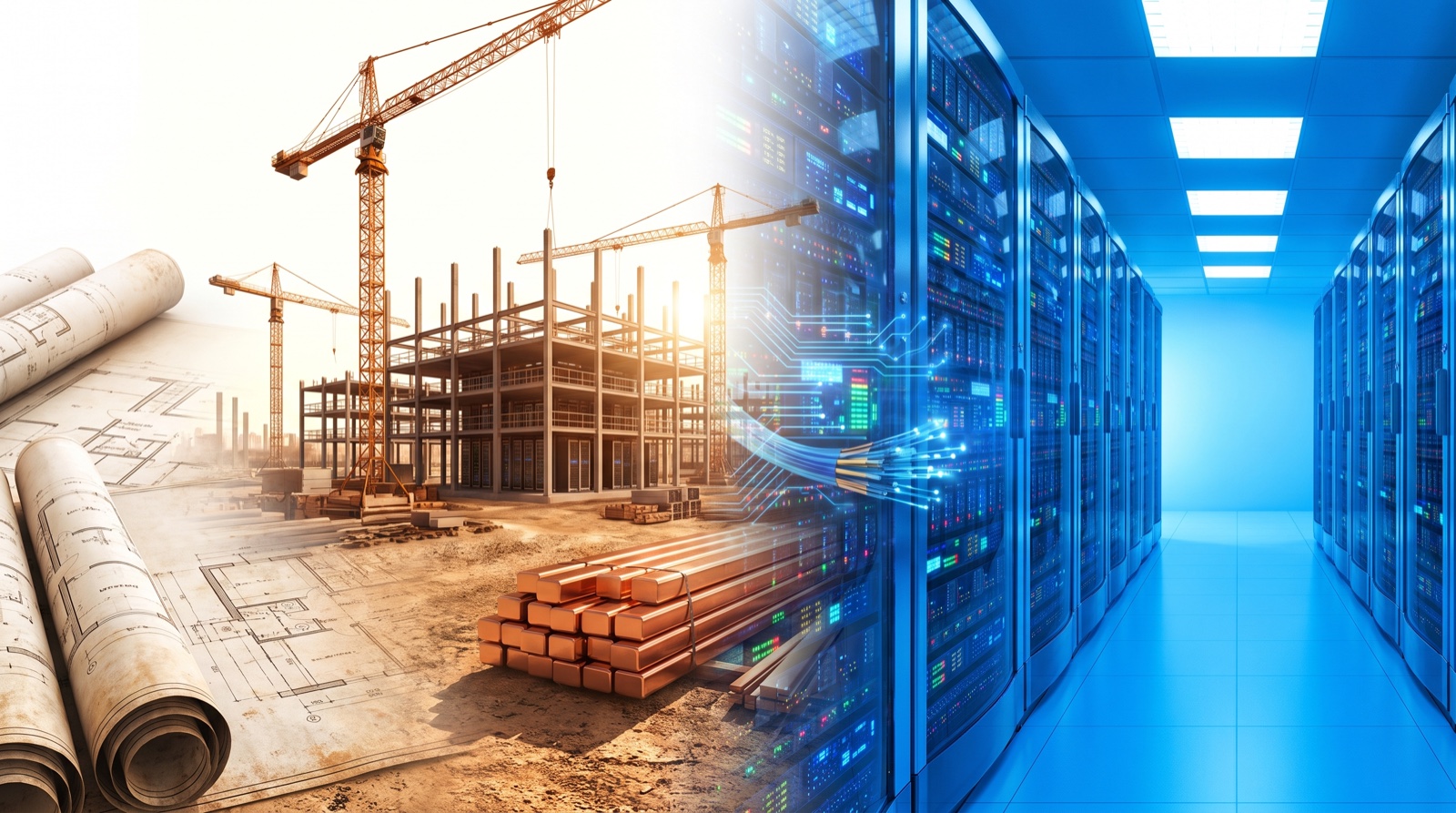
The AI data center construction cost question has a 2026 answer, and it is bigger than most capex models admit. A traditional powered shell now runs $12.9 to $15.2 per watt in the most expensive markets, per the Turner & Townsend Data Centre Construction Cost Index 2025-2026, and liquid-cooled AI capacity adds 7 to 10 percent on top. Load the compute in, and the all-in number climbs toward $50 million per megawatt. I have sat across the table from teams pricing these builds, and the pattern repeats: the building is no longer the expensive part. The schedule is.
This brief walks the 2026 capex math from the ground up: what a megawatt costs, where the dollars actually go, what tariffs and labor are doing to the number, and why the operators who compress the schedule beat the operators who compress the budget. Every load-bearing number here is sourced and current.
The full data behind this guide, claim by claim, lives on our construction cost research page.
Why the AI data center construction cost is now a treasury problem
The scale forced the move. FactSet reports that combined capital spending by the five largest hyperscalers is expected to exceed $690 billion for fiscal 2026, roughly $800 billion for the calendar year once finance leases are counted, with estimates above $900 billion by 2028. Meanwhile, the Center for Strategic and International Studies puts the planned United States AI data center buildout at roughly $1.44 trillion. Consequently, numbers that size stop being a facilities line item. They become the balance sheet.
For the CFO, two numbers now decide the project. First, the capex per megawatt of IT load. Second, the months from authorization to first token. Both drive net present value, and the second one is routinely underestimated. A finished megawatt earns nothing while it waits, and in 2026 the waiting is where projects die.
Where the dollars actually go
The AI data center construction cost stack has been rearranged by rack density. Turner & Townsend’s United States trade breakdown makes the shift concrete. On an air-cooled build, electrical work including equipment takes 54 percent of the cost, mechanical takes 22 percent, and the core and shell take 14 percent. On a liquid-cooled AI build, mechanical jumps to 33 percent while the shell shrinks to 9 percent. In other words, the money is leaving the building and moving into the systems inside it.
Specifically, the driver is the rack. A current-generation NVL72-class AI rack draws 135 kilowatts of design power and up to 155 kilowatts at peak, with roughly 90 percent of the heat rejected to liquid. Conventional halls were designed around racks a tenth that size. Consequently, everything electrical and thermal has to be rebuilt around a fundamentally denser machine, and the trades feel it first. The IBEW’s own publication reports that electrical work runs 45 to 70 percent of total data center construction cost, and that single projects now demand two to four times the membership of the union locals hosting them.
Escalation and tariffs: the 2026 numbers
Cost escalation did not cool off. It changed shape. The Associated General Contractors of America reports that the producer price index for inputs to nonresidential construction jumped 8.4 percent year over year in mid-2026, the steepest climb since the pandemic. Underneath the average: aluminum mill shapes up 48.8 percent, copper and brass mill shapes up 26.8 percent, and structural steel up 15.6 percent. Notably, contractor bid prices rose only 3.5 percent over the same period, which means contractors are absorbing the spread for now. However, that cushion does not last.
Moreover, policy is a direct input to the number. Section 232 tariffs on steel and aluminum were doubled to 50 percent in 2025, and a 50 percent copper tariff followed that August. Because roughly half of United States aluminum and about a quarter of its steel is imported, tariff design flows straight into the data hall budget. An operator pricing a 2027 delivery against 2024 material assumptions is carrying a silent gap in the model.
Labor is the constraint capital cannot buy
Meanwhile, every one of these builds lands on the same workforce. Associated Builders and Contractors estimates the industry must attract 349,000 net new workers in 2026 and 456,000 in 2027 just to meet demand, with retirements driving most of the gap. The Bureau of Labor Statistics projects electrician employment growing 9 percent through 2034, with about 81,000 openings a year across the decade. Against that supply, single campuses are requesting a thousand or more electricians for five to ten years at a stretch.
Therefore, labor strategy is now capex strategy. An operator without a labor pipeline pays the spot premium on every hall, and the premium compounds with every competing campus in the region. Prefabrication is the counter: the more of the build that happens on a production line instead of a jobsite, the fewer scarce field hours the project consumes. This is one of the quiet reasons factory-built capacity is winning the 2026 cost race.
The long-lead ladder
Some of the AI data center construction cost is not a price problem at all. It is a calendar problem. The National Electrical Manufacturers Association has documented transformer lead times averaging 120 weeks after two years of steady climb. More recent industry survey data reported by POWER magazine puts large power transformers at 128 weeks, generator step-up units at 144 weeks, and high-voltage switchgear near 44 weeks, with transformer prices up 45 to 77 percent since 2019 and a 30 percent supply shortfall estimated for 2025. We cover the full equipment picture in the AI data center supply chain brief and the transformer shortage brief.
The implication is therefore blunt. A transformer ordered the day a project is authorized arrives almost three years later. As a result, the operators who win are the ones holding equipment slots before the project exists, because the deposit on a slot is a rounding error against the value of on-time energization.
Time is the biggest line item on the budget
Here, finally, is the math the spreadsheet usually misses. The median project sat in a United States interconnection queue for 60 months in 2025, up from 20 months in 2005, per an Advanced Energy United progress report prepared by The Brattle Group, with over a million megawatts still backlogged. Meanwhile, the buildout keeps demonstrating what the calendar is worth. Epoch AI’s site-by-site tracking shows Stargate Abilene at roughly two and a half years from groundbreaking to 1.2 gigawatts, with most sibling campuses on three-year schedules, against a program valued at $500 billion for more than 9 gigawatts. Run that division and the all-in commitment lands near $50 million per megawatt once compute is included. Every idle month strands the return on that entire stack.
In fact, the market’s response tells you how much speed is worth. Meta went as far as erecting weatherproof tent structures over AI capacity at one Ohio campus, six rapid-deployment halls in a spring, because its first five conventional buildings there took years each. When the largest builders on earth choose tents over concrete, they are pricing the schedule, and the schedule is winning. Fluidstack’s $50 billion United States program with Anthropic was announced with sites coming online within about a year, for the same reason. Nobody is planning around a four-year wait anymore. They are engineering around it.
How we take the cost out
SAVRN builds AI factories, and we compress the AI data center construction cost by owning the parts of the problem that inflate it. First, we own the power. Our campuses run on-site generation behind the meter, so the 60-month interconnection queue is not on our critical path. The behind-the-meter power brief and the natural gas turbines brief cover that engineering in depth. Second, we own the manufacturing. Liquid-cooled pods, cooling skids, and power enclosures come off our Fort Worth line pre-integrated and pre-tested, which converts scarce field labor hours into factory hours we control. Third, we own the cooling. The closed-loop liquid cooling system ships married to the compute it serves, so commissioning takes days instead of quarters and the campus draws no municipal water. Finally, we pre-position the long-lead equipment, holding transformer, switchgear, and generation slots ahead of specific projects.
Each decision alone trims the number. Together they change its shape: a SAVRN campus lands at $9 million to $12 million per megawatt and reaches first token in 6 to 12 months, against an industry standard of 24 to 48 months. The deployment timeline brief walks that schedule step by step. The give-more-than-you-take rule my grandparents taught me applies here too, because the same choices that compress our cost, on-site power and closed-loop cooling, are the choices that leave the town’s grid and water untouched.
A worked 100 megawatt example
Consider a 100 megawatt AI campus authorized in early 2026. Under conventional procurement, the project files for interconnection and joins a queue with a 60-month median, orders transformers on a 128-week lead time, and competes for field electricians on the open market. Realistic first token lands in 2030 or 2031. At tier-one market pricing near $13 to $15 million per megawatt for the facility alone, the project carries roughly $1.4 billion of capital that earns nothing for four years, while the compute it was designed for ages a full hardware generation.
Under the integrated path, the same 100 megawatts runs on pre-positioned on-site generation, factory-built pods, and pre-tested cooling. First token lands inside 12 months at $9 million to $12 million per megawatt, roughly $0.9 billion to $1.2 billion total. However, the capex delta is not even the headline. The two to four years of earlier revenue is. At the all-in capital intensities the 2026 market is committing, the value of those years exceeds the entire facility budget. The comparison is not close, and it is why we treat schedule as the first engineering requirement rather than the last.
Keep going
The AI data center construction cost is one face of a bigger operating model. For the adjacent decisions, read the natural gas turbines operator brief on the generation that makes on-site power real, the grid interconnection brief on the queue math, the supply chain brief on the equipment ladder, and the tokens per watt per dollar brief on the operating economics the capex ultimately serves. The full claim-by-claim citation record for this piece lives on the construction cost research page.
Frequently asked questions
What is the AI data center construction cost per megawatt in 2026?
A traditional air-cooled facility runs $12.9 to $15.2 million per megawatt in the most expensive world markets, per Turner & Townsend’s 2025-2026 index, with liquid-cooled AI capacity adding 7 to 10 percent. By contrast, lower-cost United States markets land meaningfully below that band. All-in with compute, current gigawatt-scale programs imply roughly $50 million per megawatt.
How much of the cost is the building itself?
Less than most people expect, in fact. On a liquid-cooled AI build, the core and shell take roughly 9 percent of the budget, while electrical systems take about 48 percent and mechanical about 33 percent. In other words, an AI data center is an industrial machine wearing a building, not a building with computers in it.
Why did liquid cooling change the cost stack?
Because the racks left air cooling no choice. A current NVL72-class rack draws 135 kilowatts with roughly 90 percent of its heat rejected to liquid. Consequently, the mechanical share of the budget grew from 22 percent to 33 percent, and cooling engineering moved from a trade line to a core design decision.
What are tariffs doing to the AI data center construction cost?
As of 2025, steel and aluminum carry 50 percent Section 232 tariffs and copper carries a 50 percent tariff as well. Construction input prices rose 8.4 percent year over year by mid-2026, with aluminum shapes up nearly 49 percent. Since imported material feeds every hall, tariff policy now flows directly into project budgets.
How bad is the construction labor shortage for data centers?
The industry needs an estimated 349,000 net new workers in 2026 and 456,000 in 2027, and electricians are the sharpest gap: single campuses now request more electricians than entire union locals can supply. Therefore prefabrication, which shifts work from the jobsite to a factory floor, has become a cost strategy rather than a convenience.
What equipment has the longest lead time?
Generator step-up transformers at roughly 144 weeks, large power transformers near 128 weeks, and high-voltage switchgear around 44 weeks, per 2026 industry survey data. Accordingly, equipment slots secured ahead of the project, not equipment prices, decide when a campus energizes.
How long does a conventional AI data center take to build?
Industry-standard hyperscale campuses run 24 to 48 months of construction, and grid-dependent projects add an interconnection queue with a 60-month median wait. By contrast, integrated builds with on-site power and factory-built modules have demonstrated 6-to-12-month timelines to first token.
Does a faster build actually cost less?
Yes, twice over. First, a shorter schedule cuts soft costs directly, because financing fees, project management, and idle capital all scale with duration. Second, earlier energization pulls years of revenue forward. At 2026 capital intensities, the value of starting two years sooner exceeds the construction savings themselves.
Is it cheaper to build in Texas?
Generally yes. Land, labor availability, gas pipeline access for on-site power, and faster large-load processes give Texas and the central United States a meaningful edge over coastal markets, which is part of why so much of the national buildout is concentrating there. Our Fort Worth manufacturing line adds a further advantage for campuses in the region.
What is the SAVRN construction cost advantage?
We build the campus as one machine: on-site power instead of a queue, factory-built liquid-cooled pods instead of field assembly, closed-loop cooling that ships pre-tested, and long-lead equipment pre-positioned on our balance sheet. As a result, a SAVRN campus lands at $9 million to $12 million per megawatt with first token in 6 to 12 months.
Want the next one?
When a new piece publishes on SAVRN Insights, you get one email with what it covers and a link to read it. No digests, no promotions.
Also send me
One email when it publishes. Unsubscribe in one click. Privacy