AI Data Center Natural Gas Turbines: 2026 Operator Brief
Turbine slots, not turbine prices, now decide when AI capacity ships. The 2026 operator brief on the gas turbine orderbook and the fast paths around it.
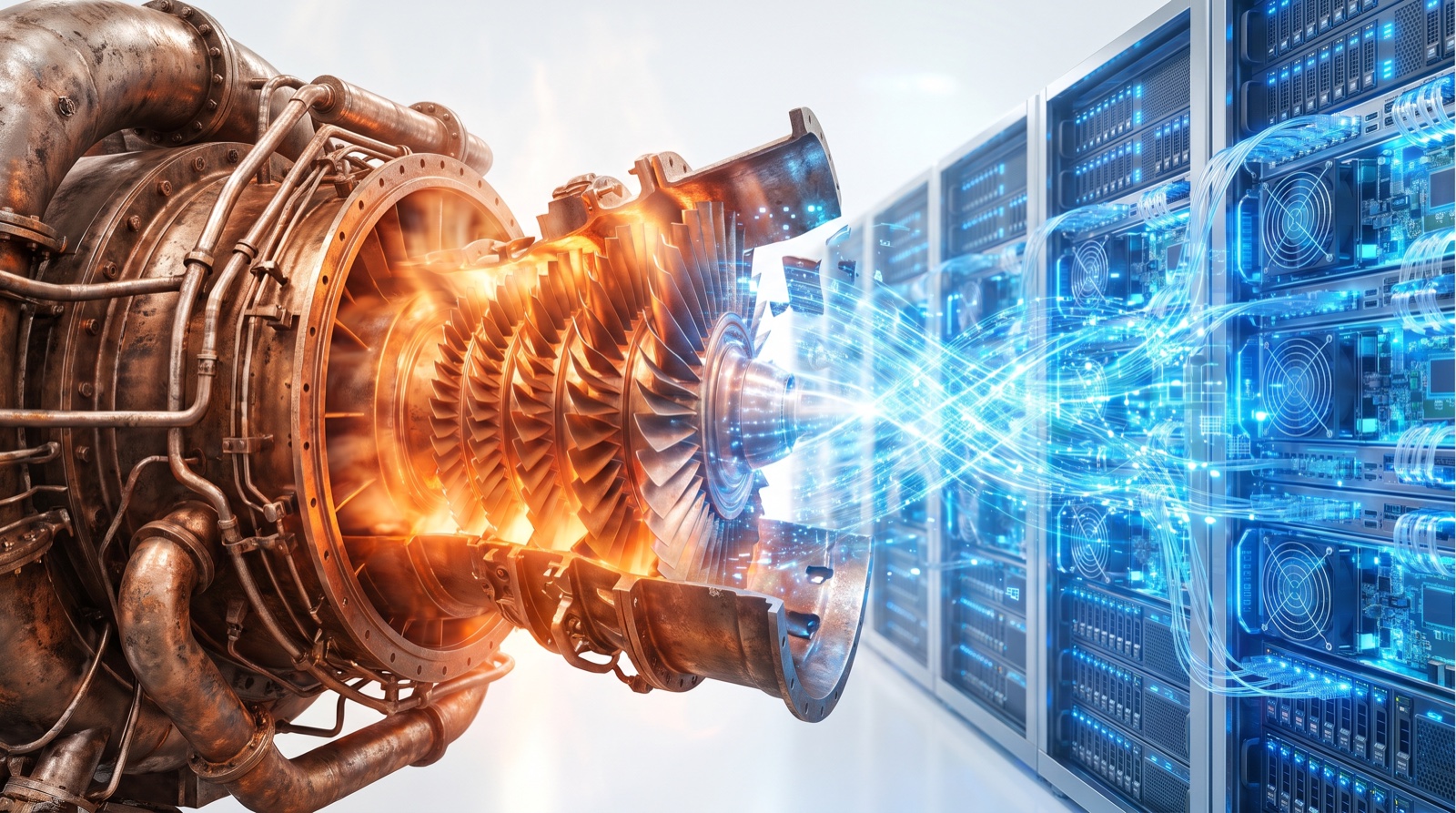
AI data center natural gas turbines have become the single most consequential procurement decision in AI infrastructure, because the machines are effectively sold out. GE Vernova ended the second quarter of 2026 with a $176 billion total backlog and gas turbine production slots mostly gone through 2030. Siemens Energy is carrying a record €162 billion backlog of its own. I watch this market every week, and the conclusion has not changed all year: the turbine slot, not the turbine price, decides when an AI campus ships.
This brief is the 2026 operator playbook. It covers the orderbook at all three major manufacturers, what a combined-cycle megawatt now costs and when it can actually arrive, the engine and aeroderivative fast lane that is quietly powering the biggest AI campuses in the country, and the gas supply side of the equation. Every load-bearing number is sourced and current.
The full data behind this brief, claim by claim, lives on our gas turbines research page.
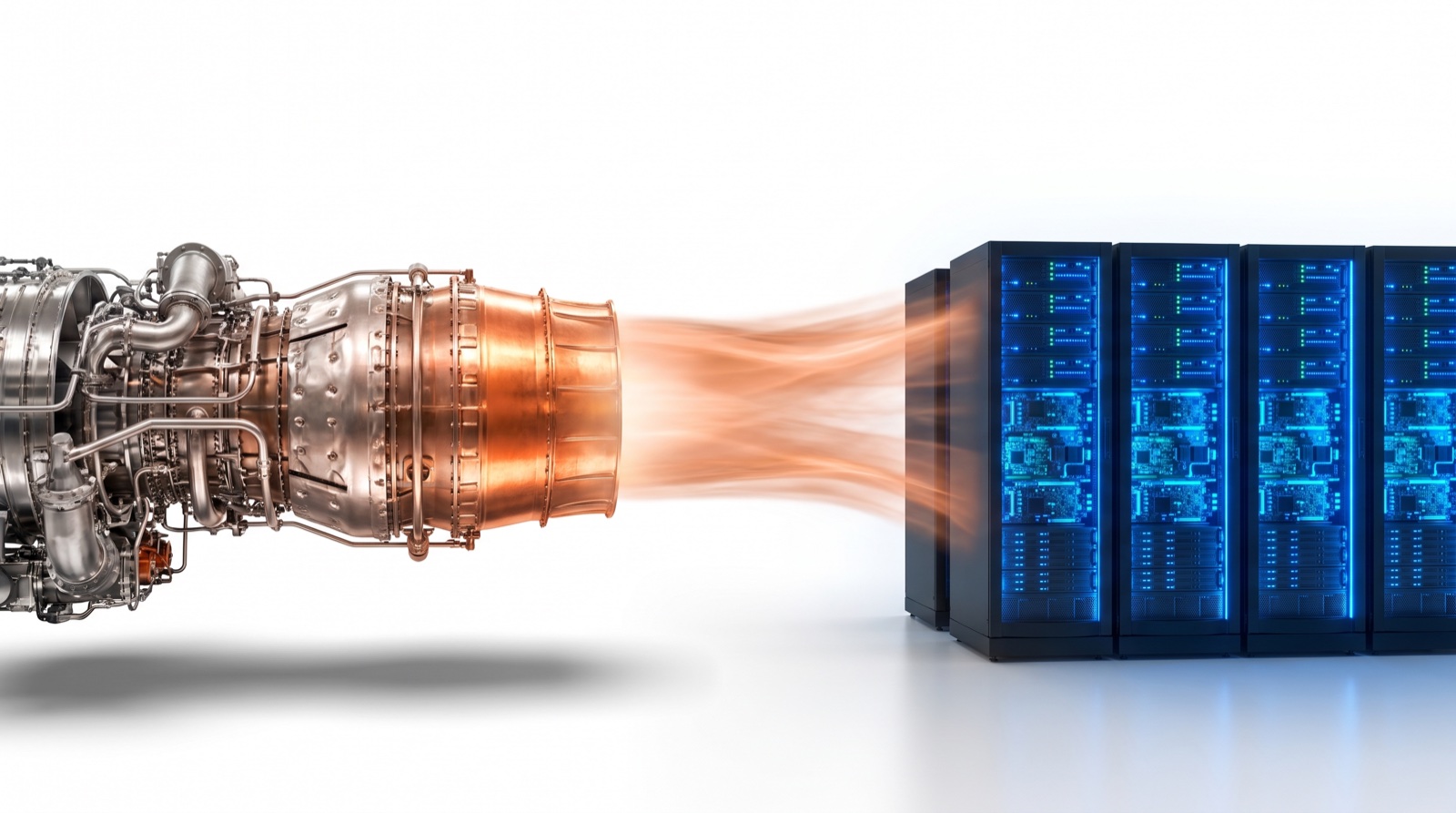
Why AI data center natural gas turbines are the binding constraint
The demand did not come from the grid. It came from around the grid. Because interconnection queues now run years, AI builders moved generation onto their own sites, and gas became the workhorse. Enverus forecasts roughly 62 gigawatts of new United States data center capacity through 2030, with behind-the-meter projects making up about 40 percent of what gets installed. Similarly, trade tracking counts about 56 gigawatts of behind-the-meter data center generation planned across 46 United States projects, and 90 percent of it was announced in a single year. We wrote the queue math behind that pivot in the grid interconnection brief and the behind-the-meter power field guide.
Meanwhile, manufacturing capacity cannot stretch that fast. Heavy-duty turbine production depends on hot-section superalloy castings from a small number of qualified foundries, and a new casting line takes years to stand up. Consequently, three demand waves, AI campuses, utility resource adequacy, and industrial on-site power, are all pulling against a production system sized for a slower decade.
The 2026 orderbook by the numbers
GE Vernova’s second quarter told the story in one line: orders up 88 percent year over year, with Power segment orders up 134 percent to $16.7 billion. The company is ramping gas turbine output from about 20 gigawatts a year toward 24 in 2028 and a targeted 30 by 2030, and it expects more than half of its 2031 production slots to be sold before 2026 ends. Earlier in the year, its gas turbine backlog plus slot reservations crossed 100 gigawatts, and it is spending $160 million to expand the Greenville, South Carolina plant that anchors its heavy-duty line.
Siemens Energy is running the same race. Its gas services division closed the June quarter with a firm turbine backlog near 69 gigawatts after booking 15 gigawatts of new orders in three months, and company lead times now stretch to three years or more. Notably, its chief executive has sized the addressable gas turbine market at up to 120 gigawatts a year, roughly half of it in the United States. Mitsubishi Heavy Industries, the third member of the heavy-duty triopoly, is investing more than $618 million to double its large gas turbine production capacity by fiscal 2030, citing the United States data center wave directly.
Therefore the market has stopped behaving like a catalog and started behaving like an allocation. All three OEMs now require reservation fees simply to hold a manufacturing slot. One utility disclosed paying a $25 million reservation fee for a single turbine delivering at the end of the decade, and the same research concludes that new combined-cycle plants often cannot come online until at least 2030 or 2031. An operator writing a 2027 energization date against an unreserved heavy-duty slot is writing fiction.
What a combined-cycle megawatt costs now

Price followed scarcity. Combined-cycle projects completing in 2026 and 2027 reported costs of $1,116 to $1,427 per kilowatt, while projects targeting 2030 and 2031 completion now routinely report $2,000 per kilowatt or more, as much as 75 percent higher. In addition, every turbine still needs its generator step-up transformer, and those carry their own multi-year waits and their own price curve; we cover that ladder in the transformer shortage brief and the wider supply chain brief.
For scale, the engineering rules of thumb still hold. A modern heavy-duty H-class unit anchors several hundred megawatts of combined-cycle output at the best heat rates in the thermal fleet. F-class units run somewhat smaller and less efficient. Aeroderivative machines deliver tens of megawatts each with fast starts, and reciprocating engines deliver single-digit to low-double-digit megawatts per unit with the shortest factory queues of all. That hierarchy matters, because in 2026 the class you choose is mostly a decision about which line you are willing to stand in.
The fast lane: engines, aeroderivatives, and fuel cells
While the heavy-duty queue stretches to the end of the decade, the smaller iron is moving now, and the biggest AI builders have noticed. Caterpillar posted a record $20.5 billion quarter with power generation retail sales up 72 percent on data center demand, and is restarting production of a 10-megawatt gas engine to bring 1.5 gigawatts of annual capacity back online. Wärtsilä just booked a 412-megawatt engine order for a single Ohio hyperscale campus, its fourth United States data center award, pushing it past 1.6 gigawatts sold. INNIO locked a framework agreement reserving 1.25 gigawatts of gas engine capacity over three years, and Cummins is supplying gas generator sets for a fully off-grid behind-the-meter AI campus in West Texas.
The aeroderivative story is the same. PROENERGY is delivering thirteen 50-megawatt aeroderivative gensets, 650 megawatts in total, for AI factory sites, every unit factory-built and tested before it ships. Beyond combustion, Bloom Energy signed an agreement covering up to 2.8 gigawatts of fuel cells for a single hyperscaler’s AI buildout, after once deploying a system in 55 days. In fact, the fastest gigawatt-class campus in the country ran this exact play: SemiAnalysis documented xAI standing up its first Memphis site in 122 days and bridging its second on gas turbines and batteries while the permanent plant followed.
The lesson generalizes. First capacity comes from the classes that ship soonest. Heavy-duty units then anchor the long-run baseload economics when their slots arrive. A campus designed around a single turbine class inherits that class’s queue; a campus designed around a layered fleet energizes on the fastest layer.
The proof on the ground
The biggest sites in the country are already built this way. Homer City in Pennsylvania is converting a former coal site into up to 4.4 gigawatts of gas-fired capacity for AI load, with seven heavy-duty turbines and first deliveries beginning in 2026. In Ohio, Williams is building two 200-megawatt behind-the-meter generation sites with in-service dates inside 2026, power that never touches the interconnection queue. Stargate’s flagship Texas campus pairs on-site gas generation with grid supply for the same reason. These are not experiments anymore. They are the operating pattern of the buildout.
Gas supply is the other half of the decision
A turbine without firm gas is a sculpture. As a result, the pipeline market is repricing alongside the turbine market. Energy Transfer signed its first direct data center supply deal, up to 450,000 MMBtu per day of firm supply to a single Texas campus, enough gas for roughly 1.2 gigawatts of on-site generation under a ten-plus-year commitment. Kinder Morgan’s project backlog reached $9.6 billion, over 60 percent of it serving power generation demand. Industry tracking counts more than 150 United States pipeline projects in motion, much of the backlog made of smaller laterals connecting data centers to gas-fired power. Accordingly, a serious operator locks the gas contract and the lateral schedule in the same motion as the turbine slot, because either one alone is worthless on the energization date.
Permitting rides alongside. Combustion generation at campus scale brings federal air permitting, state programs, and emissions controls, typically a 12-to-24-month path that must run in parallel with manufacturing rather than after it. None of it is exotic. All of it is schedule.
How SAVRN builds around the queue
SAVRN builds AI factories with the power plant designed in from the first drawing, and the turbine market above is exactly why. First, we pre-position. Generation slots, step-up transformers, and switchgear are reserved on our balance sheet ahead of specific projects, because a reservation fee is a rounding error against a stranded campus. Second, we layer the fleet. Reciprocating engines and aeroderivative units energize the first tranche in months, while heavy-duty capacity anchors the long-run economics when its slot matures. Third, we manufacture. Our Fort Worth line builds the liquid-cooled pods, enclosures, and skids that pair with the generation, so the campus assembles on our schedule instead of a field contractor’s. Finally, we close the loop on heat: the closed-loop liquid cooling system is engineered against the generation plant as one thermal system, and it draws no municipal water.
That is how a SAVRN campus reaches first token in 6 to 12 months against an industry standard of 24 to 48, at $9 million to $12 million per megawatt; the full capex math lives in the construction cost brief and the schedule detail in the deployment timeline brief. The same design choice keeps the promise that matters to the towns that host us: because the campus generates its own power and cools in a closed loop, it takes nothing from the local grid and nothing from the local water supply.
Keep going
The turbine decision sits inside a larger machine. For the adjacent moves, read the construction cost brief for the full 2026 capex stack, the behind-the-meter power field guide for the bypass economics, the grid interconnection brief for the queue everyone is escaping, and the tokens per watt per dollar brief for the operating metric all this generation ultimately serves. The claim-by-claim citation record for this piece lives on the gas turbines research page.
Frequently asked questions
How long does it take to get AI data center natural gas turbines in 2026?
It depends entirely on the class. Heavy-duty slots at the major manufacturers are mostly sold out through 2030, and new combined-cycle plants often cannot come online before 2030 or 2031. By contrast, reciprocating engines and aeroderivative units are delivering inside one to two years, which is why they carry the first tranche of nearly every fast AI campus.
Why are heavy-duty turbine slots sold out through 2030?
Because three demand waves hit at once: AI campuses buying on-site generation, utilities replacing retiring coal capacity, and industrial customers adding their own power. Meanwhile, hot-section casting capacity, the true bottleneck, expands on a multi-year timeline. Production is ramping from about 20 gigawatts a year toward 30 by 2030, against an addressable market sized at up to 120.
What do gas turbines for data centers cost per kilowatt?
Combined-cycle projects completing in 2026 and 2027 reported $1,116 to $1,427 per kilowatt, while 2030-2031 completions now report $2,000 or more. In other words, the price rises with the wait, so deferring procurement costs money twice: once in escalation and once in lost operating months.
What is a turbine slot reservation fee?
All three major manufacturers now require a deposit simply to hold a place in the production line, separate from the purchase contract. Disclosed fees run into the tens of millions per machine. Importantly, a reserved slot is a tradeable, schedule-defining asset, while an unreserved capex authorization is only a plan.
Can an AI campus run entirely on reciprocating engines?
Yes, and several do. Fleets of 2-to-20-megawatt gas engines deliver campus-scale power with the shortest lead times and excellent modularity, at somewhat higher heat rates than combined cycle. Consequently, many operators energize on engines and layer in larger units later, rather than waiting for a single heavy-duty machine.
How much gas does a 200 megawatt AI campus consume?
As a working figure, a combined-cycle plant serving 200 megawatts at high capacity factor burns roughly 30 million cubic feet per day, with simple-cycle configurations burning more. Therefore firm transportation, secured by contract on a specific pipeline with a specific in-service date, belongs in the same decision as the turbine itself.
Are gas turbines compatible with carbon capture later?
Modern heavy-duty platforms are engineered so a post-combustion capture system can be added downstream, and several announced AI power projects advertise hydrogen-enabled or capture-ready designs. Feasibility still depends on site space, steam integration, and transport infrastructure, so the option is preserved at design time or not at all.
What permits do on-site gas turbines require?
Campus-scale combustion triggers federal air permitting with best-available-control-technology review, plus state air, water, and noise programs, typically 12 to 24 months depending on the air basin. Accordingly, disciplined operators run permitting in parallel with manufacturing so the paperwork and the iron finish together.
Do fuel cells compete with gas turbines for AI campuses?
Increasingly, yes, as a complement more than a replacement. Fuel cell agreements now reach gigawatt scale for AI buildouts, with individual systems deployed in under two months. However, combustion turbines and engines still carry the bulk of firm, campus-scale generation, so most real fleets blend the technologies.
How does SAVRN secure AI data center natural gas turbines?
We hold pre-positioned reservations across generation classes, pair each one with its transformer and switchgear slots, and build the surrounding campus on our Fort Worth manufacturing line while the iron is in production. As a result, the customer-facing timeline is 6 to 12 months to first token, regardless of where the heavy-duty queue stands that quarter.
Want the next one?
When a new piece publishes on SAVRN Insights, you get one email with what it covers and a link to read it. No digests, no promotions.
Also send me
One email when it publishes. Unsubscribe in one click. Privacy