America Is Building Again: The Data Center Jobs Boom
The data center boom is unpopular. It is also putting more Americans to work with their hands than ever before, and the counties that set good terms will feel it for a generation.
Richland Parish, Louisiana, has about 19,600 people, while this year between 8,000 and 10,000 workers have been on a single construction site there on a given day, building Meta’s Hyperion campus 1. In fact, that is the clearest picture I know of what data center jobs look like right now. One hotel in nearby Monroe has charged $380 a night, against about $120 for the same chain in Baton Rouge, and RV spaces rent for $1,000 a month 1. Meanwhile, Meta says the project has already put $1.6 billion into local contracts and $1 billion into local infrastructure 2.
Abilene, Texas, tells the same story, although the details differ. Specifically, Oracle says the Stargate campus there created 9,000 immediate construction jobs 3, and a local homebuilder, Gene Lantrip, puts the number of temporary workers and their families in town at about 14,000 4. By his account, residential contractors pay $15 to $20 an hour, while data center work pays $40 or more, plus per diem 4.
Talk to people in either place and you hear two things at once. First, there is frustration: the traffic, the rents, the power bill, and the feeling that something enormous arrived without anyone asking. Second, there is something harder to say out loud at a public meeting: there is more work than anyone has seen in years, and it pays.
While both reactions are fair, I want to spend this piece on the second one, because the national data now show it plainly. The build-out of data centers, power plants and the grid is the largest hands-on building program this country has run in decades, and it is still early.
Why I built the power map
I am a tech guy at heart, so when the arguments about data centers got loud this year, I did what I always do and went looking for the data. Specifically, I wanted to know whether the build-out was changing anything for ordinary people outside the server halls, or whether it was just a story about a few big companies.
Ultimately, the answer turned into the U.S. Power Supply Chain and Demand map, which went live this week on savrn.com. Specifically, it ties together the generation pipeline, grid operators, data center demand, the jobs report, electricity prices and local policy for every state, and for 3,134 counties. In total that is 3,186 pages, each built from EIA, BLS, BEA and Census records plus our own trackers. As a result, a resident of Loudoun County or Taylor County can now see what changed in their own place since 2019, side by side with their neighbors.
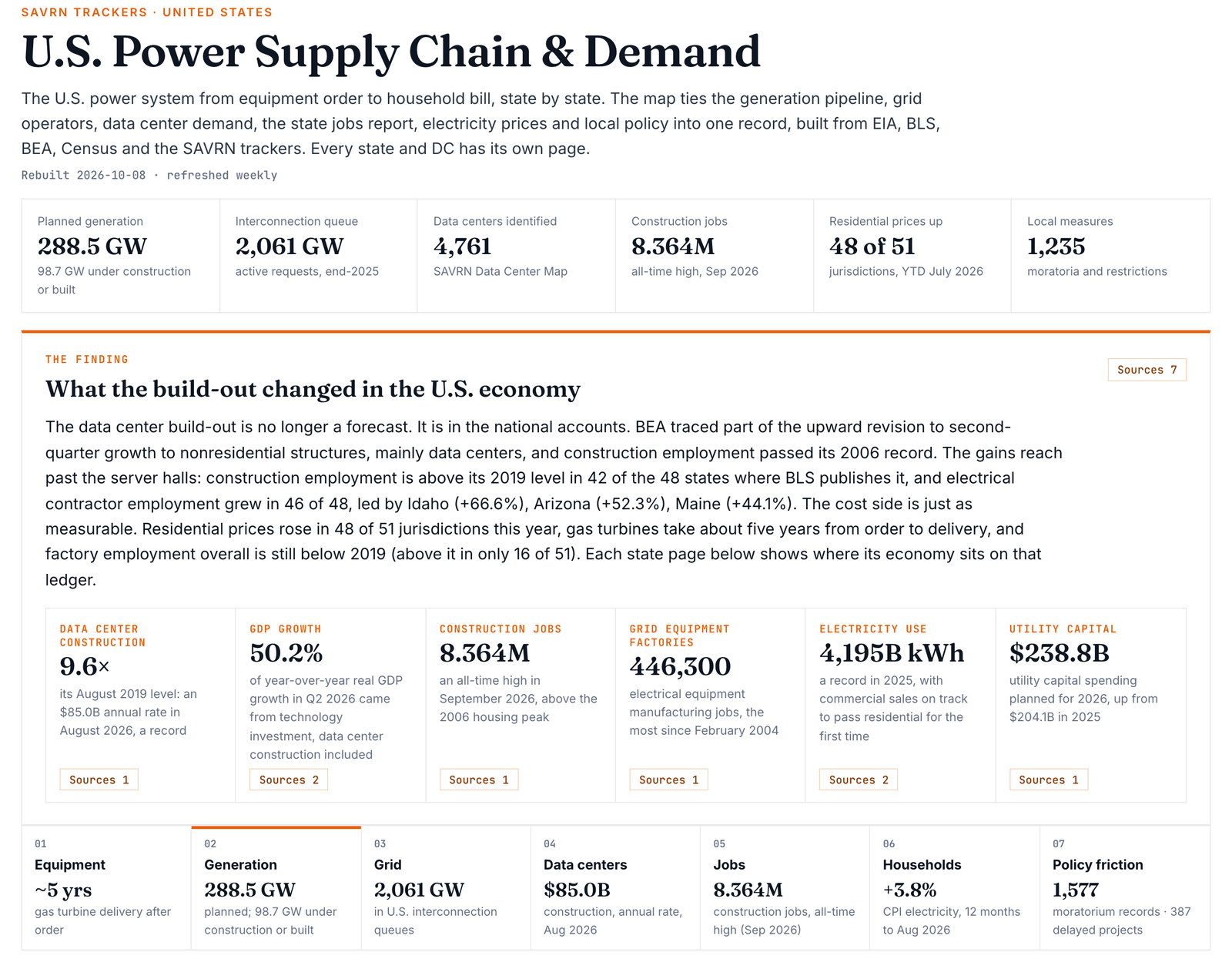
This post is the argument that map supports. In short, the build-out has put more Americans to work with their hands than at any point in the nation’s history. Power costs have gone up too, and I will get to that, because people are right to be angry about it. Despite that, I think this is one of the best openings for American workers in a generation, and the communities that set good terms will feel it for decades.
The numbers in one place
Table 1 holds the main figures in this post. Each one comes from the agency, filing or report listed at the end, while the county figures come from the power map.
Table 1 Key figures as of 8 October 2026, with the source for each
More Americans work in construction than ever before
In September 2026, 8.364 million Americans worked in construction, which is the most ever recorded 5. The old record was set in April 2006, while the housing bubble was at its height, at 7.726 million 5.
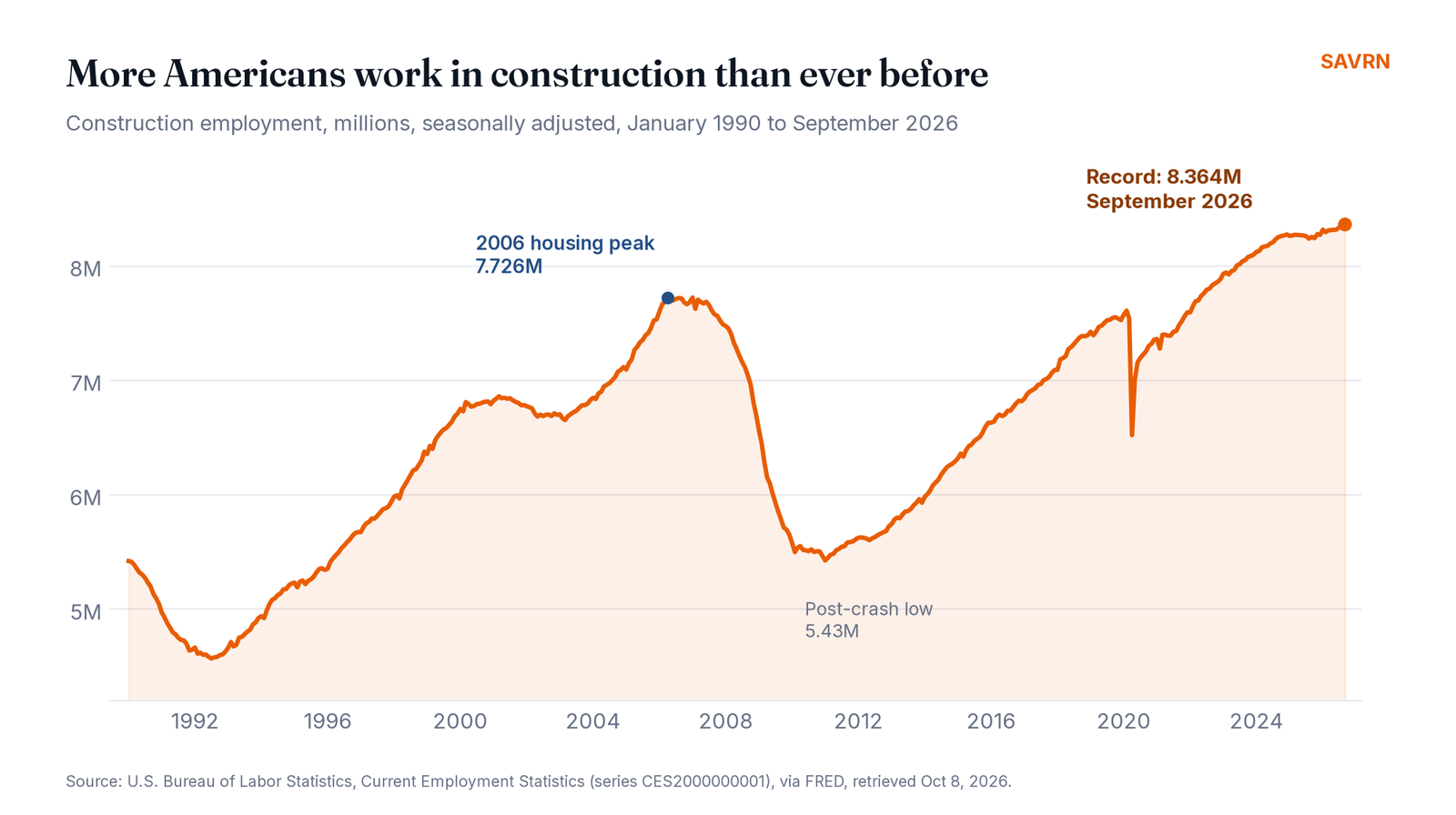
That earlier boom ended in foreclosures. Afterward, the industry spent more than a decade climbing back, the pandemic knocked it down again, and it did not pass the 2006 peak until May 2022 5. In fact, today’s construction workforce is 11.1% larger than it was in August 2019 5. Moreover, the work driving it is not houses. Instead, it is concrete pads, steel frames, switchyards, substations, transmission lines and generating plants.
Where the money is going
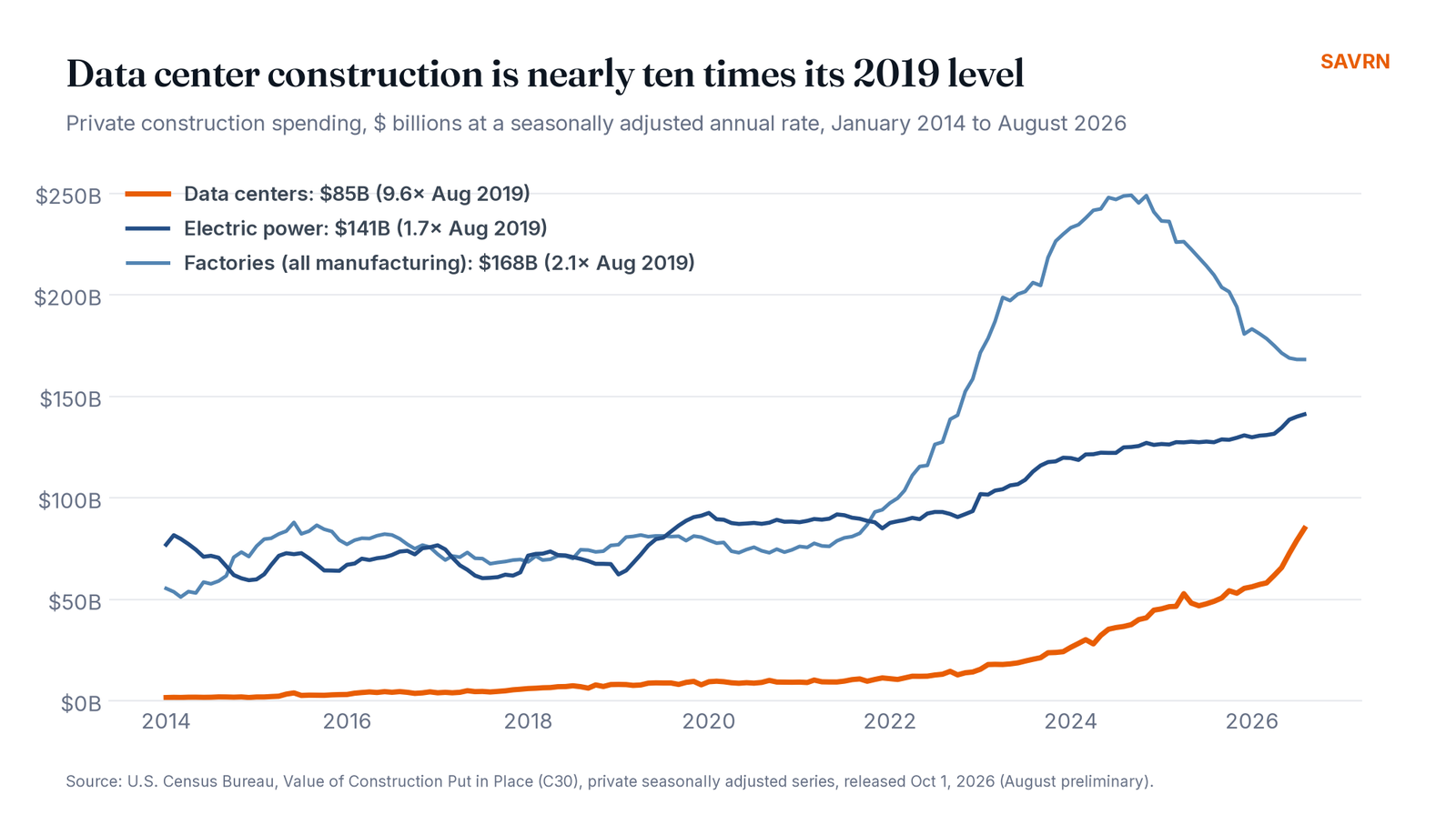
In particular, you can see the shift in the Census Bureau’s construction spending data. For example, in August 2026, private data center construction ran at a record $84.95 billion annual rate 6. That is 73% more than a year earlier and 9.6 times the August 2019 level 6. Similarly, private electric power construction ran at $141.2 billion, up 69% from 2019 6.
Behind those numbers sit two very large capital budgets. First, Big Tech’s capital spending passed $400 billion in 2025 and is set to rise about 75% in 2026 7. Second, investor-owned utilities spent $204.1 billion on their systems in 2025, and in addition they plan $238.8 billion for 2026 and $1.4 trillion over 2026 to 2030 8.
It shows up in the whole economy
This is no longer a niche trend. When the Bureau of Economic Analysis revised second-quarter 2026 growth up to 2.2%, it specifically named nonresidential structures, led by data centers, as one of the leading contributors to the upward revision in fixed investment 9. In addition, ING estimates that technology investment, including data center construction, made up 50.2% of year-over-year GDP growth that quarter 10. However, on ING’s narrower measure of computers and software, the share is 36% once imports are netted out 10.
Because I read these releases for a living, I can tell you that a line like that one from BEA is rare, since federal statisticians do not usually name a building type when they explain a GDP revision.
The factories are coming back, starting with the ones that feed the grid
While a data center is a building full of computers, it cannot run without the machines that make and move power: turbines, engines, transformers, switchgear, breakers and cable. For most of the last thirty years, America bought much of that equipment from abroad. In fact, as of 2025, about 80% of U.S. power transformer supply was imported 11.
Demand ran ahead of supply
Demand has now run so far ahead of supply that waiting is no longer an option. For example, in 2025 a gas turbine took about five years to arrive after it was ordered, against about two years in 2021 12. GE Vernova alone holds 116 gigawatts of turbine backlog and slot reservations, and it expects most of its planned 2030 output to be contracted by the end of 2026 13.
Grid equipment is just as tight, since lead times for the large transformers that connect power plants to the grid passed 160 weeks in early 2026 14. As a result, transformer prices are up 77% since 2019 15.
New plants, close to the customer
When equipment is that scarce, manufacturers build factories close to their customers. That is happening now:
- Virginia Transformer is building a plant in Muscle Shoals, Alabama, that will employ 1,100 people 16.
- Hitachi Energy is putting $528 million into a transformer factory in Gallman, Mississippi, with more than 700 jobs and more than double the capacity of its existing Mississippi plant 17.
- Siemens Energy committed $1 billion and 1,500 jobs to U.S. manufacturing 18.
- Eaton is adding more than 1,200 jobs at a new Arkansas plant 19, in addition to 700 at a $340 million transformer plant in Jonesville, South Carolina 20.
- ERMCO is opening a 566,000-square-foot distribution transformer plant in Arizona with more than 500 jobs 21.
- HD Hyundai Electric is building a second plant in Montgomery, Alabama 22.
- Cleveland-Cliffs, the dominant U.S. maker of the specialty steel that goes into transformer cores 23, is spending $200 million to raise that output by up to 25% at its Butler, Pennsylvania works 24.
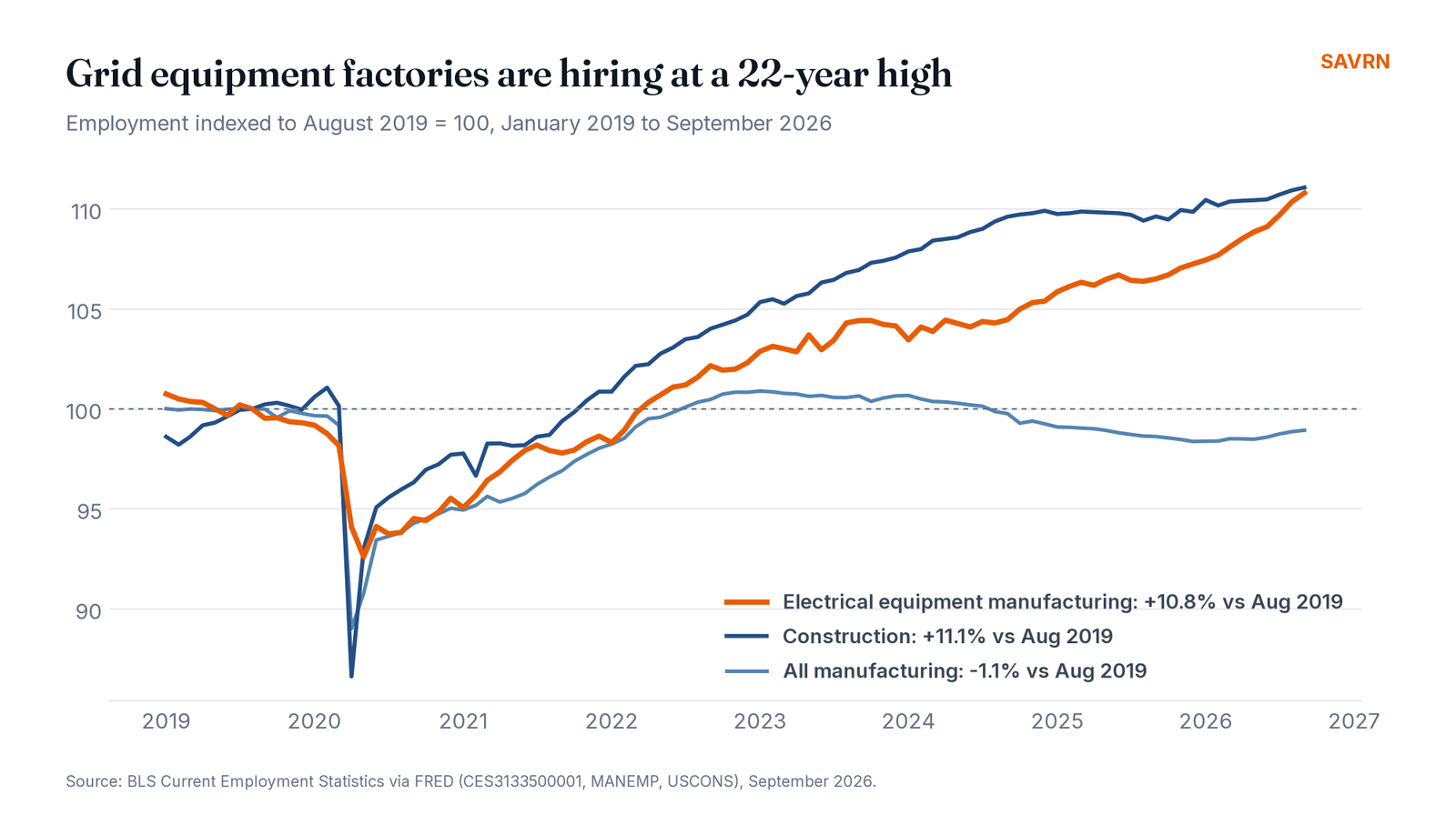
The jobs data back this up: employment in electrical equipment and appliance manufacturing reached 446,300 in September 2026, the highest since February 2004 25.
The comeback is not everywhere yet
Factory employment overall, however, is a different picture, and I want to be clear about it. Total manufacturing employment is still about 1% below its 2019 level 26. Furthermore, spending on new factory construction has fallen 32% from its September 2024 peak as a wave of chip and battery plants finished 6. On the power map, similarly, factory employment is above its 2019 level in only 16 of 51 states and DC. In other words, while the manufacturing comeback is real, it is strongest in the factories that feed the power system, which is exactly where you would expect it to start.
Backlogs that keep crews busy for years
Meanwhile, the companies that do the physical work are carrying record backlogs:
- Quanta Services, the grid construction contractor, reported a record $53.4 billion backlog 27.
- MasTec reported a record 18-month backlog of $21.4 billion 28.
- Primoris reported a record $13.9 billion 29.
- Caterpillar’s backlog reached about $72.1 billion 30, while its power generation sales rose 29% from a year earlier 31.
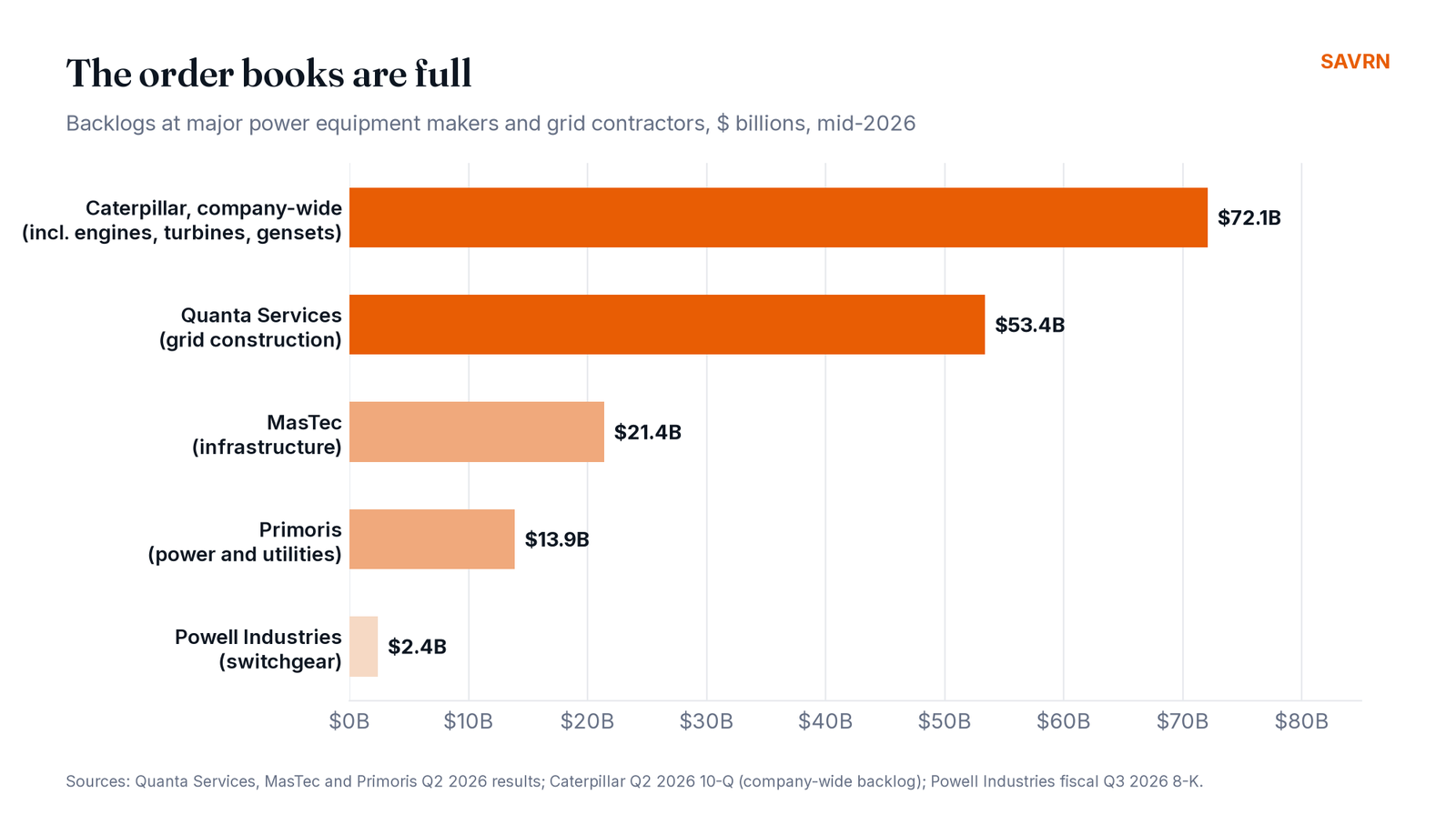
Because a backlog is work already signed, these numbers describe crews that will be on job sites through the end of the decade, whatever the next headline says.
What the power map shows, county by county
While national totals are useful, nobody lives in a national total, so this is the part of the research I care about most. First, we joined the BLS county employment census for 2019 and 2025 to the EIA generator inventory and the Census population estimates for every county with published data, and then we looked at what moved.
Here is what came back:
- Electrical contractor employment grew in 46 of the 48 states where BLS publishes it, led by Idaho at 66.6%, Arizona at 52.3% and Maine at 44.1%.
- Construction employment, similarly, is above its 2019 level in 42 of those 48 states.
- In the 1,044 counties where BLS discloses electrical contractor jobs for both years, the count rose from 820,233 to 940,138 and grew in 750 of those counties.
- Across 1,467 counties, 315,482 megawatts of generating capacity has come online since 2019, led by solar, wind, batteries and natural gas.
- States have 288.5 gigawatts of generation planned, and 98.7 gigawatts of it is already under construction or built.
These are SAVRN calculations from public federal data, and every county page shows its own sources. One caution matters: BLS counts a job where the employer is based rather than where the crew works. Consequently, a Dallas electrical firm wiring a site in Abilene shows up in Dallas County. Rural host counties therefore look smaller in these tables than they feel on the ground.
Richland Parish, the small-town case
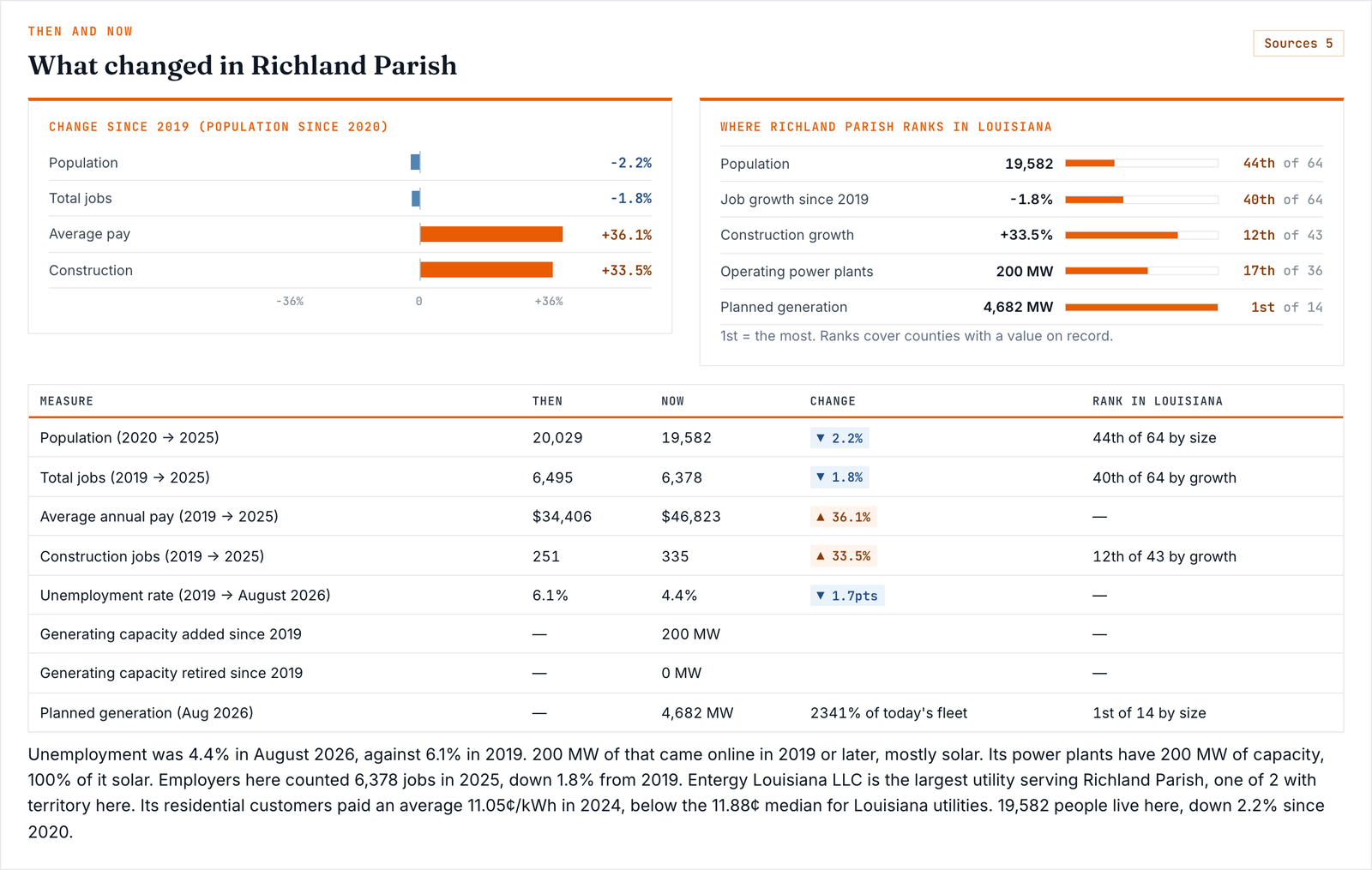
Richland Parish is the clearest example of that effect: the parish counted 6,378 jobs in 2025, slightly fewer than in 2019, even with thousands of workers on the Hyperion site, because most of those workers are employed by firms based elsewhere. Nevertheless, the local figures moved. For example, average annual pay rose 36.1%, from $34,406 to $46,823. Likewise, construction jobs based in the parish grew 33.5%. Meanwhile, unemployment fell from 6.1% in 2019 to 4.4% in August 2026. In addition, the parish now has 4,682 megawatts of generation planned, the most of any parish in Louisiana and more than 20 times its current fleet.
Loudoun County, the mature case
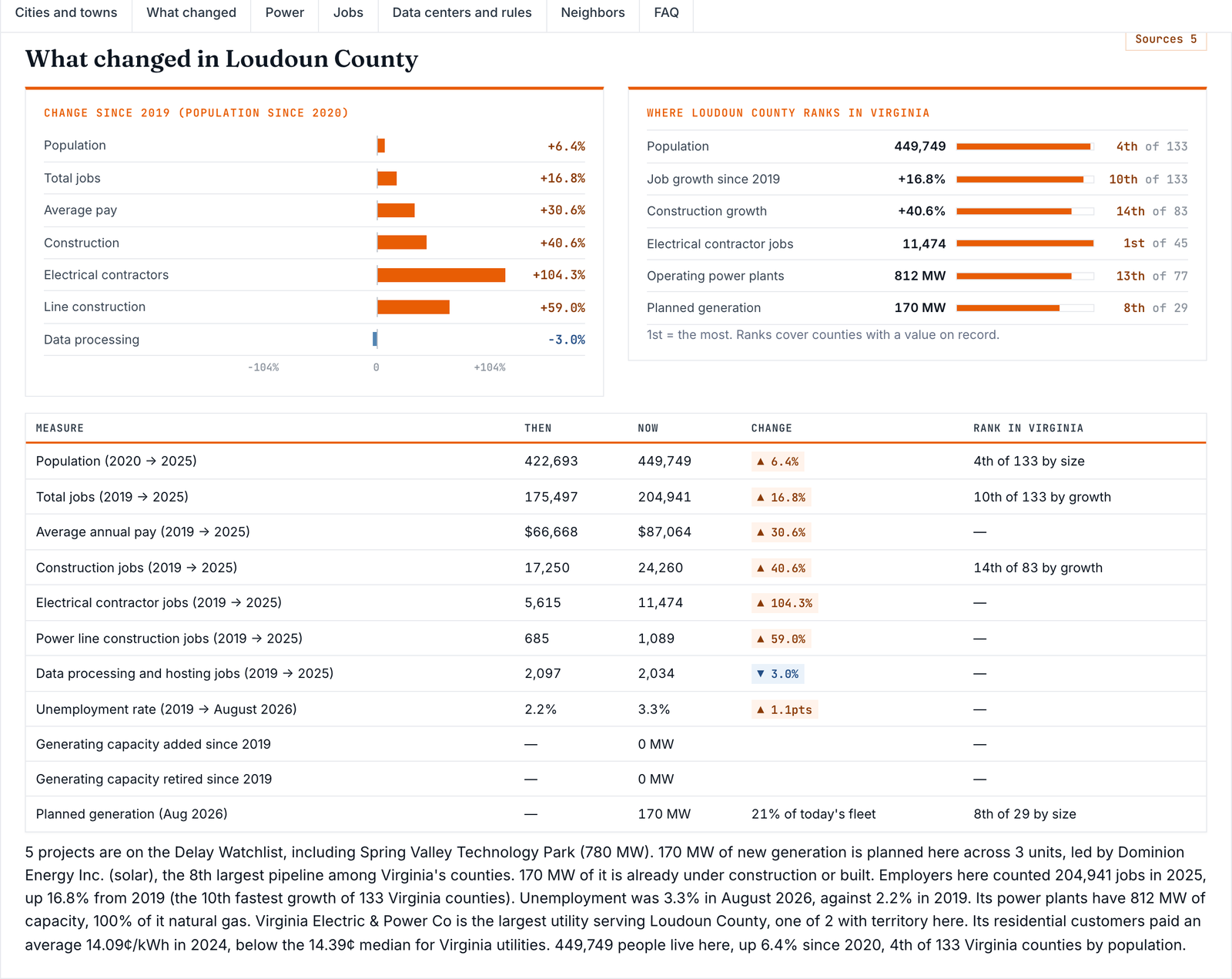
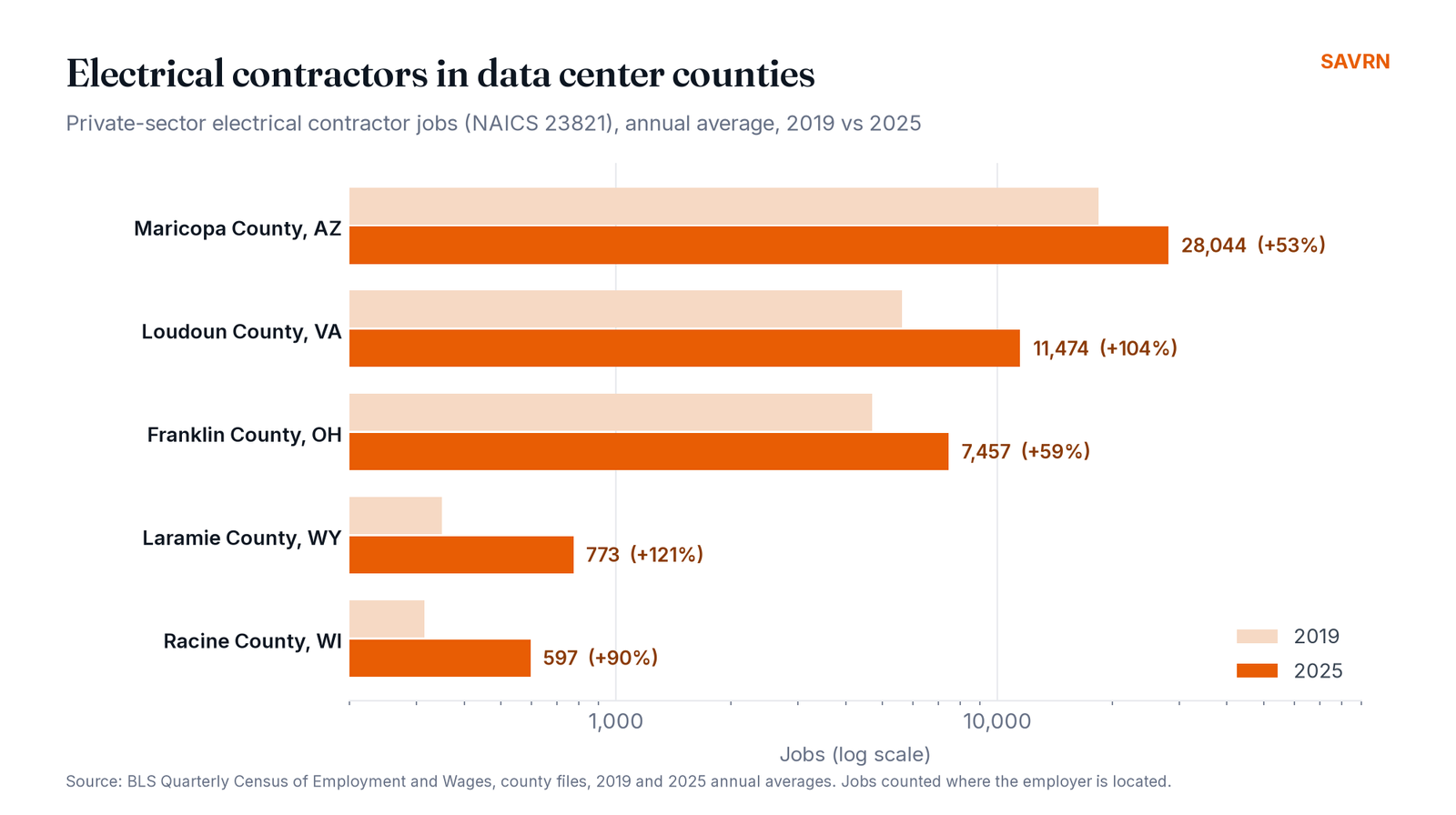
By contrast, Loudoun County, Virginia, is what a mature host county looks like. Its electrical contractor workforce more than doubled between 2019 and 2025, from 5,615 to 11,474 jobs, at an average pay of $111,334 32. In fact, that is the most of any county in Virginia. In addition, total jobs grew 16.8%, average pay rose 30.6%, and construction jobs grew 40.6% to 24,260.
What that means in dollars
It helps to turn those counts into paychecks. For instance, Loudoun added 5,859 electrical contractor jobs between 2019 and 2025 32. At the 2025 average of $111,334, that is roughly $652 million a year in new wages for one trade in one county, by our arithmetic. Furthermore, the whole electrical contractor workforce there now earns about $1.28 billion a year.
Rather than staying inside a server hall, that money is spent on mortgages, trucks, groceries, youth sports and restaurant tabs in Leesburg and Ashburn. In addition, much of it is earned by people who learned the trade through an apprenticeship rather than a university.
I should say plainly where I sit, because SAVRN builds data centers and I have a stake in this argument. That is exactly why every figure here links to a public source, and why the county pages show their work. If you think I have a number wrong, the source is one click away.
Loudoun is not alone. For example, Maricopa County, Arizona, added nearly 10,000 electrical contractor jobs 32. In addition, Laramie County, Wyoming, home to Cheyenne, more than doubled 32. Racine County, Wisconsin, where Microsoft built in Mount Pleasant, grew 90% 32. Across the country, electrical contractor employment rose 16.4% and power and communication line construction rose 21.0% from 2019 to 2025 32.
Union County, Ohio, northwest of Columbus, saw electrical contractor jobs rise from 160 to 769. Likewise, Taylor County, Texas, where Abilene sits, saw electric utility jobs more than double, from 280 to 578, while average pay rose 32.0%. You can open any of these places on the map and compare them with the counties next door.
The paycheck is the point
Why does this matter to someone who will never set foot inside a data center? Because of what the work pays.
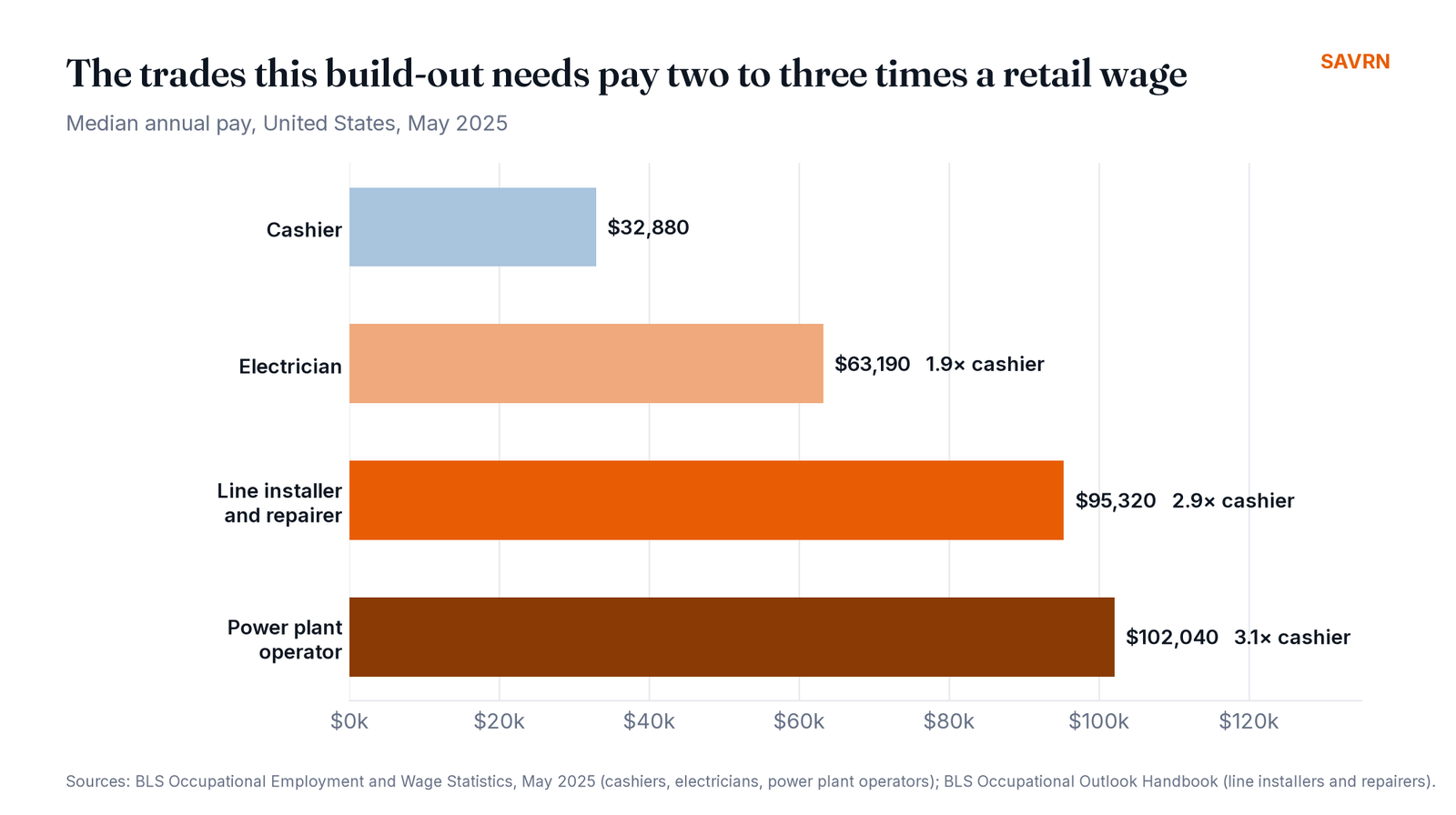
For example, according to the Bureau of Labor Statistics, the median cashier earns $32,880 a year 33. By contrast, the median electrician earns $63,190, about 1.9 times as much 34. Power plant operators earn $102,040 35, while electrical power-line installers and repairers, the people who build and fix the wires, earn a median $95,320 36.
None of these jobs requires a four-year degree. Instead, all of them can be learned through an apprenticeship that pays while you train. That is the part of this story that gets lost in the shouting.
Electrical work is most of the job
This is the wage ladder the build-out puts within reach. In fact, according to the International Brotherhood of Electrical Workers, electrical work makes up 45% to 70% of a data center’s construction budget 4. In Ohio, for instance, the Ohio Business Roundtable told a state Senate committee that data center construction pays about $58 an hour, and up to $90 with overtime 37.
The jobs inside the industry pay well too, since average pay in data processing and hosting, the federal category that covers cloud and hosting companies, rose from $129,861 in 2019 to $205,865 in 2025 32. Because that category is broader than the people on a data center floor, I treat it as a signal, not a count.
Young people are noticing
The pipeline into the trades is filling, since commercial electrician apprenticeship applications rose from 70,000 to 120,000 between 2022 and 2024, according to the National Electrical Contractors Association 38. In the Washington, D.C. area, IBEW Local 26 has doubled its membership since 2018 to more than 14,700 38. In Ohio, meanwhile, the building trades told state lawmakers that construction apprenticeships have grown 68% over the last decade 39. In the same hearing, New Albany’s development director said more than 25,000 construction jobs are in the city, 9,000 of them on the Meta site alone 39.
For an 18-year-old deciding what comes next, those are not abstract numbers. Instead, they are a path to a middle-class income without student debt.
The shortage is the opportunity
The country does not have enough skilled hands for what it has already started.
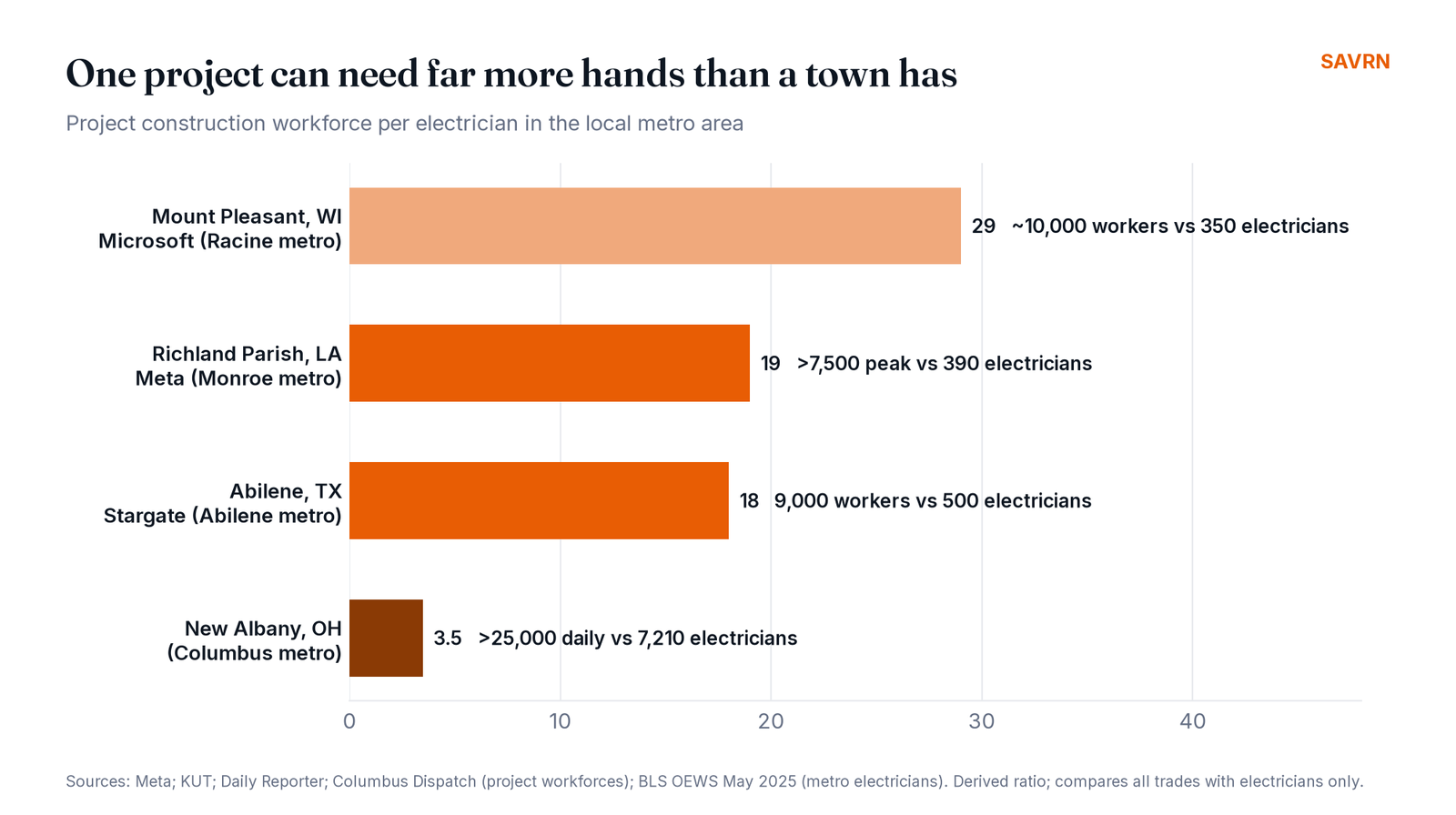
Consider three local comparisons. Microsoft’s Mount Pleasant project drew about 10,000 workers over two years 40, while the Racine metro area has about 350 electricians 41. Likewise, Meta expects its Louisiana site to support more than 7,500 construction jobs at peak 2, and the Monroe metro, which includes Richland Parish, has 390 electricians 41. Finally, Abilene’s metro has about 500 electricians for 9,000 Stargate construction jobs 3, 41.
These ratios count every trade on site against electricians alone, so they measure how much labor a project must bring in rather than a precise shortage. Even so, the direction is not in doubt.
The national estimates agree
- The construction industry needs to attract 349,000 net new workers in 2026 and 456,000 new workers in 2027, while one in five electricians is over 55 42.
- About 20,000 electricians retire every year, and the country needs more than 300,000 new ones over the next decade 38.
- Goldman Sachs estimates the U.S. power build-out alone needs about 510,000 new workers by 2030 43.
- The Bureau of Labor Statistics projects utilities to be the fastest-growing major sector of the economy through 2035 44.
- In a survey released in September 2026, 87% of contractors had hourly craft positions open, and 88% of those said the jobs were as hard or harder to fill than a year earlier 45.
For employers, that is a constraint, while for a 40-year-old ready to leave a dead-end job, it is the strongest hiring market for skilled trades in a generation. I would rather we talk about that market at every public hearing than only talk about the noise and the traffic.
Why so many people are angry
None of this means the backlash is wrong, because people who oppose data centers are reacting to real things, and I think the record should say so plainly. In fact, we built the SAVRN Moratorium Tracker to count exactly that.
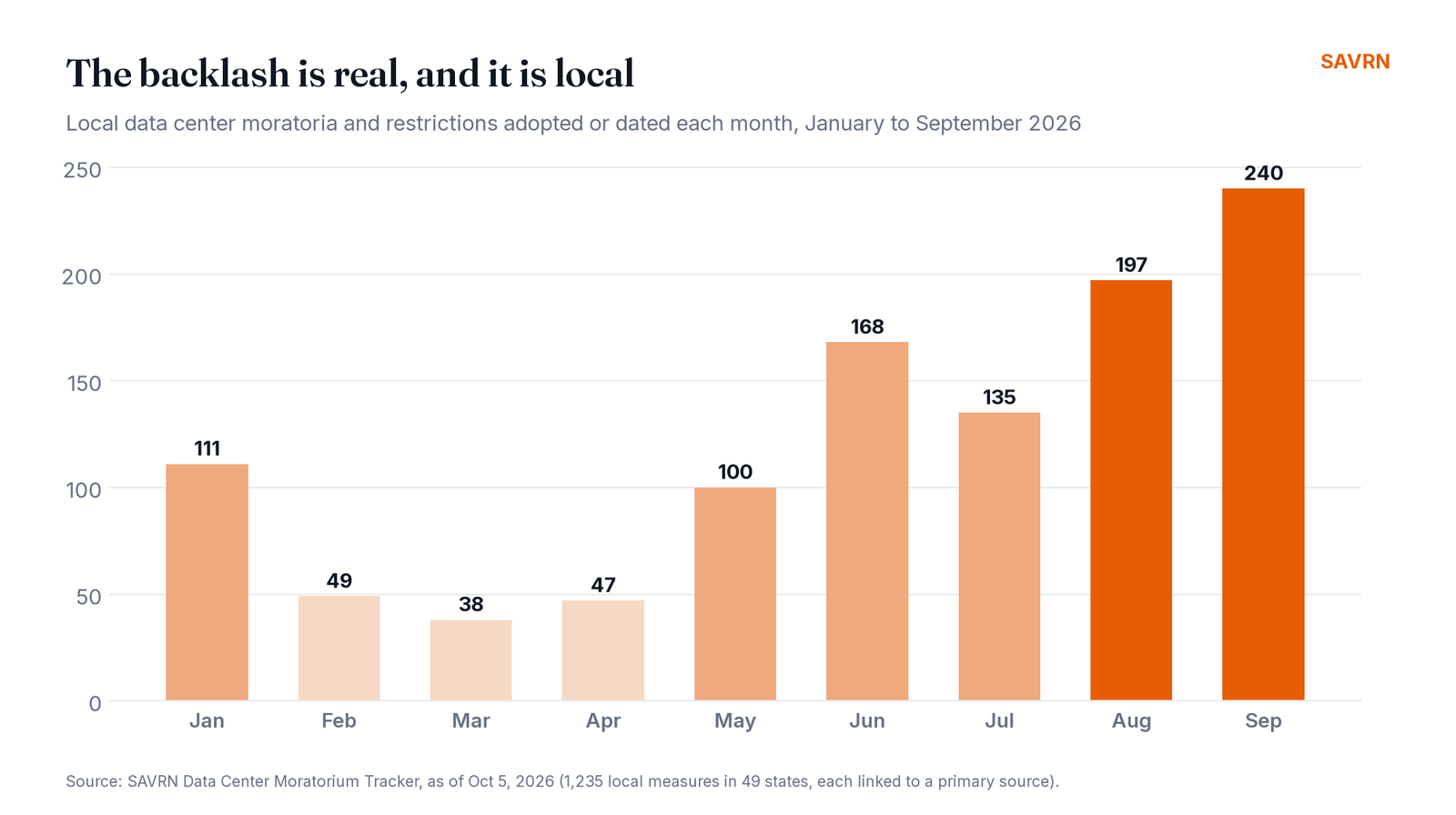
The tracker counts 1,235 local moratoria and restrictions in 49 states, and 1,001 of them are in force. Counted by the month of each source record, new local measures went from a low of 38 in March 2026 to 240 in September. At the same time, two-thirds of Americans say they oppose a data center in their community 46. New York imposed the first statewide moratorium on new hyperscale data centers 47, and the governor of Texas halted state environmental permits for data centers until a grid audit is done 48.
The grievances are measurable
First, power bills are rising, and that is the complaint I hear most. Consumer prices for electricity rose 6.7% in 2025, against 2.7% for all items 49. In addition, from January to July 2026, residential electricity prices rose in 48 of the 50 states and DC, falling only in Connecticut, Massachusetts and Rhode Island 50. In PJM, the grid that serves more than 65 million people from New Jersey to Illinois 51, the price utilities pay to secure future capacity went from $28.92 per megawatt-day to $269.92 in a single year 52.
Second, permanent jobs are few. For example, in Virginia, by one advocacy group’s count, data center projects created one direct permanent job for every $54 million invested 53. Similarly, a typical 250,000-square-foot building employs about 1,500 people at peak construction and about 50 once it opens 54.
Third, tax breaks do not always pay off. For instance, a Georgia state audit found the data center sales tax exemption cost $474.2 million in fiscal 2025, while the state revenue credited to it came to about $41 million, and that 70% of the projects would have located in Georgia anyway 55. Likewise, in Texas, the Comptroller’s office told lawmakers that 6 of 20 subsidized data centers were out of compliance with their job requirements 56.
Finally, boomtown strain is real too, since Abilene and the towns around Richland Parish are living with rents, room rates and traffic that local families did not choose 1, 4.
What the case actually is
So the case for this industry has to start by admitting all of that. The case is not that data centers cost nothing. Rather, it is that the build-out they are driving creates more value for communities than it costs, as long as communities set the terms.
What communities get when it is done right
The best evidence comes from places that have hosted data centers for years.
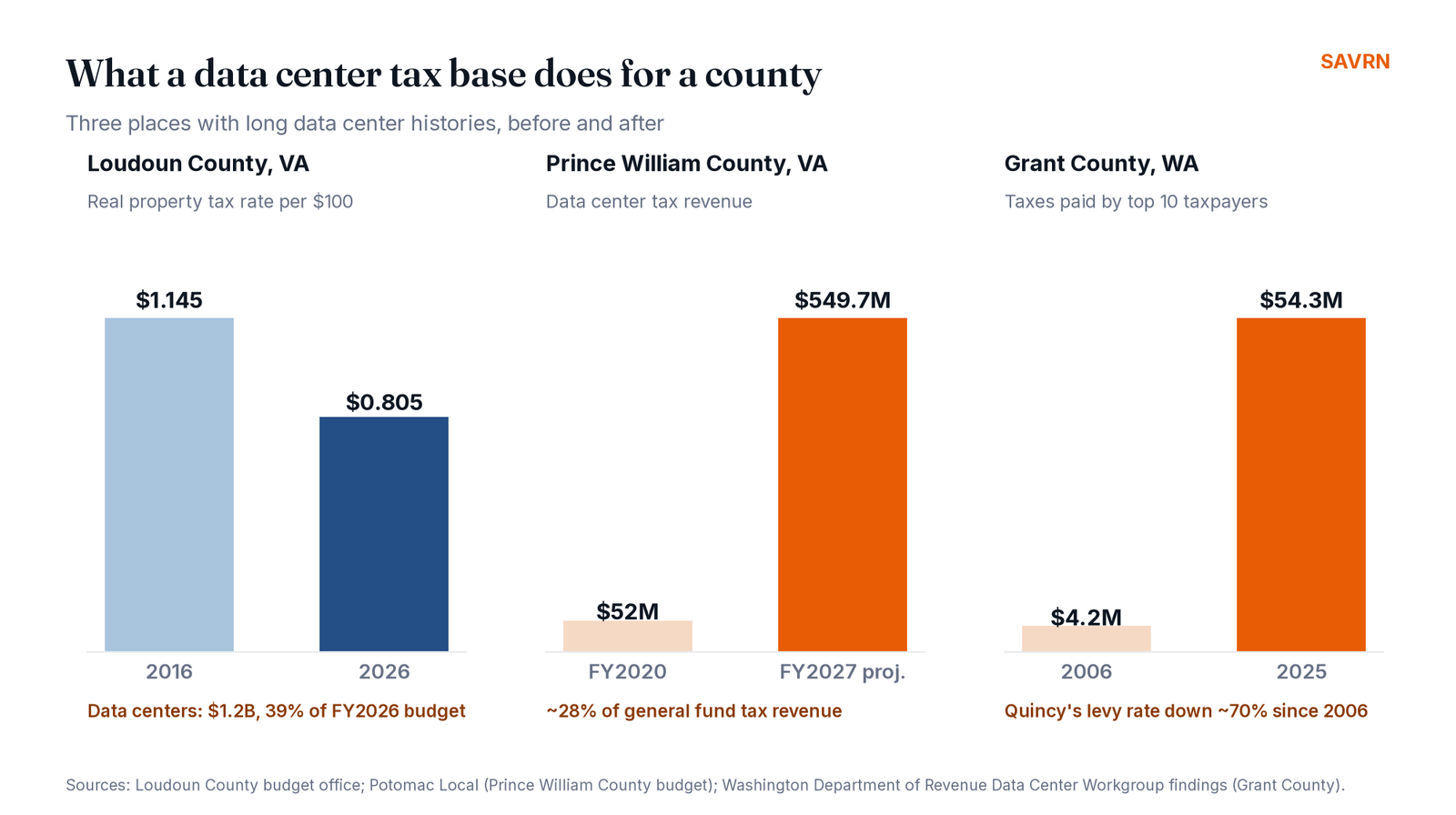
Loudoun County expects about $1.2 billion in data center property tax revenue in fiscal 2026, which is about 39% of the county budget 46. Over the same decade, its real property tax rate fell from $1.145 per $100 of value to $0.805 57. In plain terms, homeowners there pay a lower rate because servers carry a large share of the load.
Similarly, Prince William County, Virginia, projects $549.7 million in data center tax revenue for fiscal 2027, about 28% of general fund tax revenue, up from roughly $52 million in fiscal 2020 58. Meanwhile, in Grant County, Washington, the 10 largest taxpayers paid $54.3 million in 2025 against $4.2 million in 2006, and the city of Quincy’s levy rate has fallen about 70% since 2006 59.
Smaller places at their own scale
Smaller places see it at their own scale. In Ohio, for example, the Ohio Business Roundtable told lawmakers that data center land provides $2.5 million, or 9.2% of the budget, for the Johnstown-Monroe school district 37. In Cheyenne, meanwhile, the local economic development group estimates that data centers have generated more than $111 million in sales and use taxes overall 60.
That is the long tail people miss when they focus on the 50 permanent jobs. While the construction crews leave, the tax base stays. Consequently, it pays for schools, roads, first responders and lower rates for everyone else, and it does so for decades.
The power bill question is starting to turn
The electricity question is also starting to move, although it is not settled. Specifically, utilities and grid operators are rewriting their rules so large new customers pay for the capacity they use. In addition, Amazon, Google, Meta, Microsoft, OpenAI, Oracle and xAI have signed the federal Ratepayer Protection Pledge 61. In Congress, the House passed the Ratepayer Protection Act 417 to 3 on 16 September 62, although the Senate fell three votes short of taking it up on 30 September, 57 to 43 63. As a result, the federal fix is still open.
Some utilities project that large loads will lower household bills by spreading fixed grid costs over more usage. For example, Tucson Electric Power projects about $13 a month in residential savings from one 300-megawatt customer 64. These are utility projections rather than audited results, and they should be checked. Still, they show that higher bills are a design choice, not an inevitability.
A country that builds power builds everything else
There is a deeper reason this moment matters to me.
From 2007 to 2021, American electricity use was essentially flat, growing about 0.1% a year, while the economy kept expanding 65, 66. During that stretch we stopped building big power plants, stopped building much transmission and let much of the supply chain move overseas. That era is over, since U.S. electricity use set a record in 2025 and is forecast to set new records in 2026 and 2027 67.
Electricity and income move together
Across 190 countries, electricity use per person and income per person move closely together. On a log scale, the correlation is 0.92, by our calculation from Our World in Data and World Bank figures 68, 69. Correlation is not causation, although a World Bank study of Brazil found that expanding electricity infrastructure explained about a third of the country’s rise in income per person, and that manufacturing gained the most 70.
The grid outlives the servers
Data centers are the customer that has forced America to start building power again. According to EPRI’s scenarios, they could make up 9% to 17% of U.S. electricity use by 2030 71. Rather than disappearing when the servers are refreshed, the turbines, transformers, lines and substations built for them become the grid that every factory, hospital, school and household runs on for the next fifty years.
That is why I built the power map around the whole chain, from equipment order to household bill. While data centers sit in the middle of it, they are not the end of it.
What communities should ask for
The places that come out ahead will not be the ones that say yes to everything or no to everything. Instead, they will be the ones that negotiate. The evidence points to four terms worth insisting on.
- Pay your own way on power. Large-load tariffs should make sure new data centers cover the generation and grid upgrades they require, rather than leaving household bills as the backstop.
- Hire and train locally. Fund apprenticeships at the community college and the union hall before the groundbreaking, so the $40-an-hour jobs go to people who already live there.
- Put it in public. Virginia’s new executive order bars state agencies from signing nondisclosure agreements on data center projects, and it is a good start 72. Residents should know who is building, how much power and water the project will use, and what it will pay.
- Tie incentives to results. Abatements should come with job and investment requirements that are audited and clawed back if missed. As the Texas audit shows, the audit is the part that matters.
If you serve on a county board or a planning commission, open your county on the power map before the next hearing. It shows your jobs, your plants, your utility, your planned generation and your neighbors on one page. Then check the Data Center Map for what is already built near you.
The work in front of us
For a long time, the story of the American economy was that the jobs worth having were behind a screen, while the jobs that used your hands were shrinking or moving away. The numbers in this piece say that story has changed.
More people build things in this country today than ever before. In addition, the factories that make the backbone of the grid are hiring at a two-decade high. A young electrician in Loudoun County, Maricopa County or Racine County is entering a trade where demand outruns supply, at pay roughly double the median retail wage.
Although the data center industry is not popular right now, and has earned some of that, the communities that host this build-out on fair terms will gain a stronger tax base, a modern grid and a generation of skilled workers. Ten years from now, I think those benefits will be hard to miss.
What to take from this
- Construction employment hit a record 8.364 million in September 2026, and the work is pads, substations, lines and plants, not houses.
- Grid equipment factories are hiring at a 22-year high, though total factory employment is still about 1% below 2019.
- The trades this build-out needs pay about two to three times a cashier's wage and are learned through paid apprenticeships.
- Power bills, few permanent jobs and weak incentive audits are real grievances, and 1,235 local measures show it.
- Long-time host counties such as Loudoun have cut household tax rates as data centers carried more of the budget.
- Counties that set terms on power costs, local hiring, disclosure and audited incentives will get the most from the build-out.
Frequently asked questions
How many data center jobs are construction jobs?
Most of them, during the build. A typical 250,000-square-foot data center building employs about 1,500 people at peak construction and about 50 once it opens, according to Virginia’s legislative audit agency 54. By contrast, the large AI campuses are far bigger: Meta’s Louisiana site has had 8,000 to 10,000 workers on a given day 1.
Is construction employment really at a record?
Yes. BLS counted 8.364 million construction workers in September 2026, above the April 2006 peak of 7.726 million and 11.1% above August 2019 5.
What do data center electricians earn?
Do I need a college degree for these jobs?
No, because electricians, lineworkers and power plant operators typically train through paid apprenticeships. In fact, commercial electrician apprenticeship applications rose from 70,000 to 120,000 between 2022 and 2024 38.
Why are power bills going up?
Several reasons at once. Electricity prices rose 6.7% in 2025 against 2.7% inflation 49, and PJM’s capacity price jumped from $28.92 to $269.92 per megawatt-day in one year 52. Data center demand is part of that, along with grid investment and fuel costs. Large-load tariffs are meant to move more of the cost onto the new customers.
Do data centers lower property taxes?
Are data center tax breaks worth it?
Not always. A Georgia audit found the exemption cost $474.2 million in fiscal 2025 against about $41 million in state revenue credited to it, and that 70% of the projects would have come anyway 55. Incentives work best when they are audited and tied to results.
How many places have data center moratoriums?
The SAVRN Moratorium Tracker counts 1,235 local moratoria and restrictions in 49 states, 1,001 of them in force, and new local measures reached 240 in September 2026.
Is American manufacturing coming back?
How can I see the numbers for my county?
Open the U.S. Power Supply Chain and Demand map and pick your state, then your county. Each of the 3,134 county pages shows jobs, pay, power plants, utilities, planned generation and local rules since 2019, with sources.
Sources
- From RV camps to packed hotels, Meta data center project has Louisiana parish bursting at the seams, The Times-Picayune and The Advocate, NOLA.com, 2026; Reporting from Richland Parish and Monroe on worker counts, room rates and RV rents
- Deepening our investment in Richland Parish, Louisiana, Meta, Meta Data Centers, 2026; Company figures on local contracts, infrastructure spending and peak construction jobs, 13 July 2026
- Officials say data centers can boost local economies. In Abilene, they have spurred a housing crisis, KUT 90.5, KUT, 2026; Abilene reporting citing Oracle's figure of 9,000 immediate construction jobs, 12 August 2026
- Homeowners can't find contractors or electricians. The AI boom is to blame, Realtor.com, Realtor.com News, 2026; Interviews including Abilene homebuilder Gene Lantrip on pay and temporary workers; IBEW share of construction budgets
- All Employees, Construction (USCONS), U.S. Bureau of Labor Statistics, FRED, Federal Reserve Bank of St. Louis, 2026; Current Employment Statistics, seasonally adjusted; September 2026 is preliminary
- Value of Private Construction Put in Place, Seasonally Adjusted Annual Rate, U.S. Census Bureau, Construction Spending (C30), 2026; Data center, electric power and manufacturing series; August 2026 preliminary, released 1 October 2026
- Data centre electricity use surged in 2025, even with tightening bottlenecks driving a scramble for solutions, International Energy Agency, IEA News, 2026; Big Tech capital spending in 2025 and the expected 2026 increase
- EEI Data: Electric companies to invest $1.4 trillion to support customers and power growth, Edison Electric Institute, Electric Perspectives, 2026; Investor-owned utility capital spending, 2025 actual and 2026 to 2030 plan
- GDP (Third Estimate), Industries, Corporate Profits, State GDP, and State Personal Income, 2nd Quarter 2026, U.S. Bureau of Economic Analysis, BEA News Release, 2026; Revision of second-quarter growth to 2.2% and the contributors to fixed investment, 30 September 2026
- How much is AI contributing to US economic growth?, ING, ING THINK, 2026; Shares of year-over-year GDP growth from technology investment, broad and narrow measures, 20 August 2026
- Transformer troubles: manufacturing and policy constraints hit US transformer supply, Wood Mackenzie, Wood Mackenzie, 2025; Import share of U.S; power transformer supply, August 2025
- Supply chain constraints limit the growth of gas-fired generation in the US, Wood Mackenzie, Energy Pulse, 2026; Gas turbine delivery times in 2021 and 2025
- GE Vernova raises gas turbine outlook as backlog reaches 116 GW, CompressorTech2, KHL Group, 2026; GE Vernova backlog, slot reservations and 2030 output expectations, 22 July 2026
- US power companies scramble to secure equipment as surging data center demand strains supply, Reuters, Reuters, 2026; Large power transformer lead times, 9 July 2026
- The grid's bottleneck isn't just money. It's materials, Foley and Lardner LLP, Foley Insights, 2026; Transformer price increase since 2019, 3 September 2026
- Governor Ivey announces Virginia Transformer plant will bring 1,100 jobs to Northwest Alabama, Office of the Governor of Alabama, Alabama Newsroom, 2026; Muscle Shoals plant announcement, 19 May 2026
- Hitachi deepens commitment to U.S. manufacturing with $528 million Mississippi transformer factory, Hitachi Energy, Hitachi Energy press release, 2026; Gallman plant investment, jobs and capacity, 15 September 2026
- Siemens Energy to invest $1B to expand U.S. manufacturing, add 1,500 jobs, ASSEMBLY Magazine, ASSEMBLY, 2026; Siemens Energy U.S; investment, 13 February 2026
- Eaton expands manufacturing for modular electrical enclosures with new Arkansas facility, Eaton, Eaton news release, 2026; Arkansas plant and more than 1,200 jobs, 2 September 2026
- Eaton invests in new South Carolina transformer manufacturing site to power data centers, Eaton, Nasdaq press release, 2025; Jonesville, South Carolina plant, $340 million and 700 jobs, 12 February 2025
- ERMCO to open new manufacturing facility in Maricopa County, ERMCO, ERMCO news, 2026; Arizona distribution transformer plant, size and jobs
- HD Hyundai Electric expands U.S. manufacturing with new Alabama facility, T and D World, T&D World, 2026; Second Montgomery plant, 10 March 2026
- Electricity Distribution Transformers: Supply, Tariffs, and Policy Options (R48933), Congressional Research Service, EveryCRSReport, 2026; Transformer supply chain report describing Cleveland-Cliffs as the dominant U.S; maker of transformer steel
- Cleveland-Cliffs advances $200M Butler Works expansion as transformer demand rises, Construction Review Online, Construction Review, 2026; Butler Works electrical steel expansion and output increase
- All Employees, Electrical Equipment, Appliance, and Component Manufacturing, U.S. Bureau of Labor Statistics, FRED, Federal Reserve Bank of St. Louis, 2026; Current Employment Statistics series CES3133500001, September 2026
- All Employees, Manufacturing (MANEMP), U.S. Bureau of Labor Statistics, FRED, Federal Reserve Bank of St. Louis, 2026; Total manufacturing employment compared with August 2019
- Quanta Services reports second quarter 2026 results, Quanta Services, Quanta investor relations, 2026; Record total backlog, 30 July 2026
- MasTec reports second quarter 2026 results and updates full year 2026 guidance, MasTec, MasTec investor relations, 2026; Record 18-month backlog, 30 July 2026
- Primoris Services Corporation reports second quarter 2026 results (Exhibit 99.1), Primoris Services Corporation, SEC EDGAR, 2026; Record total backlog, August 2026
- Caterpillar Inc. Form 10-Q for the quarter ended 30 June 2026, Caterpillar Inc., SEC EDGAR, 2026; Backlog believed to be firm
- Caterpillar reports second-quarter 2026 results (Exhibit 99.1), Caterpillar Inc., SEC EDGAR, 2026; Power generation sales by application, second quarter 2026 against 2025
- Quarterly Census of Employment and Wages, data files, U.S. Bureau of Labor Statistics, QCEW, 2026; Private-sector county annual averages for 2019 and 2025, NAICS 23821, 237130 and 518210; jobs counted where the employer is located
- Occupational Employment and Wages, May 2025: Cashiers (41-2011), U.S. Bureau of Labor Statistics, OEWS, 2026; National median annual wage
- Occupational Employment and Wages, May 2025: Electricians (47-2111), U.S. Bureau of Labor Statistics, OEWS, 2026; National median annual wage
- Occupational Employment and Wages, May 2025: Power Plant Operators (51-8013), U.S. Bureau of Labor Statistics, OEWS, 2026; National median annual wage
- Occupational Employment and Wages, May 2025: Electrical Power-Line Installers and Repairers (49-9051), U.S. Bureau of Labor Statistics, OEWS, 2026; National median annual wage
- Testimony on House Bill 646 before the Ohio Senate Energy Committee, Ohio Business Roundtable, Ohio General Assembly, 2026; Industry testimony of 9 June 2026 on construction pay and school district revenue
- The electrician shortage is a threat to Big Tech's race to build data centers, Fortune, Fortune, 2026; NECA apprenticeship applications, IBEW Local 26 membership and retirement figures, 2 March 2026
- New Albany data center construction jobs and community pushback, The Columbus Dispatch, Columbus Dispatch, 2026; Testimony to the Ohio select committee on data centers reported by Maria DeVito, 8 June 2026
- World's most powerful supercomputer project completed in Wisconsin, The Daily Reporter, Daily Reporter, 2026; Workforce over the two-year build, 24 June 2026
- May 2025 Metropolitan and Nonmetropolitan Area Occupational Employment and Wage Estimates, U.S. Bureau of Labor Statistics, OEWS, 2026; Electrician employment (47-2111) in the Racine, Monroe (including Richland Parish) and Abilene metro areas
- Construction industry must attract 349,000 workers in 2026 despite macroeconomic headwinds, Associated Builders and Contractors, ABC News Release, 2026; Industry workforce estimate for 2026 and 2027
- The power industry may need more than 750,000 new workers by 2030, Goldman Sachs, Goldman Sachs Insights, 2025; U.S; figure of about 510,000 new workers, 23 July 2025
- Employment Projections, U.S. Bureau of Labor Statistics, BLS News Release, 2026; Fastest-growing major sectors through 2035
- Construction workforce shortages remain acute despite soft market conditions as data centers strain supply, Associated General Contractors of America, AGC News, 2026; Workforce survey conducted July to August 2026, released 3 September 2026
- The data center backlash is reshaping American politics, one community at a time, NPR, NPR, 2026; Economist and YouGov polling on local opposition; Loudoun County data center tax revenue, 21 September 2026
- First statewide moratorium on new hyperscale data centers launched by Governor Kathy Hochul, Office of the Governor of New York, Governor of New York, 2026; Statewide moratorium announcement
- Governor Abbott directs TCEQ to halt data center permits, Office of the Governor of Texas, Governor of Texas, 2026; Halt of state environmental permits pending the ERCOT audit
- Consumer Price Index: 2025 in review, U.S. Bureau of Labor Statistics, The Economics Daily, 2026; Electricity and all-items price change in 2025
- Electric Power Monthly, Table 5.6.B: Average price of electricity to ultimate customers by state, year to date, U.S. Energy Information Administration, Electric Power Monthly, 2026; Residential prices January to July 2026 against 2025
- About PJM, PJM Interconnection, PJM, 2026; Size of the PJM footprint and population served
- Power supply cannot keep up: US AI data center expansion hits limits, The Economy, The Economy, 2026; Capacity auction clearing prices across two delivery years
- Do data centers have low rates of permanent job creation compared to other sectors?, MinnPost, MinnPost Fact Brief, 2026; Investment per permanent job in Virginia, a figure that originates with Food and Water Watch
- Data Centers in Virginia (Report 598 summary), Joint Legislative Audit and Review Commission, JLARC, 2024; Construction and permanent employment for a typical data center building
- Georgia Data Center Sales and Use Tax Exemption, Georgia Department of Audits and Accounts, Georgia DOAA, 2026; Tax incentive evaluation by the Carl Vinson Institute; exemption cost, credited revenue and the share that would have located anyway
- Texas data center tax exemption faces serious legislative risk, Holland and Knight, Holland & Knight Insights, 2026; Comptroller testimony on compliance among subsidized data centers
- Data centers: tax revenues and county budget, Loudoun County, Loudoun County Government, 2026; Real property tax rate history, 2016 to 2026
- Prince William bills to rise $203 under flat tax rate, Potomac Local, Potomac Local News, 2026; Data center tax revenue in the fiscal 2027 proposed budget
- Data Center Workgroup adopted findings, Washington State Department of Revenue, Washington DOR, 2025; Grant County top taxpayers and Quincy levy rates, 2006 to 2025
- Wyomingites, Trump differ on whether data center foes will be backwards and poor, Cowboy State Daily, Cowboy State Daily, 2026; Cheyenne LEADS estimate of data center sales and use taxes
- Fact sheet: the Ratepayer Protection Pledge, The White House, White House, 2026; Signers of the federal pledge
- Roll Call 312, HR 9340, 119th Congress, 2nd Session, Office of the Clerk, U.S. House of Representatives, House Clerk, 2026; House passage, 417 to 3, 16 September 2026
- Roll Call Vote 254, cloture on the motion to proceed to HR 9340, U.S. Senate, U.S. Senate, 2026; Cloture failed 57 to 43 on 30 September 2026; 60 votes required
- List of large customer projects and tariffs, Edison Electric Institute, EEI, 2026; Utility projections of household bill effects, including Tucson Electric Power
- Monthly Energy Review, Table 7.6: Electricity end use, U.S. Energy Information Administration, Monthly Energy Review, 2026; Total electricity end use, 2007 and 2021
- Real Gross Domestic Product (GDPCA), U.S. Bureau of Economic Analysis, FRED, Federal Reserve Bank of St. Louis, 2026; Annual real GDP, used for the 2007 to 2021 comparison
- US power use to beat record highs in 2026 and 2027, Reuters, via The Spokesman-Review, Spokesman-Review, 2026; EIA short-term outlook coverage, 6 October 2026
- Total electricity demand per person, Our World in Data, Our World in Data, 2026; Country electricity use per person, input to the SAVRN correlation
- GDP per capita, Our World in Data, World Bank data, Our World in Data, 2026; Country income per person, input to the SAVRN correlation
- Electricity infrastructure and economic growth in Brazil, World Bank, World Bank Open Knowledge Repository, 2026; Share of income per person growth explained by electricity infrastructure
- Data center load growth in context, Powering Intelligence 2026, Electric Power Research Institute, EPRI, 2026; Scenario range for data center share of U.S; electricity use by 2030
- Governor Spanberger unveils data center accountability executive order, Office of the Governor of Virginia, Governor of Virginia, 2026; Executive Order 22 on state agency nondisclosure agreements, September 2026
Want the next one?
When a new piece publishes on SAVRN Insights, you get one email with what it covers and a link to read it. Choose the research that interests you.
Also send me
Receive a short introduction on days 3, 7 and 14, plus the updates you select. Unsubscribe in one click. Privacy
America Is Building Again: The Data Center Jobs Boom
Get new SAVRN Insights by email
A short introduction on days 3, 7 and 14, plus new SAVRN research articles. Unsubscribe at any time.
We use your address to send the introduction and updates described above. See our Privacy Policy.