Data center permitting reform gains momentum as grid and water constraints tighten
The bipartisan FERC transmission-siting bill is a proposal that would give FERC authority to issue transmission permits and is modeled to enable up to 40 GW of additional interregional capacity, but the evidence does not confirm that it

This report weighs the evidence on data center permitting reform to answer one question: to what extent are recent federal and state permitting reforms, including the bipartisan FERC transmission‑siting bill and Virginia’s AI‑readiness leadership, mitigating the growing grid and water constraints faced by data‑center developers?
The 24 sources reviewed describe 19 distinct arrangements: 2 water constraint severity, 12 regulatory environment, 1 technology focus (ai, geothermal, etc.), 4 geographic location. The sources tie 18 of the 19 to a data center or technology company customer. This is the set these sources happen to cover, not a count of the market.
SAVRN analysis: The bipartisan FERC transmission-siting bill is a proposal that would give FERC authority to issue transmission permits and is modeled to enable up to 40 GW of additional interregional capacity, but the evidence does not confirm that it is presently easing grid constraints for data-center developers 7, 8.
The bipartisan FERC transmission-siting bill would give the Federal Energy Regulatory Commission authority to issue permits for transmission projects when they are in the public interest 7. In Michigan, a PAC supporting Republican gubernatorial candidate John James ran ads claiming Jocelyn Benson advocated for data center development at the expense of residents and highlighted a controversial project connected to her husband’s company 1. The EPA’s repeal of greenhouse gas emissions standards for power plants was justified by citing the Trump administration’s repeal of the 2009 endangerment finding and the U.S. Supreme Court’s Loper Bright decision 6. DataOne operated 62 natural gas generators without required permits at its Vineland, New Jersey facility 18.
The arrangements these sources describe
The 24 sources reviewed describe 19 distinct arrangements: 2 water constraint severity, 12 regulatory environment, 1 technology focus (ai, geothermal, etc.), 4 geographic location. The sources tie 18 of the 19 to a data center or technology company customer. This is the set these sources happen to cover, not a count of the market.
What to take from this
- The bipartisan FERC transmission‑siting bill provides mechanisms that could shorten permitting timelines and add interregional transmission capacity, but its concrete effect on data‑center siting speed and capacity availability is uncertain.
- Significant political advertising against data centers and a wave of stricter permitting actions have occurred, yet the evidence does not establish that the advertising caused the regulatory tightening.
- States have sued the EPA over emissions‑rule rollbacks and data‑center power‑supply challenges are noted, but the sources do not directly link the lawsuits to regulatory uncertainty that threatens reliable power for data centers.
- The New Jersey data‑center case shows that weak permitting oversight allowed unpermitted generators to operate, leading to significant emissions violations and prompting new water‑use reporting requirements, though evidence of direct operational disruption is lacking.
FERC transmission bill may shorten permitting but data-center impact is uncertain
The bipartisan FERC transmission-siting bill would give the Federal Energy Regulatory Commission authority to issue permits for transmission projects when they are in the public interest 7. It would eliminate the federal right of first refusal for incumbent utilities and expand FERC’s siting authority to issue project-by-project permits based on public interest considerations 7. The legislation also requires regional grid operators and utilities to streamline how power lines are planned and permitted, and to coordinate grid buildouts to enable new power plants, solar and wind farms, batteries, and other resources to serve growing electricity demand 8.
Analysis commissioned by the Center for Climate and Energy Solutions estimated the bill could reduce electricity delivery costs by roughly $7 billion by 2035 compared with a business-as-usual scenario 8. That analysis also projected the bill could enable nearly 40 GW of increased interregional transmission capacity 8. Nathaniel Keohane, president of the Center for Climate and Energy Solutions, said the country needs to build more energy infrastructure faster and that the bill’s reforms will help 8.
Rob Gramlich, president of consultancy Grid Strategies, said the bill would likely reduce consumer utility bills over time as transmission expands and access to low-cost generation improves 8. Caitlin Marquis, managing director at Advanced Energy United, said the bill tries to rein in delays and uncertainties that add time and cost to building new infrastructure 8.
Contrary evidence on near-term grid and water constraints
A pause on new data center interconnections could impact the Electric Reliability Council of Texas’ upcoming long-term load forecast and reliability assessment, according to officials 6. The pipeline intended to supply Oracle’s Project Jupiter in New Mexico has encountered permitting problems and is running roughly six months behind schedule, pushing expected completion to February 2027 17.
Project Jupiter in New Mexico has not missed its deadline, but its supporting fuel infrastructure has, adding uncertainty to a project designed in part to sidestep traditional grid constraints 17. After Microsoft walked away from the $1 billion project in Licking County, Ohio, in April 2025, plans resurfaced with a 2029 operational target 17. In PJM Interconnection, more than 50 GW of generation projects already have grid connection agreements, yet permitting, equipment, and workforce constraints continue to delay development 21.
John Andril said delayed power can push back capacity delivery, complicate customer commitments, and leave expensive buildings idle 22. John Andril emphasized that proximity to a transmission line does not guarantee utilities can deliver required capacity on schedule, noting that if power arrives in the early to mid-2030s, “you’re probably not going to get a lot of interest” 22.
SAVRN analysis: These provisions suggest that the bill would give the Federal Energy Regulatory Commission (FERC) authority to issue permits for transmission projects when they are in the public interest, the legislation eliminates the federal right of first refusal for incumbent utilities, stripping their automatic right to build new regional lines, the legislation strengthens FERC by eliminating National Interest Electric Transmission Corridors and expanding the commission’s siting authority to “issue one or more permits for the construction or modification of electric transmission facilities,” project-by-project, based on circumstances such as the proposed construction being consistent with the public interest, the bill would require regional grid operators and utilities to streamline how power lines are planned and permitted, and the bill would require grid operators and utilities to coordinate grid buildouts to enable more new power plants, solar and wind farms, batteries, and other resources to serve growing demand for electricity7, 8. These provisions suggest that analysis commissioned by the Center for Climate and Energy Solutions found the bill’s reforms could reduce the cost of delivering electricity by roughly $7 billion by 2035 compared with a business-as-usual scenario, the modeling also indicated the bill could enable nearly 40 GW of increased interregional transmission capacity, Nathaniel Keohane, president of the Center for Climate and Energy Solutions, said the country needs to build more energy infrastructure faster and that the bill’s reforms will help, Nathaniel Keohane stated the reforms would help enable faster infrastructure buildout at a Wednesday press conference, Rob Gramlich, president of consultancy Grid Strategies, said the bill would reduce consumer utility bills over time as the transmission system expands and access to low-cost generation improves, and Caitlin Marquis, managing director at Advanced Energy United, said the bill tries to rein in delays and uncertainties that add time and cost to building new infrastructure8.
Data center permitting claims in Michigan are contested
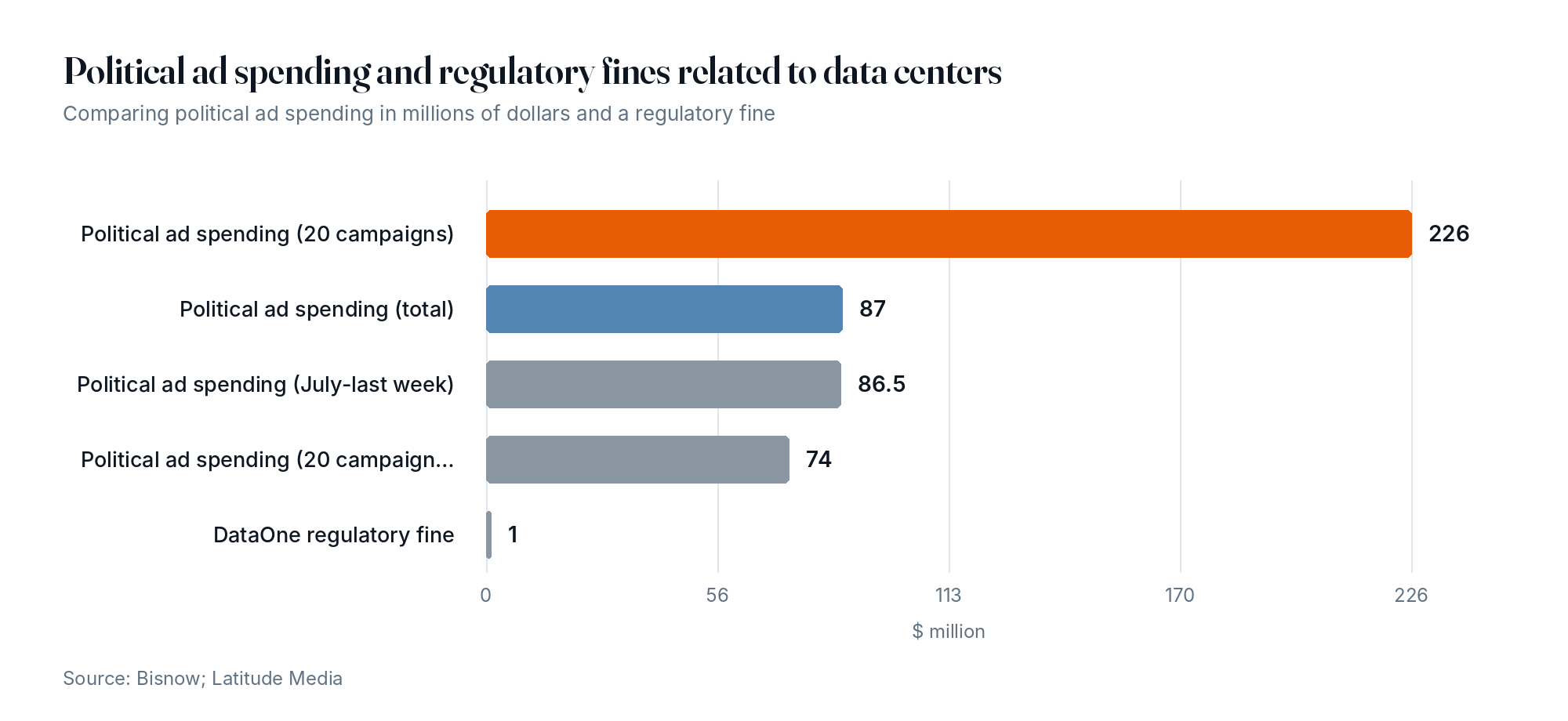
In Michigan, a PAC supporting Republican gubernatorial candidate John James ran ads claiming Jocelyn Benson advocated for data center development at the expense of residents and highlighted a controversial project connected to her husband’s company 1. Related issues of energy and artificial intelligence ranked No. 5 and No. 20 among campaign ad topics, respectively, with $226 million and $74 million spent on ads about them 1. Data center-focused political advertising is concentrated in major development hotbeds where opposition to hyperscale campuses and concerns over grid reliability and utility costs have made the issue prominent 1.

Regulatory tightening across multiple states
California enacted AB 1577, AB 2383, and SB 887, which mandate that data center developers cover the full incremental cost of electric grid upgrades required to serve their facilities 11. Massachusetts Governor Maura Healey issued Executive Order 658, requiring large data centers (with peak demand exceeding 25 MW) to bear all associated energy infrastructure costs and to fund ratepayer protection mechanisms if projects do not meet clean power obligations directly 11.
Alabama’s Public Service Commission opened generic proceedings requiring Alabama Power to demonstrate that large-load contracts fully recover incremental costs before agreements are approved 11. Texas Governor Greg Abbott directed a pause on new data center permitting decisions by the Texas Commission on Environmental Quality until grid operator ERCOT completes a comprehensive statewide audit 11. Texas Governor Greg Abbott tied the permit pause directly to enforcement of mandatory water-use reporting, tasking the Texas Water Development Board with referring noncompliant facilities to local prosecutors and disqualifying them from state water permits 11.
California now requires data center developers to provide local governments and water authorities with granular data on expected water consumption, water supply availability, efficiency technologies, and drought contingency plans before breaking ground 11. Developers in California may be required to finance municipal water infrastructure improvements needed to serve the facility as part of local approvals 11.
Statehouses in California, Texas, New York, Massachusetts, and New Jersey sent an unequivocal message: securing a utility power commitment is no longer a guaranteed green light 11. Developers must now build in full, non-socialized capital recovery for grid upgrades into power purchase agreements (PPAs) and interconnection contracts 11. The data center development shift now spans three regulatory fronts: grid cost responsibility, water transparency, and local land-use accountability 11.
Contrary evidence on causation
A May 2025 Utility Dive article stated: “A fraction of proposed data centers will get built. Utilities are wising up” 20.
SAVRN analysis: A PAC supporting Republican Michigan gubernatorial candidate John James ran ads claiming Jocelyn Benson advocated for data center development at the expense of residents and highlighted a controversial project connected to her husband’s company, and data center-focused political advertising is concentrated in major development hotbeds where opposition to hyperscale campuses and concerns over grid reliability and utility costs have made the issue prominent 1. California enacted AB 1577, AB 2383, and SB 887, which mandate that data center developers cover the full incremental cost of electric grid upgrades required to serve their facilities; Massachusetts Governor Maura Healey issued Executive Order 658, requiring large data centers (with peak demand exceeding 25 MW) to bear all associated energy infrastructure costs and to fund ratepayer protection mechanisms if projects do not meet clean power obligations directly; the Alabama Public Service Commission has opened generic proceedings requiring Alabama Power to demonstrate that large-load contracts fully recover incremental costs before agreements are approved; Texas Governor Greg Abbott directed a pause on new data center permitting decisions by the Texas Commission on Environmental Quality until grid operator ERCOT completes a comprehensive statewide audit; Texas Governor Greg Abbott tied the permit pause directly to enforcement of mandatory water-use reporting, tasking the Texas Water Development Board with referring noncompliant facilities to local prosecutors and disqualifying them from state water permits; statehouses in California, Texas, New York, Massachusetts, and New Jersey sent an unequivocal message: securing a utility power commitment is no longer a guaranteed green line; data center developers must now build in full, non-socialized capital recovery for grid upgrades into power purchase agreements (PPAs) and interconnection contracts; the data center development shift now spans three regulatory fronts: grid cost responsibility, water transparency, and local land-use accountability; and a May 2025 Utility Dive article stated: “A fraction of proposed data centers will get built. Utilities are wising up” 11, 20.
EPA lawsuits and power-supply challenges not directly linked to data-center regulatory uncertainty
The EPA’s repeal of greenhouse gas emissions standards for power plants was justified by citing the Trump administration’s repeal of the 2009 endangerment finding and the U.S. Supreme Court’s Loper Bright decision 6. In announcing the repeal, the EPA claimed that “models continue to show that GHG emissions from power plants have no material impact on global climate change” 6.
A coalition of states and local governments issued an intent-to-sue notice asserting that the EPA’s failure to promulgate emission guidelines for existing stationary combustion turbines has harmed states and local governments that have demanded EPA action for over two decades 6. The same notice states that EPA’s inaction directly harms overburdened frontline and fenceline communities, who often bear the brunt of copollutant harms from existing gas plants disproportionately sited in their communities and are vulnerable to climate change threats 6.
The coalition specifically identified existing gas-fired plants, including “peaker” plants that operate during high-demand periods and are often located in low-income communities, as the subject of the EPA’s regulatory failure 6.
Power-supply challenges for data centers remain distinct from regulatory uncertainty
From transmission and fuel constraints to construction setbacks, major data center projects are finding that turning billions of dollars in investment into energized megawatts can take longer than planned 19.
SAVRN analysis: The coalition’s intent-to-sue notice states that the EPA’s failure to promulgate emission guidelines for existing stationary combustion turbines has harmed states and local governments that have demanded EPA action for over two decades 6.
DataOne operated unpermitted generators in New Jersey
DataOne operated 62 natural gas generators without required permits at its Vineland, New Jersey facility 18. By the time state inspectors discovered the generators in July 2026, the unpermitted fleet had collectively run for more than 46,000 hours 5. DataOne did not obtain a major source permit, which would have required environmental reviews, best available pollution controls, and public comment periods before construction began 5.
Xiaomeng Jin, an assistant professor at Rutgers Department of Environmental Sciences, estimated DataOne’s generators emitted about 140 tons of NOx during their operation 5. Bruce Buckheit, a former EPA air enforcement division chief, and Xiaomeng Jin concluded that DataOne’s generators, at full use, could emit more than 1,500 tons of NOx per year 5. New Jersey designates any facility capable of emitting more than 25 tons of NOx per year as a “major source,” and DataOne’s potential emissions exceed that threshold significantly 5.
Bruce Buckheit stated that operating the generators “results in very high levels of air pollution” 5. DataOne’s potential annual NOx emissions exceed nearly twice the amount allowed for the Linden Cogeneration gas-fired power plant, New Jersey’s largest NOx emitter 5.
Tiffany Leone-Vespa, a longtime Vineland resident living about a mile from the data center, reported hearing generator noise resembling an airplane at the back of her house 5. Tiffany Leone-Vespa expressed concern about future health problems for herself and her children due to prolonged exposure to emissions from the generators 5. NOx are described as a dangerous group of smog-producing gases linked to asthma, heart attacks, and premature death 5. Xiaomeng Jin called NOx “the most important air pollutant in the U.S. that affects most people” 5.
DataOne disagrees with NJDEP’s determination and had previously argued the generators did not require permits, but now plans to apply for them 5. DataOne’s spokesperson responded to Floodlight’s emissions analysis by stating the company is “transitioning to low-emission, quiet fuel cells as part of the site’s permanent power solution and have the necessary approvals in place for this solution” 5.
A Microsoft spokesperson wrote that “we expect our suppliers and partners to meet all applicable legal and regulatory obligations” and the company was working with DataOne “to support their completion of the facility’s transition to its permanent long-term power solution” 5. New Jersey regulators stated in press releases that the generators were first detected during a site inspection in July 2026, but not during an earlier visit in December 5. A letter from DataOne to NJDEP, obtained by Floodlight, indicates the generators first arrived in July 2025 5.
SAVRN analysis: The facility operated 62 natural gas generators without required permits, the operator is identified as DataOne, DataOne did not obtain a major source permit, which would have required environmental reviews, best available pollution controls, and public comment periods before construction began, New Jersey regulators stated in press releases that the generators were first detected during a July 29, 2026, site inspection, but not during an earlier visit in December, and a letter from DataOne to NJDEP, obtained by Floodlight, indicates the generators first arrived in July 2025 18, 5. DataOne’s spokesperson responded to Floodlight’s emissions analysis by stating the company is “transitioning to low-emission, quiet fuel cells as part of the site’s permanent power solution and have the necessary approvals in place for this solution,” and DataOne disagrees with NJDEP’s determination and had previously argued the generators did not require permits, but now plans to apply for them 5.
What this evidence does not settle
SAVRN analysis: The sources reviewed here leave several questions open. They are listed so the limits of the finding are plain.
- How the bill’s provisions translate into realized timeline reductions and capacity gains for specific data‑center projects.
- Whether the $87 million ad spend directly influenced the subsequent policy changes.
- The extent to which the litigation creates power‑supply uncertainty for data‑center operators.
- Whether the violations caused actual downtime or other operational impacts for the data center.
- The evidence did not establish this point: The 73 MW ThisWay Global AI hub is being built in Texas, but the sources do not demonstrate that state‑level permitting reforms enabled its rapid deployment despite grid constraints.
- The evidence did not establish this point: Virginia’s top AI‑readiness ranking reflects the concentration of AI‑focused data‑center capacity, but the data show many sites are in high water‑stress areas and provide no evidence of improved power reliability or water availability.
- The evidence did not establish this point: Increased geothermal permitting activity on federal lands is documented, but there is no evidence that GAO recommendations or geothermal projects will supply low‑water‑use cooling for data centers or relieve water‑resource pressures.
How SAVRN builds for this
SAVRN builds AI factories that generate their own power on site and run water-free cooling, with a training institute at the front of every campus that reskills the local workforce. SAVRN also publishes and maintains public research tools that track the same trends this article covers: the Data Center Moratorium Tracker, the Water Tracker, the Data Center Delay Tracker, the Grid Operator Watchlist, the Capital Atlas and the US Data Center Map.
What to do next
Operators and developers face permitting delays due to contested claims and regulatory gaps, not solely from federal transmission policy.
1. Operators should proactively engage with local authorities early to clarify permitting requirements before construction begins.
2. Utilities should coordinate with data center developers to align grid interconnection timelines with project schedules.
3. Community leaders should establish clear local review processes that address infrastructure impacts without imposing new barriers.
4. Capital partners should factor permitting timelines into project financing and construction milestones to avoid delays.
5. Regulators should issue consistent guidance on generator permitting to prevent operational uncertainty for new facilities.
Frequently asked questions
What was the estimated reduction in electricity delivery costs by 2035 from the bill analyzed by the Center for Climate and Energy Solutions?
Analysis commissioned by the Center for Climate and Energy Solutions estimated the bill could reduce electricity delivery costs by roughly $7 billion by 2035 compared with a business-as-usual scenario 8.
How much money was spent on campaign ads about energy and artificial intelligence, respectively?
Related issues of energy and artificial intelligence ranked No. 5 and No. 20 among campaign ad topics, respectively, with $226 million and $74 million spent on ads about them 1.
What legal justifications did the EPA cite when repealing greenhouse gas emissions standards for power plants?
The EPA’s repeal of greenhouse gas emissions standards for power plants was justified by citing the Trump administration’s repeal of the 2009 endangerment finding and the U.S. Supreme Court’s Loper Bright decision 6.
How many natural gas generators did DataOne operate without required permits at its Vineland, New Jersey facility?
DataOne operated 62 natural gas generators without required permits at its Vineland, New Jersey facility 18.
What is the current status and revised completion timeline for the pipeline supplying Oracle’s Project Jupiter in New Mexico?
The pipeline intended to supply Oracle’s Project Jupiter in New Mexico has encountered permitting problems and is running roughly six months behind schedule, pushing expected completion to February 2027 17.
Which California laws require data center developers to cover the full incremental cost of electric grid upgrades, and what do they mandate?
California enacted AB 1577, AB 2383, and SB 887, which mandate that data center developers cover the full incremental cost of electric grid upgrades required to serve their facilities 11.
By July 2026, how many total hours had DataOne’s unpermitted generators operated before being discovered?
By the time state inspectors discovered the generators in July 2026, the unpermitted fleet had collectively run for more than 46,000 hours 5.
What happened to the Microsoft data center project in Licking County, Ohio, and what is its updated operational target?
After Microsoft walked away from the $1 billion project in Licking County, Ohio, in April 2025, plans resurfaced with a 2029 operational target 17.
What does Massachusetts Executive Order 658 require of large data centers regarding energy infrastructure costs and clean power obligations?
Massachusetts Governor Maura Healey issued Executive Order 658, requiring large data centers (with peak demand exceeding 25 MW) to bear all associated energy infrastructure costs and to fund ratepayer protection mechanisms if projects do not meet clean power obligations directly 11.
How much NOx did Xiaomeng Jin estimate DataOne’s generators emitted during their operation?
Xiaomeng Jin, an assistant professor at Rutgers Department of Environmental Sciences, estimated DataOne’s generators emitted about 140 tons of NOx during their operation 5.
Sources
- Political Campaigns Have Spent $87M Making Data Centers A TV Villain, Bisnow, Oct 12, 2026.
- Virginia Tops AI Readiness as Smaller States Rise, Informa TechTarget, Data Center Knowledge, Oct 12, 2026.
- ThisWay Global to Convert Bankrupt RELLIS Site into 73 MW AI Hub, Informa TechTarget, Data Center Knowledge, Oct 09, 2026.
- Geothermal Energy: Bureau of Land Management Should Improve Permitting Process as Development Demand Grows on Federal Lands | U.S. GAO, U.S. Government Accountability Office, Oct 08, 2026.
- NJ data center polluted for a year before regulators stepped in, Latitude Media, Oct 02, 2026.
- Cities, states sue EPA over power plant emissions rollback, Industry Dive, Utility Dive, Oct 02, 2026.
- Senate permitting bill would expand federal role in transmission siting, Industry Dive, Utility Dive, Oct 01, 2026.
- Senate permitting bill could greatly expand power…, Canary Media, Sep 30, 2026.
- Senators strike bipartisan permitting deal, Latitude Media, Sep 30, 2026.
- Brazil’s Data Center Growth Pushes Beyond São Paulo, Informa TechTarget, Data Center Knowledge, Oct 14, 2026.
- Why Data Center Site Selection Is Now a Three-Front Battle, Informa TechTarget, Data Center Knowledge, Oct 05, 2026.
- How utilities lost their grip on Washington, Latitude Media, Oct 06, 2026.
- Army offers up underutilized military land to private developers for new power generation and storage Army taps developers for power generation, Power Engineering, Clarion Events, Sep 25, 2026.
- Advanced grid tech gets a $1.9B DOE boost, Canary Media, Sep 24, 2026.
- Permits, Not Power, Halt Google’s Finland Data Centers, Informa TechTarget, Data Center Knowledge, Oct 08, 2026.
- Data Center Power Demand to Grow 24% Annually by 2030: McKinsey, Informa TechTarget, Data Center Knowledge, Oct 07, 2026.
- America’s data center boom is running into a grid-sized problem, Power Engineering, Clarion Events, Oct 05, 2026.
- N.J. Penalty Highlights On-Site Power Risks at AI Data Centers, Informa TechTarget, Data Center Knowledge, Sep 30, 2026.
- New York goes big on storage, renewables awards to build 1.7 GW portfolio, Power Engineering, Clarion Events, Sep 30, 2026.
- Efforts to Curb Data Center Speculation Gain Ground Across the US, Informa TechTarget, Data Center Knowledge, Sep 25, 2026.
- Speed Is the New Capacity for AI Data Centers, Informa TechTarget, Data Center Knowledge, Sep 15, 2026.
- AI Data Center Land Buying Hits $6B as Power Premiums Rise, Informa TechTarget, Data Center Knowledge, Oct 14, 2026.
- Fairfax Pays $23M For Innovation Center Site, With Plans For Affordable Housing, Bisnow, Oct 13, 2026.
- DOE presses PJM on ratepayer protections from large load costs, Industry Dive, Utility Dive, Oct 08, 2026.
Want the next one?
When a new piece publishes on SAVRN Insights, you get one email with what it covers and a link to read it. Choose the research that interests you.
Also send me
Receive a short introduction on days 3, 7 and 14, plus the updates you select. Unsubscribe in one click. Privacy
Data center permitting reform gains momentum as grid and water constraints tighten
Get new SAVRN Insights by email
A short introduction on days 3, 7 and 14, plus new SAVRN research articles. Unsubscribe at any time.
We use your address to send the introduction and updates described above. See our Privacy Policy.