The Week the Data Center Power Rules Changed
Federal, state and grid operator actions landed inside seven days. The constraint moved from permission to proof.
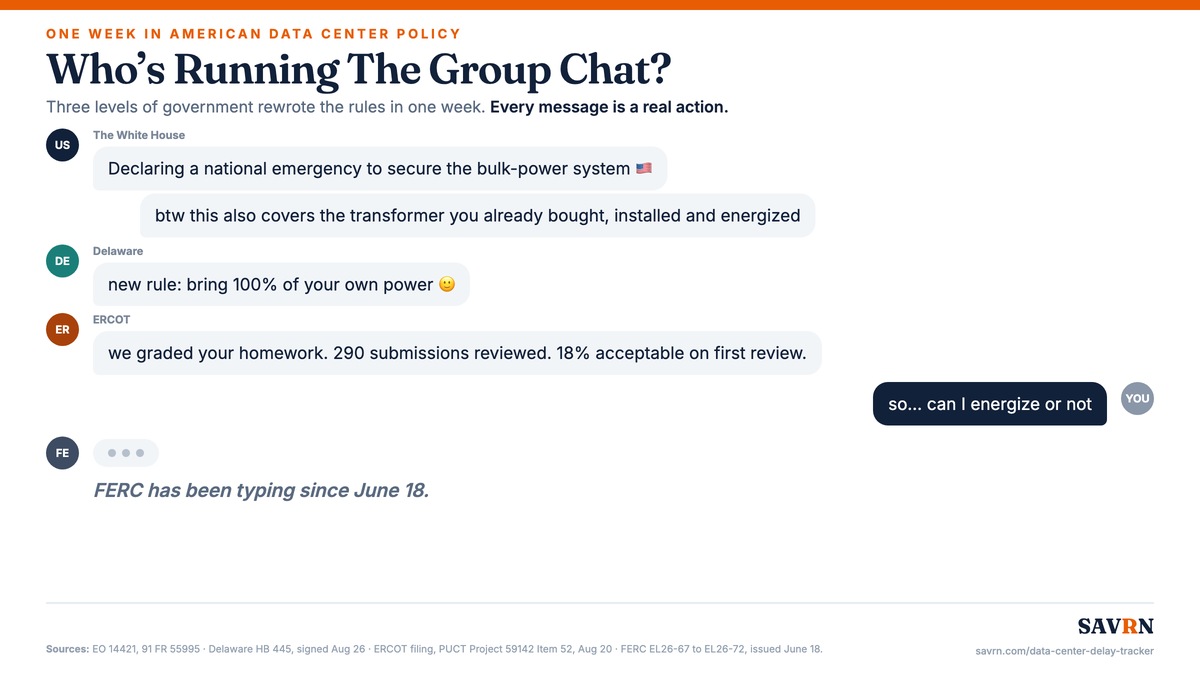
Three levels of American government changed the data center power rules in the same week, and almost none of it was covered together. The federal government declared a national emergency over grid equipment. Two states enacted cost-shift packages twenty-four hours apart. Texas published the first hard numbers on how many large loads can actually prove they are ready to connect. Taken separately, each looks like a headline. Taken together, they describe a single shift.
The constraint moved from permission to proof
For three years the binding constraint on data center development was permission. Developers needed a rezoning, a tax abatement, and a spot in an interconnection queue. Consequently the industry organized itself around winning approvals.
That is no longer where the friction sits. The new rules ask a different question, and it is a harder one. They ask whether the project is real, whether the equipment is secure, and whether the developer can pay for what it triggers.
The federal layer: a national emergency and a clock that already expired
On August 26 the President signed Executive Order 14421, “Declaring a National Emergency To Secure the United States Bulk-Power System”, published in the Federal Register on August 31. The order prohibits acquiring, importing, transferring, or installing foreign-produced bulk-power system equipment tied to what it calls a Covered Foreign Entity, where the Secretary of Energy makes a risk finding.
Importantly, the order does not stop at new purchases. Section 2(b) reaches equipment already installed, and it authorizes the Secretary to require operators to identify, isolate, monitor, secure, disconnect, replace, or remove it.
The covered list matters more than the rhetoric. Specifically, it names substation transformers, grid-connected inverters, battery energy storage systems, uninterruptible power supply systems supporting critical infrastructure, generators, high voltage circuit breakers, generation turbines, and industrial control systems. In other words, it names most of the electrical spine of a modern campus. Implementing rules are due within 120 days.
Meanwhile a second federal clock had already run out. On June 18 the Federal Energy Regulatory Commission issued show cause orders under section 206 of the Federal Power Act to all six grid operators it regulates, docketed as EL26-67 through EL26-72. Each operator had sixty days to justify why its tariff remains just and reasonable without provisions written for large loads, or to file changes. That deadline fell on August 17.
Notably, the five reform categories read like a list of the industry’s favorite workarounds. They cover study processes, cost shifting and cost transparency, co-location and behind-the-meter generation, new services for flexible loads, and how to study generation sited next to the load it serves. Because the compliance window has closed, the tariff filings landing now will set the terms for years.
The state layer: two packages, twenty-four hours apart
On August 26 Delaware enacted a four-bill package. HB 233 creates a separate rate class for large energy users, requires them to pay the full cost of infrastructure upgrades, and places them first in line for disconnection during grid emergencies unless they supply their own power. HB 310 strips them of job-creation tax credits. Most striking, HB 445 requires large energy-use facilities to produce or secure 100 percent of their required power, including a renewable component.
The next day New Jersey signed two more laws. One requires semi-annual water and energy usage reports to the Board of Public Utilities. The other is the End Data Center Tax Credits Act, which reduces credits available under the Next New Jersey Program. Both passed with wide margins. In fact the reporting bill cleared the Senate without a single no vote.
The trade press covered the reporting law. By contrast, the tax credit repeal signed the same day went largely unremarked, although it is the clearer economic signal. New Jersey now has twenty-eight data center bills live in one session.
Similarly, the pattern across the two states is the same. Both strip incentives. Both move infrastructure cost onto the load. Neither imposes a moratorium, because neither needs to.
The operator layer: Texas asked for proof, and most submissions failed
The most useful number of the week came from a slide deck, not a press release. In August the Public Utility Commission of Texas granted the state grid operator relief from its own Batch Zero deadlines while a verification and audit runs, and confirmed the approval in Market Notice M-A080326-02.
Buried in the supporting filing is this: the operator reviewed 290 dynamic models and approximately 18 percent were acceptable on first review. Therefore more than four in five technical submissions from large load developers were deficient the first time.
That single figure reframes the entire delay conversation. For example, when a queue of hundreds of gigawatts is described as blocked, the implication is that regulators are the obstacle. Instead the record suggests many of those requests were never study-ready.
The rest of the filing is equally concrete. Seventeen large loads representing 6,608 megawatts of peak demand have finished every process except approval to energize. Additionally, the operator received 41 developer requests for exceptions to eligibility criteria and does not plan to advance 27 of them. Loads that fail verification, or simply do not respond, are disqualified.
Furthermore the pause has a two-tier reach that is easy to miss. The energization pause covers facilities of 75 megawatts or greater, whereas the community impact review reaches everything at 25 megawatts or more that has not yet energized.
Cost is now measured, not argued
Underneath all of it sits a number that used to be contested. The PJM independent market monitor reported in its 2026 first-half State of the Market report that data center load accounted for 9 percent of wholesale costs so far this year, while total wholesale power costs rose 46 percent.
Consequently the argument has shifted. Cost allocation is no longer a forecast that advocates trade back and forth. It is a measured share, published by a market monitor, and legislators are writing statutes against it.
What this means for a project in development
First, the equipment schedule is now a compliance question. Transformers, switchgear, inverters, and storage all sit inside the federal order’s scope, so procurement provenance belongs in diligence rather than in the back of a submittal binder.
Second, readiness documentation is the gate. Site control, notice to proceed, end-use customer confirmation, binding contractor agreements, and confirmed financial security are what verification actually tests. Since attestation now carries disqualification risk, an optimistic package is worse than a late one.
Third, collateral is becoming standard. Letters of credit are appearing on both sides of these deals, backing utility obligations and backstopping long-term leases alike.
Finally, the state layer will keep moving. Delaware and New Jersey did not wait for federal rules, and neither will the states drafting from their language this fall.
What we corrected on our own record
We publish the Nationwide Data Center Delay Watchlist as a primary-sourced record, so this week we audited it against the filings rather than the coverage. Three things were wrong or thin.
Our Texas entry cited the August 20 open meeting but not the order that actually granted relief. It labeled August 31 as the start of information requests, whereas the filed schedule makes that date the conditional classification deadline. It also carried no megawatt threshold, despite the record setting two of them. All three are now fixed, alongside the correct FERC docket numbers, the Delaware and New Jersey packages, and the executive order. We track water separately in the Data Center Water Tracker.
Publishing the correction matters more than publishing the scoop. A record is only useful if it is right.
Frequently asked questions
What did Executive Order 14421 actually do?
It declared a national emergency over the foreign supply of bulk-power system electric equipment and prohibited covered transactions where the Secretary of Energy finds an undue risk. Importantly, it also authorized conditions on equipment already installed, including isolation, replacement, or removal.
Does the executive order affect data centers directly?
Yes, although indirectly at first. The covered equipment list includes transformers, inverters, battery storage, uninterruptible power supply systems, and industrial control systems, which are core components of any large campus. Consequently procurement provenance becomes a diligence question.
What was the FERC deadline that passed in August?
FERC issued section 206 show cause orders to all six grid operators on June 18 and gave them sixty days to justify or reform their large load tariffs. That window closed on August 17, so the resulting tariff filings are being made now.
Which states enacted new data center laws in late August?
Delaware enacted a four-bill package on August 26, and New Jersey signed two more laws on August 27. Notably, both packages remove incentives and shift infrastructure cost onto large energy users.
What is the strictest new state requirement?
Delaware’s bring-your-own-generation mandate is the most demanding. It requires large energy-use facilities to produce or secure 100 percent of their required power, including a renewable component.
Why does the 18 percent figure matter so much?
Because it measures readiness rather than politics. When roughly four in five dynamic model submissions fail first review, the queue backlog looks less like regulatory obstruction and more like incomplete engineering.
Is the Texas pause a moratorium?
No. It is a verification and audit, and the grid operator continues processing loads below the threshold. However, loads that fail verification or do not respond are disqualified from the transitional study.
What megawatt thresholds apply in Texas?
Two apply. The energization pause covers data centers and crypto facilities of 75 megawatts or greater, while the community impact review reaches facilities of 25 megawatts or more that have not yet energized.
How much of wholesale power cost is attributed to data centers?
The PJM market monitor put data center load at 9 percent of wholesale costs for the first half of the year. Meanwhile total wholesale power costs across the footprint rose 46 percent.
What should developers change first?
Start with documentation and procurement. Since verification tests site control, notice to proceed, customer confirmation, binding contracts, and financial security, the fastest improvement is an evidence package that survives audit rather than a schedule that assumes approval.
Want the next one?
When a new piece publishes on SAVRN Insights, you get one email with what it covers and a link to read it. Choose the research that interests you.
Also send me
Receive a short introduction on days 3, 7 and 14, plus the updates you select. Unsubscribe in one click. Privacy
The Week the Data Center Power Rules Changed
Get new SAVRN Insights by email
A short introduction on days 3, 7 and 14, plus new SAVRN research articles. Unsubscribe at any time.
We use your address to send the introduction and updates described above. See our Privacy Policy.