800 VDC Power Architecture for AI Data Centers: Standards, Vendors, and Lead Times in 2026
NVIDIA ties full-scale 800 VDC production to Kyber racks in 2027, but GB200 and GB300 today still run on a 54 V busbar, and no UL-listed 800 VDC system operates in a US data center yet.
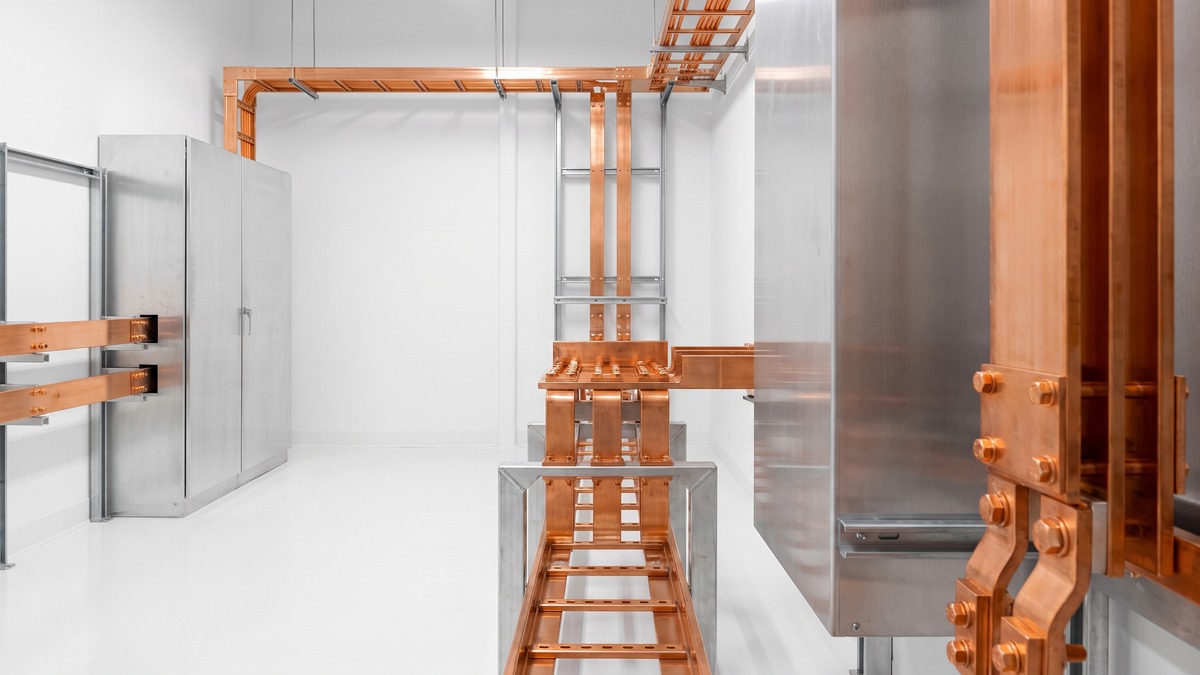
800 VDC data center power moves the AC-to-DC conversion out of the IT rack and distributes 800 volts DC to racks that step it down to 50 V, 12 V, or 6 V close to the GPU. NVIDIA states that full-scale production of 800 VDC data centers will coincide with its Kyber rack-scale systems in 2027, while today’s GB200 and GB300 NVL72 racks remain on a 54 V DC busbar fed by 415/480 VAC power shelves ([1]). Specifically, this guide covers the architecture, the OCP specifications, the vendor ecosystem with dates, the US standards position, and the hot-swap and leak-detection practices an electrical team needs before energizing an 800 VDC rack.
What 800 VDC data center power replaces, and why NVIDIA is moving to it
The conventional AI hall power chain runs medium-voltage AC (roughly 35 kV) to a transformer, then 415 VAC through an AC UPS and PDUs or busway to in-rack power shelves, which rectify 415 VAC to 54 VDC for the busbar, followed by tray-level DC/DC conversion to the GPU ([2]). Because that chain involves so many conversion stages, NVIDIA puts its end-to-end efficiency at less than 90% and counts four conductors per AC feed against three for DC (positive, return, protective earth) ([2]).
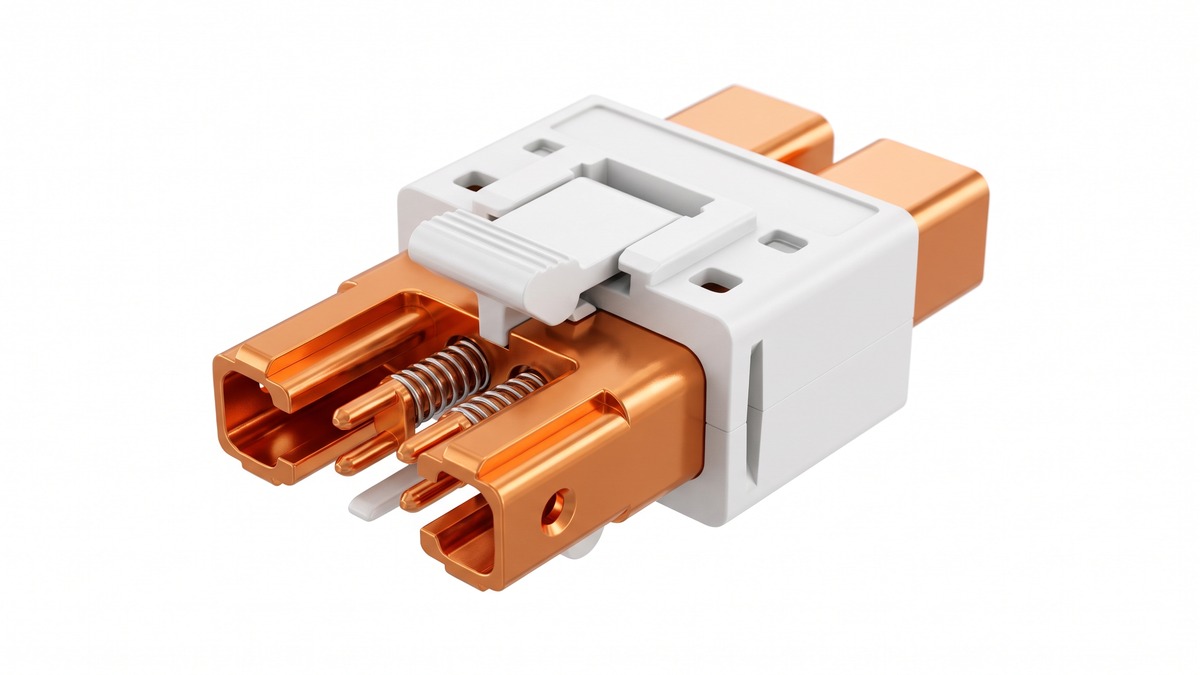
The constraint is, specifically, copper and shelf space. NVIDIA calculates that a 1 MW rack on a 54 VDC busbar would need up to 200 kg of copper busbar, and that a Kyber rack at 54 V would consume up to 64 U of power shelves; as a result, the limitations of 54 V begin above roughly 200 kW per rack ([1]). Moving from 415 VAC to 800 VDC therefore delivers 85% more power through the same conductor and reduces copper requirements by 45% in NVIDIA’s May 2025 analysis; its October 2025 note, using a same-wire-gauge basis, instead states 157% more power than 415 VAC ([1]; [2]).
Consequently, NVIDIA’s stated targets for the native architecture are up to 5% end-to-end efficiency gain versus 54 V, up to 70% lower maintenance cost from fewer PSUs, and up to 30% lower TCO ([1]). The Kyber rack, which carries 576 Rubin Ultra GPUs, is scheduled for 2027 ([3]). In addition, conversion stages drop: NVIDIA’s reference uses a single 64:1 LLC stage from 800 VDC to 12 VDC near the GPU with 26% less area than the current path ([2]).
The GB200 and GB300 NVL72 power train today: 54 V busbar, AC power shelves
A GB200 NVL72 rack draws about 120 kW and is fed by power shelves that convert AC input to a nominal 50-51 V DC on the rack busbar; each shelf holds six 5.5 kW PSUs (33 kW per shelf), and a full rack carries eight shelves in an N+N arrangement fed by power whips from a remote power panel ([4]). Similarly, HPE’s QuickSpecs for the same platform list six shelves standard (eight maximum), a 50 V DC busbar, IEC 60309 560P6W five-wire whips, and a 132 kW nominal TDP with an EDPp of roughly 192 kW that busways should be provisioned to carry ([5]).
This is, importantly, the baseline every 800 VDC decision is measured against. NVIDIA states that its rack-adjacent 800 VDC power rack “slots into” existing AC distribution without building electrical changes, and that the same MGX footprint supports GB300 NVL72 and Vera Rubin NVL72 ([6]; [3]). For more on the AC chain as built today, see Power Delivery for AI.
OCP Open Rack v3, Mt. Diablo, and the LVDC standardization push
Google announced at OCP EMEA 2025 that it was moving from 48 VDC to ±400 VDC to support racks from 100 kW to 1 MW, expecting more than 500 kW per rack before 2030, and released the Mt. Diablo 0.5 draft with Meta and Microsoft in May 2025; specifically, the design is an AC-to-DC sidecar power rack with a claimed efficiency gain of about 3% ([7]). The Mt. Diablo specification, in particular, supports either ±400 VDC bipolar or 0-800 VDC output ([8]).
In August 2026, Google, Microsoft, and NVIDIA published a joint OCP position. Namely, the OCP Power Distribution project’s LVDC work covers up to 1,500 VDC, keeps the ±400 V Mt. Diablo sidecar spec, plans a Mt. Diablo 2.0 for native 800 V, released a Solid-State Transformer specification v0.3, and is working with UL Solutions, NFPA, IEEE, and IEC ([9]). Notably, NVIDIA states that more than 80 companies are building to the specification and that the joint white paper was published in March 2026 ([6]). However, an open spec is not the same thing as a listed product, a distinction covered in The 800 VDC Standard That Doesn’t Exist.
AI factory power train architecture: the three deployment options and their dates
NVIDIA’s August 2026 roadmap and the accompanying white paper define three stages, and the dates matter more than the diagrams.
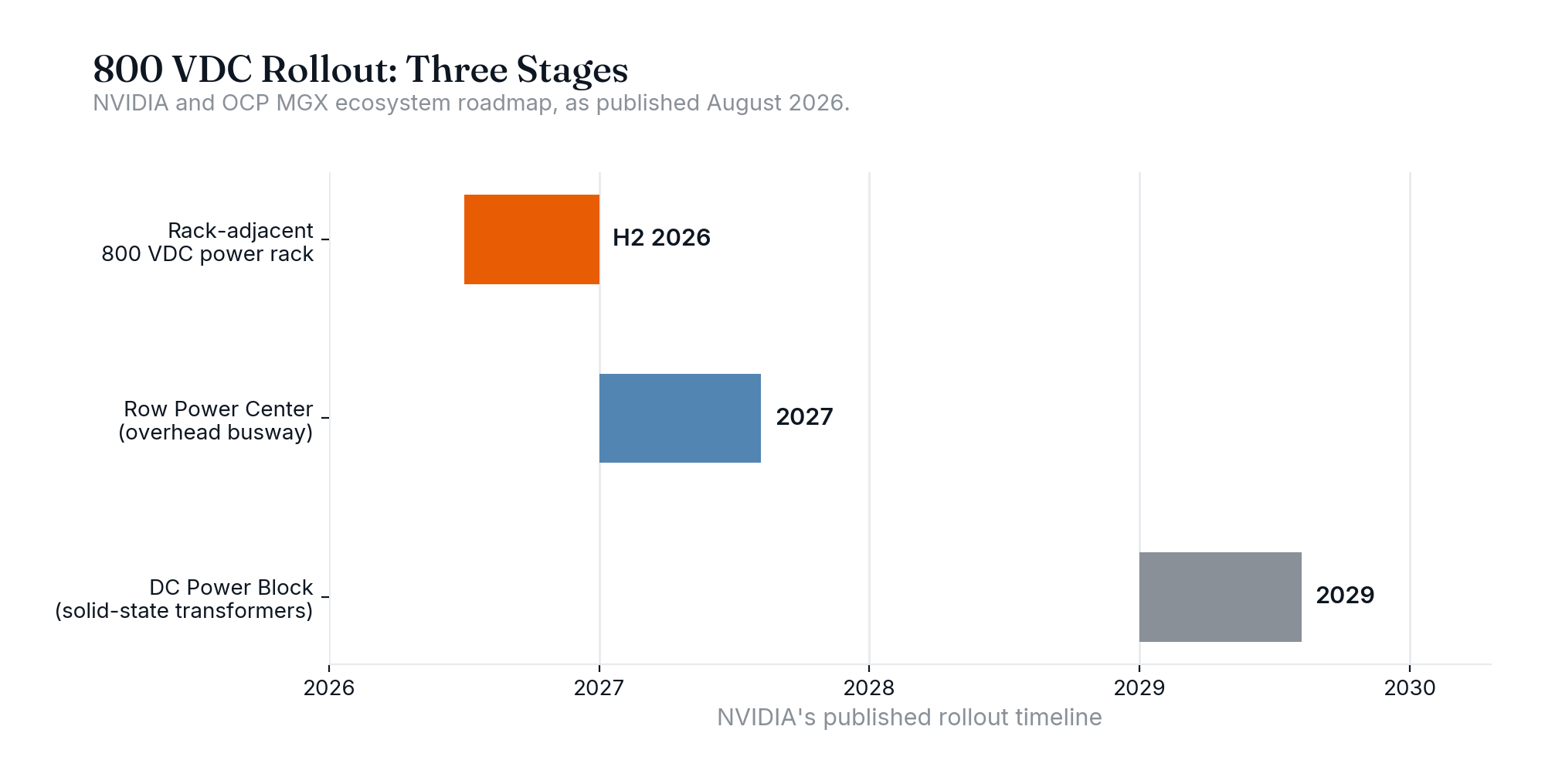
Table 1 NVIDIA's three 800 VDC deployment stages
Rack-adjacent 800 VDC Power Rack (MGX-compatible)
What it isTakes 415/480 VAC, outputs 800 VDC to adjacent compute racks via DC whips; no building electrical change
Rack power supportedGen 2 ~330 kW (Vera Rubin NVL72)
Availability, as publishedSecond half of 2026 / production Q3 2026
Source [6] · [10]
Row Power Center with overhead 800 VDC busway
What it isCentralized AC-to-800 VDC conversion, up to 2 MW per row
Rack power supportedGen 3 ~570 kW
Availability, as publishedExpected 2027 / Q3 2027
Source as above
DC Power Block with solid-state transformers
What it isDirect medium-voltage to 800 VDC at facility scale, 4.8 MW blocks
Rack power supportedUp to 1 MW per rack
Availability, as publishedTargets 2029
Source as above
The white paper’s safety requirements for all three stages, notably, include high-resistance grounding, continuous insulation monitoring, active arc-fault detection, and mechanical connector interlocks that prevent disconnection under load ([10]). In contrast, Schneider Electric’s field view is narrower than NVIDIA’s roadmap: its executives told The Next Platform that initial sidecars would supply 600 kW to 1 MW across one to three racks, centralized converters would come in 2-5 MW blocks, and no more than about 10% of new AI nodes would require 800 VDC by 2030 ([11]).
AI power delivery trends: densities, swings, and energy storage
Rack density is, first and foremost, the driver. NVIDIA reports a 75% GPU TDP increase from Hopper to Blackwell and a 3.4x increase in rack density, with rack loads swinging from 30% to 100% in milliseconds; consequently, the reference architecture answers the swing with supercapacitors near the rack for millisecond-to-second events and facility batteries for second-to-minute events ([2]). By contrast, Uptime Institute data cited in August 2026 puts the industry’s average rack density at just over 11 kW ([12]).
Which companies have actually deployed UL-listed 800 VDC power systems in production US data centers?
None of the vendor announcements reviewed for this article claims a UL listing for an 800 VDC power shelf, sidecar, or power rack, and none names a production US data center running one. Instead, the closest public deployments are outside the US or still in design: Foxconn’s 40 MW Kaohsiung-1 facility in Taiwan is being built for 800 VDC, and CoreWeave, Lambda, Nebius, Oracle Cloud Infrastructure, and Together AI are “designing for” 800 V ([3]). For example, Lite-On has a 1.5 MW-class 800 VDC rack in a named hyperscaler program with validation in Q3 2026 and production in Q4 2026 ([13]), and Wolfspeed reports its silicon carbide MOSFETs qualified for Lite-On’s 800 VDC sidecar platforms as of August 2026 ([14]).
UL Solutions’ position is that the applicable product standards do not yet exist in final form. Specifically, in January 2026 it stated that “many local codes and inspectors are not yet prepared” and that dozens of standards for switchgear, panelboards, busbars, cables, and overcurrent devices need updating; UL leads the Codes and Standards workstream inside the OCP Power Distribution sub-project with ABB and Eaton as co-leads ([15]). Therefore, the practical reading is that 800 VDC racks entering US sites in 2026 will be field-evaluated or certified against component standards, not “UL Listed” as a system category.
The 800 VDC vendor ecosystem: announced products, dates, and status
Table 2 Announced 800 VDC products, dates, and status as of September 2026

NVIDIA (MGX ecosystem)
Announced productMGX-compatible 800 VDC Power Rack; Row Power Center; DC Power Block
Availability, publishedH2 2026; 2027; 2029
Status, Sep 2026Roadmap; power rack entering production
Source [6]

Vertiv
Announced productCentralized rectifiers, DC busway, rack DC-DC, DC backup; 800 VDC MGX reference architecture
Availability, publishedCommercial availability H2 2026
Status, Sep 2026Pre-release; reference architecture published
Source [16]

Eaton
Announced product±400/800 VDC sidecar, 800 kW nominal (900 kW max), ten 90 kW shelves, twelve battery shelves; busway roadmap to 800 VDC; MV SST; Beam Rubin DSX platform
Availability, publishedNot published
Status, Sep 2026Reference architecture; sidecar described in white paper
Source [17] · [18]
Schneider Electric
Announced product800 VDC sidecar for racks up to 1.2 MW, modular conversion and storage shelves, "Live Swap capable"
Availability, publishedNot published
Status, Sep 2026Announced; DC arc-flash white paper published
Source [19]

ABB
Announced productMV UPS plus DC distribution with solid-state protection; SACE Infinitus SSCB ("world's first IEC-certified solid-state circuit breaker")
Availability, publishedNot published
Status, Sep 2026R&D collaboration for 1 MW racks
Source [20]
Delta Electronics
Announced product800 VDC in-row 660 kW power rack (six 110 kW shelves, 480 kW BBU); 90 kW 800-to-50 V shelf at 98%; SST at 98.5%; 2.4 MW CDU with 800 VDC pumps
Availability, publishedNot published
Status, Sep 2026Shown at OCP 2025 and GTC 2026
Source [21] · [22]
Flex
Announced product800 VDC Power Rack for Vera Rubin (up to 880 kW compute per rack with future GPUs); 110 kW shelf; 30 kW CESS
Availability, publishedNot published; North America manufacturing stated
Status, Sep 2026Launched Mar 2026; shown at Computex Jun 2026
Source [23] · [24]

Lite-On
Announced product110 kW MGX shelves; 800 VDC power rack above 1.5 MW; 2.5 kW DC-DC brick
Availability, published110 kW shelves mass production Q2 2026; 800 VDC rack validation Q3 2026, production Q4 2026
Status, Sep 2026Shelves in production; rack in qualification
Source [25] · [13]

Infineon
Announced product800 VDC hot-swap controller with CoolSiC JFET; 800-to-50 V and 800-to-12 V reference designs
Availability, publishedNot published
Status, Sep 2026Reference designs; joined MGX ecosystem May 2026
Source [26] · [9]

Texas Instruments
Announced product800 V hot-swap controller; 800-to-6 V GaN bus converter (97.6%); 30 kW 800 V AC/DC PSU; 800 V CBU
Availability, publishedNot published
Status, Sep 2026Demonstrations at GTC 2026
Source [27]

STMicroelectronics
Announced product800-to-50 V, 800-to-12 V, 800-to-6 V architectures; GaN LLC prototype >98%
Availability, publishedNot published
Status, Sep 2026Prototypes
Source [28]
Navitas
Announced product800-to-6 V GaNFast PDB (97.5%); 2,300/3,300 V SiC modules for SSTs
Availability, publishedNot published
Status, Sep 2026Demonstrations at Computex 2026
Source [29]

onsemi
Announced productSST, PSU, distribution, and core power silicon
Availability, publishedNot published
Status, Sep 2026Collaboration announcement
Source [30]

Siemens / Reinhausen
Announced productSolid-state transformer, MV AC up to 36 kV to 800 VDC
Availability, publishedNo commercial date
Status, Sep 2026Development
Source [12]

GE Vernova
Announced product800 VDC reference designs; transformer-plus-rectifier near term, MV SST later; 1,500 VDC option
Availability, publishedNot published
Status, Sep 2026White paper
Source [31]

Hitachi Energy
Announced productGrid-to-rack architecture supporting 800 VDC
Availability, publishedNot published
Status, Sep 2026Collaboration; $9B investment program
Source [32]
Heron Power
Announced productHeron Link 4.2 MW SST, 34.5 kV to 800 VDC, >98.5%; SuperBBU
Availability, publishedVendor states 24-week procurement lead time; no GA date
Status, Sep 2026Pre-production
Source [33]
Hillcrest Energy
Announced productZVS PCS1000 250 kW 800 V sidecar rectifier
Availability, publishedA-sample Apr 2026
Status, Sep 2026Sample
Source [34]
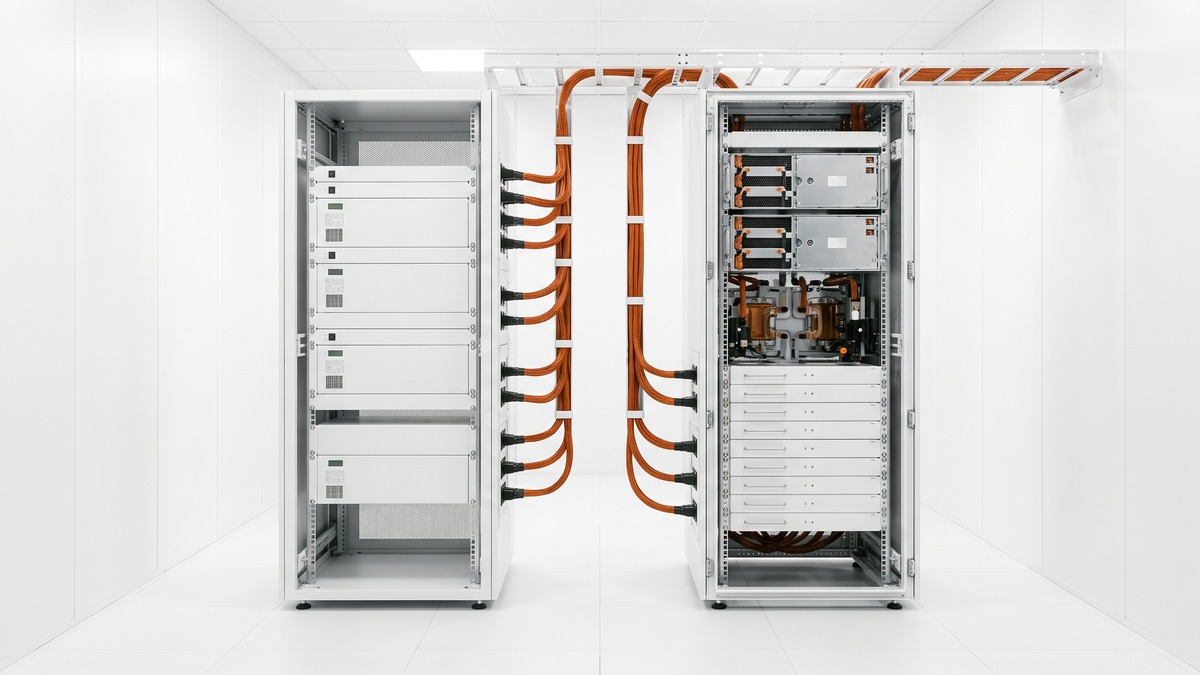
No primary source was found for Rolls-Royce/mtu or Bloom Energy 800 VDC products, so they are omitted. Instead, GE Vernova’s assessment is that the transformer-plus-rectifier side power rack “can be immediately deployed at scale,” while medium-voltage SSTs are “coming years” away ([31]).
Our facility electrical team is nervous about 800 VDC: what’s the current state of US standards and product availability?
The nervousness is, in fact, justified on standards and premature on products. The installation code, the workplace safety standard, and the arc-flash calculation method all exist for DC, but the product safety standards that would let an inspector accept an 800 VDC shelf as a listed category mostly stop at 600 V.
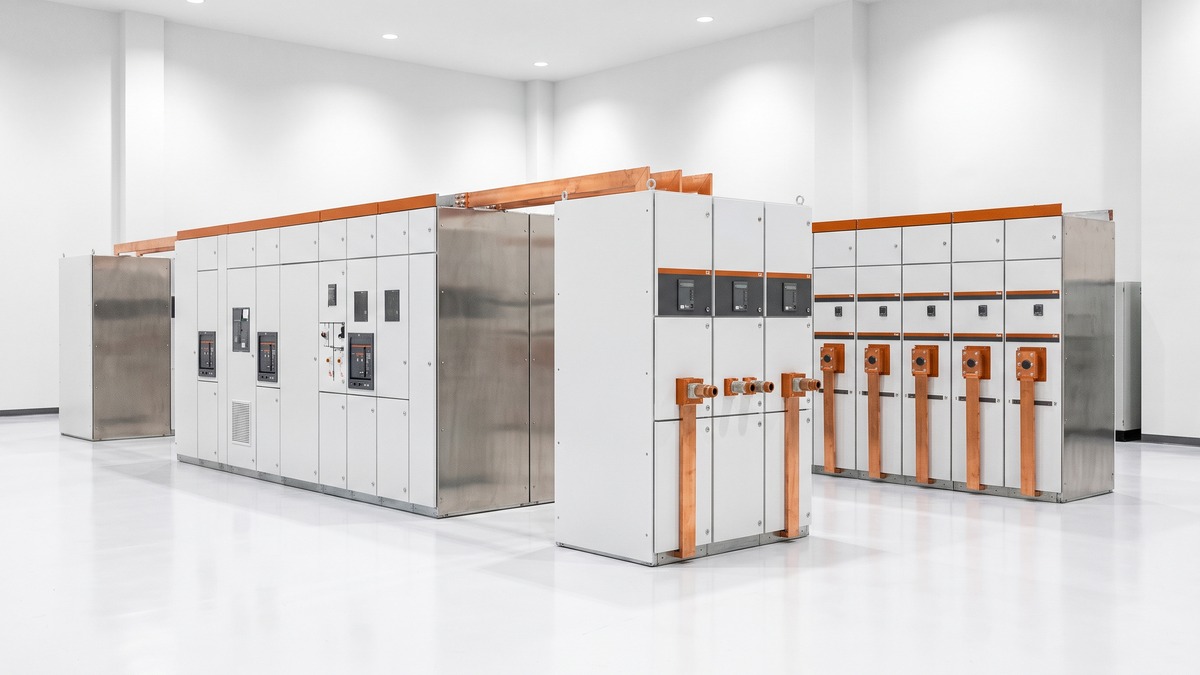
Table 3 Standards and codes against 800 VDC racks
NEC / NFPA 70 (2026)
Covers 800 VDCScope relevant to 800 VDCInstallation; Article 645 (ITE rooms; 645.4 relocated to 645.5); 110.16 arc-flash labels apply to AC and DC; new Article 270 and Articles 265-268 for systems over 1,000 VAC / 1,500 VDC
Covers 800 VDC racks?Yes for installation; no DC-specific ITE power article
Status, 20262026 edition published; state adoption varies
Source [35] · [36] · [37]
NFPA 70E (2027)
Covers 800 VDCScope relevant to 800 VDCWork practices; Table 130.4(E)(b) DC approach boundaries; Article 310 DC hazard thresholds; 130.2(A)(2) additional person for energized work
Covers 800 VDC racks?Yes (DC boundaries defined)
Status, 20262027 edition is current
Source [38] · [39]
IEEE 1584-2018
Not coveredScope relevant to 800 VDCArc-flash incident energy
Covers 800 VDC racks?No, AC only
Status, 2026DC model under FPRF research, Phase 1 focused on 800 Vdc
Source [37]
UL/IEC 62368-1
Not coveredScope relevant to 800 VDCICT equipment safety, rated voltage not exceeding 600 V
Covers 800 VDC racks?No (800 V input out of scope)
Status, 2026Gap; IEC 62477-1 (to 1,500 VDC) is the alternative
Source [40] · [41]
UL 1801
Not coveredScope relevant to 800 VDCPower distribution centers for ICT, 600 V or less
Covers 800 VDC racks?No
Status, 2026Gap
Source [42]
UL 857
PartialScope relevant to 800 VDCBusways
Covers 800 VDC racks?Partial; DC extension "in active development"
Status, 2026In progress
Source [43]
UL 489i / IEC 60947-10
Covers 800 VDCScope relevant to 800 VDCSolid-state circuit breakers
Covers 800 VDC racks?Yes for SSCBs
Status, 2026Published
Source as above
UL 943
Not coveredScope relevant to 800 VDCPersonnel GFCI, under 150 V
Covers 800 VDC racks?No
Status, 2026Does not apply at 800 V
Source as above
UL 2877 / IEEE 3105
PartialScope relevant to 800 VDCMV power converters (SST) for data centers
Covers 800 VDC racks?Emerging
Status, 2026In development
Source as above
IEC 62040-5-3 / 62040-1
Covers 800 VDCScope relevant to 800 VDCDC-output UPS performance; UPS safety
Covers 800 VDC racks?Yes for DC UPS
Status, 2026Published (2016 / 2017)
Source [44] · [45]
ETSI EN 300 132-3-1
Not coveredScope relevant to 800 VDCICT power interface, DC 260-400 V
Covers 800 VDC racks?No, stops at 400 V
Status, 2026Published; no 800 V part
Source [46]
Three points follow. First, the NEC and NFPA 70E already govern 800 VDC work: NEC 110.16 labeling applies to DC, and NFPA 70E Table 130.4(E)(b) sets a limited approach boundary of 3 ft 6 in (fixed part) and a restricted approach boundary of 1 ft for the 301 V-1 kV DC range ([37]; [47]). Second, and importantly, the incident-energy method is the weak link: IEEE 1584 is AC-only, NFPA 70E’s DC methods are conservative, and the NFPA Fire Protection Research Foundation has opened a project, sponsored by Siemens and Schneider Electric, whose Phase 1 tests an 800 Vdc rectified-converter case ([37]). However, Schneider’s own study of two 800 VDC architectures found incident energy below 1.2 cal/cm² and argues that converter-limited fault current, capacitor discharge in the first milliseconds, and reverse-current blocking govern the result more than voltage does ([48]).
Third, and perhaps most consequential, the shock hazard is the training gap. Specifically, at a 1,000 ohm body-resistance baseline, contact with 800 V yields 800 mA, and technicians qualified only to 600 VAC need requalification ([49]). Similarly, Europe has the same product-standard gap: ETSI’s DC interface standard stops at 400 VDC and IEC 62368-1 at 600 V ([46]; [41]).
Which 800 VDC rack power systems are designed to allow safe hot-swapping without full de-energization?
Hot-swap at 800 VDC is being engineered at two levels: the power shelf or module, and the server-tray input. First, at the module level, Schneider Electric describes its 800 VDC sidecar conversion shelves as “Live Swap capable” ([19]), and Heron Power lists field-replaceable modules on its SST and DC panel ([33]). Second, at the tray level, Infineon’s 800 VDC hot-swap controller with a CoolSiC JFET is designed so operators “can exchange server boards in an 800 VDC architecture while other servers continue to operate in the same rack” ([26]), and Texas Instruments demonstrated an 800 V hot-swap controller in March 2026 ([27]).
NVIDIA’s white paper requires mechanically interlocked connectors that prevent disconnect under load ([10]). However, Vertiv notes that protection at this voltage and current is currently fuse-and-disconnect, with resettable DC breakers “still maturing” ([50]).
What vendors offer combined 800 VDC power and liquid cooling systems with integrated leak detection and safety?
Delta is the only vendor in the reviewed set that ties the two together in one announcement: a 2.4 MW liquid-to-liquid CDU with N+1 pumps running on 800 VDC for 800 VDC AI factories, alongside its 660 kW in-row power racks and a 4RU 140 kW in-rack CDU for GB300 NVL72 ([21]). By contrast, Vertiv and Eaton position integrated power-and-cooling platforms (the Vertiv 800 VDC MGX reference architecture and Eaton’s Beam Rubin DSX), and NVIDIA’s Vera Rubin NVL72 introduces a liquid-cooled busbar with 45°C liquid cooling ([3]; [18]).
Leak detection itself is, however, standardized only at the guidance level. Vertiv’s cold-plate white paper states that conductive coolant leaks risk equipment failure and electrocution if accumulated coolant becomes energized, recommends placing high-voltage equipment higher in the system, and describes two-wire rope sensors (leak present) and four-wire sensors (leak location) ([51]). Meanwhile, OCP’s guidelines target an annual cold-plate and coolant-loop failure rate of 0.3% or lower ([52]). No reviewed document specifies a leak-to-trip interlock for 800 VDC circuits; that logic instead remains an owner specification. Cooling design is covered in Liquid Cooling for AI.
800 VDC power shelf lead times 2026: what is published and what is not
No vendor publishes an order-to-ship lead time for an 800 VDC power shelf. What exists instead are production windows: Lite-On’s 110 kW MGX shelves entered mass production in Q2 2026 and its 800 VDC rack is scheduled for Q4 2026 production ([25]; [13]); similarly, NVIDIA’s MGX power rack and Vertiv’s portfolio are both due in H2 2026 ([6]; [16]). Heron Power’s 24-week SST lead time is the only published figure, and importantly, it is a vendor claim for a pre-production product ([33]).
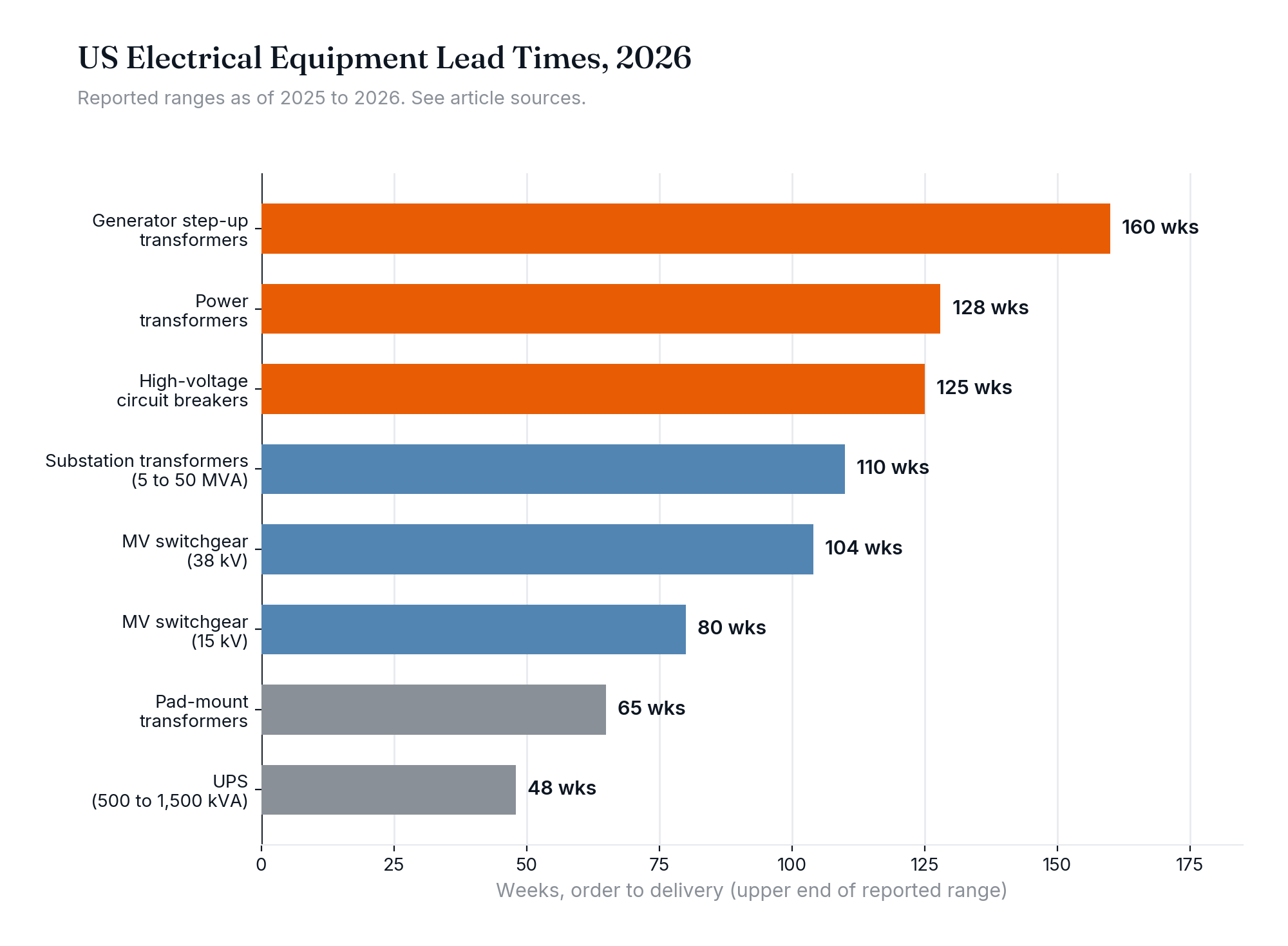
Upstream AC equipment is instead the binding schedule constraint, not the shelf.
Table 4 US equipment lead times, 2026
We’re designing power distribution for GB200 NVL72 racks: should we go 800 VDC from the bus bar or stick with 54 V?
Stay on the 54 V busbar with AC power shelves for GB200 and GB300 NVL72, and build the electrical room so an 800 VDC power rack can be added later. Because the busbar voltage is fixed by the platform, GB200/GB300 NVL72 is a Gen 1, roughly 145 kW, AC-fed system, and native 800 VDC input arrives with Vera Rubin NVL72 (Gen 2) and Kyber ([10]; [1]). Similarly, Schneider Electric’s retrofit guidance is consistent: facilities at up to 200 kW per rack can add a DC sidecar later, while above 400 kW per rack the infrastructure should be purpose-built ([56]).
Future-proofing steps that follow from the published designs:
- First, size busway and whips to the EDPp, not the TDP; HPE specifies 192 kW provisioning for a 132 kW nominal GB200 NVL72 rack ([5]).
- Second, reserve a rack position and 415/480 VAC feed adjacent to each compute pod for a Gen 2 power rack, which takes AC in and delivers 800 VDC by DC whips ([10]).
- Third, specify busway that is rated or upgradable to 800 VDC; Eaton’s Pow-R-Way III and PowerWave 2 are rated to 600 VDC today with a roadmap to 800 and 1,500 VDC ([17]).
- Additionally, plan high-resistance grounding with insulation monitoring, which the NVIDIA specification mandates for 800 VDC ([10]).
- Finally, order long-lead AC gear now; a 15 kV switchgear lineup runs 52-80 weeks ([55]).
How do I write a safety plan for hot-swapping components in liquid-cooled 800 VDC racks?
The outline below maps each plan section to the governing standard. Since it is an engineering checklist, not legal advice, confirm cited editions with the AHJ.
- Scope and system description. Define the DC system: voltage (800 VDC or ±400 VDC), grounding method (high-resistance, per the NVIDIA specification), and every energized boundary a technician can reach ([10]).
- Hazard identification. Classify DC shock thresholds under NFPA 70E Article 310 and set approach boundaries from Table 130.4(E)(b): 3 ft 6 in limited (fixed part) and 1 ft restricted for 301 V-1 kV DC ([39]; [47]).
- Incident-energy analysis. State the method and its limits: because IEEE 1584 does not cover DC, use an NFPA 70E DC method or a vendor topology study, and record that the FPRF 800 Vdc model is pending ([37]; [48]).
- Labeling. Apply NEC 110.16 labels with nominal voltage, arc-flash boundary, incident energy or PPE level, and assessment date; notably, 110.16 applies to DC ([35]; [37]).
- Hot-swap authorization. Permit hot-swap only for modules the manufacturer has documented for insertion and removal under load with interlocked connectors; require the test report and, where available, third-party live-swap certification ([26]; [45]). Otherwise, treat the work as energized work requiring an energized electrical work permit and, under NFPA 70E 130.2(A)(2), an additional person trained in contact release per 110.4(C)(1) ([39]).
- Worker qualification. Since technicians qualified only to 600 VAC are not qualified at 800 V, requalify them for DC above 600 V, with rated insulated tools and gloves ([49]).
- Liquid-cooling interface. Require rack-level leak detection with automatic response, route conductive coolant away from DC connections, and define the 800 VDC trip logic on a detected leak; this is an owner specification because no reviewed standard defines it ([51]).
- Stored energy. Address supercapacitor and BBU shelves under NFPA 70E Article 370 and the DC shock and arc-flash thresholds that apply to them ([39]; [49]).
- Verification and revision. Finally, set a re-analysis trigger for every rack generation change and for publication of the FPRF DC model and NFPA 70E updates.
How SAVRN builds for this
SAVRN’s factory-built compute blocks are designed so the power train can change without rebuilding the hall. Specifically, the Atom compute block is liquid-cooled and manufactured off site, and the Electron family supplies on-site power, which places the AC-to-DC conversion point inside a block boundary that SAVRN controls rather than in a utility-fed electrical room with 52-80 week switchgear lead times ([55]). As a result, that boundary is where a Gen 1 54 V busbar pod and a Gen 2 800 VDC power rack can coexist on the same footprint, which is the configuration NVIDIA’s own roadmap expects through 2027 ([6]).
SAVRN treats the standards position described above as a design input: no listed 800 VDC shelf category, DC arc-flash methods still under research, and leak-to-trip logic undefined by any standard. Its published work on this subject, in particular, sets out why an open specification is not a UL listing in The 800 VDC Standard That Doesn’t Exist, how today’s AC chain is built in Power Delivery for AI, and how cooling and power interact at the rack in Liquid Cooling for AI. Additionally, the campus model that lets blocks be added by generation is described in Modular AI Campus. None of this requires an operator to buy from SAVRN; instead, the standards, dates, and lead times above apply to any 800 VDC project.
Chad Harris, Founder, SAVRN
Frequently asked questions
Are there 800 VDC rack designs where the hot-swap mechanism has been independently safety tested?
No vendor document reviewed names a third-party certification for hot-swap on an 800 VDC shelf or rack. The nearest precedent is instead TÜV Rheinland’s “Live Swap” certification, which tests whether modular UPS energy-storage modules can be maintained safely during operation, goes beyond IEC 62040-1, and was first awarded to Schneider Electric’s Easy UPS 3-Phase Modular Series in April 2023 ([45]). Schneider’s 800 VDC sidecar carries the same “Live Swap” language but no published certificate for the 800 V product; buyers should therefore request the test report and the standard it was tested against.
Are there any 800 VDC power shelf systems that can ship and commission within six months in the US?
Within six months of September 2026, the published schedules that fit are Lite-On’s 110 kW MGX shelves (mass production since Q2 2026), the NVIDIA MGX-compatible power rack (H2 2026), and Lite-On’s 1.5 MW rack (Q4 2026 production for one hyperscaler) ([25]; [6]; [13]). However, allocation to a specific buyer is not public. Commissioning inside six months also depends on the AHJ accepting a field evaluation in the absence of a listed product category, and on AC feeders and switchgear carrying the lead times above.
What are the 800 VDC power shelf lead times in 2026?
No vendor publishes an order-to-ship lead time for an 800 VDC power shelf. Published production windows are Lite-On 110 kW MGX shelves in mass production from Q2 2026, Lite-On’s 800 VDC rack in production Q4 2026, NVIDIA’s MGX power rack in H2 2026, and Vertiv’s portfolio in H2 2026 ([25]; [6]). Meanwhile, upstream 15 kV switchgear runs 52-80 weeks ([55]).
Which 800 VDC rack power systems are designed to allow safe hot-swapping without full de-energization?
Schneider Electric’s 800 VDC sidecar conversion shelves are described as “Live Swap capable,” and Infineon and Texas Instruments have released 800 V hot-swap controllers that let server boards be exchanged while other trays in the rack stay energized ([19]; [26]). Importantly, NVIDIA’s specification requires connector interlocks that prevent disconnect under load.
Are there 800 VDC rack designs where the hot-swap mechanism has been independently safety tested?
No vendor document reviewed names a third-party certification for hot-swap on an 800 VDC shelf or rack as of September 2026. The nearest precedent is instead TÜV Rheinland’s “Live Swap” certification for modular UPS, first awarded to Schneider Electric in April 2023 and going beyond IEC 62040-1 ([45]). Therefore, request the test report and standard for any 800 V product before accepting the claim.
Which companies have actually deployed UL-listed 800 VDC power systems in production US data centers?
None identified. No reviewed vendor release claims a UL listing for an 800 VDC power shelf or rack, and UL Solutions stated in January 2026 that dozens of product standards still need updating for 800 VDC ([15]). Instead, the named early sites are Foxconn’s 40 MW Kaohsiung-1 in Taiwan and hyperscaler programs in qualification ([3]).
Are there any 800 VDC power shelf systems that can ship and commission within six months in the US?
Lite-On’s 110 kW MGX shelves are in mass production, and NVIDIA’s MGX-compatible 800 VDC power rack is arriving in the second half of 2026 without building electrical changes ([25]; [6]). However, allocation is not public, and commissioning depends on AHJ acceptance of a field evaluation and on AC switchgear lead times of 52-104 weeks ([55]).
Our facility electrical team is nervous about 800 VDC: what's the current state of US standards and product availability?
NEC 110.16 labeling and NFPA 70E DC approach boundaries already apply, but IEEE 1584 is AC-only and UL/IEC 62368-1 and UL 1801 stop at 600 V ([37]; [41]). Products are, however, in sample or early production, with Vertiv and NVIDIA MGX racks due H2 2026 ([16]).
We're designing power distribution for GB200 NVL72 racks: should we go 800 VDC from the bus bar or stick with 54 V?
Stick with the 54 V busbar and AC power shelves; GB200/GB300 NVL72 is an AC-fed platform of roughly 145 kW, and native 800 VDC input arrives with Vera Rubin NVL72 and Kyber in 2027 ([10]; [1]). Instead, reserve an adjacent AC-fed position for a Gen 2 800 VDC power rack and size busway to EDPp.
What vendors offer combined 800 VDC power and liquid cooling systems with integrated leak detection and safety?
Delta pairs 660 kW 800 VDC in-row power racks with a 2.4 MW CDU whose N+1 pumps run on 800 VDC, plus a 140 kW in-rack CDU for GB300 NVL72 ([21]). Vertiv and Eaton offer integrated power-and-cooling reference platforms. In contrast, leak detection follows vendor guidance (rope and point sensors, automatic response), not a published 800 VDC standard ([51]).
What is the OCP Mt. Diablo specification?
Mt. Diablo is the AC-to-DC sidecar power rack specification that Google released with Meta and Microsoft as a 0.5 draft in May 2025, moving from 48 VDC toward ±400 VDC to support racks from 100 kW to 1 MW, with a claimed efficiency gain of about 3% ([7]). Specifically, the specification supports either ±400 VDC bipolar or 0-800 VDC output ([8]), and an August 2026 joint OCP position from Google, Microsoft, and NVIDIA keeps the ±400 V sidecar spec while planning a Mt. Diablo 2.0 for native 800 V ([9]).
What efficiency gains does NVIDIA claim for native 800 VDC versus 54 V?
NVIDIA’s reference architecture targets up to a 5% end-to-end efficiency gain versus 54 V, up to 70% lower maintenance cost from fewer power supply units, and up to 30% lower total cost of ownership ([1]). Additionally, moving from 415 VAC to 800 VDC delivers 85% more power through the same conductor while cutting copper requirements by 45%, and a same-wire-gauge comparison in NVIDIA’s October 2025 note puts the gain at 157% more power than 415 VAC ([2]).
When will NVIDIA's Kyber rack ship, and what does it carry?
NVIDIA ties full-scale production of 800 VDC data centers to its Kyber rack-scale systems, which are scheduled for 2027 and carry 576 Rubin Ultra GPUs ([3]). Until then, GB200 and GB300 NVL72 racks stay on the 54 V busbar, and native 800 VDC input arrives first with Vera Rubin NVL72, the Gen 2 platform that shares the Kyber-era MGX footprint ([10]).
What safety requirements does NVIDIA's 800 VDC white paper require?
NVIDIA’s white paper requires high-resistance grounding, continuous insulation monitoring, active arc-fault detection, and mechanical connector interlocks that prevent disconnection under load, and these requirements apply across all three of its deployment stages ([10]). However, Vertiv notes that protection at this voltage and current is currently fuse-and-disconnect, since resettable DC breakers are “still maturing” ([50]).
Sources
- NVIDIA Developer Blog, “NVIDIA 800 V HVDC Architecture Will Power the Next Generation of AI Factories,” May 20, 2025 (updated Jul 31, 2025).
- NVIDIA Developer Blog, “Building the 800 VDC Ecosystem for Efficient, Scalable AI Factories,” Oct 13, 2025.
- NVIDIA Blog, “Gigawatt AI Factories, OCP, Vera Rubin,” Oct 13, 2025.
- NVIDIA, DGX GB200 User Guide, Hardware.
- HPE, GB200 NVL72 QuickSpecs.
- NVIDIA Blog, “Why Scaling AI Compute Performance Requires a New Power Architecture,” Aug 11, 2026.
- Google Cloud Blog, “Enabling 1 MW IT racks and liquid cooling at OCP EMEA Summit,” Apr 29, 2025.
- Hot Chips 2025 Tutorial, “DC Racks” (Mt. Diablo).
- Converge Digest, “OCP Pushes 800 VDC Toward an Open Standard for Megawatt AI Racks,” Aug 12, 2026.
- StorageReview, “NVIDIA Moves 800 VDC Power Architecture From Concept to Production,” Aug 15, 2026.
- The Next Platform, “Not So Fast On That Charge For 800 Volt Datacenter Power,” May 27, 2026.
- The Register, “Siemens and Reinhausen turn up the voltage for hungry AI racks,” Aug 17, 2026.
- Lite-On Q1 2026 investor conference summary, Apr 29, 2026.
- MarketScreener, “Wolfspeed and LITEON Partner to Support Hyperscale AI Data Center Deployments With 800 VDC Power Solutions,” Aug 6, 2026.
- UL Solutions, “UL Solutions and Open Compute Project Help Advance Safety and Scalability of New AI Data Center Power Architectures,” Jan 13, 2026.
- Vertiv, “From Vision to Readiness: Vertiv Collaborates with NVIDIA to Advance 800 VDC Platform Designs,” Oct 13, 2025.
- Eaton, “The future of white space and data hall design” (white paper), Oct 31, 2025.
- Eaton, “Eaton collaborates with NVIDIA to unveil the Eaton Beam Rubin DSX platform,” Mar 16, 2026.
- Schneider Electric, “Schneider Electric highlights innovation in 800 VDC power systems,” Oct 13, 2025.
- ABB, “ABB to develop next-generation AI data centers with NVIDIA,” Oct 13, 2025.
- Delta Electronics Americas, “Delta’s Power, Cooling and Microgrid Solutions Showcased at NVIDIA GTC,” Mar 16, 2026.
- Delta Electronics Americas, “Delta’s Groundbreaking 800 VDC Power Solutions Showcased at OCP Global Summit 2025,” Oct 2025.
- Flex, “Flex Launches 800 VDC Power Rack for Next-Generation NVIDIA AI Infrastructure,” Mar 16, 2026.
- Flex via PR Newswire, “Flex Showcases Scalable Power Solutions at Computex 2026,” Jun 2026.
- Taipei Times, “Lite-On expects Q1 revenue bump,” Feb 26, 2026.
- Infineon, press release INFXX202510-003, Oct 13, 2025.
- Texas Instruments, “TI unveils complete 800 VDC power architecture for future-generation AI data centers with NVIDIA,” Mar 16, 2026.
- STMicroelectronics, press release t4766, Mar 17, 2026.
- Navitas via Stock Titan, “Navitas Collaborates with NVIDIA MGX Ecosystem to Accelerate 800 VDC,” Jun 3, 2026.
- onsemi, “onsemi Collaborates with NVIDIA to Accelerate Transition to 800 VDC Power Solutions,” Jul 29, 2025.
- GE Vernova, “AI Factory 800 VDC Reference Designs” (white paper), Oct 2025.
- Hitachi Energy, “NVIDIA 800 VDC collaboration,” Oct 13, 2025.
- Heron Power, “Blueprint for 800 VDC.”
- Hillcrest Energy Technologies via Stock Titan, “Hillcrest Finalizes A-Sample Design of ZVS PCS1000,” Apr 2026.
- Consolidated Electronic Wire & Cable, “Navigating NEC 2026: The New Rules for Data Center Power.”
- The Building Code Forum, “Understanding the 2026 NEC changes to Article 645.”
- NFPA Fire Protection Research Foundation, “Direct Current Arc Flash Phenomena Model.”
- NFPA, NFPA 70E Standard Development page (current edition 2027).
- Duralabel, “NFPA 70E 2027: Key Changes Employers Should Know,” updated Aug 21, 2026.
- UL Standards & Engagement, UL 62368-1 scope.
- SIQ, “800 V DC distribution in data centers: scope limitations of IEC 62368-1,” Jun 29, 2026.
- UL Standards & Engagement, UL 1801 Outline of Investigation (PDCs for ICT, 600 V or less).
- Power Electronics News, “PowerUPs Data Center Panel: Understanding Where the 800 V DC Architecture Stands,” Aug 2026.
- IEC 62040-5-3:2016, DC output UPS (preview).
- TÜV Rheinland, “TÜV Rheinland certifies simple and safe maintenance of uninterruptible power supply for data centers,” Apr 5, 2023.
- ETSI EN 300 132-3-1 V2.1.1, “Direct current source up to 400 V.”
- Texas Tech University, NFPA 70E DC approach boundary table excerpt.
- Schneider Electric, “800 VDC safety in AI data centers: understanding the real arc flash risk,” Aug 20, 2026.
- Grace Technologies, “800 VDC Is Coming to Data Centers. Is Your Electrical Safety Program Ready?”
- Vertiv, “Powering the Future of AI Factories: Vertiv’s Role in the 800 VDC Ecosystem.”
- Vertiv, “Leak Detection and Intervention” (cold plate white paper).
- Open Compute Project, “OAI System Liquid Cooling Guidelines,” Mar 3, 2023 update.
- Reuters, “US power companies scramble to secure equipment as surging data center demand strains supplies,” Jul 9, 2026.
- IndustrialSage, “Power Transformer Lead Times Hit 128 Weeks in 2026,” May 6, 2026.
- IndustrialSage, “Switchgear Lead Times: The Data Center’s Real Constraint,” Sep 1, 2026.
- Schneider Electric, AI factory power train.
Want the next one?
When a new piece publishes on SAVRN Insights, you get one email with what it covers and a link to read it. Choose the research that interests you.
Also send me
Receive a short introduction on days 3, 7 and 14, plus the updates you select. Unsubscribe in one click. Privacy
800 VDC Power Architecture for AI Data Centers: Standards, Vendors, and Lead Times in 2026
Get new SAVRN Insights by email
A short introduction on days 3, 7 and 14, plus new SAVRN research articles. Unsubscribe at any time.
We use your address to send the introduction and updates described above. See our Privacy Policy.