Data Center Capital Atlas Update: September 10, 2026
97 capital providers, 193 named sites, 298 financing transactions and 181 blocked or delayed projects, each linked to its source.
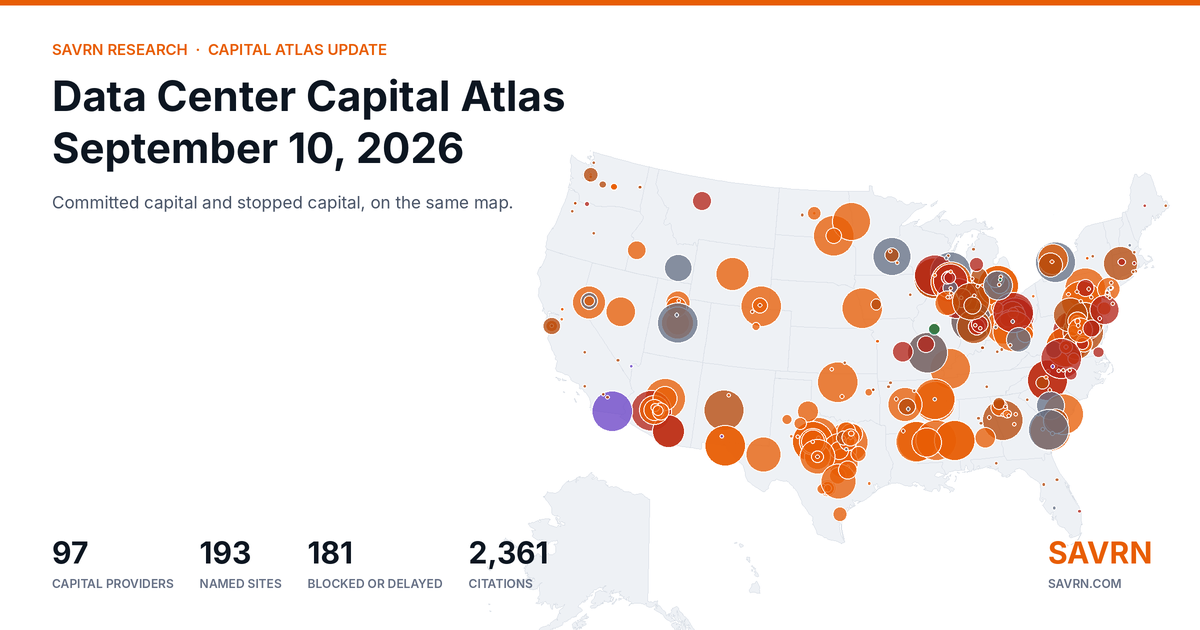
This data center capital atlas update records what changed in the North American Data Center Capital Atlas, SAVRN’s primary-sourced record of who is funding data center capacity in North America, in what structure, at which site, and how much of that capital has been stopped. The atlas is refreshed every Tuesday, Thursday, and Saturday, and each refresh publishes a note like this one recording exactly what changed.
Where the record stands
| Measure | Previous | Current | Change |
|---|---|---|---|
| Capital providers | 97 | 97 | no change |
| Named sites | 187 | 193 | up 6 |
| Financing transactions | 288 | 298 | up 10 |
| Blocked or delayed projects | 174 | 181 | up 7 |
| Source citations | 2,251 | 2,361 | up 110 |
| States with a blocked or delayed project | 42 | 43 | up 1 |
Announced capital across the tracked cohort is reported as disclosed and is never summed into a single deployment figure: site commitments overlap one another and overlap reported capital expenditure. Blocked-and-delayed totals from different trackers cover different windows and definitions and are shown side by side rather than added.
Capital at risk, added this period
- Oregon state-owned land pause for data centers, State of Oregon (OR). No dollar figure or megawatt figure disclosed; scope is all state-owned property. Governor Tina Kotek directed state agencies to immediately pause all unapproved land transactions and permits for new data center projects on state-owned property. The pause covers requests for easements, leases, rentals, land-use permits, and sales or transfers of state-owned property for data centers, and runs through 1 July 2027 or until further direction from the Governor’s Office or the legislature. The stated purpose is to allow a statewide evaluation of long-term impacts including infrastructure capacity, environmental sustainability, water usage, job creation and effects on surrounding communities, and to ensure that data center growth does not shift utility and infrastructure costs onto Oregon ratepayers. Reporting notes that Oregon does not currently have authority to impose a statewide moratorium on data center development on private land, and that this action reaches only the state’s own property. On the same day, at an anti-data-center rally outside the Capitol in Salem, Kotek said she now supports a statewide moratorium on new data centers and that the legislature should pass a temporary ban when it convenes next year, a shift from her previous position. Republican gubernatorial candidate Christine Drazan also called for a moratorium. No statewide moratorium has been enacted; what is in force is the state-land pause recorded here. (Oregon Capital Chronicle)
- Crux AI (Google-Blackstone venture) Cheyenne site, Cheyenne (WY). No site-level dollar figure or megawatt figure disclosed for the Cheyenne project. Bloomberg reported on 8 September 2026 that the Google and Blackstone cloud venture has hit delays at major data center locations intended to run Google’s chips, among them a data center being developed in Cheyenne, Wyoming. Executives involved with the venture, reported internally as Project Braid, are described as having accepted that data center projects now carry roughly a 50% chance of meeting delivery dates, against about 90% three years ago, with organized opposition, switchgear supply shortages and skilled labor constraints cited as causes. The venture, publicly named Crux AI, was launched with an initial $5 billion equity commitment from Blackstone and targets a first 500 MW in 2027. This record captures a reported schedule delay, not a cancellation, and the parties have not confirmed a revised delivery date. (Bloomberg)
- Project Camellia zoning ordinance challenge, Effingham County (GA). $20B / 1,400 acres / up to 3.2 GW of electricity requested. Three Effingham County residents filed a complaint in Effingham County Superior Court on 2 September 2026 challenging Ordinance 2026-352, which county commissioners gave final approval on 4 August 2026 and which zoned the 1,400-acre property planned for OpenAI’s Project Camellia data center campus. The residents allege the county was required to hold two public hearings before making that change, one before the planning board and one before the county commission, under state law and the county’s own rules, and that it held neither. The complaint also cites a non-disclosure agreement signed by County Manager Tim Callanan with OpenAI that it says forbade him from sharing information about Project Camellia with residents. The suit asks the court to throw out the ordinance and bar the county from using it unless the required zoning procedures are followed. The campus is reported at up to 3.2 GW of electricity demand, which local reporting compares to roughly three cities the size of Atlanta. No court ruling has issued and the project is not stopped; this record captures a filed challenge to the zoning instrument. The capital figure is left blank because the $20 billion attached to the project in press coverage is not disclosed in the complaint. (Georgia Public Broadcasting)
- Mona area data center approval process challenge, Juab County (UT). $10B / roughly 3 million square feet. Residents of the Mona area are challenging how a proposed data center of roughly 3 million square feet, described in reporting as a $10 billion project and the largest in Juab County’s history, was approved with little public input. County commissioners did not approve the project themselves: planning officials cleared it through a zone change and a conditional use permit, and the public hearing on 15 April 2026 lasted about four minutes with only the county, the selling landowners and the developers present. Residents say they learned of the project only recently and are asking how the zone change was presented to the public and how the conditional use permit was approved, and are demanding a public hearing before any further decision rather than after it is final. No approval has been rescinded and no litigation is recorded here; this is a live challenge to the process. The capital figure is left blank because the $10 billion is a press characterization, not a disclosed commitment. (KSL)
- Townsite Data Center, Boulder City area, Clark County (NV). 88.5 acres on federal public land; no dollar figure or megawatt figure disclosed. The Interior Board of Land Appeals stayed construction of the Townsite Data Center on 1 September 2026, an 88.5-acre facility the Bureau of Land Management approved on public land roughly 25 miles southeast of Las Vegas near Boulder City, and reported as the first AI data center approved on federal public land. The board found BLM likely acted unlawfully when it amended an existing right-of-way grant in June 2026 to permit a data center without a project-specific environmental review. Opponents cited projected electricity and water demand, soil disruption, light pollution and habitat loss for the Mojave desert tortoise. BLM had until 21 September 2026 to respond. This is an interim stay, not a final decision, and no capital figure has been disclosed. (Outdoor Life)
- Unincorporated Lake County data center moratorium, Lake County (IL). No dollar figure or megawatt figure disclosed; applies to all unincorporated county land. The Lake County Board approved an eight-month moratorium on data center applications and development in unincorporated Lake County, running to 11 May 2027 or earlier if the board adopts regulations, and extendable by a further four months. The county states the purpose is to evaluate data centers as an emerging land use, review best practices and assess infrastructure and environmental considerations before enacting development restrictions. The adoption process included a public hearing that generated more than 1,200 public comments in person and online. (Lake County, Illinois)
Capital at risk, added this period, newly verified from earlier periods
These entries were added in this cycle but their own dates fall before the current month. They are documentation catching up, not new activity.
- Dauphin Highlands Golf Course data center, Dauphin County (PA). No dollar figure or megawatt figure disclosed. Plans for a data center at the Dauphin Highlands Golf Course site were put on hold indefinitely to allow for more community input, after residents raised concerns at a township meeting. The pause was reported on 5 August 2026. A separate $10 billion Corscale proposal sits about two miles away in Swatara Township and is not affected by this hold. (WHP 580)
Sites added this period
- North Dallas Corridor turnkey data center (North Dallas Corridor, TX). 54 MW, announced. A turnkey data center with 54 MW of critical capacity on a 74 MW site in the North Dallas Corridor, announced 3 September 2026 for delivery in late 2027. The parties describe it as the first project under a framework to develop inference-ready sites in top tier United States markets. (Yahoo Finance / press release)
- Project Thunderbird data center campuses (Enid, OK). $35.0B, announced. A proposed 1,735-acre, four-campus data center development along a single corridor in Enid, estimated by the developer at $35 billion at build-out with up to 3.3 GW of on-site power generation and roughly 600 jobs. The developer group, Plainsmen Holdings, is made up of Enid natives. The proposal was scheduled to go before the Enid Planning Commission on 28 September 2026 and the Enid City Commission on 6 October 2026, so no approval is recorded. The $35 billion figure is the developer’s own estimate and is not a financed commitment. (News 9)
- Google Monroe County campus (Monroe County, GA). announced. Google purchased 950 acres in Monroe County for $42 million in October 2025 for a potential data center. On 8 September 2026 Monroe County approved a plan for splitting more than $1.2 billion of payments Google offered across the construction phase and the following two decades, structured through Monroe County Development Authority ownership and lease-back. The project still needs further clearances including confirmation of the site location and adherence to job-creation targets. No construction capital figure has been disclosed. (Georgia Public Broadcasting)
Sites added this period, newly verified from earlier periods
These entries were added in this cycle but their own dates fall before the current month. They are documentation catching up, not new activity.
- Fleet Data Centers Reno-area hyperscale facility (SV RNO) (Storey County, NV). $3.8B, 200 MW, construction. A 252-acre property in Storey County, Nevada carrying a turnkey data center and electrical substation of 230 MW utility capacity and 200 MW critical IT capacity. The February 2026 offering states the facility is 100% leased on a 197-month triple net lease to an AA- investment grade rated tenant with a market capitalization in excess of $3 trillion. The release does not name the tenant, and no tenant is named here. (Fleet Data Centers)
- Kingston Technology Hub (Kingston, GA). $1.0B, 150 MW, announced. Thor Equities filed a Development of Regional Impact with the Georgia Department of Community Affairs for a 350,000-square-foot data center on 559 acres near Kingston in Bartow County, valued at approximately $1 billion at build-out, drawing about 150 MW and using an estimated 50,000 gallons of water per day. The filing projects roughly $2 million of annual taxes and about 50 full-time jobs, with completion scheduled for 2030. Thor Equities must still ask Bartow County to rezone the 559 acres, so no approval is recorded. (Coosa Valley News)
- Corscale Swatara Township data center (Swatara Township, PA). $10.0B, announced. Corscale Data Centers presented a 121-page development plan for a $10 billion, 157-acre data center facility along Highland Street in Swatara Township, comprising two single-storey data centers with a closed-loop cooling system using roughly 7,500 gallons of water. The site sits about two miles from another proposed data center at Dauphin Highlands Golf Course, whose plans were placed on hold. The $10 billion figure is the developer’s own and no approval is recorded. (FOX43)
Financing transactions added this period
- Northampton Capital Partners and Provident Data Centers. jv equity, No dollar figure disclosed in the announcement. Northampton Capital Partners LLC formed a joint venture with Provident Data Centers, a division of Dallas-based Provident, to develop a turnkey data center with 54 MW of critical capacity on a 74 MW site in the North Dallas Corridor, for delivery in late 2027. No investment amount was disclosed. The parties state they have agreed a framework to continue the partnership developing inference-ready data center sites in top tier markets across the United States. (Yahoo Finance / press release)
- Vertiv and UtilityInnovation Group. acquisition, Approximately $1.45 billion in cash at closing, plus additional consideration of up to $1.15 billion contingent on EBITDA targets over 12- and 24-month periods. The contingent amount is not included in the recorded figure.. Vertiv entered into an agreement to acquire UtilityInnovation Group, a microgrid and behind-the-meter power architecture firm, for approximately $1.45 billion in cash at closing, with additional consideration of up to $1.15 billion in cash contingent on UtilityInnovation Group achieving certain EBITDA targets over 12- and 24-month periods. Vertiv frames the transaction as accelerating time to power for AI data centers. The transaction is expected to close in the fourth quarter of 2026. (Vertiv investor relations)
- Qualcomm and Amazon (AWS). other, Amazon may purchase up to $60 billion of Qualcomm AI data center chips and related products under a long-term partnership. This is a purchase ceiling, not a drawn commitment, and it is not summed with any deployment figure.. Qualcomm and Amazon announced a multi-generational partnership under which Amazon may buy up to $60 billion of Qualcomm AI data center chips and related products. The scope covers customized processors for large-scale AI inference, optical connectivity for Amazon’s data center networks, and expanded use of AWS infrastructure in Qualcomm’s chip-design workflow. Qualcomm granted Amazon warrants worth approximately $4 billion that vest with product purchases, exercisable at $161.26 per share. Qualcomm stated it expects the partnership to help drive its data center chip revenue to $15 billion by 2029. (CNBC)
- Deutsche Bank. other, Approximately EUR 2 billion (about $2.3 billion) reference portfolio of project finance debt including data center loans. This is a credit-risk transfer on an existing loan book, not new capital deployed to a site, and is never summed with deployment figures.. Bloomberg reported that Deutsche Bank is working on a significant risk transfer tied to approximately EUR 2 billion of project finance debt, including loans for data centers. The bank’s first SRT tied to a project finance portfolio, it places the bank among a growing set of European and North American lenders using the significant-risk-transfer market to hedge exposure to AI-related infrastructure lending. Terms may change following investor discussions. The reference portfolio is described as project finance debt including data center loans and is not confirmed to be North American, so it is recorded here as a financing-structure development rather than as capital deployed to a North American site. (Bloomberg)
- Google and Monroe County Development Authority. other, More than $1.2 billion of payments offered across the construction phase and the following two decades. This is a payment-in-lieu-of-taxes stream to local bodies, not construction capital, and is not summed with site investment figures.. Monroe County approved a plan for splitting more than $1.2 billion that Google offered to pay over the construction phase and the subsequent two decades for a proposed data center. Year-one payments total $31 million, split $14.5 million to the county, $14.5 million to the school district and $1.8 million to the development authority. By year 20 annual payments reach $77 million, split $29 million to the county, $43.5 million to the school district and $4.6 million to the development authority. The structure relies on ownership by the Monroe County Development Authority, which would lease the facility back to Google, exempting it from standard private property taxes and replacing those levies with contractual payments distributed through the lease. The project still requires further clearances, including confirmation of the site location within Monroe County and adherence to job-creation targets. Google purchased 950 acres in Monroe County for $42 million in October 2025. (13WMAZ)
- Anthropic, Morgan Stanley, Goldman Sachs, JPMorgan Chase and Citigroup. debt facility, $15 billion revolving credit facility, reported as nearing finalisation and not confirmed closed. Bloomberg reported that Anthropic is close to finalising a $15 billion revolving credit facility ahead of its expected initial public offering. Morgan Stanley is leading, with Goldman Sachs, JPMorgan Chase and Citigroup in prominent roles; Barclays and Wells Fargo are expected to take key positions, with Bank of America, Deutsche Bank, Royal Bank of Canada, UBS, Bank of Montreal, BNP Paribas, Credit Agricole, Mizuho, MUFG, SMFG and Toronto-Dominion also in the lender group. The facility is larger than the roughly $10 billion Anthropic initially sought and well above the $2.5 billion five-year revolving line it secured previously. The four banks with the most prominent roles are also leading the IPO. A revolving facility is borrowing capacity, not drawn capital, and is not summed with deployment figures. (Bloomberg)
- Fluidstack and Jane Street. equity raise, $1.5 billion round led by Jane Street at a reported valuation above $18 billion, taking total funding to just over $2.6 billion. Fluidstack closed a $1.5 billion round led by Jane Street at a reported valuation above $18 billion, more than doubling the $7.5 billion valuation attached to its $750 million July 2026 raise and taking total funding to just over $2.6 billion. Reporting notes Fluidstack builds and operates facilities rather than owning chips, and that the raise follows its previously disclosed multi-year Anthropic capacity programme recorded separately in this atlas. Jane Street’s participation makes it an investor in the model company, the chip-cloud provider and the facility builder at the same time. (Forbes)
Financing transactions added this period, newly verified from earlier periods
These entries were added in this cycle but their own dates fall before the current month. They are documentation catching up, not new activity.
- Fleet Data Centers and SV RNO Property Owner I, LLC. project bond, $3.8 billion aggregate principal amount of 5.875% senior secured notes due 1 March 2031. Fleet Data Centers announced the pricing of $3.8 billion aggregate principal amount of 5.875% senior secured notes due 1 March 2031, issued by SV RNO Property Owner I, LLC. Proceeds finance a portion of the development and construction of a 230 MW utility capacity (200 MW critical IT capacity) turnkey data center and electrical substation on a 252-acre property in Storey County, Nevada, plus associated fees and expenses. The release states the facility is 100% leased under a 197-month triple net lease to a tenant it describes only as an AA- investment grade rated tenant with a market capitalization in excess of $3 trillion. The tenant is not named in the release and is not named here. (Fleet Data Centers)
- SLB, Kelvion, Apollo Global Management and Triton. acquisition, $4.1 billion total: approximately $3.4 billion in cash plus assumption of about $700 million of debt. SLB agreed to acquire thermal management provider Kelvion from majority owner Apollo-managed funds and minority shareholder Triton for approximately $3.4 billion in cash plus the assumption of about $700 million of debt, a $4.1 billion total. Data centers are Kelvion’s largest and fastest-growing end market, with revenue expected to reach $1.2 billion to $1.3 billion in 2026. SLB stated the combined businesses are expected to generate more than $2 billion of data center revenue and approximately $300 million of adjusted EBITDA on a pro forma basis in 2026, targeting $4.5 billion to $5 billion of revenue and $700 million to $800 million of adjusted EBITDA from the combined data center solutions business by 2028. The transaction is subject to regulatory approvals. This is a supply-chain transaction, not data center capacity, and is not summed with site commitments. (Apollo Global Management)
- CoreWeave. senior notes, $1.25 billion of 9.625% senior notes due 2032, issued alongside EUR 2 billion of 8.500% senior notes due 2032. Only the US dollar tranche is recorded in the figure; the euro tranche is not converted, so the recorded amount understates the offering.. CoreWeave priced and closed a private offering of $1.25 billion aggregate principal of 9.625% senior notes due 2032 and EUR 2 billion aggregate principal of 8.500% senior notes due 2032, both maturing 15 July 2032, with interest accruing from 18 June 2026 payable semi-annually from 15 January 2027. Proceeds are for general corporate purposes including repayment of outstanding debt and offering fees and expenses. Recorded in this refresh as a backfill: the transaction dates to June 2026 and was absent from the atlas. (CoreWeave investor relations)
Status changes
- Imperial Valley Computer Manufacturing campus. litigation, now court halt. The project would be the largest data center in California at roughly 950,000 square feet, with a power draw that KPBS reports as approaching double Imperial County’s entire 2024 electricity consumption, its own substation, a large battery system and a natural gas generator bank for backup, and a water demand of 750,000 gallons per day. It was promoted as producing 2,500 construction jobs and $28.7M a year in tax revenue, and the developer states the county’s economic study found $100 million a year in county-directed public benefits. The developer, Imperial Valley Computer Manufacturing LLC of Huntington Beach, sought to avoid environmental review under the California Environmental Quality Act in order to begin construction quickly. On 7 April 2026 the Board of Supervisors approved a lot merger for the project by 4-1, with Supervisor Martha Cardenas-Singh dissenting. County planners described the lot merger as the only step where the county has discretion over whether the project moves forward, and stated that the project cannot receive a certificate of occupancy until the developer secures confirmed power and water supplies. County officials restricted residents from entering the hearing citing fire safety limits, and deputies removed at least three protesters. Opponents raised grid strain, water depletion, air quality and the absence of environmental analysis; the group NIMBY Imperial began a recall effort against Supervisor Peggy Price and collected signatures for a November ballot measure to ban data centers on unincorporated county land. The City of Imperial sought an emergency court order to halt the April vote and is suing the county. Supervisors had earlier approved a parcel merger and then imposed a moratorium after public outcry. The developer has separately sued the City of Imperial in federal court. On 1 September 2026 Imperial County Superior Court Judge L. Brooks Anderholt issued a tentative decision finding that the county prejudicially abused its discretion by approving the lot merger without first completing the CEQA review required for the whole project, writing that the grading, lot merger, road vacation, electrical facilities, water systems and related infrastructure serve one objective, the construction and operation of the data center campus. County planners must restart the approval process and complete a full Environmental Impact Report addressing energy demand, water supply and drainage, the battery system, and the pollution and greenhouse gas potential of the natural gas generators. The decision is tentative and both parties may comment before a final ruling. The developer said it would seek a hearing to contest the findings. Alene Taber, counsel for the City of Imperial, said the decision vindicates residents’ concerns. Separately, Judge Jeffrey Jones issued a preliminary decision in August 2026 indicating he would strike down the county’s emergency data center moratorium for want of evidence of an immediate threat to public health or safety, and the county has confirmed it was directed to set the moratorium aside. KPBS notes that Anderholt’s documentation of environmental risk may strengthen the county’s case for reimposing moratorium protections. On 9 September 2026 the ruling became final: Judge Anderholt set aside the lot merger approval granted by the Imperial County Board of Supervisors in April 2026, and county planners must restart the approval process and complete a full CEQA environmental review before the project can proceed. The suit was brought by the City of Imperial and the San Diego and Imperial Counties chapter of the Sierra Club. KPBS reports the developer, identified as Sebastian Rucci of Huntington Beach, said he plans to appeal the decision and to explore alternative project locations further from residential areas.
- Farmington Technology Park (Tract). litigation, now litigation. Denver-based Tract’s 340-acre, up-to-12-building, 2.5M-sq-ft campus (~$5B at full buildout) on former golf-course/school land. Residents sued on technical and later environmental grounds; MCEA joined as party. On 9 September 2026 the Coalition for Responsible Data Center Development announced it is withdrawing its lawsuit against the city of Farmington, the Farmington School District and Tract Land Development, with chair Cathy Johnson stating that the merits remain valid but the ongoing high costs of litigation are no longer sustainable by the few residents who have personally shouldered the legal costs. Castle Rock Township’s companion lawsuit against Farmington, challenging a breach of the Orderly Annexation Agreement, is unaffected and continues. This is a withdrawal on cost, not a ruling on the merits, and it removes one of the two challenges facing the project.
How to read this
Every figure in the atlas links to the page that states it. Where a value could not be confirmed from a fetched source, the entry reads n.a. rather than an estimate, and roughly two-thirds of the capital-at-risk rows carry either a dollar figure or a megawatt figure but not both, because local rezoning dockets disclose acreage and square footage while investment figures come from economic-development announcements that a withdrawn project never makes. The dollar total of the rows that do disclose a figure is therefore a floor, not a census.
The atlas sits alongside two companion references: the Nationwide Data Center Delay Watchlist, which tracks project-level slippage, queues, and securities filings, and the U.S. Data Center Moratorium Tracker, which maps state and local policy measures. All citations behind this atlas are listed on one page.
Would you like the atlas update?
The atlas is re-verified and republished on Tuesday, Thursday and Saturday. You get one email when it goes out, with what changed.
Also send me
Receive a short introduction on days 3, 7 and 14, plus the updates you select. Unsubscribe in one click. Privacy
Data Center Capital Atlas Update: September 10, 2026
Get new SAVRN Insights by email
A short introduction on days 3, 7 and 14, plus new SAVRN research articles. Unsubscribe at any time.
We use your address to send the introduction and updates described above. See our Privacy Policy.