How data centers are shaping clean energy power and grid planning in 2026
A look at how data centers are driving renewable energy adoption and grid infrastructure planning across the U.S. in 2026.
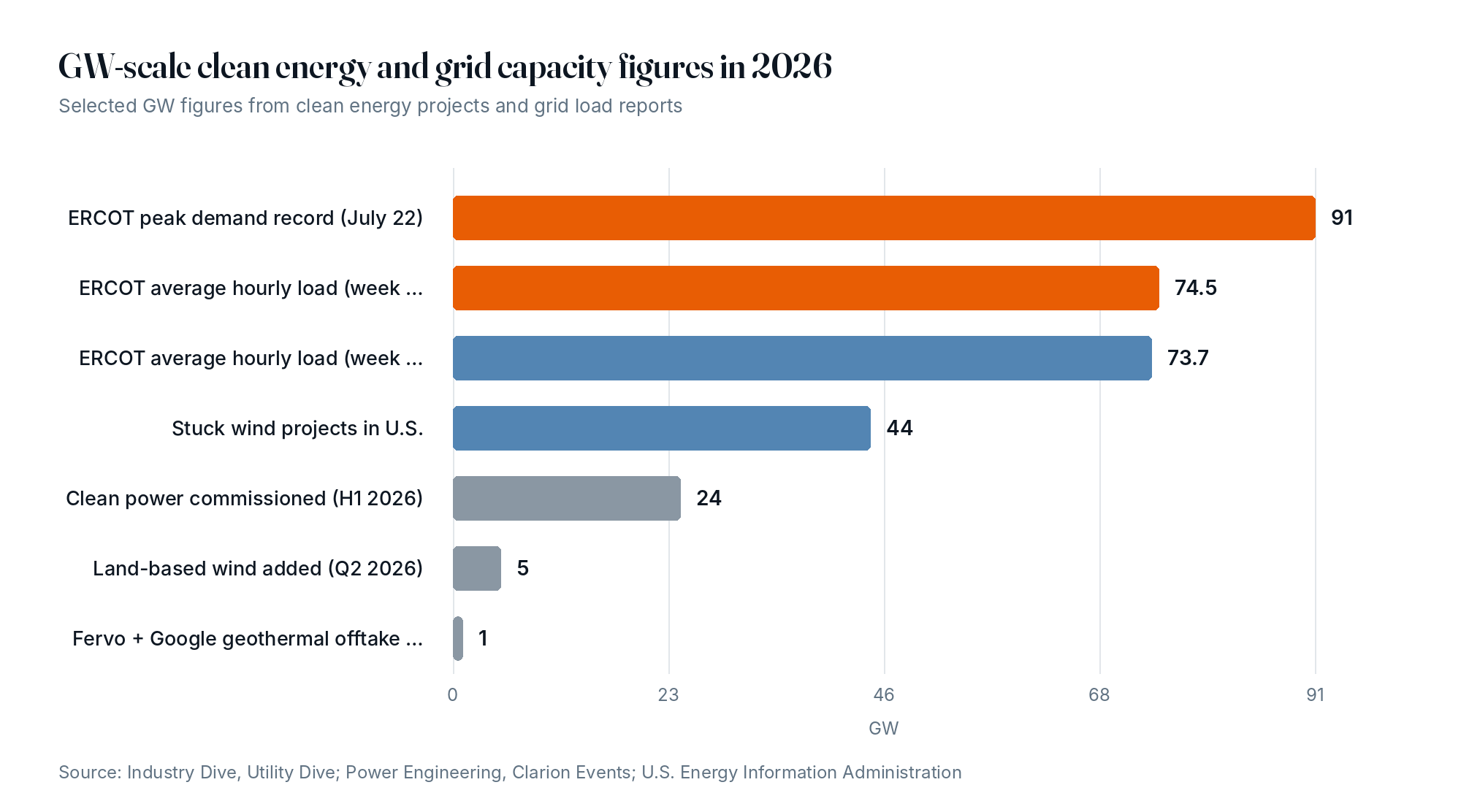
Data center clean energy power is shaping the direction of U.S. electricity infrastructure in 2026. Solar and storage accounted for more than two-thirds of the 28.4 GW of new power capacity added to the grid in the first half of 2026 3. As a result, the reliance on renewable sources has increased significantly. Meanwhile, the Electric Reliability Council of Texas (ERCOT) set a record weekly average peak load of 74.5 GW for the week ending August 22, 2026 2. However, at least 44 GW of land-based wind projects remain stuck in the permitting pipeline, which is contributing to a growing gap between solar and wind development 1.
Why this matters now
Data centers are the fastest-growing electricity load in the U.S. 2, 3 As a result, utilities and grid operators are planning years ahead to meet rising demand. Solar and storage now make up more than two-thirds of new power capacity added to the grid in the first half of 2026 3. Meanwhile, ERCOT set a record weekly average peak load of 74.5 GW for the week ending August 22, 2026 2. This combination is forcing a shift in how clean energy is sourced and how grids are planned. Land-based wind projects face a growing backlog, with at least 44 GW stuck in permitting 1. Data center developers are therefore accelerating solar-storage and geothermal projects instead 5, 7. Utilities are also auditing data center interconnection proposals more closely as demand surges 6. These changes are shaping the direction of U.S. electricity infrastructure for the next decade.
What to take from this
- Solar and battery storage now dominate new power builds for data centers.
- ERCOT is experiencing sustained record peak loads, stressing the grid.
- Land-based wind is losing competitiveness to solar-storage combinations.
- Geothermal PPAs are emerging as a reliable baseload option for hyperscale.
- Early engagement with utilities is essential due to lengthy transmission timelines.
What the sources report
What is being built and why
At least 44 GW of land-based wind projects are stalled in review at the U.S. Department of Defense as of September 2026 1. Solar and battery storage accounted for more than two-thirds of all new power capacity added to the U.S. grid in the first half of 2026 3. Meanwhile, the Electric Reliability Council of Texas (ERCOT) recorded a record weekly average peak load of 74.5 GW for the week ending August 22, 2026 2. These trends, therefore, reflect high electricity demand and regulatory challenges that are shaping how data centers and utilities plan and procure power.
Solar and storage dominate new power builds
In the first half of 2026, solar and storage made up over two-thirds of new U.S. power capacity 3. Furthermore, average national power purchase agreement (PPA) prices in Q2 2026 were $83.79 per MWh for land-based wind and $61.40 per MWh for solar 1. Solar PPA prices fell 4.8% from Q1 2026, while wind prices rose 5.5%, which widened the wind-solar price gap to $22.39 per MWh 1. As a result, this price shift has accelerated the adoption of solar-plus-storage projects instead of wind.
ERCOT faces sustained record peak loads
ERCOT’s weekly average peak load exceeded 70 GW for six consecutive weeks through late August 2026, reaching a high of 74.5 GW for the week ending August 22 2. This average is 10% higher than the highest weekly average in summer 2025 and 6% above the previous record set in 2023 2. Consequently, high demand has led ERCOT to audit data center interconnection proposals 6.
Wind projects face major permitting delays
At least 44 GW of wind projects are stuck in review at the U.S. Department of Defense as of September 2026 1. Additionally, the land-based wind pipeline declined 4% in Q2 2026 due to regulatory and price pressures 1. Hyperscalers such as Google and Meta are increasingly pursuing solar-storage and geothermal projects instead of wind 1.
Geothermal gains traction for reliable data center power
Google signed a 396 MW geothermal power purchase agreement with Fervo Energy for a project in Utah, with an option to expand to nearly 1 GW by 2030 7. This project is designed to deliver round-the-clock clean energy for potential data center loads 7. Moreover, Google previously supported a geothermal project in Nevada and helped develop new tariff structures to enable geothermal development 7.
Transmission planning struggles to keep pace
The U.S. Department of Energy’s draft 2026 National Transmission Needs Study identifies accelerating data center electricity demand as a key driver for new transmission infrastructure 8. However, DOE did not designate three proposed National Interest Electric Transmission Corridors after its review, citing insufficient evidence for federal designation 8. This outcome leaves utilities uncertain about how much transmission to build ahead of data center load growth 8. Data centers that secure clean energy contracts early and collaborate with utilities on transmission planning are therefore more likely to achieve reliable and cost-effective power 8.
What this means for data center power choices
Data centers are increasingly choosing solar with storage due to lower costs and faster deployment compared to wind 1, 3. In addition, geothermal power is emerging as a reliable, round-the-clock option where resources and policy support exist 7. Utilities face pressure to plan transmission well in advance, but project commitments can be uncertain 8. Ultimately, data centers that act early and work closely with utilities are more likely to secure reliable and cost-effective power 8.
How do data centers choose their clean energy sources?
Data centers increasingly select solar and battery storage because these technologies made up more than two-thirds of all new U.S. power plant capacity added in the first half of 2026 3. Solar and storage accounted for 90% of new capacity in that period 3. This trend is driven by lower costs and faster deployment compared to wind, where the land-based wind power pipeline has dropped and the price gap with solar has widened 1. However, data centers also require power that is available around the clock. To provide 24/7 reliability, they are adding geothermal and long-duration storage 7. For example, Google signed a 396 MW geothermal power purchase agreement with Fervo Energy for a potential Utah data center, with an option to expand to nearly 1 GW by 2030 7. Site-specific resources and local grid needs shape these decisions. The Mammoth Solar project in West Virginia includes 86 MW of solar, 70 MW/280 MWh of lithium-ion batteries, and 10 MW/100 MWh of zinc-based long-duration storage, designed to match data center load profiles throughout the day 5. In PJM, recent capacity auctions reached the price ceiling and a nearly 7 GW shortfall is expected to be addressed in a backstop auction this fall, making early clean energy commitments more important 5.
How do utilities respond to data center load growth?
Utilities are responding to record electricity demand by accelerating transmission and infrastructure upgrades, often years before data centers come online. In ERCOT, the system set a new peak demand record of 91 GW on July 22, 2026 6. For the six weeks ending August 29, 2026, ERCOT’s weekly average peak loads exceeded the previous 2023 record every week 6. As a result, the region has experienced sustained high demand. The hourly average load for the week ending August 22, 2026, was 74.5 GW, which is 10% higher than the highest hourly average in summer 2025 and 6% above the 2023 record of 70 GW 6. This increase has been driven by sustained high temperatures 6.
ERCOT’s planning under record load
ERCOT projects peak loads will reach 154 GW by 2035 6. The utility is auditing around 300 data center interconnection proposals following Governor Abbott’s moratorium on new data center connections 6. However, despite these challenges, ERCOT has stated there is expected to be sufficient generation to meet summer 2026 needs, but ongoing monitoring and infrastructure planning are required 6. Therefore, proactive measures are essential.
Transmission planning and federal review
The U.S. Department of Energy’s 2026 National Transmission Needs Study identifies data center load growth as a major driver for new transmission capacity 8. However, the DOE did not designate three proposed National Interest Electric Transmission Corridors after its study cited data center load growth as a key factor 8. This outcome leaves utilities uncertain about how far ahead to build transmission, as data center developers may seek gigawatts of power years before lines can be permitted and constructed 8. Consequently, utilities face a difficult planning balance.
Infrastructure bottlenecks and alternatives
Utilities face the challenge of building transmission early enough to avoid bottlenecks, but not so early that infrastructure is built for loads that may not materialize 8. For example, Texas’s Competitive Renewable Energy Zones program demonstrates that proactive transmission planning, building lines ahead of large-scale generation deployment, can support later load growth 8. As a result, such strategies are increasingly considered.
Grid reliability and emergency thresholds
Despite setting multiple new peak demand records, ERCOT has not declared energy emergencies, unlike PJM during its peak periods 6. This difference has been partly attributed to Texas’s rapid solar deployment, which reached a record 35 GW in 2026 6. In addition, utilities are prioritizing resources that can meet both peak and around-the-clock demand, while managing interconnection queues and infrastructure timelines 6.
Long-term implications for utilities
Utilities must now plan transmission and generation additions with longer lead times to accommodate data center load growth, which can be committed years before facilities are operational 8. This requires coordination among data center developers, utilities, and regulators to balance reliability, cost, and timing 8. Ultimately, effective planning will be crucial to ensure grid stability as demand continues to rise.
What is driving the shift away from land-based wind?
Land-based wind projects are losing market share to solar and storage as the cost gap widens 1. Specifically, in Q2 2026, the average national PPA price for land-based wind was $83.79/MWh, while solar was $61.40/MWh, a $22.39/MWh difference 1. As a result, land-based wind PPA prices increased 5.5% quarter-over-quarter and 17.5% year-over-year in Q2 2026, while solar PPAs fell 4.8% from the previous quarter but still remained 6.7% higher than a year earlier 1. Meanwhile, at least 44 GW of wind projects are “stuck” in review at the U.S. Department of Defense 1. In addition, the U.S. land-based wind project pipeline fell 4% in Q2 2026, reflecting ongoing regulatory and price pressures 1.
Hyperscalers and utilities favor solar-storage
In fact, in Q2 2026, Google accounted for 54% of corporate power purchase agreements 1. Furthermore, utilities were the largest clean power buyers in the first half of 2026, contracting 15,048 MW through PPAs, which made up 71% of offtake agreements 1. Notably, new clean energy offtake announcements rose 23% year-over-year in Q2 2026, with much of the demand linked to data center load growth 1.
Regulatory and market pressures slow wind
Consequently, U.S. land-based wind capacity additions in Q2 2026 were nearly 5 GW, but the pipeline shrank as solar became more cost-competitive 1. Because the price gap between land-based wind and solar reached $22.39/MWh, a 36% increase from previous gaps, wind has become less attractive 1. Additionally, at least 44 GW of wind projects are delayed at the U.S. Department of Defense, creating a bottleneck for project approvals 1.
Solar and storage dominate new builds
Ultimately, solar and battery storage continue to dominate new U.S. power plant construction 3. For example, projects pairing solar with storage can deliver both peak and baseload power, making them attractive for data center needs 3. Therefore, as solar prices decline and wind prices rise, land-based wind is becoming less competitive for new data center power contracts 1.
How are data centers accelerating geothermal adoption?
Hyperscalers sign large geothermal PPAs for data centers
Major hyperscalers are securing multi-hundred-megawatt geothermal power purchase agreements to supply data centers with reliable, round-the-clock clean power. For example, Fervo Energy and Google signed a 396 MW geothermal PPA to supply a potential data center in Utah, with an option to expand to 996 MW by June 2030 7. Additionally, the Cape Station project is expected to deliver 100 MW from Phase I in 2026 and an additional 400 MW from Phase II by 2028 7. In fact, the project has received permitting approval for up to 2,000 MW of capacity 7.
Geothermal provides baseload power that complements solar and storage
Geothermal energy is available 24/7, making it a strong complement to intermittent solar and battery storage. Therefore, the Fervo-Google PPA positions geothermal as a foundational building block for data center power needs 7.
These deals help unlock new geothermal projects
Large PPAs from hyperscalers can de-risk investments and encourage new geothermal development. As a result, Fervo Energy said the Google agreement unlocks new, around-the-clock electricity capacity at no cost to existing ratepayers 7. Moreover, the partnership began with a 115 MW PPA with Google and NV Energy in June 2024, which helped pioneer a Clean Transition Tariff that enabled more geothermal on the Nevada grid 7.
Geothermal projects are moving from pilot to commercial scale
Fervo’s Project Red in Nevada began commercial operation in 2023 and supplies power to the local grid and Google data centers 7. Meanwhile, Cape Station Phase I is set to deliver 100 MW in 2026, and Phase II will add 400 MW by 2028 7.
Geothermal can support local economic development
Fervo and Google said the Utah project will deliver economic benefits to the local community and help reduce long-term energy costs 7.
Utilities and regulators are adapting to new clean energy sources
As geothermal projects scale, grid planning is evolving to integrate these baseload resources. This shift is part of a broader trend, since data center load growth influences transmission and resource planning across regions 8.
How does this change the economics?
Solar and storage dominate new capacity additions
A single solar plus storage project in West Virginia includes 86 MW of solar and 340 MW of storage, comprising 70 MW/280 MWh of lithium-ion batteries and 10 MW/100 MWh of zinc-based long-duration storage 5. As a result, solar plus storage now make up the majority of new U.S. power plant capacity additions, with Texas solar capacity reaching 35 GW, a deployment record 6, 3. Furthermore, developers are increasingly pairing solar with long-duration storage to meet 24/7 data center load profiles 5.
Land-based wind faces a shrinking pipeline
At least 44 GW of wind projects are “stuck” and unable to move forward under current market conditions 1. Consequently, the land-based wind pipeline is shrinking as solar becomes cheaper and more flexible, and the price gap between wind and solar is widening 1.
ERCOT’s record peak loads raise near-term costs
ERCOT set a new weekly peak load record of 91 GW on July 22, 2026, and sustained above-record loads for six consecutive weeks 6. On that day, solar supplied 32% and natural gas 48% of generation 6. This situation tightens capacity markets and can increase short-term energy prices, affecting data center power costs in Texas 6. Therefore, ERCOT’s projection that peak loads will reach 154 GW by 2035 6 suggests continued pressure on the grid.
Transmission planning faces new pressures
The DOE reconsidered three proposed transmission corridors due to data center load growth, noting that developers can request gigawatts of power years before transmission lines are built 8. This delay can increase costs for developers and utilities and may slow project timelines 8.
Geothermal projects scale with major PPAs
Google signed a 396 MW power purchase agreement with Fervo Energy for enhanced geothermal systems, the largest geothermal PPA to date 7. In addition, the Cape Station project is expected to deliver 100 MW in 2026 and 400 MW by 2028 7. This growth supports the commercialization of geothermal energy for data centers 7.
Long-duration storage gains traction
The West Virginia project includes 10 MW/100 MWh of zinc-based long-duration storage, one of the largest deployments of its kind 5. Zinc batteries can discharge energy for more than eight hours and use a nonflammable electrolyte 5. Because of these features, this storage is designed to match data center load profiles across all hours 5.
Regional cooperation lowers transmission costs
Six New England states agreed to share the cost of a transmission line for an 800 MW Maine wind project, with Maine ratepayers covering less than 11% of the total cost 4. This cost-sharing model reduces financial risk for utilities and developers facing transmission bottlenecks 4.
Capacity shortages in PJM prompt backstop auctions
PJM’s capacity auction hit the price ceiling, leading to a backstop auction to fill a nearly 7 GW shortfall 5. In response, solar plus storage projects are being developed to address these capacity gaps and provide reliable power for data centers 5.
How SAVRN builds for this
SAVRN builds AI factories that generate their own power on site and run water-free cooling, with a training institute at the front of every campus that reskills the local workforce. SAVRN also publishes and maintains public research tools that track the same trends this article covers: the Data Center Moratorium Tracker, the Water Tracker, the Data Center Delay Tracker, the Grid Operator Watchlist, the Capital Atlas and the US Data Center Map.
What to do next
Lock in renewables early and engage utilities at the start
Operators should secure long-term renewable power purchase agreements as early as possible, because solar and storage accounted for 67.2% of new U.S. power capacity additions in 2026 3. Land-based wind projects face a widening price gap with solar, with at least 44 GW of wind projects “stuck” in the pipeline according to ACP 1. Therefore, engaging utilities during site selection is essential, since it can significantly reduce transmission planning timelines, which can take years even after project approval 8.
Plan for ERCOT’s high-load environment
In ERCOT, weekly peak loads have exceeded the previous record for six consecutive weeks in 2026, reaching a new peak of 91 GW on July 22 6. As a result, the average hourly load for the week ending August 22 was 10% higher than the highest weekly average in summer 2025 6. Moreover, ERCOT is auditing data center interconnection proposals following a state moratorium 6.
Evaluate geothermal and long-duration storage
Google signed a 396 MW geothermal power purchase agreement in 2026 to supply data centers 7. For example, a solar-storage project in West Virginia includes 100 MWh of long-duration zinc-based storage from Eos Energy Enterprises 5. Operators should assess geothermal resource availability and storage options during planning.
Align with transmission planning and policy changes
The U.S. Department of Energy’s 2026 National Transmission Needs Study identifies accelerating data center load growth as a key driver for new transmission 8. However, DOE did not designate three proposed National Interest Electric Transmission Corridors in 2026, citing insufficient evidence for federal designation 8. Consequently, operators should track state and federal transmission planning and potential moratoria closely.
Use SAVRN tools to track risks and opportunities
Use the Data Center Moratorium Tracker to monitor state-level restrictions on new data center interconnections. In addition, the Grid Operator Watchlist provides updates on utility planning and interconnection queues. Furthermore, the Data Center Delay Tracker flags permitting and construction holdups.
Next steps for operators and partners
- Secure long-term renewable PPAs, prioritizing solar plus storage or geothermal where available 3, 7.
- Start transmission and interconnection discussions with utilities early in the site selection process 8.
- Model 24/7 reliability using geothermal and long-duration storage solutions 5, 7.
- Monitor ERCOT load trends and policy changes weekly, since peak demand has remained near record highs for six weeks 6.
- Track transmission corridor decisions and moratoria using SAVRN tools before finalizing site plans 8.
Frequently asked questions
How much of new U.S. power capacity is now solar and storage?
Currently, solar and storage projects make up the majority of new power plant construction in the United States. 3 As a result, these technologies are leading the expansion of the nation’s energy infrastructure.
What is the current weekly peak load in ERCOT?
Recently, ERCOT’s weekly average peak load has remained near record highs for several consecutive weeks. 6 In fact, over the past six weeks, this average has consistently exceeded the previous 2023 record.
Why are land-based wind projects being delayed or canceled?
Land-based wind projects are being delayed or canceled because solar plus storage has become cheaper and faster to build. 1 Therefore, the price gap between wind and solar has widened, which is causing a decline in the wind project pipeline.
How do data centers influence transmission planning timelines?
Data center load growth is frequently cited in studies that question how far in advance transmission lines should be constructed. 8 For example, the Department of Energy’s study references data center load when evaluating transmission corridor proposals.
What role does geothermal energy play in powering data centers?
Geothermal energy can supply large, steady amounts of electricity suitable for data centers through power purchase agreements. 7 Specifically, Fervo Energy signed a 396 MW geothermal PPA with Google to power data centers.
How far in advance should data center developers engage with utilities?
Developers should begin discussions with utilities well in advance, as transmission planning often takes several years. 8 In addition, data center developers may need to seek power commitments years before construction begins.
What is a long-duration energy storage solution?
Long-duration energy storage refers to systems that can provide power for many hours, such as zinc-based battery technology. 5 Notably, a project in West Virginia includes 100 MWh of zinc-based storage designed for long-duration needs.
How do solar and storage compare to wind for data center power contracts?
Solar plus storage is now more commonly chosen than wind in new power contracts for data centers, mainly due to cost and speed of deployment. 3 As a result, solar and storage dominate new U.S. power plant construction.
What are the risks of waiting for utility transmission upgrades?
Waiting for transmission upgrades can delay the delivery of power, which risks project timelines and operational readiness. 8 Meanwhile, the Department of Energy’s study points out the uncertainty involved in building transmission far ahead of actual load.
How can data center operators reduce grid impact?
Sources
- Land-based wind power pipeline shrinks as price gap with solar widens, Industry Dive, Utility Dive, Sep 03, 2026.
- Weekly average load in ERCOT continues near record high, U.S. Energy Information Administration, Sep 03, 2026.
- Solar and storage still dominate US power plant…, Canary Media, Aug 21, 2026.
- Is Maine finally about to make wind power happen?, Canary Media, Aug 25, 2026.
- Google backs solar-storage project at former West Virginia coal mine, Industry Dive, Utility Dive, Sep 08, 2026.
- ERCOT load continues to reach record highs, Industry Dive, Utility Dive, Sep 08, 2026.
- Fervo Energy and Google ink largest-ever geothermal PPA to power data centers, Power Engineering, Clarion Events, Sep 02, 2026.
- DOE Retreat on Transmission Corridors Tests Grid Planning, Informa TechTarget, Data Center Knowledge, Aug 28, 2026.
Want the next one?
When a new piece publishes on SAVRN Insights, you get one email with what it covers and a link to read it. Choose the research that interests you.
Also send me
Receive a short introduction on days 3, 7 and 14, plus the updates you select. Unsubscribe in one click. Privacy
How data centers are shaping clean energy power and grid planning in 2026
Get new SAVRN Insights by email
A short introduction on days 3, 7 and 14, plus new SAVRN research articles. Unsubscribe at any time.
We use your address to send the introduction and updates described above. See our Privacy Policy.