How power availability drives data center site selection in 2026
Electricity supply constraints are now the primary factor in where new data centers are built.
Data center power availability is now the first question any developer asks before buying land. In 2025, US data centers consumed 312.6 TWh of electricity, a 25.5% increase from 2024. As a result, the US accounted for 39.7% of global data center electricity consumption, which totaled 787.8 TWh that year. Global data center electricity demand rose 19.7% in 2025, up from 410.8 TWh in 2020. This growth rate was nearly eight times the overall US electricity generation growth rate of 3.2% in 2025. Because of this surge, power is now the primary factor in site selection. Therefore, developers must prove they can secure scalable, reliable power before breaking ground.
Why this matters now
The surge in data center electricity demand is changing how and where new facilities are built. In 2025, US data centers used 312.6 TWh of electricity, a 25.5% increase from the previous year. As a result, power availability has become the primary factor in site selection. Proximity to electrical infrastructure no longer guarantees access to the needed megawatts. Instead, developers must now prove they can secure scalable, reliable power before signing leases or breaking ground. Utilities and regulators are responding by introducing new tariffs, forecasting tools, and clean energy projects to manage the strain. Consequently, the sequence for site selection has changed: developers now prioritize where power can be delivered, rather than just where land is cheap or well-connected. Forecasts must account for future phases and growth, because a campus that starts at 100 MW can quickly expand to several hundred megawatts. Time to revenue is now as important as cost. Utilities are auditing data center interconnection proposals and setting stricter requirements, including upfront payments and ramp schedules. In constrained regions like Northern Virginia, Dallas, and Phoenix, power access is the main limiting factor. Operators should therefore engage utilities and network providers early and verify that quoted capacity is firm and funded. Ultimately, the central question has shifted from “Where do we want to build?” to “Where can we actually secure and deliver the power?”
What to take from this
- Power availability, not land cost, is now the primary site selection criterion for data centers.
- Large-load tariffs increasingly require upfront payments and exit fees to protect grid reliability.
- Solar-plus-storage and nuclear restarts are key clean energy solutions for data center power needs.
- AI-driven forecasting and grid-forming technologies are essential for integrating large, unpredictable data center loads.
- Early utility engagement and flexible contract structures are critical to securing scalable power for new data centers.
What the sources report
US data center electricity use reached an estimated 312.6 TWh in 2025, a 25.5% year-over-year increase, according to the Energy Institute’s 2026 Statistical Review of World Energy. Global data center electricity consumption also rose in 2025, increasing 19.7%. Specifically, the US accounted for 39.7% of the total global consumption. In Texas, ERCOT recorded consecutive weekly peak load records over six weeks during summer 2026. Hourly averages exceeded previous highs, reaching a peak demand of 91 GW on July 22. As a result, ERCOT projects that peak loads will reach 154 GW by 2035. In addition, ERCOT is currently auditing around 300 data center interconnection proposals to assess grid capacity and reliability.
Large-load tariffs have become more common and stricter since early 2025. Therefore, utilities now frequently require large-load customers, including data centers, to pay upfront for system impact studies. Moreover, these customers must often meet minimum demand thresholds that can exceed 150 MW. They must also ramp up to full load within set timeframes and pay exit fees if they reduce load before contract expiration. These practices appear in more than two-thirds of large-load tariffs and are intended to manage financial, planning, and operational risks for the grid.
To secure reliable power, developers are pursuing multiple solutions. For example, a solar-plus-storage project in West Virginia will include 100 MWh of long-duration zinc-based storage alongside lithium-ion batteries. Additionally, the US Department of Energy provided a $1.9 billion loan to restart the Duane Arnold nuclear plant in Iowa. Utilities are also adopting AI-driven forecasting tools for more precise weather, load, and financial planning. Furthermore, some utilities are considering joining extended day-ahead markets to better integrate large loads and improve reliability.
These changes are shifting site selection priorities. Consequently, power availability and the ability to deliver scalable, firm capacity are now the primary factors in choosing data center locations, often considered before land cost or connectivity. Developers must confirm that promised capacity is funded and deliverable on schedule. They must also plan for future expansion. Early engagement with utilities and network providers is now standard practice. Ultimately, these steps help ensure that data centers can operate reliably and sustainably in a rapidly changing energy landscape.
How do utilities decide who connects first?
Utilities evaluate large-load applicants by looking at contractual commitments and the ability to deliver firm, scalable power. As of August 17, 2026, 264 large-load tariff filings involving data centers and other industrial customers were tracked 8. Since that date, the number of active and proposed large-load tariffs has increased sharply 8. Qualifying demand thresholds for covered customers range from less than 1 MW to 150 MW across these tariffs 8. More than two-thirds of these tariffs include at least eight established practices, such as minimum contract durations and collateral requirements 8. In addition, five emerging practices have become more common recently 8. For example, these include upfront payments for system impact studies and ramp schedules that require gradual load increases 8. However, utilities require proof that promised power capacity is funded and can be delivered before approving projects 1. This ensures that only viable and committed customers proceed 1. As a result, the approval process helps maintain reliability and fairness in the grid 1.
What clean energy projects are being built for data centers?
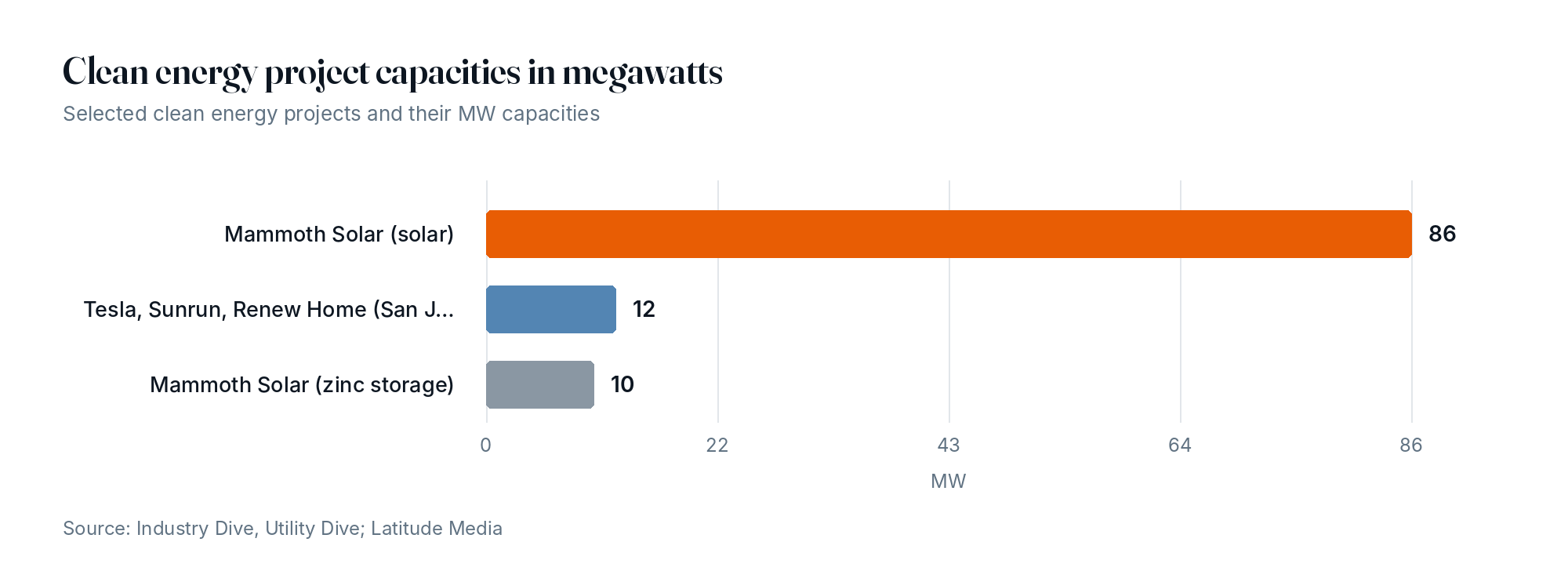
Developers are pairing solar with long-duration storage and reviving nuclear plants to meet data center power needs. For example, the Mammoth Solar project in West Virginia will include 86 MW of solar, 70 MW/280 MWh of lithium-ion batteries, and 10 MW/100 MWh of zinc-based long-duration storage 6. This project demonstrates a growing trend toward hybrid energy solutions. As a result, Google has secured a supply agreement to purchase the energy generated for its data centers. Furthermore, Eos Energy Enterprises has entered into a supply agreement to provide up to 750 MWh of zinc-based battery modules for projects in PJM and other U.S. markets 6. Meanwhile, NextEra Energy has secured a $1.9 billion federal loan to restart the Duane Arnold nuclear plant in Iowa, which will supply power for data center growth 11. First, in the first half of 2026, global solar-plus-storage projects attracted $25 billion in investment. Second, nearly half of the new U.S. storage capacity added during that period was installed alongside solar farms 19. Therefore, utilities are increasingly focused on integrating these resources. Ultimately, they are using AI-driven forecasting tools to better align these resources with data center load profiles 5.
How are site selection criteria changing?
Power availability is now the primary filter for new data center sites. Developers no longer start by looking for cheap land or fiber; they start by identifying where large, reliable power can be delivered and scaled over time 1. In 2025, U.S. data center electricity use rose to 312.6 TWh, a 25.5% increase year-over-year, making power constraints a central issue in site selection 1. Regions with proven grid capacity and flexible large-load tariffs are the most competitive for new builds 8.
Utilities are increasingly requiring upfront payments and exit fees for large-load tariffs, which affects how developers plan projects and where they choose to build 8. In ERCOT, weekly peak loads have set new records, reflecting the pressure on transmission and generation capacity 7. Developers must now verify that quoted capacity is firm and funded, not just indicative, and that delivery timelines align with project schedules 1.
Clean energy projects are being built specifically to serve data centers, but these take time to permit and construct 15, 16. For example, a solar-storage project in West Virginia includes 86 MW of solar and 10 MW of long-duration zinc-based storage, with Google as the offtaker 6. Utilities are also exploring advanced forecasting tools and grid-forming inverters to better match data center load profiles 5, 17.
Because a campus can grow from 100 MW to several hundred MW over multiple phases, site selection must account for future scalability and transmission upgrades 1. Developers are prioritizing locations where transmission and generation can be expanded quickly, rather than relying on distant or underbuilt grids 1, 4.
As a result, the most competitive sites are those with available transmission, clear large-load interconnection processes, and access to both clean and firm power sources 1, 8, 16.
What role do advanced forecasting and storage play?
Forecasting demand spikes with AI and weather models
Utilities and data center operators are using AI-driven weather and load forecasting to predict when demand will spike. As a result, they can plan more effectively and allocate resources more efficiently. For instance, Santee Cooper is using Google’s WeatherNext to obtain probabilistic forecasts, which helps the utility improve power load predictions and save millions of dollars a year 21, 5. These forecasts are specifically tailored to local conditions, such as the influence of large lakes on regional weather 5. Meanwhile, Google is supporting a virtual power plant pilot in California that uses distributed energy resources and AI-based orchestration to manage demand variability and unlock grid capacity 5.
Storage and grid-forming technologies stabilize the grid
Solar-plus-storage projects are being developed to provide firm power and help smooth out demand fluctuations. For example, a solar-storage project in West Virginia includes 86 MW of solar and long-duration storage, designed to support large data center loads 6. In addition, a grid-forming technology can respond to grid changes quickly, aiding data centers in integrating with the grid and handling rapid demand shifts 17. Furthermore, grid-forming inverters and advanced power conversion systems are part of a broader movement toward more flexible power delivery for AI data centers 17.
Virtual power plants and distributed resources add flexibility
Virtual power plants aggregate thousands of distributed energy resources, such as home batteries and smart thermostats, to provide grid services. PG&E’s SHARE program is enrolling a significant number of devices to demonstrate how distributed resources can enhance grid capacity and reliability, with support from Google 5. Additionally, these programs show how data center operators and utilities can use flexible, distributed assets to meet large and unpredictable loads 5.
Grid planning and integration rely on accurate forecasting
Utilities are adopting integrated gas-electric planning and using AI to enhance financial and load forecasting, which supports planning for large, variable data center loads 21. This approach is essential for maintaining responsible grid reliability as demand increases 21.
Storage complements new generation and transmission
Long-duration storage is being paired with solar to supply reliable power for data centers over extended periods 6. Therefore, these storage solutions help address the timing gap between solar generation and data center power needs 6.
Connecting to the grid requires advanced power electronics
Power conversion systems using advanced architectures can consolidate functions and reduce losses, simplifying the connection of high-density AI data centers to the grid 17. However, these systems are also designed to support rapid demand changes and integration with on-site generation and storage 17.
What this means for site selection
Sites that combine accurate forecasting, flexible storage, and advanced power electronics are more likely to secure interconnection and deliver reliable power to large data centers 5, 6, 17.
SAVRN Data Center Moratorium Tracker
How does this change the economics?
The need for reliable, scalable power is now the main driver of data center economics. As a result, developers must prove they can secure power before breaking ground, because utilities are prioritizing projects that can demonstrate firm, long-term supply 1. This shift means that the cost and availability of power, not just land or connectivity, shapes site selection and project timing 1.
Large-load tariffs have changed significantly, often requiring upfront payments and exit fees, which raises capital costs and makes it harder to exit a project if demand falls 8. Consequently, qualifying demand thresholds are rising, so smaller projects may not meet the minimums that trigger favorable terms 8.
Utilities are also introducing ramp schedules and stricter interconnection processes, which can delay projects and increase costs 8. These new requirements push developers to sign longer-term power contracts and to invest in on-site generation and storage to meet utility requirements 6, 17.
On-site solar plus storage is growing rapidly as a way to meet both power needs and regulatory expectations 6, 19. For example, Google’s Mammoth Solar project in West Virginia shows how pairing solar with both lithium-ion and long-duration zinc batteries can match data center load profiles and help meet regional capacity needs 6. This approach can reduce exposure to volatile grid tariffs and help secure capacity payments 6, 15.
Power conversion systems using 800V DC architectures and grid-forming technology are becoming standard in new data centers because they reduce losses and help integrate with on-site generation 17. These systems can make it easier to connect to constrained grids and support rapid changes in demand 17.
The economics now favor sites that can combine accurate forecasting, flexible storage, and advanced power electronics 5, 6, 17. Therefore, this raises upfront costs but can lower long-term energy and capacity expenses, and improve the chances of securing interconnection 5, 6, 17.
Because of these changes, developers are looking for sites with available grid capacity, clear interconnection timelines, and access to clean energy projects that can be scaled quickly 1, 6. In addition, in markets where power is tight, projects that can bring their own generation and storage are more likely to move forward 1, 6.
How SAVRN builds for this
SAVRN builds AI factories that generate their own power on site and run water-free cooling, with a training institute at the front of every campus that reskills the local workforce. SAVRN also publishes and maintains public research tools that track the same trends this article covers: the Data Center Moratorium Tracker, the Water Tracker, the Data Center Delay Tracker, the Grid Operator Watchlist, the Capital Atlas and the US Data Center Map.
What to do next
Operators and developers should secure early utility engagement and lock in long-term clean energy contracts for at least 312.6 megawatts, with delivery terms guaranteed within 36 months, before committing to site selection 1. Furthermore, they must model power availability scenarios that include 12-, 24-, and 36-month delay cases to ensure quoted capacity is firm and deliverable, not just indicative 1, 8. For example, utilities can deploy AI-driven forecasting tools such as Google’s WeatherNext 2, which provides probabilistic weather forecasts up to 15 days in advance 5. This improves load and weather prediction accuracy and can save millions annually in planning costs. Additionally, campuses should be designed with staged, incremental energization that aligns with utility large-load tariff ramp schedules, which often require minimum qualifying demand thresholds and ramp-up periods of several months 1, 8. In addition, operators should monitor local moratoria, grid operator watchlists, and project delay risks using publicly available tracking tools before finalizing capital plans SAVRN Data Center Moratorium TrackerSAVRN Data Center Delay Tracker.
Frequently asked questions
What is the current electricity consumption of US data centers?
US data centers used an estimated 312.6 TWh of electricity in 2025 1.
How much did US data center electricity use grow in 2025?
US data center electricity use increased by 25.5% year-over-year in 2025 1.
Why are large-load tariffs changing now?
Active and proposed large-load tariffs have increased sharply since early 2025, reflecting higher demand from data centers 8.
What new clean energy projects are being built specifically for data centers?
How do utilities prioritize data center connections?
What technologies help data centers secure reliable power?
Which regions are most competitive for new data center sites?
How does AI forecasting improve power reliability for data centers?
What financial mechanisms are now required for large data center loads?
Utilities now often require upfront payments, exit fees, and ramp schedules for large data center loads 8.
Sources
- Power Availability Now Determines Where Data Centers Get Built, Informa TechTarget, Data Center Knowledge, Sep 09, 2026.
- Questionable data center forecasts are driving up Ohio…, Canary Media, Sep 09, 2026.
- Shuttered nuclear plant in Iowa gets $1.9B federal…, Canary Media, Sep 08, 2026.
- Houston Healthcare’s Race For Space Hits A Data Center Roadblock, Bisnow, Sep 08, 2026.
- Why is Google funding PG&E’s latest VPP pilot?, Latitude Media, Sep 08, 2026.
- Google backs solar-storage project at former West Virginia coal mine, Industry Dive, Utility Dive, Sep 08, 2026.
- ERCOT load continues to reach record highs, Industry Dive, Utility Dive, Sep 08, 2026.
- Large-load tariffs increasingly rely on upfront payments, exit fees, ramp schedules, Industry Dive, Utility Dive, Sep 08, 2026.
- As midterms approach, electricity bills are on the ballot, Latitude Media, Sep 08, 2026.
- Bonneville eyes switch to CAISO’s EDAM from Southwest Power Pool’s Markets+, Industry Dive, Utility Dive, Sep 08, 2026.
- NextEra secures $1.9B DOE loan for Duane Arnold nuclear restart, Industry Dive, Utility Dive, Sep 08, 2026.
- A VPP is a garden. Let’s make them flourish nationwide., Industry Dive, Utility Dive, Sep 08, 2026.
- EnerNex: large loads, new rules, Industry Dive, Utility Dive, Sep 08, 2026.
- ‘We Aren’t Competitive’: Power, Taxes Keep Colorado On The Data Center Sidelines, Bisnow, Sep 06, 2026.
- Beating the heat: Earning capacity payments via gas turbine fogging, Power Engineering, Clarion Events, Sep 04, 2026.
- Building clean power for data centers in a gas-obsessed market, Latitude Media, Sep 04, 2026.
- Flex Pays $4.4B for EPC Power as AI Data Centers Push 800V DC, Informa TechTarget, Data Center Knowledge, Sep 04, 2026.
- Utilities eye small modular nuclear reactors for reliability as hyperscalers drive demand, Industry Dive, Utility Dive, Sep 04, 2026.
- Solar-plus-storage is having a global growth spurt, Canary Media, Sep 04, 2026.
- Shawn Hunstock, American Public Power Association, Sep 03, 2026.
- National Grid’s different gas-electric forecasts are responsible planning, Industry Dive, Utility Dive, Sep 03, 2026.
- Land-based wind power pipeline shrinks as price gap with solar widens, Industry Dive, Utility Dive, Sep 03, 2026.
- Ansaldo Energia re-enters U.S. power generation market, Power Engineering, Clarion Events, Sep 03, 2026.
- Santee Cooper partners with Google in shift toward AI-driven forecasting, Industry Dive, Utility Dive, Sep 03, 2026.
Want the next one?
When a new piece publishes on SAVRN Insights, you get one email with what it covers and a link to read it. Choose the research that interests you.
Also send me
Receive a short introduction on days 3, 7 and 14, plus the updates you select. Unsubscribe in one click. Privacy
How power availability drives data center site selection in 2026
Get new SAVRN Insights by email
A short introduction on days 3, 7 and 14, plus new SAVRN research articles. Unsubscribe at any time.
We use your address to send the introduction and updates described above. See our Privacy Policy.