How utilities and operators ensure data center power reliability in a rapidly changing market
A deep dive into the technologies, policies, and partnerships that keep data centers running reliably amid soaring demand and grid strain.
Data center power reliability: explore how utilities and data center operators ensure power reliability through advanced forecasting, flexible interconnection, energy storage, and new generation . The question is simple: how do utilities and operators keep the lights on for data centers as AI-driven demand surges and grids strain under record loads. The answer is not one thing. Instead, it is a stack of coordinated moves, flexible interconnection, advanced forecasting, storage, and new generation, all moving faster than the old rules allow. First, the stakes are high. In ERCOT, weekly average load is near record highs, with the grid averaging 74.5 GW the week ending August 22, 2026 14. Meanwhile, the pipeline for new generation is shifting. Land-based wind projects are shrinking as solar becomes cheaper 11. At the same time, geothermal is growing. Fervo Energy and Google signed a 396 MW geothermal power purchase agreement, the largest of its kind, to power data centers in Utah, with an option for nearly 1 GW more by 2030 18. In addition, utilities are also piloting flexible interconnection programs that let large loads connect faster if they agree to cut back when the grid is tight. Pacific Gas & Electric’s Flex Connect program has allowed most customers to energize in months instead of years, and during the first two years, capacity limits were needed less than 1% of the time 19. Furthermore, operators are using advanced forecasting, too. Santee Cooper is partnering with Google to use AI for more precise weather, load, and financial planning 13. As a result, on the reliability front, gas turbines are being retrofitted with wet compression to keep running during heat waves, so they can still earn capacity payments 4. Moreover, public power associations are pushing for policies that support these changes. The American Public Power Association has leaders focused on grid reliability and planning 7, 9. Finally, utilities are also eyeing new sources like small modular reactors to meet baseload needs as hyperscalers add more load 6. Ultimately, the result is a system in motion, adapting to a new era of demand.
Why this matters now
The rapid expansion of artificial intelligence data centers is placing unprecedented strain on the electric grid. As a result, utilities are now facing record or near-record demand levels, long interconnection queues, and the challenge of balancing reliability with speed. In the Electric Reliability Council of Texas, weekly average load has repeatedly approached record highs in recent weeks, reflecting sustained high electricity demand driven by hot weather and large loads such as data centers 14. At the same time, traditional interconnection studies are no longer sufficient to assess the stability risks posed by facilities with rapidly fluctuating power demand, such as AI training campuses 2. Therefore, utilities are adopting new tools like electromagnetic transient studies and considering flexible interconnection solutions that allow controlled load curtailment during system stress 2.

Consequently, utilities are accelerating the deployment of advanced forecasting tools, including artificial intelligence-based weather and load models, to better anticipate demand spikes 13. In addition, they are exploring a broader mix of generation sources, from geothermal to small modular reactors, to provide reliable baseload power 6,18. For example, Fervo Energy and Google recently signed a 396-megawatt geothermal power purchase agreement aimed at supporting data center operations 18. Meanwhile, public power associations and utility leaders are playing a central role in shaping policy responses to these challenges 7,9.
Because interconnection delays and grid constraints can stall or reshape data center projects, operators and capital partners must now consider not just site readiness but also the pace and certainty of utility approvals 19,15. Utilities are piloting programs that offer faster interconnection for loads willing to accept temporary capacity limits, which can reduce wait times from years to months 19. These initiatives highlight that the changes are not just technical but also affect investment decisions and regulatory compliance.
Ultimately, the difference between a data center that comes online on schedule and one that does not often depends on how well the project aligns with the utility’s evolving approach to reliability, forecasting, and interconnection. Operators should monitor local interconnection queues and utility pilot programs, and consider flexible load or storage solutions to improve their chances of timely connection 19.
What to take from this
- Flexible interconnection programs can cut data center energization timelines from years to months.
- AI-driven forecasting is becoming essential for managing volatile, AI-driven data center loads.
- Hybrid generation and storage, including geothermal and advanced gas turbines, are key to ensuring baseload and peaking reliability.
- Early utility engagement and operational innovations are critical for maintaining uptime as demand surges.
- Policy advocacy by public power associations can accelerate deployment of advanced reliability solutions.
What the sources report, with the numbers
Utilities in Texas and across the U.S. are reporting sustained high electricity demand and are responding with a range of measures to keep data centers online. The weekly average load in the Electric Reliability Council of Texas (ERCOT) remained near record highs through August 2026, with hourly averages exceeding previous summer records 14. This persistent demand has prompted ERCOT to audit new data center interconnection proposals after a state moratorium was announced 14.
Pacific Gas & Electric (PG&E) has seen rising interest in a flexible interconnection pilot that allows larger loads, including some data centers, to connect in months instead of years 19. The program lets customers accept temporary capacity limits, reducing wait times from several years to roughly four to eight months in some cases 19. Most current and prospective participants in PG&E’s Flex Connect program are in electric vehicle charging, but the pipeline includes smaller data centers and advanced manufacturing facilities 19.
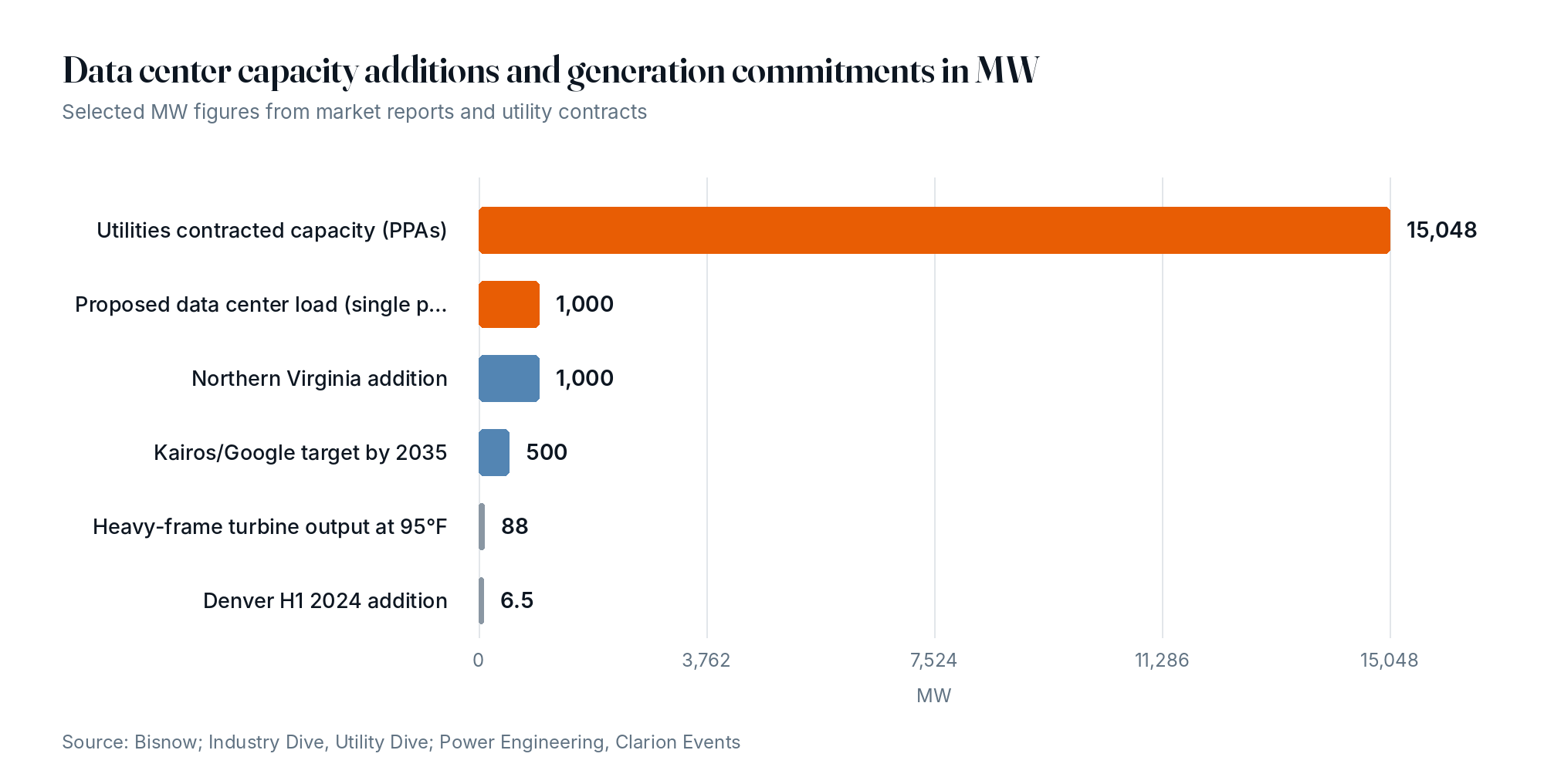
A large geothermal power purchase agreement (PPA) between Fervo Energy and Google highlights new sources of baseload power for data centers. The deal covers 396 MW of geothermal capacity, with an option to expand to nearly 1 GW, and is intended to serve a potential data center in Utah 18. Fervo’s Cape Station project is expected to deliver up to 2 GW of reliable, renewable geothermal energy, with the first phase coming online in 2026 18.
Utilities are also using advanced forecasting tools to manage volatility. Santee Cooper in South Carolina is working with Google to use AI-driven weather and load forecasting to improve planning and reduce costs 13. The utility aims to automate routine tasks while keeping human oversight for risk management 13.
In addition to interconnection and forecasting, operators are deploying gas turbine fogging to maintain capacity during hot weather, which can help fulfill contractual obligations and keep receiving capacity payments 4. Utilities are exploring other generation sources, including small modular nuclear reactors, as they seek reliable, dispatchable power to meet hyperscaler and mission-critical data center demand 6.
Some utilities are coordinating gas and electric planning to ensure reliability as demand grows 10. Meanwhile, the pipeline for new land-based wind projects is shrinking as solar becomes more cost-competitive, which may affect the mix of generation available for new data center load 11. New transmission projects could deliver billions in savings and reliability benefits, but interconnection delays remain a challenge for data center developers 20.
Finally, cybersecurity risks to battery energy storage systems are a growing concern for grid operators and data center owners, with recent studies modeling the probability and financial impact of coordinated cyberattacks on these assets 21.
How do utilities decide who connects first?
Utilities use formal interconnection studies and queue management to prioritize large loads such as data centers. These studies assess the impact a new load will have on grid reliability and stability. Traditionally, utilities evaluated large customers using static load profiles, but AI-driven data centers behave differently, with rapid and variable power demand. As a result, utilities increasingly require more detailed analyses, such as electromagnetic transient studies, to understand how these facilities interact with the grid during faults and rapid load changes.
Utilities also manage interconnection queues to balance grid capacity with customer needs. Some utilities have introduced flexible interconnection pilots that allow qualifying customers to energize in months instead of years. These programs require customers to accept temporary capacity limits during grid stress events and to coordinate with grid operators through real-time energy management systems. For example, Pacific Gas & Electric’s Flex Connect program has enabled many customers to connect faster by agreeing to follow grid-imposed capacity limits during rare system constraints.
Project readiness and firmness of need are important factors in queue prioritization. Utilities may give preference to projects that demonstrate operational controls, grid support capabilities, and clear timelines. In regions with high demand growth, such as ERCOT, utilities face pressure to expedite interconnections while maintaining reliability. This has led to new pilot programs and expedited review processes for certain customer types.
Because large data center loads can strain local distribution systems, utilities may also consider the location and grid strength of the proposed site. Some utilities coordinate gas and electric planning to ensure that both fuel supply and electric delivery can support the new load. In areas where transmission or distribution capacity is tight, utilities may require additional studies or system upgrades before granting full interconnection.
Utilities are also exploring alternative generation sources and advanced forecasting to support large loads. This includes integrating more flexible resources and considering the operational characteristics of new technologies like geothermal and small modular reactors. However, interconnection delays remain a challenge, and utilities are working to streamline processes where possible.
Finally, cybersecurity and operational reliability concerns influence how utilities evaluate new large loads. Utilities assess the risk that electronically coupled equipment in data centers could respond to grid events in ways that affect system stability. As a result, some interconnection agreements now include requirements for advanced controls and coordination with grid operators to prevent unintended system impacts.
How are utilities forecasting demand surges?
Utilities are using advanced forecasting tools to predict demand surges driven by AI data centers. These tools combine weather modeling, load prediction, and financial planning to help utilities prepare for large, variable loads. As a result, utilities can anticipate spikes more accurately and plan grid operations accordingly.
AI-driven forecasting partnerships
Utilities are increasingly partnering with technology companies to improve forecasting accuracy. For example, Santee Cooper is working with Google to use AI tools for weather and load forecasting. The utility plans to use Google’s WeatherNext 2 for medium-range weather forecasts and Gemini Enterprise Agent Platform for financial and load planning. Because weather can cause sudden changes in power demand, even a small forecast error can translate into large swings in load. In practice, Santee Cooper estimates that a one-degree variance in forecast can shift demand by about 100 MW per hour.
Weather and load modeling
Accurate weather forecasting is critical for load prediction, especially in regions with large data center footprints. Santee Cooper is building custom models that account for local weather factors such as the impact of large man-made lakes. These improvements are expected to help utilities save millions of dollars annually by reducing the need for expensive last-minute generation or imports. However, the effectiveness of these models depends on continuous data and local adaptation.
Scenario-based financial planning
Utilities are also using AI to automate parts of financial planning related to major projects. Santee Cooper’s approach includes using agentic AI to execute multi-step processes autonomously while keeping accountability with human operators. This shift helps utilities move away from legacy systems and streamline decision-making for large investments. Additionally, the cost and scope of automation vary by utility and depend on existing infrastructure.
Regional load trends
Demand for power is rising rapidly in some regions. In the Electric Reliability Council of Texas (ERCOT), weekly average load has remained near record highs. These high load levels increase the importance of precise forecasting and rapid response to unexpected changes. Meanwhile, utilities in other regions are also planning for similar trends as data center development accelerates.
Interconnection and flexible planning
Flexible interconnection programs are emerging to accommodate unpredictable and large loads. For example, Pacific Gas & Electric’s Flex Connect program allows larger distribution-connected loads to energize more quickly than under traditional processes. This flexibility helps utilities manage the timing and impact of new data center interconnections. However, interconnection bottlenecks remain a challenge in many areas.
What generation sources are being added for reliability?
Utilities and developers are expanding the mix of generation sources to ensure reliable power for data centers as demand grows. First, geothermal power is emerging as a major baseload option. For example, the largest U.S. geothermal power purchase agreement to date is a 396 MW deal between Fervo Energy and Google, which will supply a potential data center in Utah starting in 2028 18. As a result, this project is part of a larger enhanced geothermal systems development that could reach nearly 1 GW by 2030 18.
Meanwhile, small modular nuclear reactors are being considered for their firm, low-carbon output. However, utilities note that the grid may not be ready to absorb new generation quickly, and cost recovery remains a challenge 6. Additionally, advanced gas turbines with wet compression technology are being deployed to maintain capacity during hot weather, when turbine output can drop by up to 20% due to higher ambient temperatures 4. Because of this, these upgrades help operators avoid penalties and fulfill capacity obligations during peak demand 4.
In addition, utilities are pursuing flexible interconnection programs and advanced forecasting to integrate new generation and manage uncertainty 2, 19. Furthermore, some utilities are exploring non-pipeline alternatives and integrated gas-electric planning to support reliability under changing load patterns 10.
The largest U.S. geothermal PPA to date, a 396 MW deal, demonstrates growing confidence in baseload sources that can reliably serve data centers.
At the same time, battery energy storage systems are being added to provide short-term reliability and frequency control, though large-scale deployment faces risks that require careful modeling and risk assessment 21, 23. Consequently, transmission expansion is also being evaluated as a way to unlock billions in savings and support reliability across regions 20.
Ultimately, the generation mix for data center reliability is shifting toward firm, dispatchable sources like geothermal and advanced nuclear, combined with flexible gas turbines and storage, all supported by better forecasting and grid planning 6, 18, 4.
Therefore, if you operate or plan data centers, track the progress of these generation projects and interconnection programs in your region to anticipate when new capacity will come online Data Center Delay Tracker.
How are operators maintaining uptime under stress?
Operators are using a mix of operational techniques and new technologies to keep data centers online during periods of high grid stress. One approach is gas turbine fogging, which increases turbine output during hot weather by cooling the air entering the turbine, allowing operators to avoid capacity penalties and keep availability payments 4. This is especially important because summer temperatures are rising and demand from data centers is straining the grid 4. At the same time, battery energy storage systems are being added to provide short-term reliability and help ride through grid volatility 21, 23. In addition, operators are modeling cybersecurity risks for these systems to prevent new failure modes. As a result, operators are combining these tools to maintain uptime even when the grid faces pressure from record loads and heatwaves 14.
How do public power associations shape policy?
Public power associations advocate for policies that support flexible interconnection, integrated gas-electric planning, and the deployment of advanced generation technologies. As a result, they emphasize reliability, affordability, and innovation in how public utilities respond to the rapid growth of data center demand 7, 9. Moreover, these associations work to ensure that utilities can meet the needs of large, predictable loads while maintaining grid stability and cost-effectiveness 2.
Advocating for flexible interconnection and integrated planning
Public power associations push for flexible interconnection processes that allow large loads like data centers to connect more quickly and predictably. For example, they argue that traditional interconnection queues can delay projects for years, which is not practical for data center operators with tight timelines 2, 19. Instead, they promote programs that enable customer-driven, expedited interconnection, reducing wait times from several years to a few months 19. Additionally, these groups support integrated gas-electric planning, which coordinates forecasts and investments across both fuels to avoid overbuilding and ensure reliability 10. This approach helps utilities plan for both peak electric demand and the potential for customers to switch from gas to electric heating or cooling 10.
Promoting advanced generation and storage technologies
Public power associations also advocate for the deployment of advanced generation sources and energy storage to support data center reliability. Specifically, they highlight the need for baseload and dispatchable power as data center loads strain the grid, pointing to technologies like geothermal and small modular reactors as promising options 6, 18. In addition, associations support battery energy storage systems to provide short-term reliability and ride through grid volatility, though they caution about cyber risks and the importance of robust controls 21. Therefore, by promoting these technologies, public power associations aim to ensure that utilities can meet both current and future reliability needs as AI-driven demand grows 6, 21.
Shaping policy and regulatory responses
These associations play a key role in shaping state and federal policy responses to data center growth. Notably, they provide technical expertise and policy recommendations to lawmakers and regulators, focusing on reliability standards, cost allocation for new infrastructure, and fair interconnection processes 7, 9. Furthermore, their leadership often emphasizes the importance of public utility innovation in the face of rapid load growth and changing market conditions 7. In some regions, public power associations have also supported the use of non-pipeline alternatives and coordinated planning to avoid unnecessary investments and keep costs manageable for customers 10.
Supporting transparent and responsive planning
Transparency in planning and forecasting is another area where public power associations push for improvement. They recommend that utilities use clear, purpose-specific forecasts and explain the differences between electric and gas planning to avoid confusion among customers and policymakers 10. By doing so, these associations help utilities navigate the energy transition while maintaining reliability for all customers, including large data center loads 10.
Public power associations are central to aligning utility policies with the needs of large, predictable data center loads, advocating for flexible interconnection, integrated planning, and advanced generation to ensure reliability as demand surges.
How SAVRN builds for this
SAVRN builds AI factories that generate their own power on site and run water-free cooling, with a training institute at the front of every campus that reskills the local workforce. SAVRN also publishes and maintains public research tools that track the same trends this article covers: the Data Center Moratorium Tracker, the Water Tracker, the Data Center Delay Tracker, the Grid Operator Watchlist, the Capital Atlas and the US Data Center Map.
What to do next
Review your interconnection agreements and plan for flexibility
First, examine your current interconnection agreements with utilities. Make sure they allow for modular scaling and flexible operation so you can add capacity as demand grows 2. In addition, check if your site can participate in any utility flexible interconnection pilots or programs that allow staged energization and capacity limits during peak grid stress 19. As a result, you can better manage capacity and avoid unexpected outages. Finally, use tools like the Data Center Delay Tracker to anticipate and plan around potential permitting or interconnection delays.
Assess and upgrade on-site generation and storage
Second, evaluate your on-site generation and energy storage capacity. Ensure you can maintain uptime during peak grid stress periods, especially during hot summer afternoons when turbine output drops and grid constraints tighten 4. Therefore, consider adding gas turbine fogging or other cooling technologies to preserve capacity payments during high-temperature events 4. Moreover, review your battery energy storage systems for cyber risk and operational readiness, given the high probability of coordinated cyberattacks modeled in recent studies 21.
Use public data tools to anticipate regulatory and market shifts
Third, monitor evolving policy and regulatory changes that affect reliability and interconnection. Use the Data Center Moratorium Tracker to track local restrictions and the Grid Operator Watchlist to stay ahead of utility planning changes Data Center Moratorium TrackerGrid Operator Watchlist. Specifically, track large load interconnections and transmission expansion plans that could impact your site’s reliability and costs 20. Additionally, watch for new generation sources like geothermal and small modular reactors that utilities are adding to support data center loads 6, 18.
Engage early with utilities on forecasting and planning
Fourth, engage with your utility early on forecasting and planning. Adopt AI-driven load forecasting and coordinate with the utility on scenario-based planning to align your operations with grid needs 13. By doing so, you can reduce the risk of unexpected outages and better manage resource allocation. Furthermore, participate in any utility programs that use advanced weather and financial modeling to improve load prediction and reduce surprise outages 13.
Prepare for capacity market changes and hot-weather performance
Fifth, understand how capacity markets are shifting to value reliable, dispatchable power during peak hours 4. Make sure your generation assets can deliver contracted capacity under hot-weather conditions and respond quickly to grid signals during contingencies 4. This means you may need to invest in cooling technologies or demand-response capabilities.
Plan for new generation and storage partnerships
Sixth, explore partnerships for new generation and storage, including geothermal and advanced nuclear, as utilities expand these sources to meet data center demand 6, 18. Notably, stay informed about pilot programs and permitting timelines that could affect project delivery 5, 20.
Monitor regional load growth and transmission constraints
Seventh, track regional load growth and transmission constraints. For example, ERCOT has seen weekly average loads near record highs, which increases the risk of grid stress and capacity shortages 14. Consequently, plan for potential transmission bottlenecks and consider alternative interconnection paths or non-wire alternatives 10, 20.
Act now: concrete steps for operators and utilities
- Operators should review and update interconnection agreements for flexibility and staged energization 2, 19.
- In addition, utilities should expand flexible interconnection pilots and streamline permitting for new generation and storage 19, 5.
- Both should use AI-driven forecasting and scenario planning to align operations with grid conditions 13.
- Operators should invest in hot-weather performance upgrades for on-site generation 4.
- Utilities should monitor and report on new generation sources like geothermal and advanced nuclear to support reliability 6, 18.
- Finally, both should use public data tools to anticipate and mitigate regulatory and market risks Data Center Moratorium TrackerGrid Operator Watchlist.
Frequently asked questions
How are utilities managing record-high data center load growth?
Utilities are adding flexible resources and upgrading infrastructure to meet rising demand from data centers. In addition, they are coordinating with developers to plan for predictable load profiles. As a result, they are able to use advanced forecasting tools to anticipate growth more effectively 2, 14.
What is a flexible interconnection pilot and how does it help data centers?
A flexible interconnection pilot allows larger loads, like data centers, to connect to the grid faster by using more adaptable terms than traditional firm interconnection. This approach reduces wait times significantly. Therefore, data centers can energize in months instead of years 19.
Why are utilities turning to geothermal and small modular reactors for data centers?
How does gas turbine fogging help maintain reliability during heatwaves?
Gas turbine fogging, or wet compression, cools the air entering the turbine, allowing it to produce more power during hot weather. This method helps operators keep units running. Consequently, they can meet capacity obligations even during heatwaves 4.
What role does AI play in utility load forecasting for data centers?
AI tools help utilities make more accurate weather, load, and financial forecasts by analyzing large and complex data sets. For example, this improves planning. Ultimately, it reduces uncertainty for data center operators 13.
How do public power associations influence data center policy?
What are the main risks in deploying battery energy storage for data centers?
How can data center operators reduce interconnection queue times?
Operators can join flexible interconnection pilots and work closely with utilities to provide detailed load forecasts and design plans. By doing so, utilities can evaluate and approve interconnections more quickly 19.
What operational innovations are keeping data centers online during grid stress?
How can utilities and operators collaborate to ensure future reliability?
Sources
- A VPP is a garden. Let’s make them flourish nationwide., Industry Dive, Utility Dive, Sep 08, 2026.
- EnerNex: large loads, new rules, Industry Dive, Utility Dive, Sep 08, 2026.
- ‘We Aren’t Competitive’: Power, Taxes Keep Colorado On The Data Center Sidelines, Bisnow, Sep 06, 2026.
- Beating the heat: Earning capacity payments via gas turbine fogging, Power Engineering, Clarion Events, Sep 04, 2026.
- Building clean power for data centers in a gas-obsessed market, Latitude Media, Sep 04, 2026.
- Utilities eye small modular nuclear reactors for reliability as hyperscalers drive demand, Industry Dive, Utility Dive, Sep 04, 2026.
- Scott Corwin, American Public Power Association, Sep 03, 2026.
- Scott Corwin, American Public Power Association, Sep 03, 2026.
- Shawn Hunstock, American Public Power Association, Sep 03, 2026.
- National Grid’s different gas-electric forecasts are responsible planning, Industry Dive, Utility Dive, Sep 03, 2026.
- Land-based wind power pipeline shrinks as price gap with solar widens, Industry Dive, Utility Dive, Sep 03, 2026.
- Ansaldo Energia re-enters U.S. power generation market, Power Engineering, Clarion Events, Sep 03, 2026.
- Santee Cooper partners with Google in shift toward AI-driven forecasting, Industry Dive, Utility Dive, Sep 03, 2026.
- Weekly average load in ERCOT continues near record high, U.S. Energy Information Administration, Sep 03, 2026.
- What comes after the data center backlash?, Latitude Media, Sep 03, 2026.
- New York’s big new bet on nuclear energy, Canary Media, Sep 03, 2026.
- This novel power line could link 3 grids across 3 time…, Canary Media, Sep 03, 2026.
- Fervo Energy and Google ink largest-ever geothermal PPA to power data centers, Power Engineering, Clarion Events, Sep 02, 2026.
- PG&E sees rising interest in ‘customer-driven’ flexible interconnection pilot, Industry Dive, Utility Dive, Sep 02, 2026.
- Transmission expansion could spur billions in savings, especially in PJM: study, Industry Dive, Utility Dive, Sep 02, 2026.
- GRIDLOCK: A Monte Carlo Risk Assessment of Coordinated Cyberattacks on Battery Energy Storage Systems, American Public Power Association, Sep 02, 2026.
- Fervo-Google geothermal deal underscores baseload power scarcity, analysts say, Industry Dive, Utility Dive, Sep 02, 2026.
- The US built more grid batteries last quarter than…, Canary Media, Sep 01, 2026.
- Inside the U.S. Army’s $2.2B plan to build microreactors at five bases, Power Engineering, Clarion Events, Sep 01, 2026.
Want the next one?
When a new piece publishes on SAVRN Insights, you get one email with what it covers and a link to read it. Choose the research that interests you.
Also send me
Receive a short introduction on days 3, 7 and 14, plus the updates you select. Unsubscribe in one click. Privacy
How utilities and operators ensure data center power reliability in a rapidly changing market
Get new SAVRN Insights by email
A short introduction on days 3, 7 and 14, plus new SAVRN research articles. Unsubscribe at any time.
We use your address to send the introduction and updates described above. See our Privacy Policy.