Why low WUE doesn’t mean water resilience in data centers
A low water usage effectiveness score doesn’t guarantee a data center can withstand droughts or heatwaves.
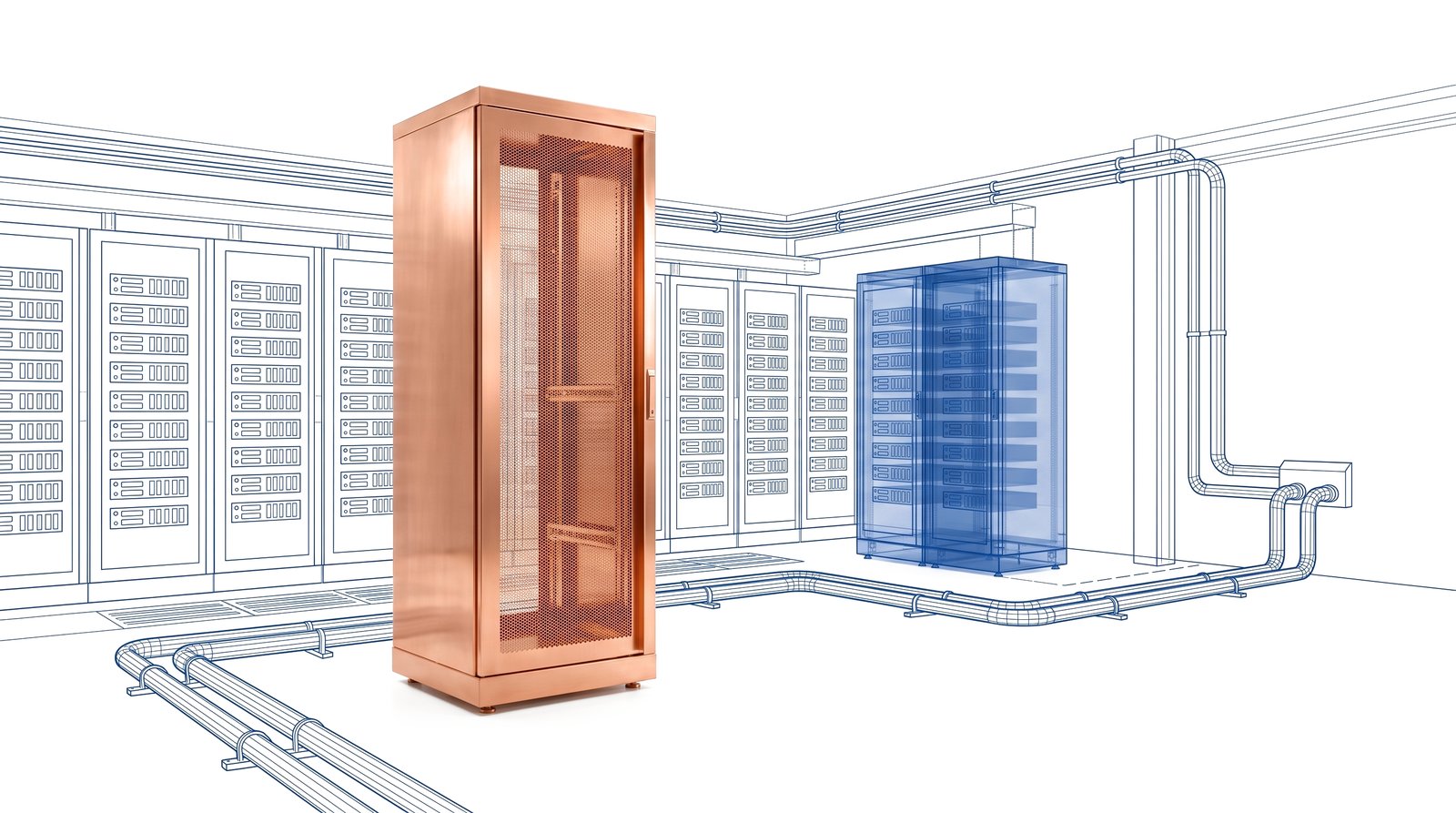
Data center water cooling resilience is not guaranteed by a low water usage effectiveness score. A 100 megawatt facility can consume about 2.5 billion liters of water per year, a figure that draws scrutiny from communities and regulators alike 1. Despite claims of efficiency, most data centers still rely on evaporative cooling systems that release water vapor and leave behind residual water that is difficult to reuse 1. Even when a site reports excellent WUE, it may still struggle during droughts or heatwaves because local water availability and treatment infrastructure are often the real constraints 2. As AI workloads push rack densities higher, operators are investing in advanced cooling equipment while grappling with the limits of power, cooling, and resilience 5, 6.
Why WUE alone is misleading for resilience
WUE measures how efficiently a data center uses water, but it does not reveal whether the facility can maintain cooling during a drought or water supply disruption 2. For example, a low WUE score may mask issues with local water sourcing and treatment infrastructure 2. However, resilience requires more than just efficient water use. It depends on the facility’s ability to access water when it is most needed, not just on average usage 2.
Site-specific risks outweigh headline metrics
A facility’s cooling capability during heatwaves depends largely on local conditions such as watershed health and water allocation policies 2. Specifically, using reclaimed water does not guarantee sufficient or suitable supply during periods of high demand 2. Meanwhile, regulatory and community factors can alter water access after a project begins 2. As a result, site-specific assessments are essential for understanding true water resilience 2.
A site-specific resilience assessment is more important than a good WUE score when preparing for droughts or heatwaves.
Cooling performance under stress is the real test
During extreme heat, cooling demand rises and grid stress may force operators to reduce load or switch to backup power 2. Therefore, if the water system cannot meet these increased demands, operators may have to raise temperature setpoints, risking equipment and uptime 2. Ultimately, WUE measured under normal conditions does not predict performance during water and power shortages 2.
What this means for operators
Consequently, a low WUE number does not ensure water resilience. Operators should evaluate water availability during peak stress periods and consider water quality for equipment protection 2. Additionally, they must account for potential regulatory changes that could affect water access 2. In fact, planning for these scenarios is crucial for maintaining reliable operations.
What to take from this
- Low WUE does not guarantee water resilience during droughts or supply disruptions.
- Cooling water reuse remains rare due to high costs and operational complexity.
- Corrosion risks are often introduced during construction, not during operations.
- Community and regulatory scrutiny over heat island effects is intensifying.
- AI-driven cooling investments are accelerating, but physical limits constrain rack density.
Economic and operational barriers to water reuse
Most data centers do not reuse cooling water because the economics do not justify the higher capital costs and operational complexity 1. A 100 MW facility can consume about 2.5 billion liters of water per year, which makes the scale of any reuse system significant 1. Closed-loop systems that circulate water or other fluids through sealed pipes can reuse nearly all the fluid, but they require more upfront investment and take up more space 1. These systems also typically use more electricity than traditional evaporative cooling in many climates 1. Treating water for reuse requires softening, filtration, reverse osmosis, or other methods to remove minerals, which adds cost and complexity 1. As a result, most facilities continue to send residual water to municipal treatment or discharge it under local regulations 1. Residual water left in cooling media must be flushed periodically to prevent scaling and clogging, which further limits reuse 1. Operators can repurpose treated water for non-potable uses like irrigation, but this still requires treatment and infrastructure 1. Despite advocacy for sustainability, the financial incentives to invest in reuse are not immediate for most operators 1.
Corrosion risks start during construction
Corrosion in data center infrastructure often begins before the facility even opens. Construction and installation practices, therefore, determine the starting point for long-term reliability 3. Equipment is exposed to moisture, variable temperatures, and incomplete protection during manufacturing, transport, and storage 3. Responsibility for preservation shifts between manufacturers, logistics providers, contractors, and owners as the project progresses 3. Without clear preservation governance, protective measures can be inconsistent or skipped entirely 3. This inconsistency, as a result, becomes especially critical as liquid cooling systems expand in AI data centers 3. These systems introduce new metals, water chemistries, and complex piping that, in addition, raise corrosion risk 3. Industry studies estimate that corrosion costs about 3.4% of global GDP each year, much of it preventable 3. In data centers, corrosion can reduce cooling efficiency and, ultimately, shorten equipment life before the building even goes live 3.
Heat island effects and community scrutiny
Local opposition and regulatory attention grow
Data centers are facing increased scrutiny over their contribution to local temperature rises, known as the heat island effect 4. As a result, a study using NASA satellite data found that operational data centers warmed their surroundings by an average of 2°C, with some locations reaching up to 9°C warmer 4. This study analyzed 8,472 data centers built outside urban areas between 2004 and 2024 4. Meanwhile, the NASA land surface temperature dataset used for the study has a 500-meter resolution 4. During a June 2026 UK heatwave, for example, residents in Slough reported local temperatures above 36°C near major data center hubs 4. In addition, national groups such as Good Jobs First have added heat island concerns to calls for Local Benefits Agreements to address local harms from data centers 4.
Policy and community engagement expectations
Because of this growing attention, data center operators and developers are now expected to demonstrate both monitoring and mitigation measures for local temperature increases during community engagement and permitting processes 4. However, some local groups have called for specific measures to address local warming, even though public discussions sometimes confuse local and global warming 4. Uptime Institute guidance notes that opposition to new data centers is expanding due to issues such as rising electricity prices, noise, water use, and the heat island effect 4. Therefore, this is shaping permitting requirements and may lead to stricter environmental conditions for new projects 4.
Tracking and transparency tools
To respond to these challenges, operators are increasingly using environmental tracking and reporting tools to monitor regulatory and community responses related to local environmental impacts, including heat and water use Data Center Moratorium Tracker. Specifically, these tools help track local opposition and policy developments Data Center Moratorium Tracker.
AI-driven cooling investments and rack density limits
Rising AI rack densities push cooling investments
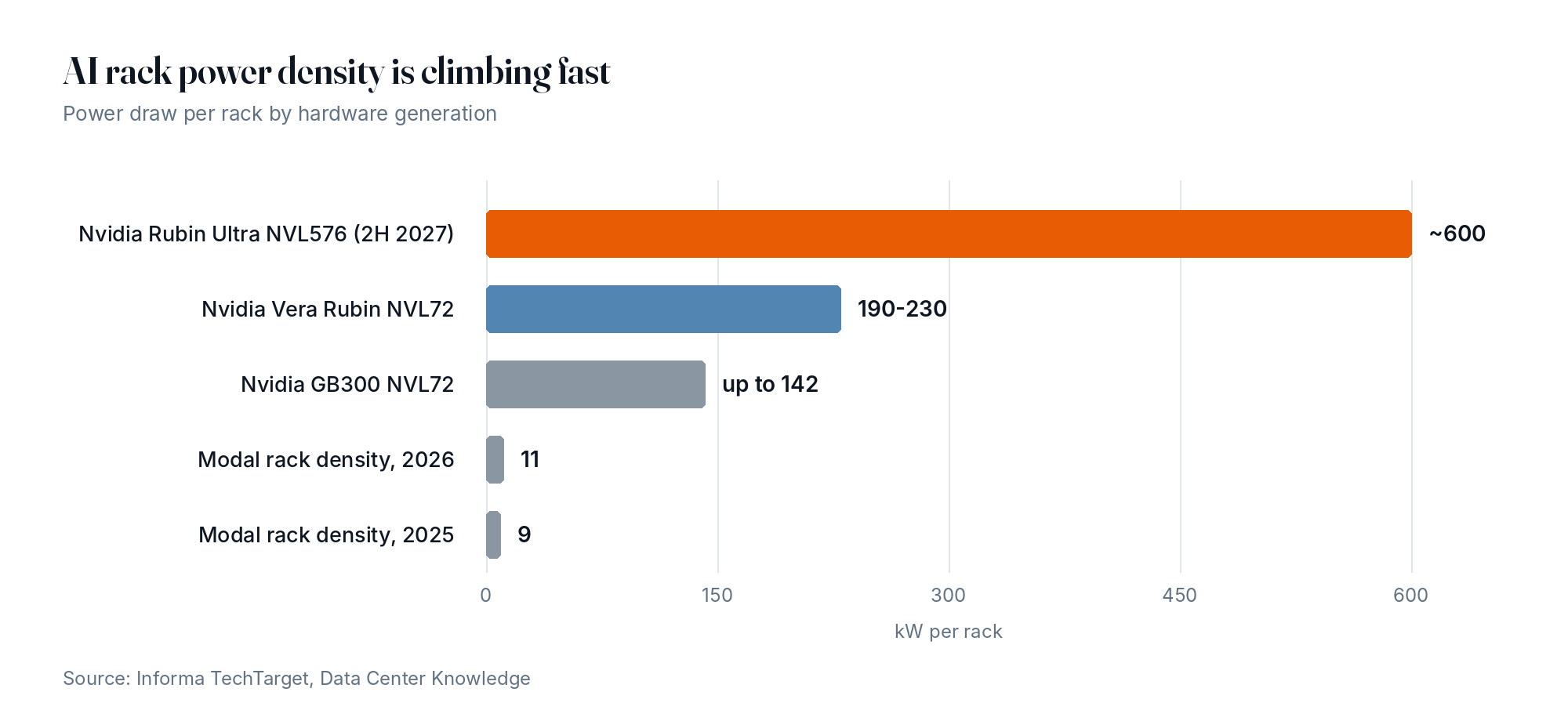
AI workloads are increasing rack power densities, prompting large investments in advanced cooling and thermal management. Nvidia’s GB300 NVL72 platform requires up to 142 kW per rack, while its Vera Rubin NVL72 is reported to range from 190 kW to 230 kW per rack 6. Nvidia’s Rubin Ultra NVL576 “Kyber” is slated for roughly 600 kW per rack in the second half of 2027 6. These increases have driven major acquisitions in thermal management, such as SLB’s $4.1 billion acquisition of Kelvion, which adds heat exchangers and heat rejection equipment to its data center business 5.
Heat removal sets the practical density ceiling
The primary factor limiting rack density is the facility’s ability to remove heat, not just the number of GPUs or fan size 6. Air cooling is generally impractical above about 50 kW per rack, according to Uptime Institute 6. Liquid cooling via cold plates is now the dominant method for higher densities, holding a 55% market share in 2026 6.
Heat rejection and water constraints shape system design
As rack power increases, facilities must expand heat rejection capacity, making it a critical investment 5. SLB notes that modern GPUs already push rack power above 100 kW, with some designs approaching 1 MW 5. In water-scarce or water-restricted regions, dry coolers and hybrid or adiabatic systems are being prioritized, as Kelvion’s technologies support these approaches 5.
Modular integration and revenue impact
Thermal management is now integrated into modular data center designs from the outset, rather than added later 5. SLB expects cumulative delivered data center capacity to exceed 2 GW by the end of 2026 5. The combined business is projected to generate more than $2 billion in 2026, with a target of $4.5 billion to $5 billion in revenue by 2028 5. The acquisition is expected to more than double SLB’s revenue opportunity per gigawatt of capacity 5.
Cooling technology adoption is evolving
Microfluidic cooling remains in development, with mainstream deployment expected several years out 6. Two-phase immersion cooling adoption slowed due to PFAS restrictions, but a replacement fluid was qualified in early 2026 6.
Why this matters now
Data center operators are facing stricter water and heat regulations as AI workloads increase cooling demands. As a result, a 330 MW AI data center project in Imperial Valley, California, sought Colorado River water after other sources were unavailable, leading to a lawsuit in May 2026 2. Meanwhile, during the July 2026 U.S. heatwaves, PJM Interconnection warned that large electricity consumers, including data centers, might need to switch to on-site generation to maintain grid reliability 2. For example, a NASA-based study analyzing data from 2004 to 2024 found that operational data centers raised surrounding land surface temperatures by an average of 2°C, with some areas reaching up to 9°C warmer, using data from 8,472 facilities 4. In addition, corrosion, which can affect cooling system reliability, often begins during construction but is frequently left out of project governance frameworks 3. Furthermore, in 2026, SLB acquired Kelvion for $4.1 billion to strengthen its thermal management capabilities for AI data centers 5.
What the sources report
WUE does not capture resilience during drought or heatwaves
Most data centers report low water usage effectiveness (WUE), but this metric alone does not reveal how well a facility can maintain cooling during water shortages or heatwaves 2. As a result, a site-specific resilience assessment is more important than a single WUE score when planning for extreme weather 2. During the July 2026 U.S. heatwaves, for example, grid operators warned large electricity users, including data centers, that they might need on-site generation to avoid reliability issues 2.
Cooling water reuse remains rare despite advocacy
Cooling water reuse is often discussed as a potential solution, but many data centers do not adopt it because the economics do not justify the higher capital costs and operational complexity 1. Instead, the industry has not shifted toward widespread reuse, even as water scarcity concerns continue to grow 1.
Corrosion risk starts during construction, not operations
Corrosion that affects cooling system reliability frequently begins during the construction phase, yet preservation measures are rarely included in early project planning 3. Industry studies estimate that the global cost of corrosion is about 3.4% of GDP each year, largely preventable 3. Therefore, as liquid cooling becomes more common in AI data centers, corrosion risk is likely to increase due to the use of multiple metals and complex water chemistries 3.
Heat island effects draw new regulatory and community scrutiny
A 2026 academic study using NASA satellite data found that operational data centers raised surrounding land surface temperatures by an average of 2°C, with some areas reaching up to 9°C warmer 4. The study specifically analyzed 8,472 data centers built outside urban areas from 2004 to 2024 4. In addition, media and local groups have highlighted the heat island effect during recent heatwaves, prompting some communities to call for monitoring and mitigation measures in data center permitting 4. Ultimately, opposition to new data centers now includes concerns about local temperature increases, alongside electricity prices and water use 4.
AI-driven cooling investments rise as rack density climbs
SLB’s $4.1 billion acquisition of Kelvion in 2026 reflects a growing emphasis on thermal management for AI data centers 5. This deal is expected to more than double SLB’s revenue opportunity per gigawatt of data center capacity 5. AI workloads are pushing rack power densities above 100 kW, and some chip architectures may soon approach 1 MW, increasing the heat that cooling systems must manage 5. Consequently, dry coolers and hybrid or adiabatic systems are attracting more attention, as water use and community opposition limit traditional cooling options 5.
Sources used in this section
1 Why Data Centers Rarely Reuse Cooling Water (Sep 02, 2026)
2 Beyond WUE: Assessing Data Center Water Resilience (Sep 09, 2026)
3 The Corrosion Blind Spot in the AI Buildout (Sep 03, 2026)
4 Data centers face new scrutiny over heat island effect (Aug 20, 2026)
5 SLB’s $4.1B Kelvion Deal Expands AI Data Center Push (Aug 31, 2026)
How SAVRN builds for this
Designing for water resilience from day one
SAVRN builds AI factories that generate their own power on site and run water-free cooling, which sidesteps the evaporative-water risk this article covers entirely rather than trying to manage it. The Water Tracker tracks the same water-stress trends operators are weighing when they choose a cooling approach.
Seeing construction and delay risk before it compounds
Corrosion and other reliability risks introduced during construction are easiest to manage when timelines and permitting are visible early. The Data Center Delay Tracker tracks the construction and permitting timelines that shape how much schedule pressure a project is under when these decisions get made.
Reducing the waste heat that drives community scrutiny
SAVRN’s campuses generate their own power on site and run water-free cooling, which lowers the waste-heat and water footprint that communities raise in permitting fights over the heat island effect. The Data Center Moratorium Tracker tracks where this kind of local opposition and policy response is emerging.
Water-free cooling regardless of rack density
As AI rack densities climb and heat rejection demand grows with them, a cooling approach that never depended on evaporating water in the first place does not face the same water-availability ceiling. This is the model SAVRN’s campuses already run. The Capital Atlas tracks where capital is moving in response to this kind of infrastructure demand.
Connecting data to decisions
SAVRN maintains public tools that track water use, delays, and regulatory developments so operators and communities can anticipate risk before it becomes a problem: the Water Tracker, the Data Center Delay Tracker, the Data Center Moratorium Tracker, the Capital Atlas and the Grid Operator Watchlist.
What to do next
Conduct site-specific resilience assessments
Assess water resilience at the site level, not just by water use efficiency, because average water use does not predict performance during droughts or heatwaves. 2 Evaluate cooling performance under peak stress and local water availability, since annual averages can be misleading. 2 Map water sources and watershed rules next, in order to understand who can use water when shortages occur. 2
Integrate water reuse and corrosion prevention early
Plan for water reuse from the start, even though most data centers still rely on single-pass evaporative cooling due to cost and complexity. 1 Include closed-loop or recirculating cooling systems where feasible, although they require higher capital and maintenance. 1 Address corrosion by including preservation and corrosion management in project governance, because these steps are essential from construction through commissioning. 3 Specify materials and water chemistry that reduce scaling and fouling, which can extend system life. 1
Engage communities and regulators on heat island effects
Model and monitor local temperature impacts from facility heat rejection, particularly near urban areas, because these areas are often more vulnerable. 4 Prepare to demonstrate heat island mitigation measures during permitting and community engagement, since this can prevent delays. 4 Track local regulations and opposition concerns around water, noise, and temperature changes, as these factors can influence project timelines. 4
Invest in modular, adaptable cooling systems
Prioritize cooling systems that can adapt to rising rack densities and changing regulatory requirements, since flexibility is crucial for long-term viability. 5 Choose thermal management solutions that support higher power densities and reduce reliance on potable water, which helps meet sustainability goals. 5 Design for flexibility in cooling approaches, including dry and hybrid systems, because local constraints may change over time. 5
Use public tools to anticipate risk and delay
Monitor water scarcity, regulatory delays, and grid operator watchlists to anticipate and plan for local risks, because early awareness can prevent costly surprises. 6 Track AI rack density trends and power delivery limits, since these factors can affect when a facility can operate at full capacity. 6 Use tools such as the Water Tracker and Grid Operator Watchlist, as they provide valuable information for site selection and timing. 6
Take concrete next steps
- Run a site-specific water resilience assessment before finalizing site selection. 2
- Include corrosion prevention and water reuse in design and procurement specifications, because these steps build resilience from the beginning. 1, 3
- Begin community engagement on heat island and water use impacts early in the planning process, which can foster support and reduce opposition. 4
- Select cooling systems that allow future upgrades to lower water use or higher density as rack power increases, since this future-proofs the investment. 5, 6
- Subscribe to public tracking tools for water, delays, and grid operator alerts, thereby staying ahead of local risks. 6
Frequently asked questions
What does water usage effectiveness (WUE) actually measure?
WUE measures the amount of water a data center uses to remove a kilowatt of heat. However, it is expressed in liters per kilowatt-hour or gallons per kilowatt-hour. Importantly, WUE does not indicate how resilient a facility is during droughts or heatwaves 2.
Why do most data centers still rely on once-through cooling water?
Most data centers use once-through cooling because it is simpler and cheaper to build than reuse systems. As a result, the higher upfront and operational costs of reuse systems often deter investment 1.
What are the main barriers to implementing cooling water reuse?
Barriers include high capital costs and complex system design. In addition, regulatory uncertainty and water quality concerns further complicate adoption 1.
How does corrosion threaten data center infrastructure?
Corrosion can degrade pipes and heat exchangers, leading to leaks and system failures. Therefore, it can cause unplanned downtime and expensive repairs, especially in AI data centers with high capital investment 3.
When does corrosion risk begin in a data center build?
Corrosion risk starts during construction, when materials are exposed to air and moisture. Meanwhile, early preservation and careful material selection are crucial to prevent long-term damage 3.
How does the heat island effect impact data center siting?
The heat island effect raises local temperatures around data centers, increasing cooling loads. Consequently, it becomes more challenging to maintain cooling setpoints during hot weather 4.
What are the limits of increasing AI rack density?
Electrical capacity and cooling system limits set practical caps on rack density. For example, pushing racks past certain power thresholds can make maintaining reliability difficult 6.
How are capital markets responding to cooling technology needs?
Capital markets are funding acquisitions and investments in thermal management companies. Specifically, SLB acquired Kelvion for $4.1 billion to expand its data center cooling capabilities 5.
What steps can operators take to improve water resilience?
How can early planning reduce long-term operational risk?
Early planning allows for the selection of corrosion-resistant materials and the integration of reuse systems from the beginning. Ultimately, this approach reduces future retrofit costs and operational disruptions 3.
Sources
- Why Data Centers Rarely Reuse Cooling Water, Informa TechTarget, Data Center Knowledge, Sep 02, 2026.
- Beyond WUE: Assessing Data Center Water Resilience, Informa TechTarget, Data Center Knowledge, Sep 09, 2026.
- The Corrosion Blind Spot in the AI Buildout, Informa TechTarget, Data Center Knowledge, Sep 03, 2026.
- Data centers face new scrutiny over heat island effect - Uptime Institute Blog, Uptime Institute Journal, Aug 20, 2026.
- SLB’s $4.1B Kelvion Deal Expands AI Data Center Push, Informa TechTarget, Data Center Knowledge, Aug 31, 2026.
- AI Rack Density’s Real Limits: Power, Cooling, Failure Risk, Informa TechTarget, Data Center Knowledge, Aug 28, 2026.
Want the next one?
When a new piece publishes on SAVRN Insights, you get one email with what it covers and a link to read it. Choose the research that interests you.
Also send me
Receive a short introduction on days 3, 7 and 14, plus the updates you select. Unsubscribe in one click. Privacy
Why low WUE doesn’t mean water resilience in data centers
Get new SAVRN Insights by email
A short introduction on days 3, 7 and 14, plus new SAVRN research articles. Unsubscribe at any time.
We use your address to send the introduction and updates described above. See our Privacy Policy.