One Network, Ground and Space: The SpaceX Mobile Network
SpaceX already reaches phones on five continents from orbit. Its talks for 80,000 U.S. cell sites are the first sign it wants a ground network too. Here is how the pieces fit and what still has to be proven.

The SpaceX mobile network took a big step toward the ground on October 22, 2026, when Bloomberg reported that SpaceX is in talks to secure access to at least 80,000 U.S. cell sites 1. Reuters relayed the story and named Crown Castle as one of the companies involved 2. However, SpaceX has not commented, and no agreement has been announced.
Most coverage read this as a U.S. telecom story. Instead, I read it as the last piece of a global one. SpaceX already sells satellite broadband in more than 160 countries and territories 3. In addition, its satellites talk to ordinary phones through carrier partners on five continents. In Ukraine, Kazakhstan and Bangladesh alone, VEON says the service connected more than 11 million people in its first year 4. Then, in October, SpaceX signed for nationwide U.S. low-band spectrum and won FCC authority for a 15,000-satellite mobile constellation 5, 6.
However, what SpaceX has never had is a dense ground network of its own. The tower talks are the first sign it intends to build one, and it is starting in its largest, richest market.
In fact, every mobile carrier on Earth today is a ground network that rents some sky. By contrast, SpaceX would be the first built the other way around: one sky network over the whole planet, plus owned spectrum and rented ground where demand is dense. If it works, a customer gets one service that covers the places towers reach and the places they never will. Therefore, that is the case for calling it the most complete communications service in the world. The rest of this article is about what has to be true for that case to hold.
The numbers in one place
Table 1 Key figures as of 23 October 2026, with the source for each
The footprint that already exists
Before talking about towers, it helps to see how far satellite-to-phone service has already spread. For example, the figure below plots every carrier this article’s sources name as a Starlink direct-to-cell partner.
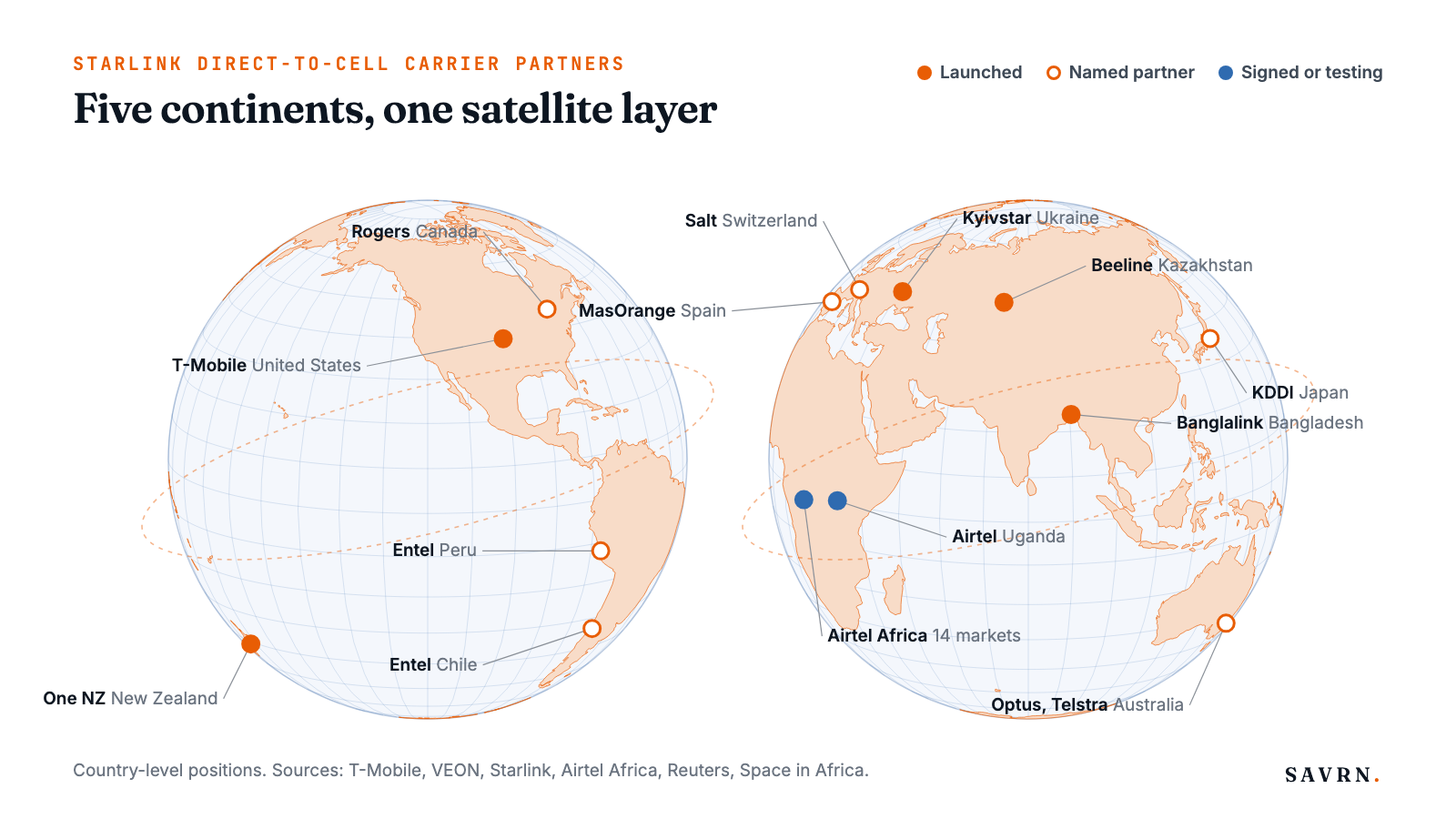
Table 2 Starlink direct-to-cell carrier partners by status
Two things stand out. First is speed. The VEON markets went from signing in November 2025 to service in three countries within eleven months 4, 10. Second is reach. Specifically, the VEON agreement covers more than 150 million potential customers, and the Airtel agreement covers 174 million more across 14 African markets 10, 13. Admittedly, those are addressable bases, not users. Still, they show how quickly a satellite layer can sit on top of existing carriers without anything new on the ground.
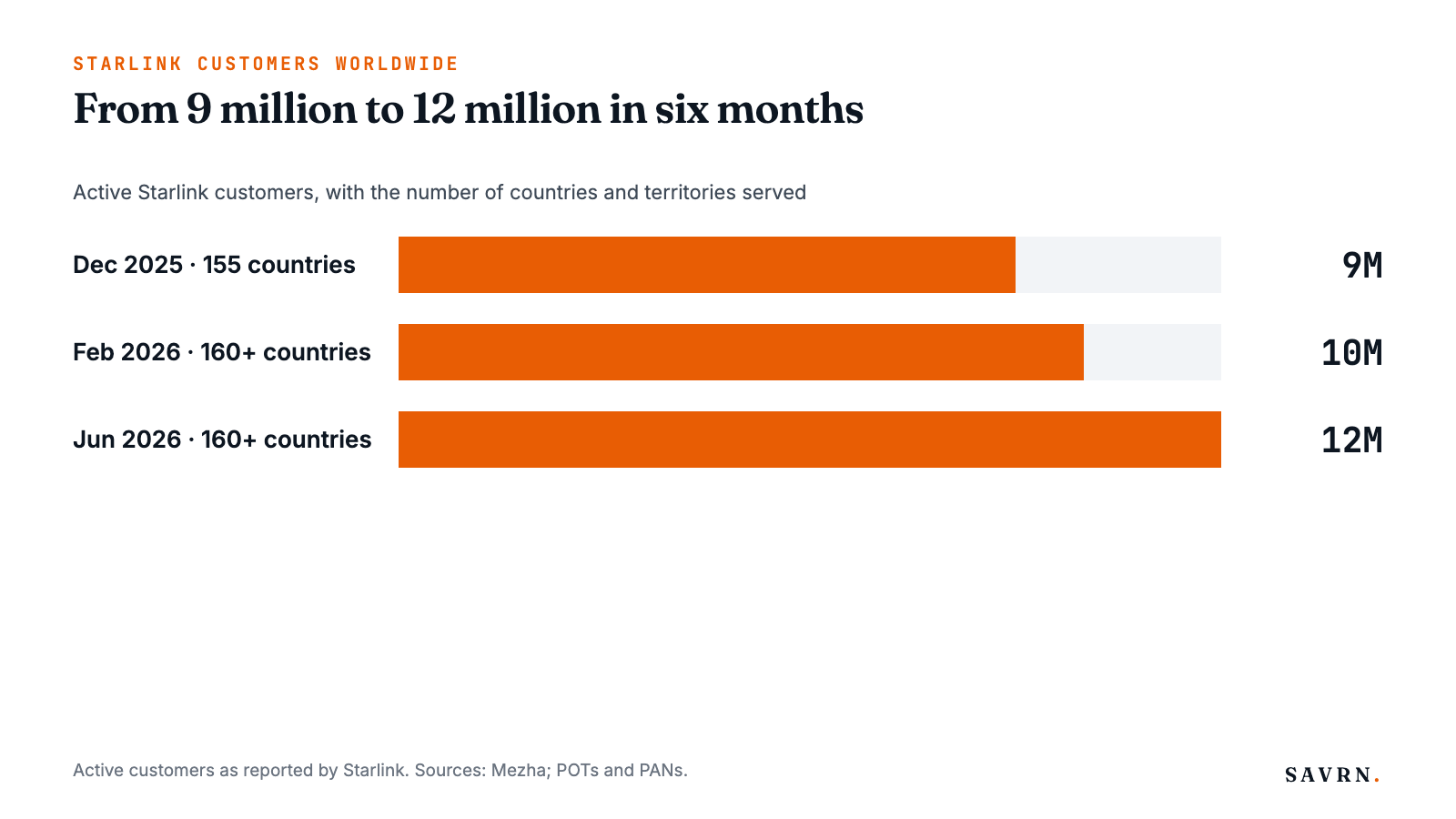
Meanwhile, the broadband business behind it keeps growing too. In addition, Starlink reported 9 million active customers in 155 countries in December 2025, 10 million in February 2026, and more than 12 million in June 2026 3, 14. Similarly, a public satellite catalog counted 11,143 working Starlink satellites on September 30, 2026 15.
Why “most complete” is the right test
Coverage maps measure where a signal exists. Customers, however, measure whether the phone works where they happen to be. As a result, those two things diverge in four places.
The first is indoors. Most mobile traffic is used inside buildings, and higher frequencies lose strength through walls. Because of that, low-band spectrum below 1 GHz is so valuable to every carrier. The second is the long tail of geography: ranch roads, forests, open water, mountain passes and deserts. However, a tower network stops being economic long before it reaches all of that. The third is the moment the ground network fails, whether from a hurricane, a wildfire, a fiber cut or a war. Finally, the fourth is borders, because a carrier’s network ends where its license ends.
For context, the global numbers show how big the gap still is. According to the GSMA, about 300 million people, 4% of the world, live where there is no mobile broadband at all, and in Sub-Saharan Africa the gap is 10% 16. Moreover, coverage grew by only about 40 million people in 2024. At that pace, therefore, towers alone take years to close it.
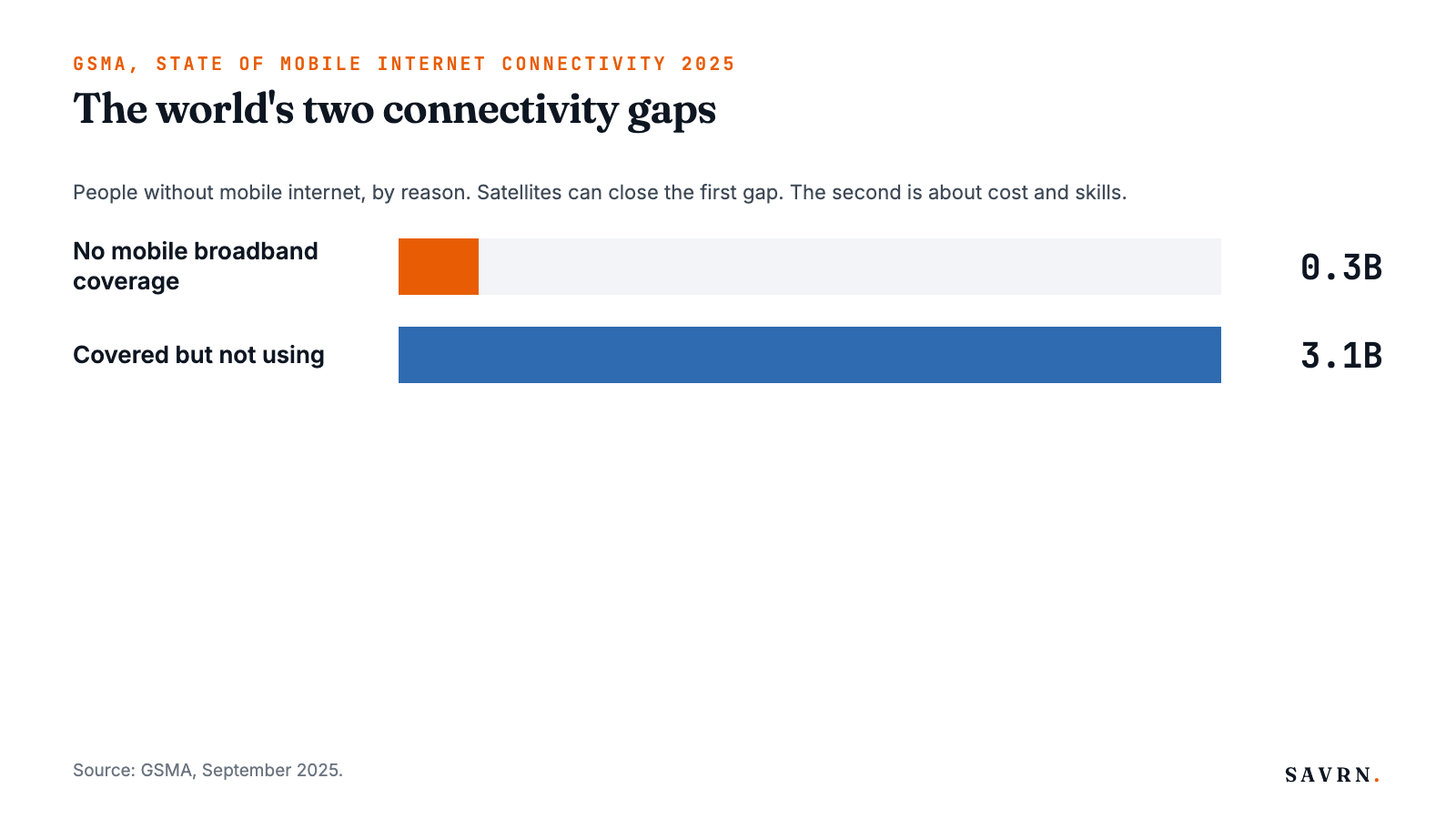
In fact, the usage gap of 3.1 billion people is ten times bigger than the coverage gap, and satellites do not fix affordability or digital skills 16. Instead, what a satellite layer can fix is the coverage gap and the failure gap. Today, no carrier anywhere solves all four problems with assets it owns. SpaceX, however, is trying to.
Two operating models: partner abroad, carrier at home
Read the filings together and a clear pattern appears. To be clear, this is my reading, not a SpaceX statement.
Outside the United States, SpaceX sells satellite coverage to the local carrier, which keeps the customer, the brand and the license. Accordingly, the FCC grant covers mobile satellite and direct-to-cell service outside the U.S. 6. That model scales fast because it needs no towers, no retail stores and no local spectrum auctions.
Inside the United States, by contrast, SpaceX is buying its own spectrum, seeking its own ground sites, and holds an FCC waiver to offer satellite wireless service without a carrier’s spectrum lease 6. In other words, that is the shape of a fourth national carrier.
In fact, the split makes sense. Licensing a national mobile network in 160 countries would take decades, while selling one sky layer to hundreds of carriers takes contracts. In the U.S., one country with one regulator and some of the highest-spending mobile customers in the world, SpaceX can afford to own the whole stack. As a result, the U.S. becomes the proof that a hybrid carrier works, and every partner abroad becomes a buyer of the satellite half of it.
However, there is a tension here worth naming. T-Mobile is both SpaceX’s launch partner and the carrier most exposed to a SpaceX service at home. Nothing in the reporting says the partnership has ended 7. Even so, partners abroad will watch how that relationship holds.
The six layers of the hybrid network
The framework below is my reading of public filings and announcements. In particular, it is not a disclosed SpaceX engineering design. Each layer has a different job, a different reach and a different status today.
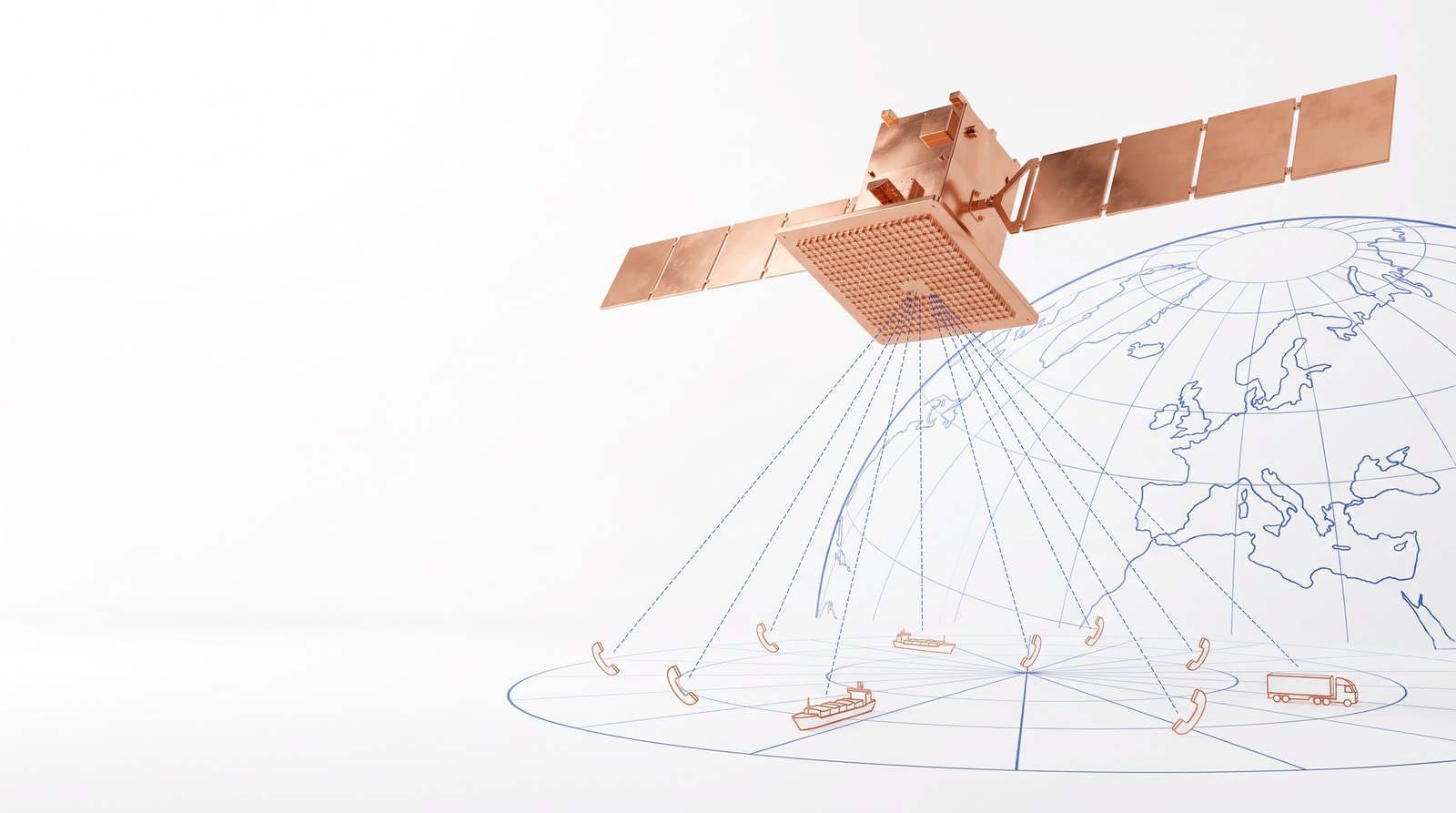
Layer 1: very-low-orbit satellites that reach phones
Today, more than 650 direct-to-cell satellites serve partners worldwide 7. In addition, the FCC authorized 15,000 more in nine shells between 326 and 335 km, low enough to cut latency, with a deadline of October 2035 6. Furthermore, deployment is expected to begin in 2027 and depends on Starship 17. SpaceX also says the next generation carries more than 100 times the bandwidth of the current one. However, that is a company claim, not measured customer throughput.
Layer 2: the laser mesh between satellites
Starlink’s direct-to-cell satellites carry an onboard cellular modem and connect into the wider constellation over lasers, and the phone side works like a roaming relationship with the partner carrier 18. Consequently, traffic can cross oceans in orbit without touching another country’s ground network.
Layer 3: mid-band mobile satellite spectrum
EchoStar’s AWS-4 and H-Block licenses moved into a trust as the first step of a $17 billion deal 19. Specifically, the filings describe 50 MHz across specified bands plus up to 15 MHz of additional AWS spectrum in relevant areas. However, the final transfer to SpaceX is targeted for about November 30, 2027 20.
Layer 4: low-band 800 MHz
The Grain portfolio is up to 14 MHz of paired spectrum. Previously, Grain got it from T-Mobile in August 2026 and agreed on October 8 to sell all of it to SpaceX, subject to FCC approval 5, 21. This is the layer that reaches into buildings, and it is the reason towers suddenly matter.
Layer 5: terrestrial macro sites
This is the reported 80,000 sites, where concentrated demand gets served: cities, suburbs and highways 1. Because ground radios reuse the same spectrum many times across small areas, they carry far more traffic per square mile than a satellite beam can.
Layer 6: small cells, indoor systems and Wi-Fi
The U.S. already has 198,100 outdoor small cells and 830,350 indoor nodes 22. Similarly, Starlink’s 12 million broadband customers could carry phone traffic over Wi-Fi at home and at work 3. Even so, nothing public shows how SpaceX plans to use either.
Why 800 MHz turned towers into a priority
Spectrum is described two ways, and the two get mixed up. “800 MHz” is where the spectrum sits on the dial, while “14 MHz paired” is how wide the holding is. Low frequencies travel far and go through walls, whereas width decides how much traffic a band can carry.
The Grain deal gives SpaceX a low-band layer that reaches indoors, alongside the 2 GHz mid-band it is getting from EchoStar 21. Moreover, SpaceX said the purchase fills one of the key remaining technical gaps for Starlink Mobile 23. Admittedly, low-band spectrum is useful from orbit too. Its full value, though, comes from ground radios that reuse it cell after cell. For instance, a 14 MHz paired block broadcast from a satellite beam covers a huge area with one slice of capacity, while the same block on 80,000 towers is reused across 80,000 small areas.
In short, that is the engineering reason the tower story followed the spectrum story by two weeks. Bernstein made the same point from the other side: buying spectrum does not commit SpaceX to building towers, but it keeps the tower option very much alive 23.
For the EchoStar spectrum, there are at least five separate dates to keep apart: regulatory approval, transfer to the trust, operating rights, final closing, and commercial service. The filings show the first transfer step is done, but they do not show FCC approval of the full transfer 19, 20. Therefore, calling it a finished purchase hides real dependencies.
How big is 80,000 sites, really
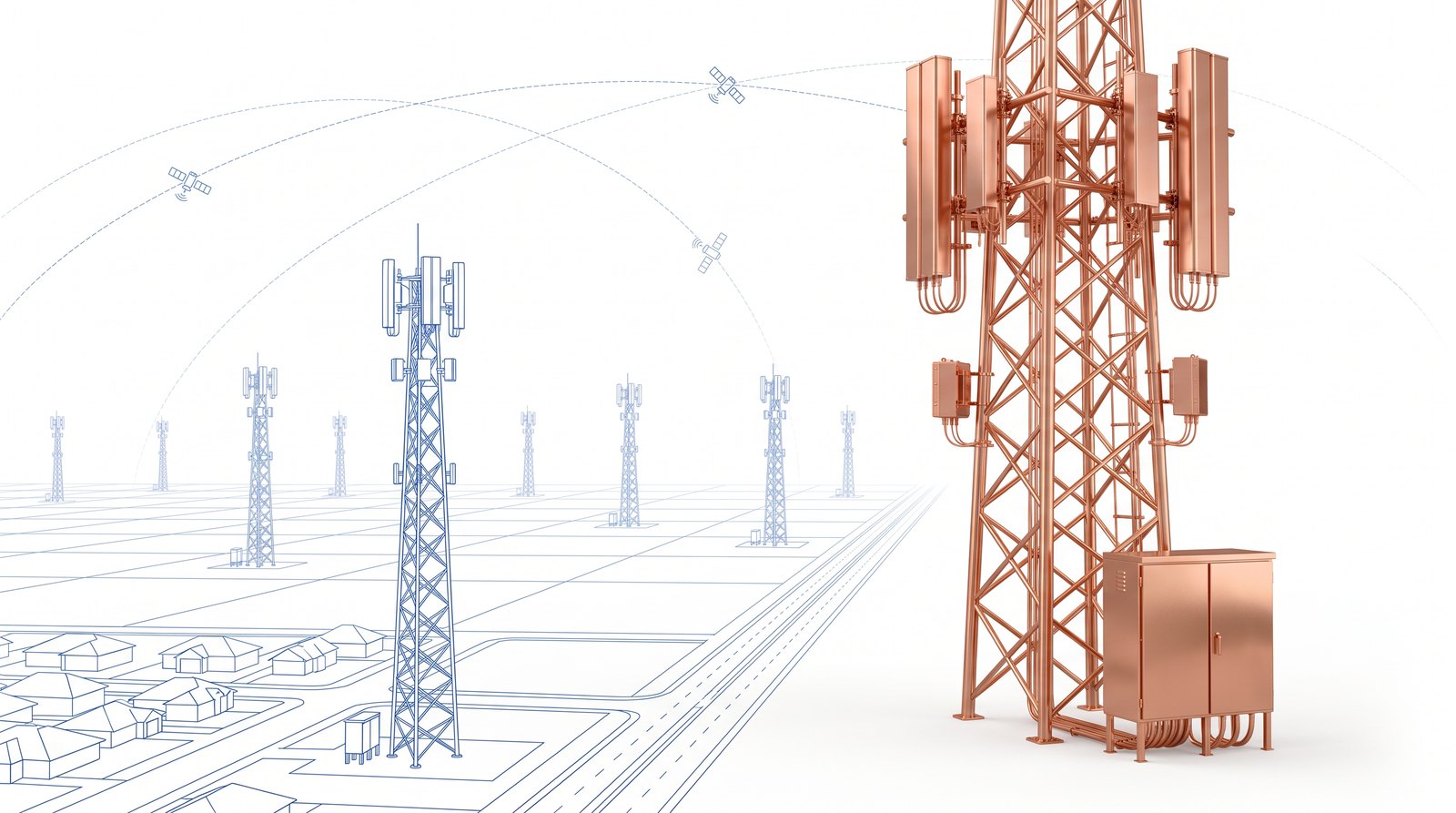
Table 3 80,000 sites against the U.S. base
A cell site is a set of radios at a location, and several carriers can share one physical tower. Thus 80,000 sites does not mean 80,000 new towers. Instead, it most likely means SpaceX radios added to structures that already exist, which is faster and cheaper than new construction and is exactly what tower companies sell.
Specifically, Crown Castle’s chief executive said the company was talking with all parties when asked about satellite providers, and declined to name customers 2. That confirms engagement, although it is not a SpaceX contract. Firm leases, options to pick sites later, minimum commitments and a master agreement with site-by-site orders all create very different obligations. However, none of those terms are public.
What it costs to deliver
TD Cowen estimates a full U.S. ground network could cost more than $80 billion and take years 2. Bernstein’s range runs from 30,000 to 120,000 sites and from $50 billion to $130 billion, depending on how far the build goes 24. In both cases, these are analyst estimates rather than a SpaceX budget.
The recurring cost is the part most coverage skips, because site rent is paid every month for the life of the lease, before and after customers arrive. The figures below are assumptions I chose for illustration. In particular, they are not reported SpaceX lease terms or market quotes.
Table 4 Illustrative site rent across 80,000 active sites (SAVRN assumptions)
Rent sits beside radios, antennas, installation, power, backhaul, maintenance, software, operations, insurance and customer acquisition. Furthermore, turning on 80,000 sites evenly takes about 2,222 activations a month over three years, 1,333 over five, or 952 over seven, and that assumes every site goes live.
Worked example: how many customers pay the rent
Take the middle case of $2,000 per site per month, or $1.92 billion a year. At $40 a month in average service revenue, each line brings in $480 a year. Therefore, covering site rent alone takes 4.0 million paying lines, before radios, power, backhaul, staff or marketing.
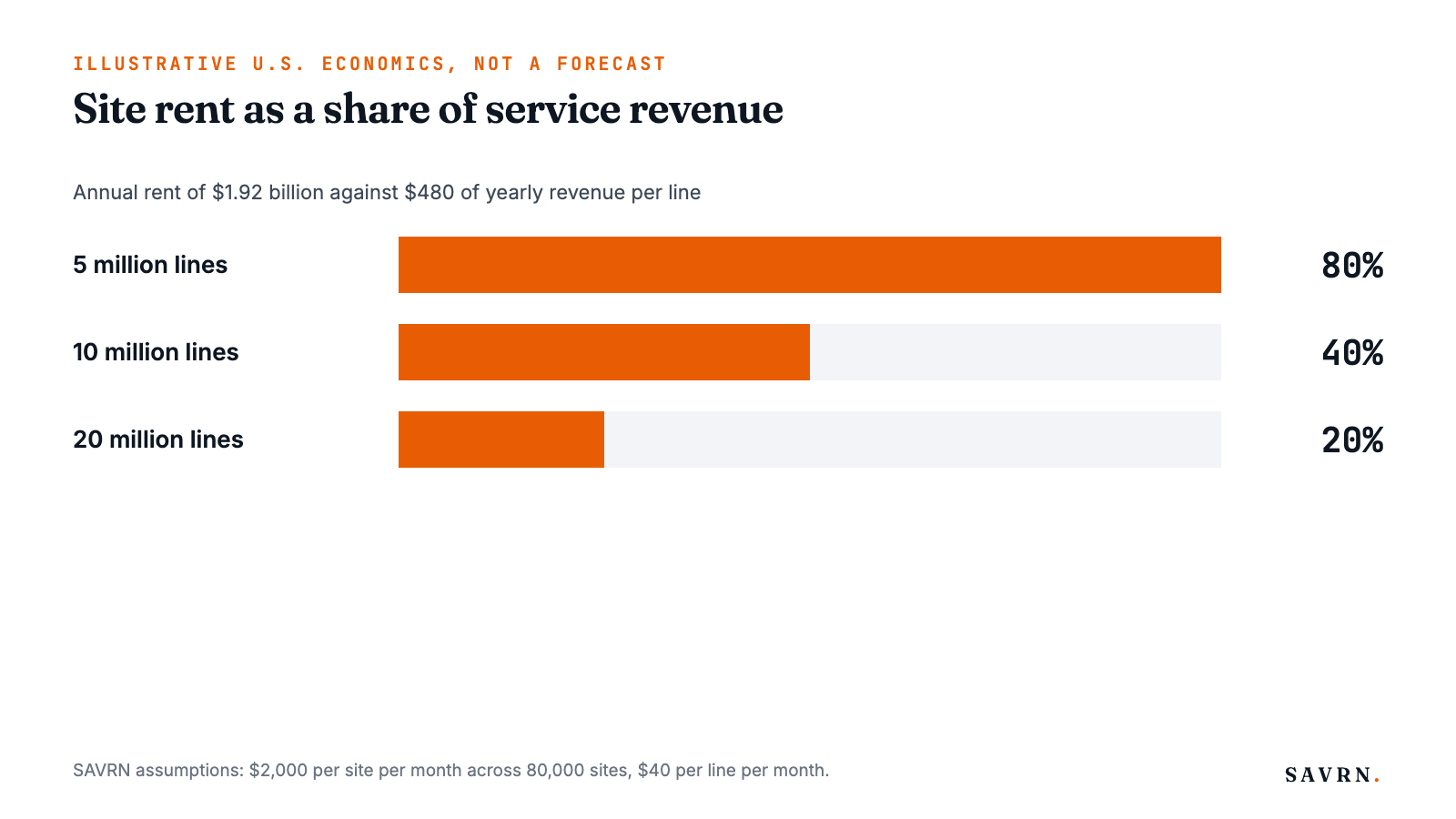
Five million lines bring in $2.4 billion a year, 10 million bring in $4.8 billion, and 20 million bring in $9.6 billion. However, those figures leave out discounts, taxes, devices, churn and bad debt. The point is simple: customer density is the whole game. At 10 million lines, for example, each of 80,000 sites carries 125 paying customers.
Additionally, this is where the global footprint matters. The satellite layer is paid for once and sold many times, to U.S. retail customers and to partner carriers in dozens of countries. Revenue from abroad does not pay U.S. tower rent directly; however, it spreads the cost of the constellation that every U.S. customer also uses. No U.S. carrier has that offset.
Where SpaceX has an edge on delivery
The global layer is already in orbit
Satellite-to-phone service across many countries is the piece no ground carrier owns. SpaceX already runs it commercially with partners from the U.S. to Bangladesh 4, 7. Carriers rent that reach, whereas SpaceX owns it.
It controls its own launch cost
New constellation deployment depends on Starship 17. Since no other satellite operator launches on its own rockets at this volume, SpaceX can add capacity on its own schedule, and more than 11,000 working Starlink satellites are already up 15.
It can rent the ground instead of building it
The U.S. has 158,500 towers run by neutral landlords whose business is adding tenants 22. As a result, SpaceX needs signed leases, radios and crews rather than concrete.
Partners abroad keep paying while the U.S. builds
Meanwhile, each new partner adds revenue without new ground spending. For instance, the Airtel Africa deal alone covers 174 million customers 13.
Resilience is built into the design
When a tower loses power or fiber, a phone on a hybrid network can still reach the sky. Kyivstar’s free launch in Ukraine during wartime is the clearest real case of why that matters 9. Even so, independent performance tests are still missing.
What could stop it
Capacity where people are
A satellite beam is wide, while dense demand needs ground cells. Consequently, if the U.S. tower layer comes late or thin, the service is strongest where the fewest people live.
Handoff between layers
Moving a live session from a tower to a satellite and back, cleanly and securely, across millions of phones, is the least proven part of the design.
Regulators in every country
The Grain sale needs FCC approval, and the EchoStar deal closes in late 2027 5, 20. Abroad, each launch needs a local license; in fact, Airtel’s 14-market rollout is subject to approval country by country 13.
Partner trust and incumbent response
Carriers abroad may hesitate to depend on a supplier that is becoming a carrier at home. Meanwhile, AT&T, Verizon and T-Mobile can cut prices, sign other satellite partners and bundle. Their shares fell between 4.2% and 5% on the report 2.
What it means for towers, carriers and fiber
Tower owners would gain a new national tenant, which lifts use of existing steel and brings installation and amendment work. However, the value depends on committed volume, rent start dates, upgrades, cancellation rights and credit support.
In effect, carriers will see two different companies. Outside the U.S., SpaceX is a supplier that fills coverage gaps. Inside the U.S., it is becoming a possible competitor. Naturally, carriers in each group will price that risk differently.
Fiber, power and field services firms would see site-by-site work, since any large ground rollout needs backhaul, electrical service, backup power and crews. The same supply chain questions we track in our piece on the AI data center supply chain apply to radios, cabinets and batteries.
Application to SAVRN
SAVRN builds and operates AI data center capacity, so my question is narrow. Could a small number of network aggregation points in a SpaceX ground build also host power and governed inference that stands on its own economics? We covered the demand side in AI inference infrastructure. Tower access alone, though, does not make a site fit for compute, so each location would have to clear six checks first, the same screens our free Site Intelligence tool runs on an address.
Table 5 Site checks before any compute claim
The 80,000-site report does not create demand for 80,000 AI facilities. Instead, the disciplined path is a short list of places where demand, transport, power and operating economics already line up. Any SAVRN capability claim follows delivery there, not before.
The eight milestones that would prove it
- Signed U.S. infrastructure agreements, with committed sites separated from optional access.
- Lease start dates, which show when rent begins relative to deployment.
- Equipment orders and installs, as evidence that talks are turning into construction.
- Spectrum approvals and closings, which decide which rights are usable for which service.
- The first Starship launches of the 15,000-satellite system.
- Independent performance tests of indoor reliability, busy-hour speed, voice and handoffs, both in the U.S. and in partner markets.
- Partner launches abroad, starting with Airtel Africa going live market by market.
- Funding and unit economics, including deployment spend, acquisition cost, retention and margin.
Bottom line
SpaceX is the only company putting every part of a complete mobile network under one owner: a satellite layer that already covers the planet, carrier partners on five continents, its own spectrum in the U.S., and a ground layer it can rent at national scale. By contrast, no carrier has that combination, and none can build the satellite half quickly. That is why I think SpaceX has the best shot at delivering the most complete communications service in the world.
Still, the evidence supports a serious, global, well-funded attempt, not yet a working hybrid carrier. The U.S. tower talks matter because they move the story from orbit to signed leases and monthly rent. The test from here is execution: whether satellites, spectrum, partners, sites and customers come together into one service that works in a basement in Manhattan, on a ranch road in West Texas, on a farm in Uganda and on a ship at sea, and earns a return doing it.
What to take from this
- SpaceX already sells a satellite layer to carriers on five continents; the U.S. tower talks would add a ground layer in its largest market.
- Abroad, SpaceX works as a supplier to local carriers. At home, it is assembling the parts of a fourth national carrier.
- The 800 MHz deal explains the tower talks: low-band spectrum earns most of its value when ground radios reuse it cell after cell.
- No 80,000-site agreement is public, and the EchoStar spectrum does not close until late 2027.
- At an assumed $2,000 per site per month, 80,000 sites cost $1.92 billion a year, so customer density decides the economics.
- The test is execution: signed leases, Starship launches, independent performance tests and partner launches abroad.
Frequently asked questions
Has SpaceX signed a deal for 80,000 cell sites?
Is the SpaceX mobile network only about the United States?
No. The tower talks are U.S.-only; however, the satellite layer is global. Starlink broadband operates in more than 160 countries and territories, and its phone service runs through carrier partners on five continents 3.
Which countries have Starlink phone service today?
Does 80,000 sites mean 80,000 new towers?
No. A site is a set of radios at a location, rather than a structure. Because it can sit on an existing tower, rooftop or other structure, and several carriers can share one tower, most of the work would be added equipment rather than new steel.
How much did SpaceX pay for the 800 MHz spectrum?
Grain did not disclose a price, since the deal is still pending. However, the Wall Street Journal reported about $8 billion, and the deal still needs FCC approval 21.
When will the new satellites be in service?
How fast will the hybrid service be?
The sources do not say, because the service does not exist yet. SpaceX claims more than 100 times the bandwidth of its current satellites; nevertheless, no independent measurements of a hybrid service exist yet.
Does this end T-Mobile's Starlink partnership?
What would it cost SpaceX to rent 80,000 sites?
No lease terms are public, so any figure is an illustration. As an illustration only, $2,000 per site per month across 80,000 sites comes to $1.92 billion a year, or $19.2 billion over ten flat years.
What does this mean for data center and edge computing sites?
Only a small share of network sites could host compute, because most are small structures. Specifically, each one would need power, land, fiber, backup, cooling and a paying customer before it qualifies, so the opportunity is site by site rather than 80,000 at once.
Sources
- SpaceX in talks for 80,000 cell sites to build nationwide wireless network, report, Investing.com, citing Bloomberg News, Investing.com, 2026; Report of the talks and the 80,000-site figure, October 22, 2026
- SpaceX seeks access to 80,000 US cell sites for wireless network, Reuters, AOL, 2026; Crown Castle chief executive comment; U.S; tower counts by owner; TD Cowen estimate above $80 billion; carrier shares down 4.2% to 5%
- Starlink reaches 12 million users, Mezha, mezha.ua, 2026; More than 12 million active customers in more than 160 countries and territories, June 2026
- Starlink's Phone Service Has Now Reached 11 Million People in Ukraine, Kazakhstan and Bangladesh, TeslaNorth, citing Starlink and VEON, TeslaNorth, 2026; Launch dates, customer bases and the counting method behind the 11 million figure
- Latham & Watkins Advises on Grain Management Definitive Agreement to Sell Spectrum Portfolio to SpaceX, Latham & Watkins, lw.com, 2026; Definitive agreement for the nationwide 800 MHz portfolio and its regulatory conditions
- FCC OKs SpaceX to deploy 15K D2D satellites, and nine years to complete it, Light Reading, Light Reading, 2026; 15,000 satellites in shells from 326 to 335 km, October 2035 deadline, carrier-lease waiver, service scope inside and outside the U.S
- T-Satellite is Here, And Now It's Powering Apps, T-Mobile, Business Wire, 2025; App data on T-Satellite from October 1, 2025, over 650+ Starlink direct-to-cell satellites
- Starlink Direct to Cell Service Now Available, SpaceX, starlink.com, 2025; Service live with T-Mobile and One NZ; testing in Australia, Canada, Chile and Japan at the time
- Kyivstar Launches Starlink Direct to Cell Satellite Connectivity in Ukraine, Kyivstar, Kyivstar investor relations, 2025; First launch in Europe, starting with messaging
- Starlink signs landmark global direct-to-cell deal with Veon as satellite-to-phone race heats up, Reuters, Yahoo Finance, 2025; More than 150 million potential customers; Rogers named as a partner; partners in 11 countries at the time
- Starlink Direct to Cell Becomes the World's Largest 4G Coverage Provider, TechAfrica News, TechAfrica News, 2025; Partner list naming Optus, Telstra, Rogers, One NZ, KDDI, Salt, Entel and Kyivstar; the headline is the outlet's own claim
- Airtel Uganda Joins a Growing Global Wave as It Begins Testing Starlink's Direct-to-Cell Service, Space in Africa, Space in Africa, 2026; Uganda testing from May 2026; MasOrange added early 2026; partner status list
- Kenya: Airtel, SpaceX Partner On Starlink Mobile Connectivity, AllAfrica, AllAfrica, 2025; Agreement across 14 African markets and 174 million customers, launch in 2026 subject to approvals
- Starlink Update, Doug Dawson, CCG Consulting, POTs and PANs, 2026; Earlier customer milestones of 9 million in 155 countries and 10 million
- How many satellites does the US have, KeepTrack, using Jonathan McDowell's catalog, keeptrack.space, 2026; 11,143 working Starlink satellites on September 30, 2026
- The State of Mobile Internet Connectivity 2025: Network Coverage and Infrastructure, GSMA, GSMA, 2025; 300 million people without mobile broadband coverage; Sub-Saharan Africa gap 10%; 3.1 billion covered but not using
- FCC Grants SpaceX Approval for 15,000 Direct-to-Device Satellites in MSS Spectrum, Via Satellite, Satellite Today, 2026; FCC order of October 6, deferred spectrum requests, Starship-dependent deployment from 2027
- Starlink Direct to Cell, SpaceX, starlink.com, 2026; Onboard cellular modem, laser backhaul and roaming-style carrier integration
- EchoStar Corporation Form 10-Q, quarter ended June 30, 2026, EchoStar Corporation, SEC EDGAR, 2026; Transfer of AWS-4 and H-Block licenses to the trust completed; $17 billion consideration; AWS-3 add-on
- EchoStar Corporation Form 10-K, fiscal year 2025, EchoStar Corporation, SEC EDGAR, 2026; Spectrum acquisition closing expected about November 30, 2027, and the two-step trust structure
- SpaceX to acquire Grain's 800MHz spectrum assets to further advance carrier ambitions, DatacenterDynamics, DCD, 2026; Low-band role next to 2 GHz holdings; Wall Street Journal report of about $8 billion; T-Mobile origin of the spectrum
- Wireless Infrastructure By The Numbers: 2025 Key Statistics, Wireless Infrastructure Association, WIA, 2026; U.S; towers, macrocell sites, outdoor small cells and indoor nodes at year-end 2025
- Crown Castle Soars 13% as SpaceX's $8 Billion Spectrum Buy Keeps Tower Build Option Very Much Alive, TIKR, TIKR, 2026; Bernstein view on the tower option; SpaceX statement on the remaining technical gap
- SpaceX Teil 2: US-Funkmastbetreiber mit Kursaufschlaegen, stock3, stock3, 2026; Bernstein range of 30,000 to 120,000 sites and $50 billion to $130 billion
Want the next one?
When a new piece publishes on SAVRN Insights, you get one email with what it covers and a link to read it. Choose the research that interests you.
Also send me
Receive a short introduction on days 3, 7 and 14, plus the updates you select. Unsubscribe in one click. Privacy
One Network, Ground and Space: The SpaceX Mobile Network
Get new SAVRN Insights by email
A short introduction on days 3, 7 and 14, plus new SAVRN research articles. Unsubscribe at any time.
We use your address to send the introduction and updates described above. See our Privacy Policy.