University Affiliated Research Centers: How Universities Build Lasting National Research Capability
A research award can end on schedule while the capability behind it simply disappears. University Affiliated Research Centers show how some universities keep that capability alive. Here is what the model establishes, what the money shows, and a framework any university can use.

University Affiliated Research Centers are one of the clearest examples of how a university can turn research talent into a lasting national capability. The federal directory lists 15 of them today1. Together they received about $2.181 billion in federal research and development obligations in FY20244. However, the dollar figure is not the interesting part. The interesting part is what these centers keep alive between individual projects: specialized people, tested methods, working facilities, and independent technical judgment.
This post walks through our new SAVRN Insights paper, From University Research to National Capability, in detail. The paper runs about 10,000 words, cites 18 primary sources, and ends with a framework any university can use. It is written for university leaders, trustees, research administrators, federal sponsors, and industry research partners. Because it touches our own business, I will also be clear about where SAVRN sits, and that disclosure comes near the end.
One definition first. In this post, national capability means expertise and supporting resources that can be applied again and again to a consequential scientific, public, or operational problem. It does not mean a federal designation, a security accreditation, a government endorsement, or exclusive procurement rights.
Key figures
Table 1 Key figures
The question every research award leaves behind
A university can assemble an excellent team for one award. Once the award ends, however, a hard question appears: what happens to the capability that made the work possible?
For example, the researchers may move to other projects. Specialized equipment may lose its operating budget, while a prototype may stay usable only by the person who built it. Meanwhile, a sponsor may need follow-on testing after the grant period has closed. Finally, students may finish valuable work with no clear path to the next stage.
In fact, these are institutional questions about continuity. Specifically, they ask who maintains a capability, how it is governed, and what keeps it useful between assignments. Buying more equipment can fix one of those problems, although it leaves the others where they were.
UARCs offer a useful model because they tie university-linked expertise to a sustained federal mission. In addition, the directory separates formal designation from the ordinary receipt of defense research money1. Thus a university that takes defense funding is not automatically a UARC.
The broader question, however, applies far beyond defense. For instance, universities pursuing civilian agency research, industrial innovation, or regional science priorities face the same problem. Therefore the framework in the paper starts with the capability and then asks which structure can sustain it.
Continuity has a cost
Keeping a standing capability is not free. For example, staff need support between assignments. Similarly, equipment needs maintenance even when nobody is using it. In addition, an institute may keep a technical approach alive after a better one appears.
Therefore, a university should decide which pieces deserve continuity and which should stay flexible. For instance, an experimental method, a specialized engineering team, or a trusted dataset can justify ongoing support even when projects come and go. By contrast, a particular generation of hardware may have a short useful life. Treating both as equally permanent can leave a university financing obsolete equipment while the core research skills go unfunded.
The strongest case for an institute names that difference. Specifically, it explains why the mission needs accumulated knowledge, what would be lost if the team dispersed, and whether another institution could do it better. It also names the campus activities that would get less support if money moved, since national relevance does not remove those tradeoffs.
Scale matters here too. For example, at an R1 university the review should connect to research strategy, faculty development, graduate education, and stewardship. For a smaller or specialized school, however, a focused role inside a consortium may create more value than a broad research enterprise. Ultimately, neither size nor research classification substitutes for technical fit.
What the UARC model actually establishes
The federal UARC model links long-term mission needs to maintained technical competencies. In particular, designation follows a government-led requirements and selection process. As a result, a center’s value depends on staying useful and independent over time1.
The 2026 UARC Management Plan sets a $10 million annual funding threshold for newly established centers2. The plan document is dated March 2026, while its approval signature is dated April 18, 20262. In addition, it requires a sponsor’s case for a new center. That case specifically covers mission need, funding commitment, independent capability, and alternatives. Finally, the plan provides for periodic review2.
These rules describe an obligation. In fact, they do not promise the university a profit, and they do not fund a new building automatically. That distinction, however, gets lost in a lot of commentary.
The contracting authority is similarly bounded. FAR 6.302-3 specifically allows other-than-competitive procedures to establish or maintain essential engineering, research, or development capability in specified circumstances5. However, it does not make every purchase tied to a university or its commercial partners eligible for a noncompetitive award.
Industry collaboration is possible inside the model, although it is subject to conflict screening and sponsor oversight. For example, the updated plan directs appropriate access to UARC expertise2. It also separates similar competencies, which may be necessary, from duplicative work, which should not be funded2. Consequently, an AI proposal needs a specific mission case and an alternatives analysis. It does not, however, need to claim that no other institution studies AI.
For other universities, therefore, the lesson is discipline. Explain what must persist, why existing arrangements fall short, and how oversight will keep the work useful and trustworthy. In fact, an ordinary research institute can apply that same discipline without claiming UARC status.
What the federal money shows, and what it does not
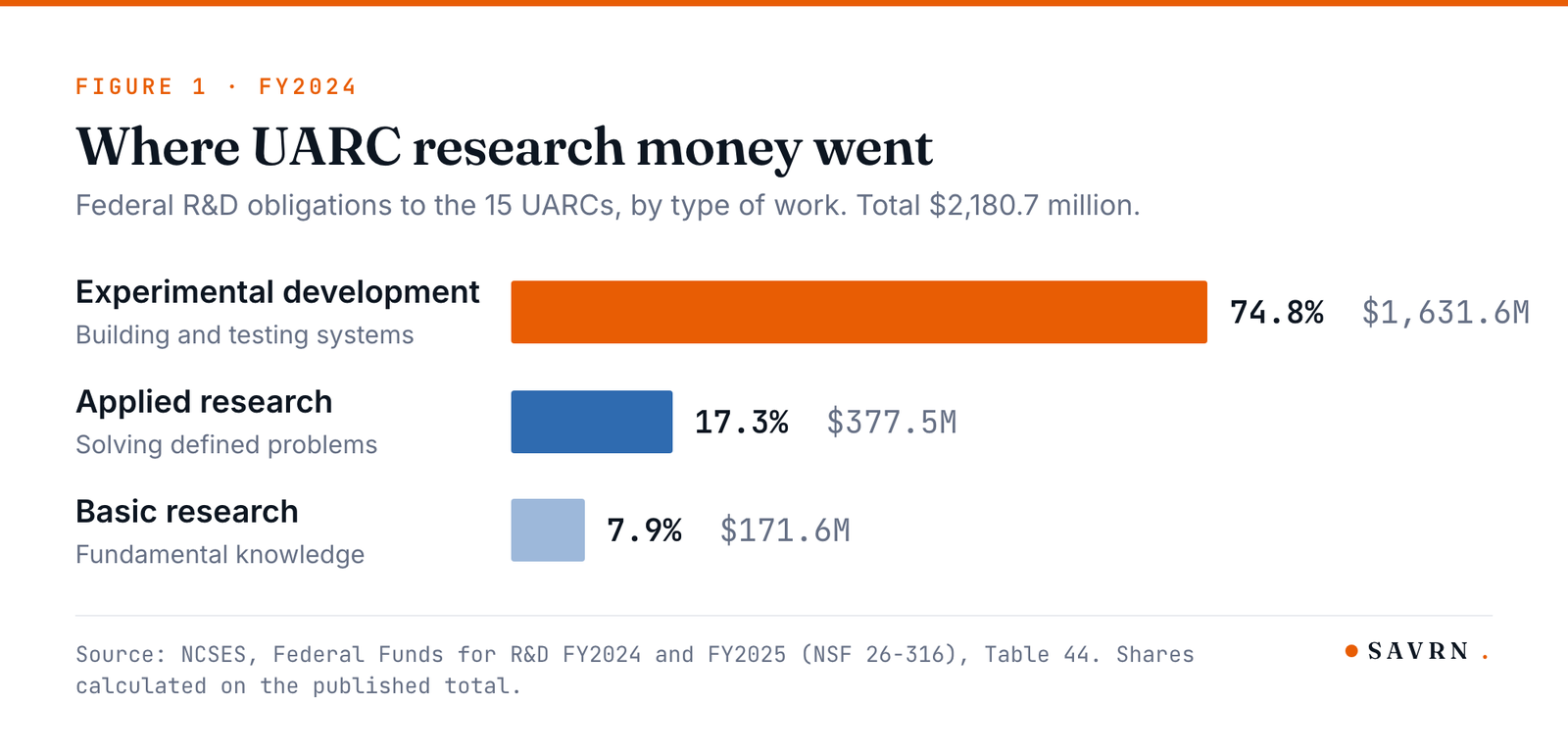
The National Center for Science and Engineering Statistics reports $2,180.702 million in FY2024 federal R&D obligations to the 15 listed UARCs4. In particular, experimental development accounts for 74.8% of that total, or $1,631.6 million. Applied research accounts for 17.3%, or $377.5 million. Finally, basic research accounts for 7.9%, or $171.6 million4. These shares are calculated from the published table.
Furthermore, the money is highly concentrated. For example, Johns Hopkins APL alone received $1,294.0 million, which is 59.3% of the total4. By contrast, the median center received $58.297 million4. Because APL is so large, the simple average is about $145.4 million, although only two of the 15 centers sit above it. Without APL, in fact, the average of the other 14 falls to about $63.3 million. The largest center received roughly 680 times the smallest.
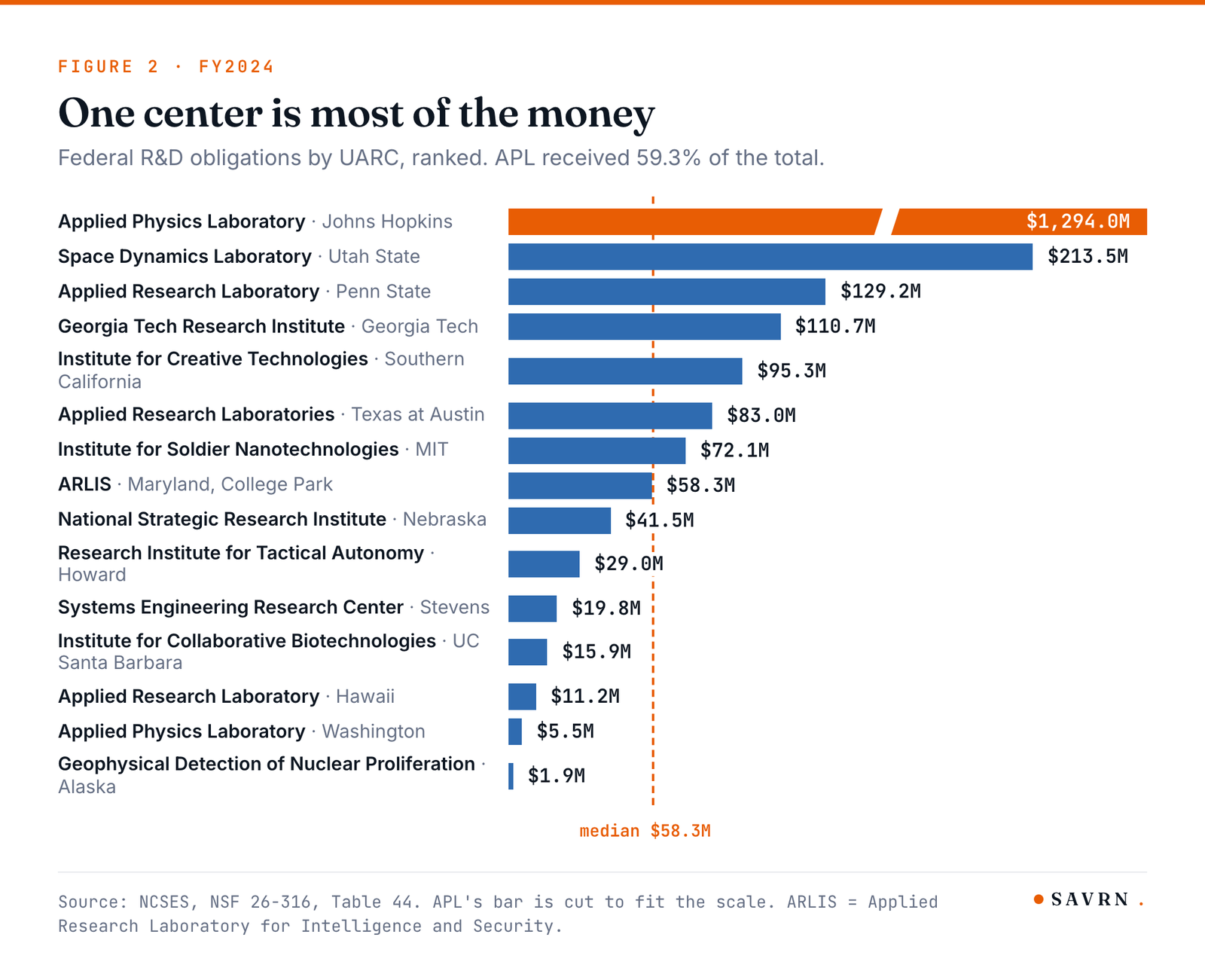
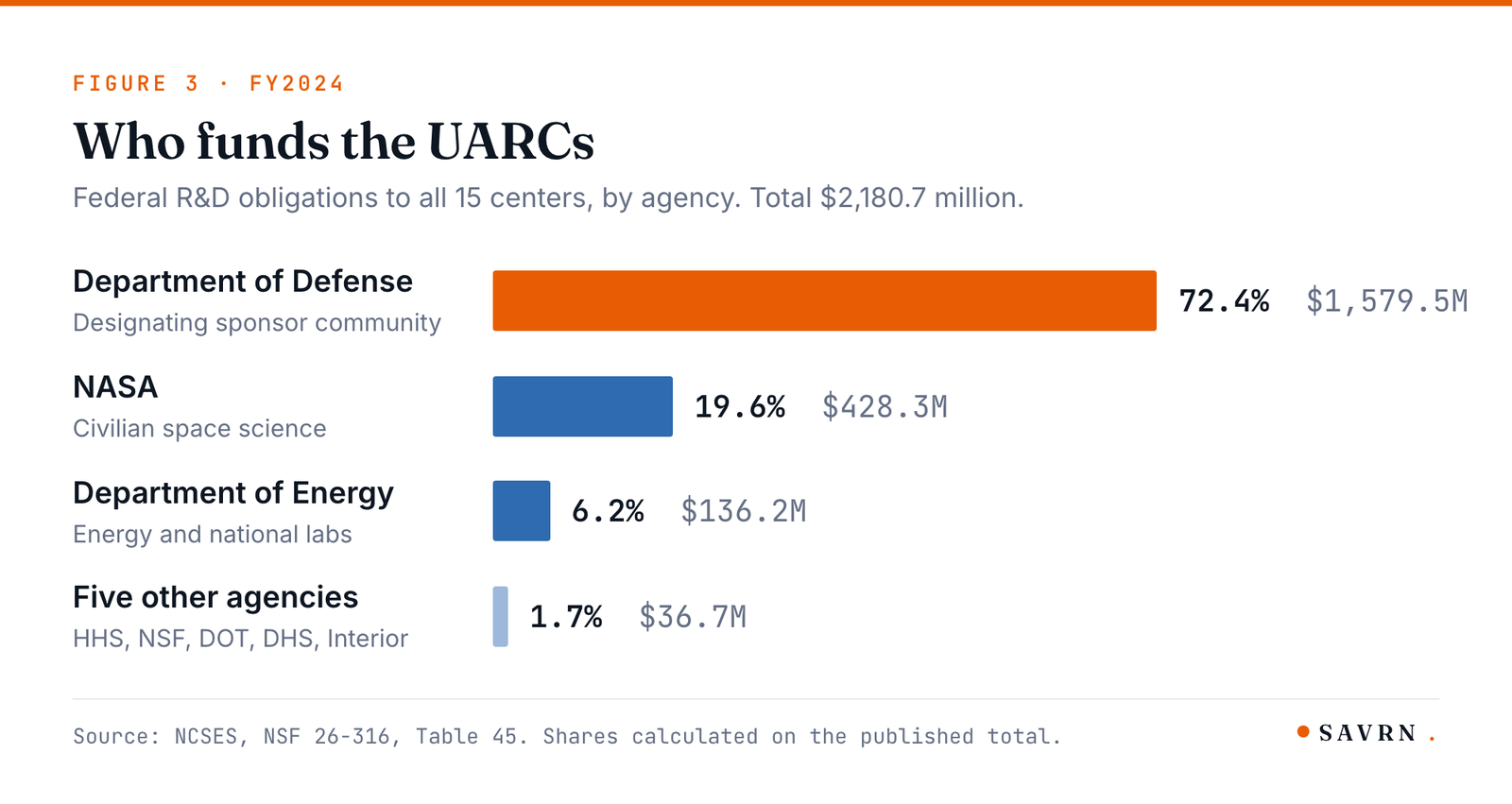
Table 45 in the same report shows which agencies supplied the money. Specifically, the Department of Defense obligated $1,579.5 million, or 72.4%. Meanwhile, NASA obligated $428.3 million, or 19.6%. The Department of Energy obligated $136.2 million, or 6.2%4. Finally, Health and Human Services, NSF, Transportation, Homeland Security, and Interior together added about $36.7 million, or 1.7%4. In short, these centers are defense-designated, while a meaningful slice of their federal work comes from civilian science agencies.
This distribution therefore makes simple averages misleading. As a result, a mature laboratory’s scale should not become a new initiative’s base case. In addition, the research-type breakdown shows a portfolio heavy in engineering and development. However, it does not prove that every center has the same mix, or that every development activity reaches operational use.
The accounting boundary deserves equal care. For example, GTRI’s FY2024 annual report records $869.4 million in sponsored research awards and $918.8 million in revenue earned10. NCSES, meanwhile, reports $110.715 million for GTRI in its UARC obligation table4. In fact, those publications measure different things. Therefore their gap cannot be closed by assuming one of them is the full economic footprint.
A sound assessment separates five measures: potential contract ceilings, actual obligations, research expenditures, recognized revenue, and the university’s own residual contribution. They stay separate because none of them is interchangeable. Likewise, the published obligation total cannot be turned into a market estimate for GPU capacity, electricity, or infrastructure services. That would require workload and spending evidence the tables do not contain.
Five institutions, five different routes
Comparing institutions helps when it shows organizational choices. However, it helps much less when it becomes a ranking by award size. Accordingly, the paper picks cases for what they reveal about structure.

A new mission can organize a consortium
The federal announcement selecting Howard University described a center focused on tactical autonomy. Specifically, it announced $12 million a year for five years to support research, faculty, and students6. In addition, Howard’s Research Institute for Tactical Autonomy lists a consortium of participating institutions7. Together, these sources show a mission-defined initiative whose participation reaches beyond the host campus.
The lesson is that a consortium needs an intellectual and operational purpose. A shared name, a memorandum, or a facility does not explain what each school contributes. Instead, a useful network assigns responsibility for methods, experiments, data stewardship, student supervision, and technical integration. However, this case does not show that every consortium should become a UARC. Rather, it shows how a defined mission can organize complementary contributions.
Research participation can be distributed
Stevens’ Systems Engineering Research Center describes itself as a network of 25 universities8. It also identifies its 2008 founding as the first networked UARC8. In particular, its work covers systems engineering and related methods for national security problems.
Hosting a research organization and contributing to one are different roles. For example, a university can offer a specialized method, team, test environment, or discipline without copying the whole network. However, a distributed model still needs a working agreement. Who leads a task, and which institution holds the data? Who settles competing claims on shared resources, and what happens when an investigator leaves? Ultimately, these answers decide whether a network functions between announcements.
Independent judgment is a capability in its own right
The University of Maryland’s ARLIS describes work in AI, information engineering, acquisition security, and social systems9. Furthermore, it describes itself as an independent and objective government advisor that conducts classified and unclassified research9.
This example explains why an AI research center’s value cannot be described only by the hardware it can reach. For instance, a sponsor may need a reliable evaluation of competing methods, systems, or suppliers. In that case, the ability to deliver an unwelcome technical conclusion is part of the value. For a university working with an infrastructure provider, the arrangement should therefore preserve the ability to evaluate alternatives and disclose methodological limits. In particular, equipment access should never quietly become control over the research conclusion.
Mature scale remains a distinct case
Johns Hopkins APL is the largest entry in the NCSES UARC table4. Meanwhile, GTRI shows a broader applied research enterprise with its own institutional reporting10. Both show what sustained organizations can become, although neither establishes a predictable growth path for a newly formed center.
Instead, the useful comparison is the function a university is trying to build. For example, that might be maintaining an engineering workforce, retaining specialized knowledge, supporting complex experiments, or helping sponsors evaluate and transition technology. Scale becomes meaningful only after that function is clear.
Civilian research centers broaden the comparison
The same institutional problem appears outside defense. For example, NSF describes Engineering Research Centers as interdisciplinary, multi-institutional organizations15. They combine fundamental research, technology development, engineering workforce development, and university and industry relationships15. However, they operate under a different program framework from UARCs.
The Center for Cell Manufacturing Technologies is a useful example. NSF lists Georgia Tech, the University of Georgia, the University of Puerto Rico at Mayaguez, and the University of Wisconsin-Madison as its core partners15. Additionally, the center connects research experiences to participating campuses16. As a result, it shows a specific translational problem organizing a distributed university effort. However, it does not show that the center has solved every manufacturing or commercialization barrier.
Similarly, biomedical translation offers another comparison. The National Center for Advancing Translational Sciences describes its Clinical and Translational Science Awards program as a national network of medical research institutions17. That network supports moving discoveries toward improved care17. Although the public purpose differs from defense engineering, the organizational question is the same: how do institutions keep the resources and relationships that help successive projects move forward?
Because authority, eligibility, review, intellectual property, data protection, and sponsor expectations all vary between these programs, they are not interchangeable. Instead, the transferable element is the coordination of a sustained capability around a defined problem. Thus an institution working on energy resilience, agricultural sensing, biomedical manufacturing, or trusted AI should pick the arrangement that fits its work.
What the cases can and cannot prove
The cases were chosen to show variety. However, they do not prove that consortia outperform single-campus institutes. Similarly, they do not prove that UARC designation raises research productivity. Nor do they prove that a center pays a financial return to its university. Those claims would require comparable data and a study design that accounts for mission, history, selection, and scale.
Nevertheless, each case raises a useful planning question. For example, Howard shows how a sponsor-defined mission can organize a new consortium. SERC shows how tasks spread across institutions, while ARLIS makes independent advice visible. Likewise, GTRI makes the accounting boundary visible. Finally, the civilian centers show that sustained collaboration and workforce development can be built around other public purposes.
A framework other universities can use
The paper proposes five participation models. These are analytical categories rather than federal classifications. Similarly, they are not stages every school must climb through.
Table 2 A framework other universities can use
Practical first arrangement: Sponsored research group or institute
Evidence needed before expanding: Repeat demand, technical quality, and viable staffing
Practical first arrangement: Consortium, or approved collaboration with an existing center
Evidence needed before expanding: Clear task leadership, data arrangements, and resource allocation
Practical first arrangement: Expanded portfolio within appropriate authorities
Evidence needed before expanding: Maintained competencies, sound operations, and sponsor confidence
Practical first arrangement: University and industry institute, or a cooperative research model
Evidence needed before expanding: Added research value and benefits beyond a single supplier
Practical first arrangement: Government consideration of a new UARC
Evidence needed before expanding: Sponsor justification and the required federal process
These models leave room for very different schools. For example, one institution might add domain expertise to a larger effort while using outside computing. A second might run a testbed that several partners need. A third might focus on open science and education rather than accept the limits of sensitive programs.
Participation also reaches beyond the defense model. For instance, NSF’s Industry-University Cooperative Research Centers use a consortium and membership framework for cooperative research11. Because their governance and intellectual property terms are specific to that program, they should not be treated as UARC rules. Ultimately, the real decision is which arrangement fits the research purpose, the mission, and the resources. A new designation is only one possible outcome of that analysis.
Running the institute day to day
An institute becomes usable through its daily practices, because it has to connect scientific leadership, sponsored programs, technical operations, and the people who depend on the results. Otherwise it simply adds a layer of cost and slows the work down.
Start with a defined research portfolio
The portfolio should consist of specific questions and programs, each tied to an identified user. A general interest in AI, cybersecurity, or resilience is too broad to staff or evaluate. By contrast, a program that studies inference quality during a communications loss is specific. It names a testable condition, a class of tasks, and a reason an operational user should care.
For each program, the university should name the principal investigator, technical lead, intended sponsor or user, data owner, required infrastructure, deliverables, and the decision expected after the work. At the same time, administration should stay proportional to project size and sensitivity rather than uniform.
Portfolio review should also decide what the institute will stop doing. After all, continuing every project eats the capacity that promising new work needs. A program may deserve to close because its question was answered, a sponsor’s need changed, or someone else can now provide the capability. In each case, a credible institute records those decisions and keeps the knowledge successor teams will need.
Separate scientific leadership from service operations
Scientific leaders set the questions, methods, and standards of evidence. Technical operations, in contrast, maintain the environment where the work runs. Meanwhile, sponsored-programs staff handle agreements, reporting, and financial obligations. These roles interact, but one should not quietly absorb the others.
For example, a principal investigator should not have to become the sole administrator of a controlled computing environment. Likewise, an infrastructure operator should not decide whether a study’s conclusion is good enough to publish. Similarly, a commercial sponsor should not assume that paying for access lets it direct students’ academic decisions.
The institute therefore needs a small, named operating leadership group with authority to settle these conflicts. In many cases, though, existing university offices can do the work. As a result, creating a new legal entity or a large administrative team should require a specific reason.
Keep the staff who hold the knowledge
Faculty and students bring ideas, methods, and depth. However, research engineers, scientific programmers, lab managers, data stewards, and program managers often provide the continuity between those contributions. The staffing plan should name which roles are essential to the capability, instead of treating every non-faculty position as a temporary project cost.
Continuity also takes more than headcount. Therefore, the institute should keep documentation, reproducible environments, cross-training, and succession plans. In particular, a capability that depends on one person’s undocumented knowledge stays fragile even when the university owns expensive equipment.
Because standing positions are a financial commitment, the university should know how those roles are paid for when awards start late or end early. A mix of projects can smooth demand, although it can also create competing deadlines. The operating review should therefore count actual staff availability, not the same person as fully available to several programs at once.
Give consortium members a real role
A consortium agreement should cover work allocation, leadership opportunities, resource access, financial duties, and dispute resolution. In particular, the host’s administrative role should be kept separate from scientific authority over every project. In addition, participating campuses need a practical way to propose research and reach shared services.
Specifically, shared computing should use identifiable accounts and allocations. Each member should know what capacity exists, which workloads qualify, who provides support, and how charges or credits are recorded. Finally, the network should survive a member leaving. For instance, agreements should address unfinished work, data stewardship, student supervision, and continued access to necessary records.
Governance decides whether a partnership deserves trust
An outside observer will reasonably ask whether a university and industry partnership protects the university’s capacity for independent inquiry. Answering that takes concrete decision rights instead of reassurance.
Specifically, the federal review guide examines continuing need, independence, technical performance, and management3. Those are useful planning categories for any institute, although an ordinary institute is not subject to UARC review. Building on them, the paper therefore proposes this starting allocation.
Table 3 Governance decides whether a partnership deserves trust
Evidence it is working: Written protocols, review records, and documented limitations
Evidence it is working: Defined scope, acceptance criteria, and change control
Evidence it is working: Service records, incident reporting, and audit access
Evidence it is working: Disclosures, recusals, alternatives assessment, and award rationale
Evidence it is working: Clear review periods, protection requirements, and rights allocation
Evidence it is working: Access approvals, boundary documentation, and revocation records
Evidence it is working: Eligibility rules, supervision, thesis arrangements, and grievance routes
Financial ties deserve explicit treatment. For instance, a company might provide facilities, fund projects, take part in experiments, and hope to sell the resulting technology. Each role can be legitimate. Combined, however, they can create conflicts. As a result, a university should be able to explain how its evaluations stay credible when a partner has a financial interest in the result.
The same principle applies to sponsors. However, protecting independence does not erase legitimate mission requirements, proprietary protections, or security restrictions. Instead, it requires those limits to be visible in the operating arrangement before a disagreement, not discovered after one.

Independence needs a procedure when interests conflict
Consider a hypothetical institute comparing several inference architectures. In this case, a commercial partner provides part of the computing environment and helps fund the research. Then one evaluation finds that a competing system performs better on a specified workload. At that point, the institute’s credibility depends on whether it can keep that result and report it under the agreed terms.
For that reason, before testing begins, the parties should settle who approves the protocol, how systems are selected, which configuration changes are allowed, and who reviews the analysis. A supplier may, for example, correct factual errors about its own system. However, a right to suppress unfavorable findings would undermine the whole study. Instead, proprietary and security limits should run through defined review processes.
When a conflict arises, the university needs an escalation route outside the affected project and outside the commercial relationship. In addition, the record should show the interest, the decision, any recusal, and the mitigation. Sometimes disclosure plus independent review is enough. In other cases, the university should change the arrangement or decline the work, because a disclosure statement cannot make every conflict manageable.
The same discipline applies to purchasing, because supporting research, donating equipment, and winning a university contract are three distinct relationships. Accordingly, their terms should be visible to the right reviewers. An institute should be able to explain how a provider was chosen and which alternatives were considered, without implying that a research affiliation settles procurement in advance.
Openness and protection need explicit boundaries
A university may run open research next to work under contractual or security restrictions. The operating design should therefore state which activities belong in each environment and who can join them. It should also avoid forcing the most restrictive project’s conditions onto unrelated open work just because one institute runs both.
Georgia Tech’s Academic Research Security program explicitly aims to preserve an open academic environment while strengthening research security and integrity18. That framing helps because it treats both goals as real rather than assuming one cancels the other.
For any proposed program, the key questions cover publication rights, access conditions, international collaborators, data and materials handling, and effects on student theses. Because the answers depend on the actual work and agreements, universities should settle the academic implications before students and faculty commit serious effort. If a student cannot publish essential thesis findings, the institution needs a different academic arrangement or a different project. Likewise, if an open team needs only public or synthetic data, placing it in a restricted environment adds cost and shuts out collaborators without improving the science.
Public legitimacy has to be built in
People judge a research partnership by what they can inspect, rather than by what is announced. Announcing national importance while leaving academic rights, public costs, and student access undefined invites reasonable skepticism.
Each group has a different stake. First, trustees need to understand the university’s financial exposure if research demand falls. Second, faculty need to know how participation affects publication, appointments, and priorities. Third, students need to know which opportunities are open, which carry restrictions, and how those restrictions affect their education. Communities, meanwhile, need a credible account of local benefits and resource demands.
These interests can conflict. For example, a controlled program may produce important results while limiting disclosure. A dedicated facility may improve reliability for one mission while competing with other campus needs for capital and staff. Similarly, a consortium may promise broad access while concentrating real control at its host.
The paper’s answer is a public institutional charter, backed by protected agreements where needed. Specifically, the charter should explain the mission, governance, commercial interests, educational purpose, and reporting commitments. In addition, annual reports should separate what was achieved from what is still planned. Where findings cannot be disclosed, the university should explain the boundary and the oversight that still applies. This is a recommendation for credibility, rather than a claim that every university already works this way, or that transparency settles every disagreement about defense or industry sponsorship.
A charter should describe commitments people can check
A useful charter says what the institute studies, which university authority oversees it, what commercial relationships exist, and how results will be judged. It should also state the educational purpose in concrete terms: funded research appointments, supervised projects, practical training, and access to suitable facilities. Those commitments can be evaluated, whereas a vague promise of a future workforce pipeline cannot.
The charter should say which information can be reported publicly, since sensitive work may block project details. Even then, the institution can usually describe its governance, aggregate finances, educational activity, and oversight. Public reporting also needs a correction process, because a launch statement may no longer describe the funding, partners, or scope a year later. Therefore an accessible revision history and a named owner help readers see what is current. Finally, an announced collaboration, a funded project, an operating service, and a completed research outcome should each be reported as a different state.
Community benefit should be weighed against local burden
When an institute needs serious physical infrastructure, neighbors have interests beyond research output. For instance, land use, noise, traffic, water, electrical demand, local emissions, and public financial exposure can all matter, depending on the design. These therefore call for site-specific evidence and proper review.
Claims about energy independence or resilience need a defined boundary. For example, a computing facility with onsite generation may still depend on fuel delivery, maintenance, communications, or a grid connection. Similarly, equipment that can serve its own load does not automatically back up the rest of a campus. Any campus-support claim should tie to a documented electrical design, an operating agreement, and a permitted use.
An institution should also compare benefits with the burdens its actual project creates. For example, counting a research budget as local economic benefit, without checking where the money is spent, can overstate the effect. Likewise, promised jobs should separate construction work, permanent operations, and university research positions. Ultimately, those distinctions let the public judge a proposal on its own terms. We hold ourselves to the same test in our community value work.
AI infrastructure makes the operating choices visible
AI research pulls together several constraints that are easy to discuss one at a time: computing access, data rights, software environments, evaluation, specialist support, and continuity of operation.
Take an illustrative team testing AI assistance for a time-sensitive engineering workflow. Its useful output depends on more than inference that runs. The team also needs an agreed quality measure, an identifiable model version, authorized data, a reproducible configuration, and a record of human intervention. If the work must continue through a network outage, the experiment also needs a defined disruption scenario and a recovery measure.
Those needs can justify specialized infrastructure in some cases. On the other hand, they can also reveal that existing campus systems, a cloud environment, or a shared research resource is enough. NSF’s National Artificial Intelligence Research Resource is an important resource-access model that belongs in any alternatives analysis12. However, its availability and suitability must be checked for the particular workload.
Table 4 AI infrastructure makes the operating choices visible
Data location alone does not authorize anyone to process sensitive information. NIST SP 800-171 covers protection of controlled unclassified information in nonfederal systems14. Still, the contractual requirements and versions for an actual program must be established separately. Classified work, in contrast, needs its own arrangements entirely.
That is why a label like sovereign AI should be defined in terms a university can verify. For example, who may access the data? Who administers the environment? What dependencies exist? Which approvals apply? How can the university audit or change providers? The label alone answers none of these. We wrote more about that in our research on sovereign AI in a university data center.
Shared capacity needs rules for real demand
A university network can share computing or lab capacity efficiently only if members understand the allocation rules. A theoretical pool helps very little when every project expects priority at once. So the institute should define normal service levels, peak demand, reservation rights, and who can authorize exceptions.
Workloads should be measured by the characteristics that matter: compute time, memory, data movement, storage retention, scheduling flexibility, software dependencies, and support needs. For example, two projects requesting the same number of GPUs may have very different operating costs. Thus the allocation unit should reflect the service actually provided and stay understandable to investigators.
A practical model uses defined work orders and budgeted units of research work. The principle is simple: authorize a bounded unit of work, name the responsible program, record the resources used, and keep evidence of completion. In addition, a university must be able to inspect the accounting and contest an incorrect charge.
Test portability before you need it
A university may change providers because costs rise, a research requirement shifts, a sponsor adds a condition, or a service stops performing. Since any of these can happen, the agreement should say how data, configurations, models, and records can be exported or retained. In addition, ownership and access rights are separate from the technical ability to move a file.
A practical portability exercise picks a representative workload and repeats it in an alternate environment. Specifically, it records transfer time, conversion effort, software changes, performance differences, and any rights that block migration. A failed test is valuable, because it exposes dependencies before a long commitment is signed.
A hybrid setup may fit some programs: open development on shared resources, controlled testing inside an approved boundary, and dedicated capacity where predictable demand justifies it. However, moving between those environments still requires review of data, model artifacts, credentials, and logs. After all, a network connection is not evidence that every transfer is permitted.
Research on resilient AI needs experiments that can fail
AI assurance and resilient computing are promising research themes because they connect software behavior to the conditions systems actually face. However, whether a given university should pursue them depends on its expertise and its sponsors’ needs. The paper therefore offers the agenda below as a proposal, rather than a description of completed SAVRN or university experiments.
Table 5 Research on resilient AI needs experiments that can fail
Measures that make the result useful: Task quality, completion rate, latency, and synchronization errors
Measures that make the result useful: Unavailable time, lost work, restart time, and post-recovery quality
Measures that make the result useful: Unauthorized-access outcomes and completeness of audit evidence
Measures that make the result useful: Energy and full cost per accepted task, including supporting overhead
Measures that make the result useful: Version traceability, repeatability, approval evidence, and explained variance
An accepted task is a task that meets a predefined quality requirement. Reporting energy per accepted task therefore keeps a system from being rewarded for producing more low-quality output. However, the measure still needs explicit accounting boundaries for cooling, storage, networking, and other supporting systems. That idea runs through our own work on AI infrastructure for universities.
NIST’s AI Risk Management Framework 1.0 is a useful reference for organizing governance and evaluation13. However, using it is not a certification, and it does not prove a system is safe or suitable. Instead, the research contribution comes from well-designed comparisons, documented uncertainty, and findings others can check. Claims that one architecture is uniquely necessary should therefore follow that evidence rather than precede it.
Keep research money and capital commitments apart
A research award funds defined work under specific terms. In contrast, a facility, network, or computing commitment may create costs that outlast that work. A university therefore needs to understand both before calling a partnership financially sustainable.

The paper therefore proposes three connected budgets:
- Research programs: personnel, project equipment, data, travel, subcontracts, and other costs of defined assignments.
- Shared operations: technical support, security, research administration, maintenance, and capabilities used across projects.
- Capital and long-term commitments: buildings, utility systems, leased capacity, equipment replacement, financing, and exit obligations.
These are planning categories, although actual accounting and chargeability must follow the relevant agreements and institutional policies. Even so, the categories expose a problem that aggregate award announcements hide: a program can cover its project costs while leaving a shortfall in shared operations or capital.
Specifically, the assessment should ask what happens if the largest sponsor cuts back, equipment becomes obsolete early, an authorization takes longer, or the university needs to switch suppliers. In addition, it should ask whether purchased capacity can shrink as well as grow. Educational and scientific benefits belong in the decision even when they bring in no cash. However, they should be measured on their own rather than used as an undefined offset to a financing gap.
For an infrastructure provider, a university affiliation or a possible future award cannot substitute for an executed payment obligation. Similarly, for a university, an attractive financing arrangement cannot substitute for a research mission.
A worked example of an ordinary research institute
The paper builds a hypothetical university and industry institute to show how research growth can coexist with a financing gap. It is an ordinary institute, separate from UARC funding rules. All amounts are assumed nominal millions of dollars rather than market forecasts, allowable federal charges, or a SAVRN offer.
Program receipts rise from $8 million to $16 million over five years, while project delivery consumes 80% of receipts. In addition, standing operations cost $1.6 million a year, and a separate capacity and replacement commitment costs $1.2 million a year. Startup funding of $3 million is needed in Year 0. The example leaves out interest, tax, inflation, working capital, terminal value, and cross-subsidy.
Table 6 A worked example of an ordinary research institute
Across five operating years, $60 million of receipts cover $48 million of project delivery and $8 million of standing operations. Thus only $4 million goes toward the separate $6 million commitment. As a result, the $2 million shortfall plus $3 million of startup costs leaves $5 million unrecovered at Year 5. Finally, measured at year end, the cumulative funding need peaks at $5.4 million at the end of Years 3 and 4.
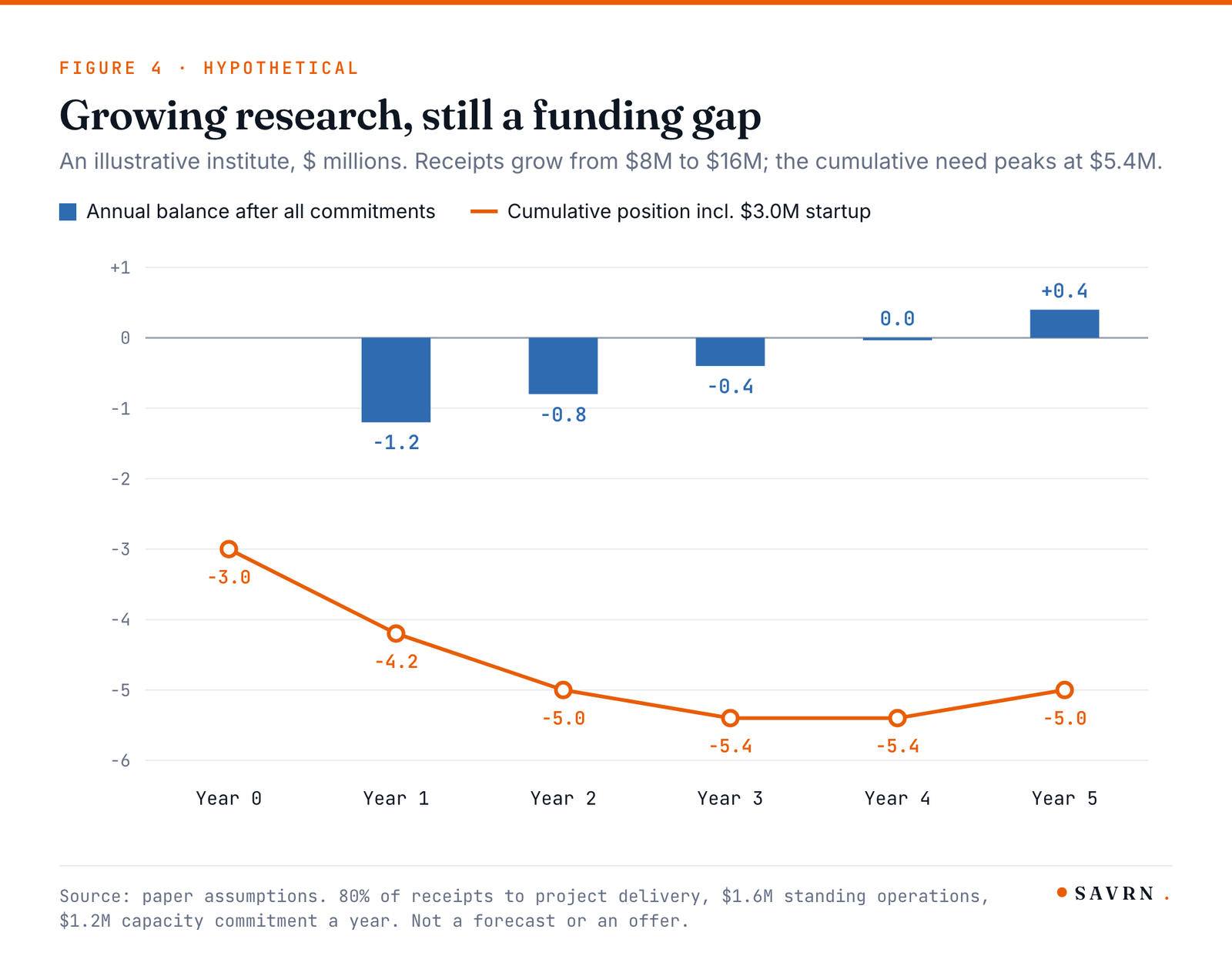
Therefore an announcement of $60 million in research activity would not settle the financial case. Instead, the initiative needs a permitted source for each use of funds and an explicit plan for the shortfall. Research benefit could justify university or philanthropic support, although that support should then be acknowledged and approved as such.
For example, at the assumed 20% contribution rate, annual receipts of $14 million cover the combined $2.8 million fixed requirement. However, that arithmetic is specific to these assumptions. Therefore it does not establish a typical break-even level, a federal fee entitlement, or a bankable revenue commitment.
Downside cases should change the decision
If Year 3 receipts come in 20% below the base case, they fall to $9.6 million. Even if project delivery costs drop immediately to $7.68 million, the annual balance is still negative $0.88 million, because the $1.6 million standing cost and the $1.2 million commitment do not change. In practice, real staffing and service costs may adjust more slowly, which makes that assumption optimistic.
In addition, timing can matter as much as annual totals. For instance, a delayed receipt can create a cash need while the annual forecast still looks balanced. The institution should therefore model the payment schedule, procurement timing, and working capital for its actual agreements. An award ceiling or a hoped-for renewal is not cash on hand.
Similarly, an infrastructure arrangement should separate electricity and other variable usage, reserved capacity, service operations, and replacement obligations. In particular, the institution should know which amounts shrink when demand falls and which remain payable. Therefore the allocation of downside risk should be visible before financing terms make it hard to change.
From research result to sustained use
A result can be scientifically valuable without becoming an operational product. Universities should protect that distinction while still giving applied programs a credible path to use. Ultimately, whether a prototype moves forward depends on whether an accountable user can adopt it, maintain it, and meet the relevant requirements.
For an applied program, the institute should therefore identify its transition partner early. For example, that partner could be a government program office, a health system, an industrial firm, another research organization, or a campus service. However, interest from a technical participant is not the same as authority and resources to deploy.
The transition plan should name the evidence the next user needs, for instance validation against a baseline, documentation, security review, data rights, software maintenance, interoperability, or an acquisition arrangement. A successful demonstration, however, covers only some of these. So the university should record which conditions remain open rather than treat a demonstration as proof of adoption.
In addition, intellectual property terms should support both the research and the transition. First, the parties need to separate preexisting tools and data from newly created results. Second, they need to identify the rights researchers, sponsors, operators, and future users require. Otherwise, assuming everything becomes freely available, or that one commercial partner controls it all, can derail a collaboration after useful work is done.
Maintenance is part of transition too, because a model, dataset, or software tool can become unreliable as inputs, dependencies, or user behavior change. As a result, the accepting organization needs an owner and a budget for continued operation. If nobody accepts that duty, the accurate outcome is a research result with an unresolved deployment path.
Finally, universities should report transition states precisely. For instance, a result can be published, reproduced, demonstrated, evaluated by a user, accepted for a pilot, or adopted for ongoing use. Each state takes different evidence. Similarly, a commercial license is distinct from demonstrated use. An evaluation system that respects those differences therefore produces a more credible account of what an institution contributed.
Build evidence before expanding commitments
A university can apply this framework through a series of decision gates. The sequence is a planning tool rather than a federal establishment procedure or a promised timetable.

First, define the mission by identifying the scientific or operational problem, the intended users, and the capabilities that already exist. Proceed when there is a credible reason for the proposed contribution.
Second, set the institutional terms by establishing leadership, academic oversight, conflict controls, data responsibilities, and a realistic cost model. Proceed when the parties can explain who decides and who carries the downside.
Third, run a bounded program by funding a limited research effort with defined deliverables and suitable infrastructure. Proceed when the work produces evidence people can interpret and reveals operating demands the team can manage.
Fourth, test continuity by checking whether repeat demand, staff retention, student participation, and recurring operations can be sustained. Expand capacity only when those needs are supported, rather than in advance of them.
Fifth, select the durable arrangement by comparing continued sponsored research, a cooperative institute, consortium participation, collaboration with an existing UARC, and government consideration of a new designation where it is justified.
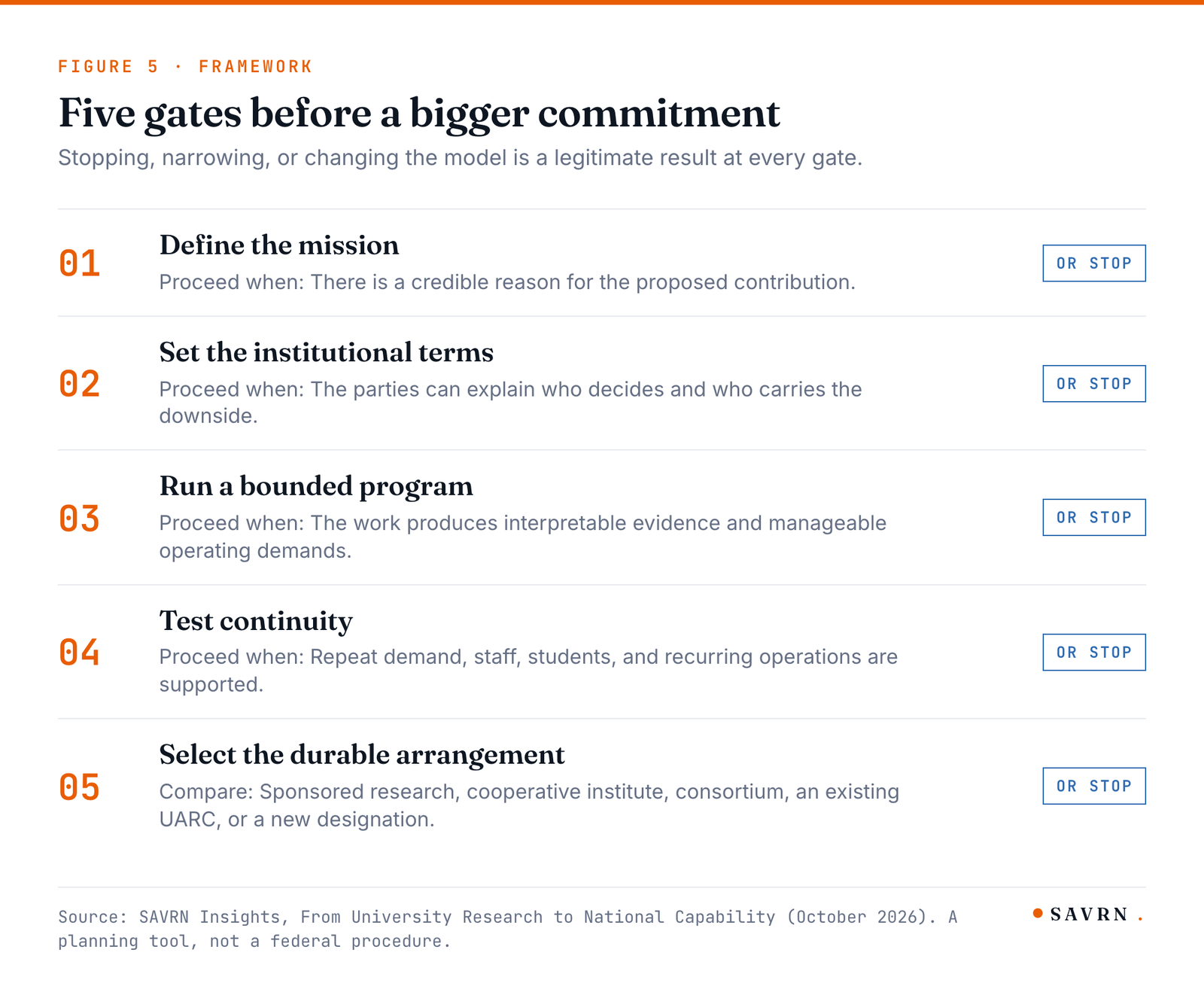
At every gate, stopping, narrowing, or changing the model is a legitimate result. In fact, a technically successful pilot can still show that the proposed commercial or institutional structure does not fit.
An illustrative first two years
An institution can organize early work around milestones instead of a promised designation date. The following is only a planning example, because awards, security requirements, hiring, approvals, and construction may change the timing a great deal.
During the first three months, the university defines the mission, inventories existing capabilities, identifies interested research users, and compares organizational options. The product is a short evidence-based concept and a decision on whether more institutional work is warranted. However, meetings and letters of interest should be recorded as exploratory evidence, nothing more.
During months four through six, the university settles operating responsibilities, conflict procedures, academic terms, data boundaries, and a funded pilot scope. In addition, the financial model should identify startup support and the obligations that survive the pilot. If the parties cannot agree on publication, control, or downside responsibility, that disagreement is a reason to revise the model before buying capacity.
During months seven through twelve, a bounded program tests research methods and operating practices on suitable existing or contracted resources. Its review should examine scientific results, actual support demand, costs, data handling, and participant experience. Ultimately, the goal is to learn the conditions under which the capability is useful.
During the second year, expansion should depend on repeat demand and evidence that the operating organization can support it. Accordingly, a university may add programs, join an existing network, change providers, or keep the pilot at a modest scale. By contrast, pursuing a formal federal designation remains a separate, government-led matter with its own requirements.
Stop conditions protect the mission
Some conditions justify pausing or ending expansion. In particular, they include unresolved conflicts that compromise evaluation, no funded user, unacceptable academic restrictions, an inability to protect required data, or a recurring deficit without approved support. In addition, a pilot may show that existing shared resources meet the need at lower total cost.
Those outcomes are useful findings rather than failures. The university can preserve research results, complete student obligations, and close or redirect the program responsibly. Defining closure arrangements at the start is far easier than negotiating them after a partner has already left.
Judge the institute by outcomes people can inspect
A balanced assessment separates scientific quality, educational benefit, operational usefulness, and financial sustainability rather than blending them into one score. For example, good measures include reproducible results, independent technical review, funded student appointments, completed research projects, repeat sponsor use, adoption by an accountable operational user, full operating cost, and the share of recurring costs covered by committed funding.
The denominator matters because a raw count of publications, partnerships, or GPU hours cannot establish success by itself. Therefore, report transitions relative to completed projects, student opportunities relative to eligible participants, and cost relative to accepted work.
In addition, each measure should name its purpose, denominator, source, reporting period, and accountable reviewer. For example, faster time to start a research workload should be measured from an agreed authorization point and compared with a prior or alternative arrangement. However, faster access is not an improvement if the resulting work fails its quality standard.
Table 7 Judge the institute by outcomes people can inspect
Necessary qualification: Compare like work and describe the limits of outside review
Necessary qualification: Report eligibility, duration, and access across campuses
Necessary qualification: Distinguish demonstration, pilot, and sustained operation
Necessary qualification: Hold quality and workload definitions constant
Necessary qualification: Include standing staff, security, and replacement obligations
Necessary qualification: Explain protected-information boundaries and revisions
Independent review should be proportionate: a small pilot may need technical reviewers and university oversight, while a major enterprise may justify a formal periodic assessment. In either case, reviewers should be able to examine unfavorable results and recommend changes to scope, leadership, or resource allocation.
Four objections worth taking seriously
Four objections deserve attention because the case for durable research institutions is strongest when it survives alternatives that might serve a university better.
A new institute may add administration without improving research
This objection is fair when existing departments, research offices, and technical services can already do the job. The response should therefore name a coordination problem current arrangements cannot solve efficiently. If the institute cannot show that difference, the university should fund the work through existing structures instead. A lighter option may also be enough, for example common project administration, a shared appointment, an interdepartmental program, or membership in an existing network.
Dedicated infrastructure may create avoidable fixed costs
This concern is real because demand is uncertain. Shared national resources, campus systems, or cloud services may fit the workload instead, without a long commitment. Therefore the framework treats dedicated capacity as a conclusion that workload and cost evidence must support. Specifically, the comparison should include queues, staff support, data requirements, replacement, migration, and the cost of idle capacity. A provider’s preferred architecture is one candidate in that analysis, and the university should keep the ability to choose differently.
Commercial participation may compromise independent research
A financial interest can shape topic selection, evaluation design, and interpretation even without an explicit instruction to change a result. Disclosure, independent review, procurement separation, and publication terms reduce some risks, although they do not eliminate every conflict. As a result, the university needs authority to decline work or change the relationship. Nevertheless, commercial partners can contribute equipment, operational expertise, and knowledge of practical limits. The real question is whether those contributions are governed in a way that protects the research.
National missions may displace academic priorities
A university can grow sponsored work while weakening open inquiry, broad participation, or graduate education. Thus growth in awards alone would not answer that concern. Instead, academic oversight must ask whether the initiative supports the university’s mission and whether restrictions stay proportionate to the work. The right result may be a smaller program, a clearer line between open and controlled work, or participation through a partner institution.
Where SAVRN stands as an infrastructure provider
Because I run an infrastructure company, I want to be plain about our position. SAVRN has a commercial interest in university research infrastructure and related services. The universities and federal programs named in this post and in the paper are there as public examples. Their mention does not imply an affiliation, endorsement, procurement intent, or award to SAVRN. Similarly, the paper does not claim that SAVRN or any partner is authorized to process a particular category of sensitive information. Finally, it is a research and strategy paper, and it has not been peer reviewed.
The paper’s conclusion matters to us precisely because of that interest. The institutional requirement for a provider is to support a university’s decisions with transparent service boundaries, evidence of performance, credible cost allocation, and workable exit arrangements. Commercial value can follow a well-run research relationship, although it should never decide a university’s technical findings. For example, if a university tests portability, measures energy per accepted task, and keeps the right to choose another provider, that is the relationship working the way it should. Our university partnership approach starts from the same place.
For university leaders, the central decisions concern mission fit, academic rights, operational accountability, and the source of support for continuing commitments. First, trustees should see the downside case. Faculty should understand the effect on research and publication, while students should see concrete opportunities and the conditions that come with them. Finally, sponsors should see a capability they can use and evaluate.
The recommended first step is a documented institutional assessment covering the mission, existing alternatives, governance, staff, workloads, and financial obligations. A bounded program can subsequently produce the evidence needed for the next decision. Ultimately, expansion becomes defensible once the university can show useful research, responsible operation, and support for every commitment it is making.
The 15 designated centers
The table below follows the official directory as reviewed on October 21, 20261. The funding figures, meanwhile, are historical FY2024 federal R&D obligations from NCSES Table 44, in millions of dollars4. The sponsor labels, however, are simplified from the directory. In addition, the table makes no prediction about pending initiatives or later changes.
Table 8 The 15 designated centers
The all-center total is $2,180.702 million before presentation rounding4. By contrast, the 15 center amounts sum to $2,180.701 million, one thousand dollars below the published total, which is consistent with the source’s rounding note4. The median of the 15 is $58.297 million. However, neither the mean nor the median is a recommended budget for a new center.
How this was researched
The paper uses a structured review of public federal policy, descriptive NCSES data, and institutions’ own descriptions. Specifically, the source set was chosen to establish governing distinctions, examine funding measures, and compare organizational mechanisms. It also includes civilian collaboration models so that no single institution or designation carries the argument.
Quantitative observations use FY2024 obligations rather than treating them as 2026 budgets. For instance, shares divide each published component by the published all-center total. In contrast, reports that use awards or earned revenue are treated as different measures, and the paper does not claim a full reconciliation.
Because case selection is purposive, the examples illustrate variety and cannot establish average performance, comparative effectiveness, or causality. Likewise, institutional self-descriptions establish stated structure and mission rather than independently validated outcomes. Moreover, the paper includes no interviews, confidential contracts, workload measurements, infrastructure cost survey, or institution-specific financial underwriting.
The participation models, governance allocation, experiments, implementation sequence, and evaluation measures are proposed analytical tools. The five-year financial example, in particular, is explicitly hypothetical. The main limitation is the lack of comparable operating and outcome data across the selected institutions. A follow-on empirical study could therefore test the framework using common definitions, several years of observations, and cases that closed, shrank, or chose different arrangements.
Chad Everett Harris is the founder of SAVRN. Figures checked October 21, 2026. Based on the SAVRN Insights paper From University Research to National Capability.
Frequently asked questions
What is a University Affiliated Research Center?
A University Affiliated Research Center, or UARC, is a formal defense research designation for a university-linked organization that maintains essential technical competencies for a federal mission1. Receiving defense research money does not make an institution a UARC, because designation follows a government-led requirements and selection process.
How many UARCs are there, and how much federal money do they receive?
How much of UARC funding goes to the largest center?
Johns Hopkins APL received $1,294.0 million in FY2024, or 59.3% of the total4. By contrast, the median center received $58.297 million. Because of that concentration, a large laboratory’s budget is a poor starting estimate for a new center.
What does the 2026 UARC Management Plan require for a new center?
The plan sets a $10 million annual funding threshold for newly established centers2. In addition, it requires a sponsor’s case covering mission need, funding commitment, independent capability, and alternatives, and it provides for periodic review2. However, it does not promise university profit or fund a new building.
Does a UARC get noncompetitive contracts for everything?
No. FAR 6.302-3 permits other-than-competitive procedures to establish or maintain essential research and development capability in specified circumstances5. It does not, however, make every purchase tied to a university or its commercial partners eligible for a noncompetitive award.
Can a university build national research capability without becoming a UARC?
Yes. The paper describes five participation models: a sponsored research group, a consortium, an expanded applied research portfolio, a university and industry institute, and a new UARC. They are options, not stages. Similarly, civilian models such as NSF Engineering Research Centers, NSF IUCRCs, and NCATS CTSA networks show other ways to sustain capability15, 11, 17.
How should a university protect research independence when a company provides infrastructure?
Assign decision rights before work starts. Specifically, university investigators own methods and conclusions, the operator runs infrastructure under university requirements, and procurement with affiliated suppliers gets independent conflict review. A supplier may correct factual errors about its own system, although it should never have a right to suppress unfavorable findings.
What does sovereign AI mean for a university?
Because the label alone answers nothing, a university should define it by verifiable facts: who may access the data, who administers the environment, what dependencies exist, which approvals apply, and how the university can audit or change providers. In particular, data location by itself does not authorize processing sensitive information14.
Why separate research budgets from capital commitments?
Because a program can cover its project costs while leaving a gap in shared operations or capital. For example, in the paper’s hypothetical institute, $60 million of receipts over five years still leaves $5 million unrecovered, with a peak cumulative funding need of $5.4 million.
What should a university do first?
First, conduct a documented institutional assessment of the mission, existing alternatives, governance, staff, workloads, and financial obligations. Second, run a bounded program to produce evidence for the next decision. Stopping, narrowing, or changing the model is a legitimate result at every gate.
Sources
- Office of the Under Secretary of Defense for Research and Engineering; Federal FFRDC and UARC directory; center inventory and the distinction between designation and ordinary defense funding
- Office of the Under Secretary of Defense for Research and Engineering; University Affiliated Research Center Management Plan, March 2026, approved April 18, 2026; applicability at PDF page 5, industry work at page 7, establishment at pages 16 and 17
- Office of the Under Secretary of Defense for Research and Engineering; UARC Comprehensive Review Reference Guide, January 2024; review standards at PDF pages 9 to 12
- National Center for Science and Engineering Statistics; Federal Funds for Research and Development, Fiscal Years 2024 and 2025, NSF 26-316, May 4, 2026; Tables 44 to 46, PDF pages 124 to 128
- Acquisition.gov; Federal Acquisition Regulation 6.302-3; industrial mobilization, engineering, developmental, or research capability, or expert services
- US Department of Defense; US Air Force Selects Howard University for Science Research Partnership, January 23, 2023
- Howard University Research Institute for Tactical Autonomy; Consortium members
- Systems Engineering Research Center; About SERC; network size and 2008 founding as the first networked UARC
- University of Maryland Applied Research Laboratory for Intelligence and Security; About ARLIS
- Georgia Tech Research Institute; FY2024 Annual Report; financial statement at PDF page 2
- National Science Foundation IUCRC Program; Industry-University Cooperative Research Centers membership agreement
- National Science Foundation; National Artificial Intelligence Research Resource
- National Institute of Standards and Technology; Artificial Intelligence Risk Management Framework, AI RMF 1.0, January 2023, NIST AI 100-1
- National Institute of Standards and Technology Computer Security Resource Center; Protecting Controlled Unclassified Information in Nonfederal Systems and Organizations, SP 800-171 Revision 3, May 2024
- NSF Directorate for Engineering; Engineering Research Centers program, including the Center for Cell Manufacturing Technologies partner list
- Center for Cell Manufacturing Technologies; Research experiences
- National Center for Advancing Translational Sciences; Clinical and Translational Science Awards Program
- Georgia Tech Office of Research; Academic Research Security
Want the next one?
When a new piece publishes on SAVRN Insights, you get one email with what it covers and a link to read it. Choose the research that interests you.
Also send me
Receive a short introduction on days 3, 7 and 14, plus the updates you select. Unsubscribe in one click. Privacy
University Affiliated Research Centers: How Universities Build Lasting National Research Capability
Get new SAVRN Insights by email
A short introduction on days 3, 7 and 14, plus new SAVRN research articles. Unsubscribe at any time.
We use your address to send the introduction and updates described above. See our Privacy Policy.