Don't Bury the Carbon. Build With It.
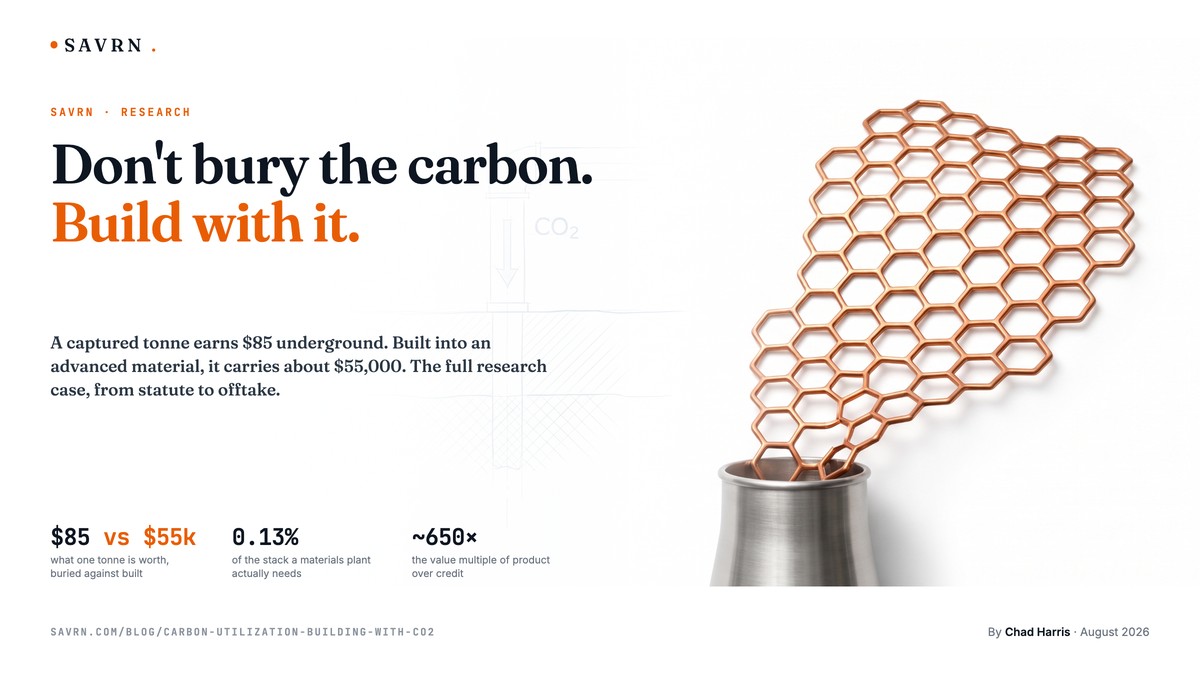
A captured tonne earns $85 underground. Built into an advanced material, it carries about $55,000. The full research case for carbon utilization, from statute to offtake.
There is a project on my desk right now that changed how I think about carbon capture, and I want to walk through it in full. The industry has settled on one answer for captured CO₂: compress it, pipe it, and push it underground. But carbon utilization asks a different question. Instead of paying to make carbon disappear, what happens when you build something out of it? We spent months researching that question against a real site, with real statutes and real offtake markets, and the answer surprised us. So this post lays out the whole case: the project, the arithmetic, the tax law, the conversion science, the markets, and what we are actually trying to achieve.
The three fates of a captured tonne
Start with the number that frames everything else. Under current federal law, a tonne of CO₂ that is captured and permanently sequestered earns a tax credit of $85 under Section 45Q. That is the ceiling on the burial economy. Every capture project in America is underwritten against some version of that number.
There is a second fate the industry treats as an afterthought, and it deserves a sentence before we dismiss it properly. You can truck captured CO₂ to merchant gas buyers, the people who carbonate beverages, chill food with dry ice, and feed greenhouses. That market pays $20 to 80 a tonne, it is regional and shallow, a plant of any size overwhelms it quickly, and most merchant CO₂ returns to the atmosphere within weeks. It is a fine ancillary revenue line. It is never a business.
Now run the third fate. A tonne of biogenic CO₂ contains about 273 kilograms of carbon. Converted into turbostratic graphene and sold into industrial markets at roughly $200 per kilogram, that same tonne supports somewhere near $55,000 of product revenue. In other words, the manufactured route carries roughly 650 times the value of the buried route.
That ratio is why I have stopped thinking of credits as the business. Credits are scaffolding. The building is the product. And importantly, this is not a hypothetical: the IPCC’s Sixth Assessment Report explicitly recognizes storage in manufactured products as durable carbon dioxide removal. Locking carbon into a road or a bridge deck is inside the climate accounting, not outside it.
The project on the table
Here is what we are working with, described plainly. Two decommissioned biomass power units, 18 and 21 megawatts, sit on 160 acres in a rural Western county, with an existing grid interconnect and a natural gas trunk line crossing the property. Nobody has restarted them, because a straight power sale does not clear the cost of biomass fuel at current tariffs. The units have been idle for years, and on a spreadsheet that only sells electrons, they should stay idle.
But the same site holds a position almost nobody prices: an American source of biogenic carbon at industrial scale, sitting next to permitted infrastructure that would take a decade to recreate from a greenfield. Run at an 85 percent capacity factor on wood fuel, a 39 megawatt biomass plant emits roughly 387,000 tonnes of biogenic CO₂ per year. For context, that sits squarely inside the range the Global CCS Institute treats as in-scope for bioenergy carbon capture studies. This is a small but legitimate capture host, and biomass flue gas runs about 12 percent CO₂ by volume, which makes it behave like coal for capture purposes rather than like natural gas. Higher concentration means cheaper separation.
So the reframing is this. The site is not a power project with a carbon problem. It is a carbon source with a power business attached. The highest use of that carbon is not a wire, and it is not a well. It is a material.
The number that reorganized the entire plan
When we sized the materials plant, one number rearranged everything we thought we knew. A 135 tonne per year turbostratic graphene plant consumes about 490 tonnes of CO₂ equivalent carbon annually. Against a 387,000 tonne stack, that is 0.13 percent of the stream.
Read that chart twice, because it cuts both ways. First, the good news: feedstock is essentially free forever, and the electricity to convert it is a rounding error. Flash conversion draws about 2 kilowatt hours per kilogram of product, which at full production is 0.09 percent of the plant’s annual generation. Second, the correction: a 490 tonne slipstream earns about $42,000 a year in Section 45Q utilization credits. Against $27 million of annual product revenue, the credit is 0.15 percent of the top line. The graphene business does not need the credit, and it cannot lean on it.
That correction matters because the casual version of this pitch, the one you see in decks across the industry, stacks the credit and the product as if they were additive pillars. They are not. The statute itself says so, and reading it carefully is where this project earns its footing.
What the statute actually pays for
We put every incentive through the plain text of the law, and I want to share what survived, because most of the “carbon credit stacking” narratives circulating right now do not.
First, Section 45Q. Under the 2025 reconciliation law, utilization and sequestration now pay the same $85 per tonne, which is a genuine improvement for product pathways. However, the statute requires capture equipment at a power facility to be sized to at least 75 percent of baseline emissions. You cannot claim it on a 0.13 percent slipstream. To earn Section 45Q here, you would build a full capture train handling roughly 290,000 tonnes a year, which at $85 is worth $25 to $30 million annually for twelve years. That is a real opportunity, but it is a second business with its own capital and its own storage requirement. It sits beside the materials plant, not underneath it.
Second, Section 48C, the Advanced Energy Project Credit, turns out to be the anchor incentive for the manufacturing side. Thirty percent of qualified investment on a roughly $196 million materials plant is about $59 million, one time, at the front of the capital stack where it does the most work. Critical materials processing and industrial emissions reduction are both qualifying limbs. That single allocation is worth about 1,400 years of the slipstream’s annual 45Q value.
Third, the manufacturing credit everyone assumes applies here does not. Section 45X requires graphite to be at least 99.9 percent graphitic carbon by mass, and turbostratic material is structurally different from that specification. It is also mutually exclusive with Section 48C. So we model 48C and carry 45X at zero.
Fourth, the power side has its own clean path. Technology-neutral clean electricity credits can be worth about $4.4 million a year to the restarted plant, but only if a verified lifecycle analysis shows zero or negative net emissions considering the fuel’s alternative fate. Here the region gives us an unusual advantage. The agricultural valley around the site permits hundreds of open field burns every year, and that smoke happens with no scrubber, no filter, and no useful work extracted. A plant that intercepts fuel already destined for open burning is not adding combustion to the world. It is moving existing combustion behind emissions controls, and that is precisely the counterfactual a lifecycle analysis wants to see.
Notice the shape of the corrected stack. Every dollar in it survives a statutory reading, and none of it is credit arbitrage. The product carries the business, one allocation de-risks the build, and the credits that remain are earned by separate, real activities. That is a stack you can defend in a diligence room, which is the only place a stack matters.
How carbon actually becomes a product
The conversion science is the part of this research I enjoyed most, because three genuinely different chemistries compete for the job, and they force a choice about what story you are telling.
The workhorse is flash Joule heating. In early 2020, researchers demonstrated in Nature that almost any solid carbon source can be converted to graphene in under a second with about 7.2 kilojoules per gram of electricity, at 80 to 90 percent yield and better than 99 percent carbon purity. Critically, the product is turbostratic: its layers are rotated relative to each other rather than neatly stacked, so they shear apart and disperse easily when mixed into concrete, asphalt, or polymers. That misalignment, which sounds like a defect, is exactly what makes the material usable in bulk composites. This is now commercial reality rather than a paper result. Universal Matter operates a 378 tonne per year flash graphene facility and has already put its product into a public road, a world first for the technology.
The second route runs through methane. A plasma torch splits CH₄ into hydrogen plus graphene before any combustion happens. It is elegant, and it is commercially moving: a Gulf gas producer signed in May 2026 to build a graphene park on this process, with a first phase disclosed at $2 to 5 million. But published energy figures for the route span 66 to 440 kilowatt hours per kilogram, which is at minimum 30 times the flash number, and any serious deployment should demand a guaranteed energy spec in the license.
The third route is the purest expression of carbon utilization: molten carbonate electrolysis converts captured CO₂ directly into carbon nanomaterials at around 750 degrees Celsius, with oxygen as the byproduct and energy input of 8 to 16 kilowatt hours per kilogram. The chemistry takes CO₂ as its sole reactant, which makes it the truest CO₂-to-material pathway of the three. It is earlier on the readiness curve, and its product leans toward nanotubes and fibers rather than platelets.
Our working configuration follows the energy table. Flash conversion is the volume producer, because its economics are an order of magnitude ahead. A molten carbonate line is the flagship, because it is the process where the marketing claim and the chemistry are the same sentence. And we describe each one accurately, because the difference between those two stories is exactly the kind of thing diligence teams are paid to find.
Where the product actually sells
A materials business is only as real as its offtake, so we start with the four markets where the first contracts land, each of which now has commercial deployments rather than lab claims. The full breadth of the material comes right after.
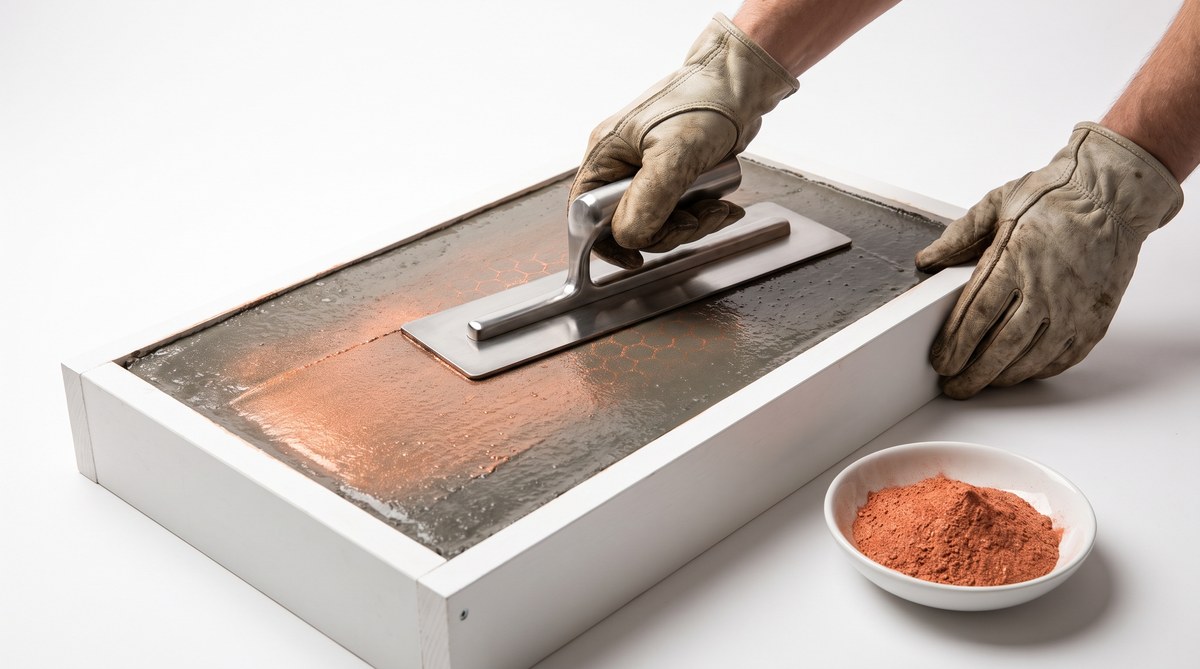
Concrete is the volume prize. The world places about 14 billion cubic meters of concrete every year, and cement production alone accounts for roughly 8 percent of global CO₂. Graphene loadings below 0.1 percent of cement weight measurably change the material: one commercial supplier documents 34 percent compressive strength gains in standard mortar testing, and a university-led pour demonstrated a ternary blend cutting concrete’s carbon footprint by up to 49 percent per cubic meter at a working utility site. The candid caveat: the leading graphene-concrete developer prices its system as cost-neutral against the cement it removes, with no green premium. Concrete buys tonnes, not margin, and a blended price model has to respect that.

Asphalt is the most credible near-term market. Graphene-modified bitumen has moved from test tracks to public infrastructure: a graphene additive is already down on high-traffic public roads and an international airport in Europe, and the first flash-graphene public road went in during February 2025. Roads are procured by specification, and a state resurfacing spec is the kind of reference contract that turns a plant into a company.

Coatings are the margin market. The graphene coatings segment is small but growing at roughly 29 percent a year, led by anti-corrosion primers, and it absorbs tens of tonnes at premium realizations. Rubber and elastomers round out the four: a major tire maker reports measurably better rolling performance, grip, and puncture resistance in its graphene compounds, and every road tire it sells now uses them.
One necessary calibration belongs here. The entire global graphene market was around $1 billion in 2024, projected toward $3.6 billion by 2030 on the aggressive end of analyst views. A $27 million plant is 2 to 4 percent of the whole current market, which means we would be a market maker in a small market, not a share taker in a large one. Volume has to be created, qualification cycles with specifiers run 12 to 36 months each, and the commercial team has to run several of those tracks in parallel. That is the actual work.
What graphene becomes: the full catalog
Four markets got the deep treatment above because they are where the first contracts land. But stopping there would miss the point of the material, because the plain answer to “what is graphene for” is that the list keeps going, and the breadth is itself the business case. One reactor feeds markets that have nothing to do with each other, which is what lets a plant survive any single market disappointing it. Here is why one substance covers so much ground, and then the rest of the map.
Every 100 kWh battery pack carries roughly a tonne of graphite, and nearly all of it is refined in one country. A CO₂-derived domestic graphitic carbon tuned to anode shape walks into a supply chain actively looking for exactly that.
At under two percent in electrode slurries, graphene cuts cell resistance. The richer prize is silicon anodes, which swell and crack on cycling; a graphene coating is what holds them together.
With 2,630 square meters of surface per gram, graphene electrodes store charge at the surface instead of in chemistry, charging in seconds and cycling millions of times. Grid smoothing and regenerative braking are the fit.
Atom-thin sheets shear past each other almost without resistance, so trace graphene in oils cuts friction and wear in bearings, gearboxes, and engines, with immediate measurable payback for operators.
The candid tiering: shipping today are thermal films inside flagship phones, printed conductive inks, and shielding. In the lab sit graphene interconnects, wafer-scale growth, and photonic modulators, with electron mobility far beyond silicon. Replacing silicon is a long horizon; sitting inside the package, moving heat and blocking interference, is now.
Graphene films and pastes spread heat several times faster than copper at a fraction of the weight, which is why phone makers laminate them over processors. The same physics serves GPU thermal interfaces and AI accelerator packaging. For us this closes a loop: carbon captured by power infrastructure can cool the compute it feeds.
Every atom of a graphene sheet is surface, so anything that touches it changes its conductivity. That yields the most sensitive practical strain, gas, and biosensor platform known, printable as ink on flexible substrates.
Conductive films, foils, and adhesives block electromagnetic interference for 5G and 6G equipment, radar, drones, and satellites, replacing heavier metal shielding. Defense and telecom spending is pulling this segment fast.
Spun into polymer yarn or coated onto fabric, graphene spreads body heat evenly, dissipates static, blocks UV, and suppresses bacteria without silver. Commercial apparel lines already ship graphene-treated jackets, activewear, and workwear. Add conductivity and the fabric becomes the sensor, the entry point for clothing that monitors heart rate or posture without wires.
Rackets, skis, bicycle frames, running-shoe plates, and golf shafts already use graphene for stiffness-to-weight the customer can feel. Small tonnage, strong margins, and consumer-visible branding that pulls the rest of the catalog along.
Graphene-reinforced polymer composites offer corrosion-free reinforcement and lighter sections for bridges, precast elements, and marine structures where steel rusts. The same mechanism strengthens wind turbine blades.
In carbon-fiber laminates and engineering plastics, graphene raises interlaminar strength, adds lightning-strike and interference protection, and sheds weight. Aerospace grades command the highest prices in the catalog and the longest qualification cycles.
Graphene oxide membranes pass water while rejecting salts and contaminants, promising desalination at lower pressure and energy. The same selectivity is being engineered to pick CO₂ out of mixed gas streams, a neat closing of the loop for a capture site.
Graphene biosensors detect disease markers at vanishing concentrations, graphene oxide carries drugs to targets, and antibacterial dressings exploit the same surface chemistry. Tiny volumes, the highest margins in the catalog, and a regulatory road measured in years.
Graphene-coated fertilizers release nutrients slowly and cut runoff, and carbon soil amendments improve water retention while locking carbon into the ground as a working input rather than buried waste.
Graphene-infused filaments, powders, and resins print parts that are stronger, conductive, or thermally active, letting small manufacturers buy the material one spool at a time.
This ladder is the commercial strategy in one picture. Specialty tiers pay for the plant, volume tiers absorb the tonnage, and the displacement tier is the endgame if the cost curve cooperates. No single application needs to absorb the stream, and no single market failure sinks the plant, because the same reactor can be steered toward graphene platelets, nanotubes, battery graphite, or carbon black substitute as demand develops. We built an interactive version of this catalog, with the sizing model and plant design behind it, at savrnplatform.com/p/co2-to-graphene.
The part that is not about money
The site sits in a county where unemployment runs above 17 percent, more than three times its state’s average. That single fact carries more weight with me than any line in the incentive stack.
A restarted plant plus a materials line supports a realistic 50 to 120 direct skilled positions across power operations, chemical processing, logistics, and commercial roles, with indirect fuel-supply and construction employment at several multiples of that. Just as important, the wage anchor is a choice. Federal wage data puts power plant operators in this state above $100,000 a year at the mean, and our position is that the project budgets to the state mean, not to the lower biomass-industry mean. A materials plant that pays real wages in a county that has been waiting decades for one is the strongest public-interest argument in the whole file, and it stands no matter which conversion chemistry wins.
There is also a public-health dimension that credits never capture. Every tonne of agricultural residue this plant consumes is a tonne that does not burn in an open field upwind of somebody’s house. The region’s air basin already carries a fine-particulate burden from permitted burning. Moving that combustion behind a stack with controls, and then pulling a product out of the exhaust, is the version of this story a community can actually see. This is the same principle we wrote about in how an AI factory can give a community more than it takes: infrastructure earns its welcome by what it leaves behind.
What we are trying to achieve
Let me state the outcome we are working toward, in build language rather than vision language.
Restart two idle biomass units to run baseload power behind the meter. Layer a turbostratic graphene plant on top, drawing its carbon from a small biogenic slipstream. Stand the materials business on product revenue and a one-time 30 percent manufacturing allocation. Stand the power business on clean-electricity credits gated by a defensible lifecycle analysis. Hold the full capture train, and its $25 to 30 million a year of sequestration credits, as an optional third business rather than baseline. Sell into asphalt first, concrete at scale, coatings for margin, and elastomers on repeat contracts. Hire locally, publish the wage commitment, and let the air-quality improvement speak in the community’s own terms.
And underneath all of it sits the thesis this post opened with. The carbon credit system, as built, pays $85 to make a tonne of carbon vanish. A manufacturing business can put that same tonne to work at several hundred times the value, permanently locked in materials the IPCC itself counts as durable removal, while employing people the burial economy never would. We own the infrastructure thesis behind this view too, and we have written about why owning the machine beats renting the output across every layer of our work.
Credits should be the scaffolding of a carbon project. The product should be the building. That is the whole argument, and this project is where we intend to prove it.
Frequently asked questions
Is graphene made from CO₂ chemically different from mined graphite products?
Yes, in a useful way. Turbostratic graphene has rotationally misaligned layers that separate and disperse easily in composites, while mined and milled graphite stacks in ordered layers that resist exfoliation. For bulk uses like concrete and asphalt, the misaligned form is the one you want.
How pure does the captured CO₂ need to be for conversion?
Less pure than you would guess. Biomass flue gas runs about 12 percent CO₂ by volume, and standard amine capture concentrates it to feed grade. The flash route sidesteps the question entirely by accepting solid carbon directly, while molten-salt electrolysis takes the concentrated stream as its sole reactant.
Does making products from CO₂ actually count as carbon removal?
When the product is durable, yes. The IPCC’s current framework explicitly lists storage in long-lived manufactured products as a removal pathway. Carbon bound into roads, buildings, and composites stays out of the atmosphere for the service life of the structure.
What happens to the 99.87 percent of the CO₂ the materials plant does not use?
In the base configuration it goes up the stack as biogenic emissions, the same as any biomass plant, with the lifecycle case resting on the fuel’s alternative fate. A full capture-and-sequestration train remains available as a separate future project if storage and economics line up.
Could the plant skip capture entirely and flash solid biomass into graphene?
Technically yes, and it is the cheapest feedstock route since flash conversion accepts solid carbon directly. We treat that as an engineering option rather than a secret, because a project should say plainly which feedstock its economics actually run on.
How long before a graphene plant like this reaches full sales?
Plan on three to five years. Each specifier qualification runs one to three years, and they only partially overlap. The power business and the manufacturing allocation are what carry the project through that ramp.
What is the biggest single risk in this plan?
Offtake pace. The global graphene market is still small, and a plant this size must grow the market rather than take share. Second is the manufacturing allocation, which is awarded competitively rather than claimed automatically.
Why has nobody restarted these biomass units already?
Because as pure power plays they lose money at current tariffs. The economics only invert when the site is treated as a carbon and infrastructure position with a materials business on top, which is a lens traditional power investors do not apply.
Do hydrogen or oxygen byproducts factor into the economics?
They can. The methane-plasma route yields substantial hydrogen, and molten carbonate electrolysis releases oxygen. We model byproducts conservatively as secondary revenue, never as load-bearing lines, because byproduct markets are local and price-volatile.
Where does this leave conventional carbon capture and storage?
Still necessary. Product markets can absorb only a fraction of global captured carbon, so geological storage remains the volume tool for the gigatonne problem. Our argument is narrower: when a tonne can be built into something valuable, burying it is the least productive thing you can do with it.
Want the next one?
When a new piece publishes on SAVRN Insights, you get one email with what it covers and a link to read it. Choose the research that interests you.
Also send me
Receive a short introduction on days 3, 7 and 14, plus the updates you select. Unsubscribe in one click. Privacy
Don't Bury the Carbon. Build With It.
Get new SAVRN Insights by email
A short introduction on days 3, 7 and 14, plus new SAVRN research articles. Unsubscribe at any time.
We use your address to send the introduction and updates described above. See our Privacy Policy.