The Data Center Industry Is Not One Business Model
Record demand and distressed debt showed up in the same week. Here is what the bond market priced, which part of the industry it applies to, and where I think the next problem sits.
The CoreWeave bond selloff was the loudest data center story of October 2026. However, it was not a story about the whole data center industry. On Wednesday, October 14, CoreWeave stock fell 15.5% after Bloomberg reported that its unsecured notes due 2032 were trading below 80 cents on the dollar8. The next day, CNBC reported that the yield on CoreWeave’s 9.75% bond due 2031 had reached 15.78%. Meanwhile, the price of five-year default insurance on the company jumped past 1,140 basis points at one point2.
Since then, a lot of people have asked me the same question. Is the AI data center boom breaking?
My answer is no. Instead, what broke that week was confidence in one way of financing one layer of the industry. That is a real problem for that layer. However, it is not a picture of the whole market. In the same quarter, North American data center vacancy sat at 1.4%. In fact, published GPU rental prices on the SAVRN Index were going up, not down.
Because both things are true, this post lays out the numbers so you can see them side by side. I also share where I think the next pressure point is, because I do not think it ends with CoreWeave.
Key figures
The data center industry is several businesses
People say “the data center industry” as if it is one thing. In practice, it is at least four businesses stacked on the same land and the same power. However, each one earns money a different way.
The developer controls land, secures power and builds the building. As a result, it gets paid for powered space, usually per kilowatt per month, on long leases.
The landlord or operator runs the facility. That means power distribution, cooling, security and connectivity, while the tenant brings its own servers.
The AI cloud operator buys or finances the GPUs, servers and network gear. It then sells computing time, either per GPU-hour or as a reserved cluster. This is where CoreWeave lives, since it owns the chips it rents out.
The model company takes that compute and sells AI as a service. For example, it often prices output per million tokens.
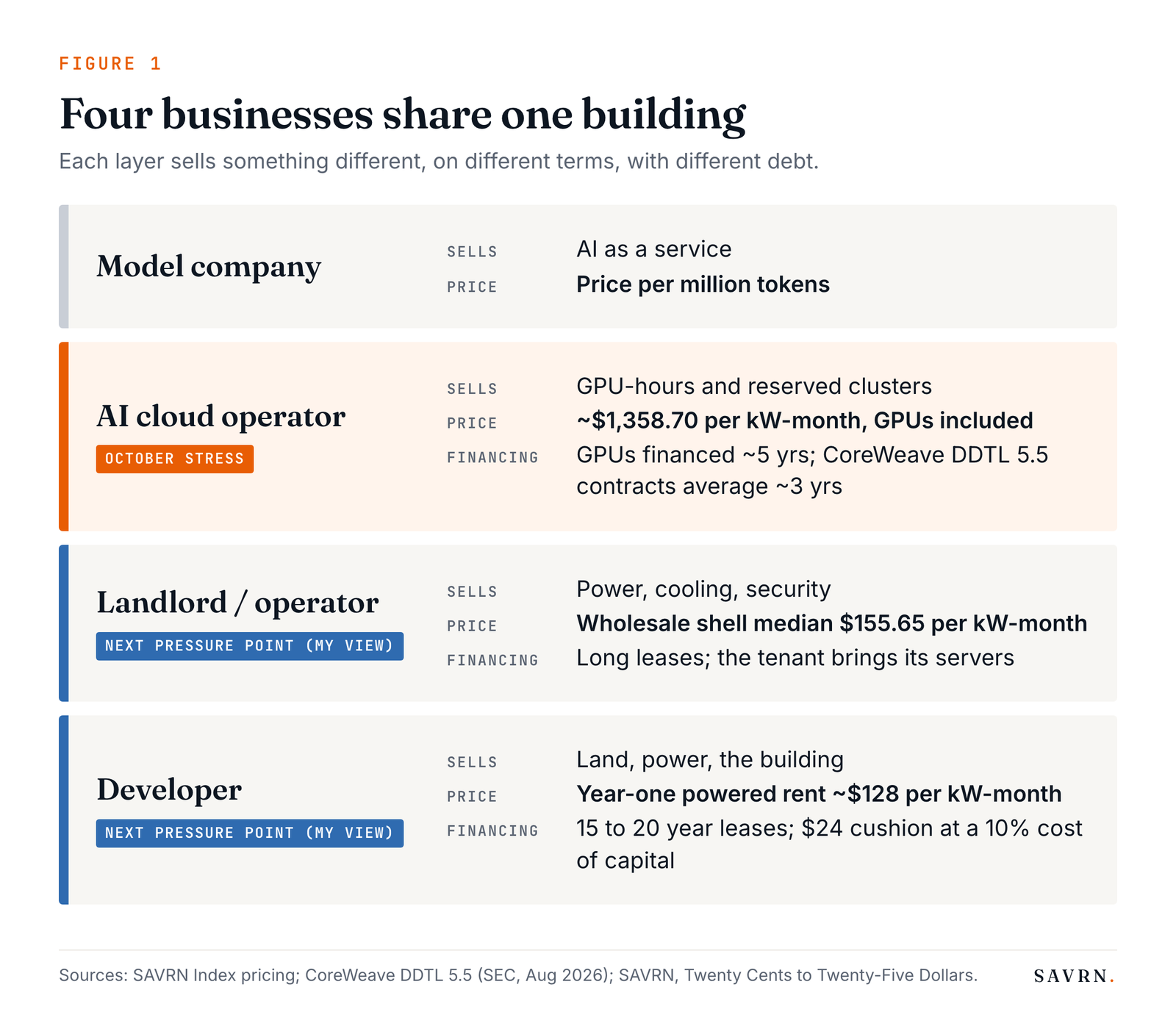
Each layer carries a different risk. For instance, a building can be financed over 15 or 20 years, while GPUs are financed over about five. In addition, the pricing gap between layers is large. SAVRN’s pricing research puts a developer’s first-year rent for powered space at $128 per critical kilowatt-month, based on 47 disclosed contracts. By contrast, an AI cloud operator charges about $1,358.70 for that same kilowatt with the accelerators included. That is 10.6 times the building figure.
That gap is not profit, however. The cloud operator has to pay for the GPUs, the network, the power, the depreciation and the debt. In other words, it is the layer with the most expensive equipment and the shortest equipment life. In CoreWeave’s case, it is also the layer with the most borrowing, because the company finances most of its chips with debt. That is where the stress showed up first.
Where CoreWeave sits, in its own numbers
CoreWeave’s second-quarter 2026 results show a company with real demand1.
Look at the interest line first. Adjusted EBITDA was $1.51 billion, while net interest was $640 million. So more than 40 cents of every adjusted EBITDA dollar went to lenders before depreciation was even counted.
Second, look at the cash. For the first six months of 2026, CoreWeave generated $3.663 billion from operations. Meanwhile, it spent $14.117 billion on property and equipment. That leaves a gap of about $10.45 billion. In fact, net cash from financing over the same six months was $13.985 billion4. Although this is a simple measure and not the company’s full financing need, it still tells you the main fact. As a result, this business grows only as fast as lenders and investors will fund it.
That is normal for a capital-heavy business in a build phase. For example, airlines, telecom networks and utilities all went through it. The difference, however, is that GPUs lose their edge faster than airplanes or copper wire.
Why a $104 billion backlog did not calm the bond market
Backlog is contracted future revenue. However, it is not cash in the bank. Before CoreWeave collects most of it, someone has to deliver power, finish the building, install cooling, receive the servers and commission the cluster. As a result, the bills for that work arrive years before the revenue does.
There is a second timing issue. In August 2026, CoreWeave closed a $2.6 billion delayed-draw loan called DDTL 5.5. The company said the loan has an approximate five-year maturity, while the customer contracts behind it average about three years3. By contrast, earlier facilities were backed by contracts that ran as long as the debt. CoreWeave said it chose this structure because shorter contracts often carry higher prices and margins.
That may be true. Still, it means that for about two years, the lender is relying on the GPUs finding new customers at prices nobody can see yet. So the real test is not whether a contract exists. Instead, it is whether contracted cash, plus re-leasing income, plus whatever the equipment is worth, covers the debt.
The depreciation argument, and what the price data says
CoreWeave depreciates its GPUs over six years. Investor Michael Burry argued last November that the big cloud companies understate depreciation by $176 billion between 2026 and 2028. His point is that five- and six-year GPU lives do not match a chip cadence that now brings a new NVIDIA architecture about every year9.
So far, however, the public evidence cuts against the short-life view. On its second-quarter earnings call in August, CoreWeave said it had signed a customer contract for NVIDIA A100 capacity running into 2029. The A100 launched in 2020. In addition, CEO Mike Intrator had earlier told CNBC that a batch of H100s coming off an expired contract was rebooked right away at 95% of the original price.
Similarly, our own data points the same way. The SAVRN GPU Price History tracks published list prices across providers. Here is where it stood on October 22, 2026:
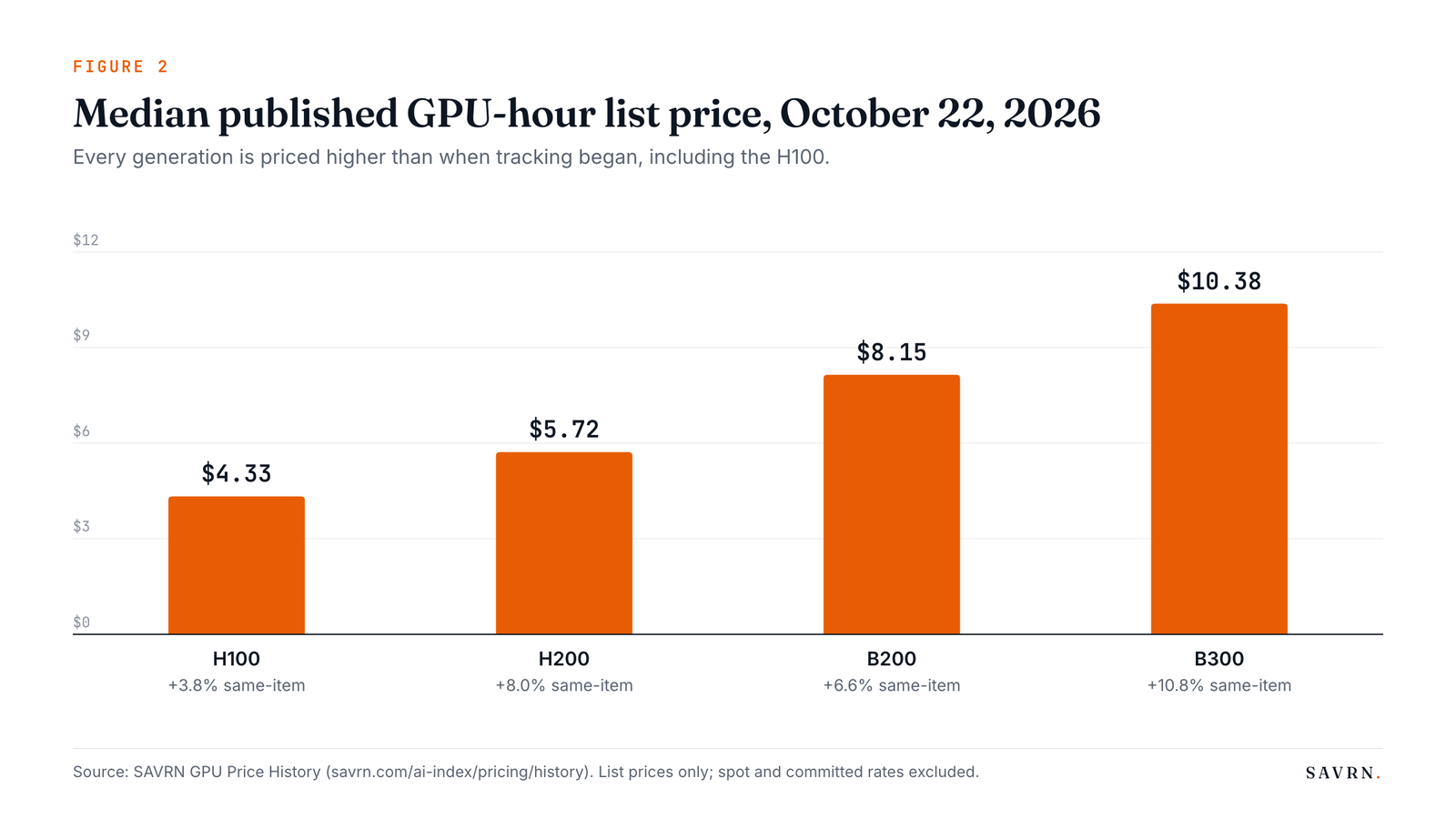
Every generation is up, including the old one. The newest chips do more work per hour. Even so, older chips still sell. Software runs on them, they are available, and they cost less. In addition, many existing buildings cannot cool the newest racks.
Keep in mind that these are list prices. For example, they leave out spot and committed rates. They also do not tell you how many hours each GPU is actually rented. Because a list price shows what sellers ask, not what any one operator collects, we track it alongside financing and delivery data instead of treating it as the answer.
Worked example: how much utilization matters
Here is why lenders care so much about those two unknowns. Take 1,000 H100s at the $4.33 median list price. Since a year has 8,760 hours, the math is simple.
Now hold utilization at 70%. If the realized price fell from $4.33 to $3.00, annual revenue would drop by about $8.16 million. Nothing in the building would change, since the servers would still run and the customers would still be there. However, the money available to pay the debt would be 31% lower.
This is my math, not CoreWeave’s. Because it uses a public list price and no costs, it is a simple model. Still, it shows one thing clearly. In the GPU cloud layer, small moves in price and occupancy decide whether the debt gets paid.
What the credit market was pricing
A credit default swap is insurance against a company missing its debt payments. Its price is quoted as a yearly spread in basis points. You can turn that spread into a rough default probability. However, you can only do it by assuming how much bondholders would recover.
Here is the arithmetic at CNBC’s October 15 level of about 1,038 basis points. If bondholders recover 40 cents, the implied five-year default probability is about 58%. If they recover 25 cents, it is about 50%. Commentary that week cited figures around 60%11. Those are prices set by traders, not forecasts. As a result, they move with the recovery assumption.
It also matters which debt you hold. A secured lender has a claim on specific GPUs, contracts or receivables, whereas an unsecured bondholder does not. If equipment values fall or contracts do not renew, the pledged assets pay the secured lenders first. As a result, the unsecured bonds fell hardest. Despite all of this, CoreWeave has not defaulted on anything.
The same segment, on another continent
CoreWeave was not alone that month. In fact, the other case was in the same layer. Firmus, an NVIDIA-backed AI data center operator in Australia, shelved a planned IPO of about $5 billion a few days before its October 23 listing date10. Specifically, reports said institutional buyers were worried about valuation, debt and unbuilt capacity. For example, investor documents cited by Bloomberg showed a 921 MW pipeline with 46 MW built.
The pattern is the same. Investors are not doubting that AI needs compute. Instead, they are asking hard questions about debt, and about the gap between announced capacity and capacity that is actually running. CoreWeave’s own gap is 1.5 GW active against about 3.7 GW contracted.
What the rest of the industry looked like that quarter
This is the part that rarely makes the headline. CBRE’s first-half 2026 report on North America found the following5:
- Primary-market vacancy of 1.4%, with Northern Virginia at 0.2%.
- A record 7,481.1 MW under construction, up 24.8%.
- 80.4% of that construction already preleased, up from 74.3% a year earlier.
- Net absorption of 1,456 MW, up nearly 12%.
That is a market short of space, not long on it.
Meanwhile, the largest buyers fund this from very different balance sheets. For instance, Meta reported $60.8 billion of revenue and $31.9 billion of operating cash flow in Q2 2026 alone. In addition, it guided full-year 2026 capital spending to $130 billion to $145 billion7. Because of that, Meta can overspend on AI and still pay its bills from advertising. By contrast, a GPU cloud operator that borrowed against three-year contracts does not have that cushion.
So the same quarter gave us record-low vacancy, rising GPU prices, record preleasing and a distressed bond. All four are true, because they describe different layers.
My view: the landlord layer is underpriced
Here is where I part ways with most of the coverage. I do not think CoreWeave is the only layer at risk. Instead, I think the next pressure point is the developer that leases powered buildings to companies like CoreWeave. The reason is price.
Why the first movers priced low
The first movers in AI hosting were mostly bitcoin miners. Core Scientific, Hut 8, TeraWulf, Cipher, Applied Digital, CleanSpark and Riot already had land, substations and power contracts. As a result, they could deliver capacity faster than anyone else. In addition, their tenants are often the same GPU cloud operators now under pressure. For example, Core Scientific’s June 2026 10-Q says its hosting revenue is concentrated with a single customer, and CoreWeave has about 590 MW leased across its sites13. To win those first long leases, this group priced low.
What the rent has to cover
SAVRN’s research on 47 disclosed contracts puts the typical first-year rent for powered space at $128 per critical kilowatt-month (SAVRN, Twenty Cents to Twenty-Five Dollars). Specifically, the same research uses a build cost of $9,500 per kilowatt. Recovering that cost over a 15-year lease at a 10% cost of capital takes $104.08 per kilowatt-month. Since most of these leases are triple-net, the tenant pays taxes, insurance and maintenance. That leaves the developer about $24 of cushion per kilowatt-month.
Twenty-four dollars is thin. Because of that, the real question is what happens when the cost of capital moves. These are my calculations on the same $9,500 build cost and 15-year term:
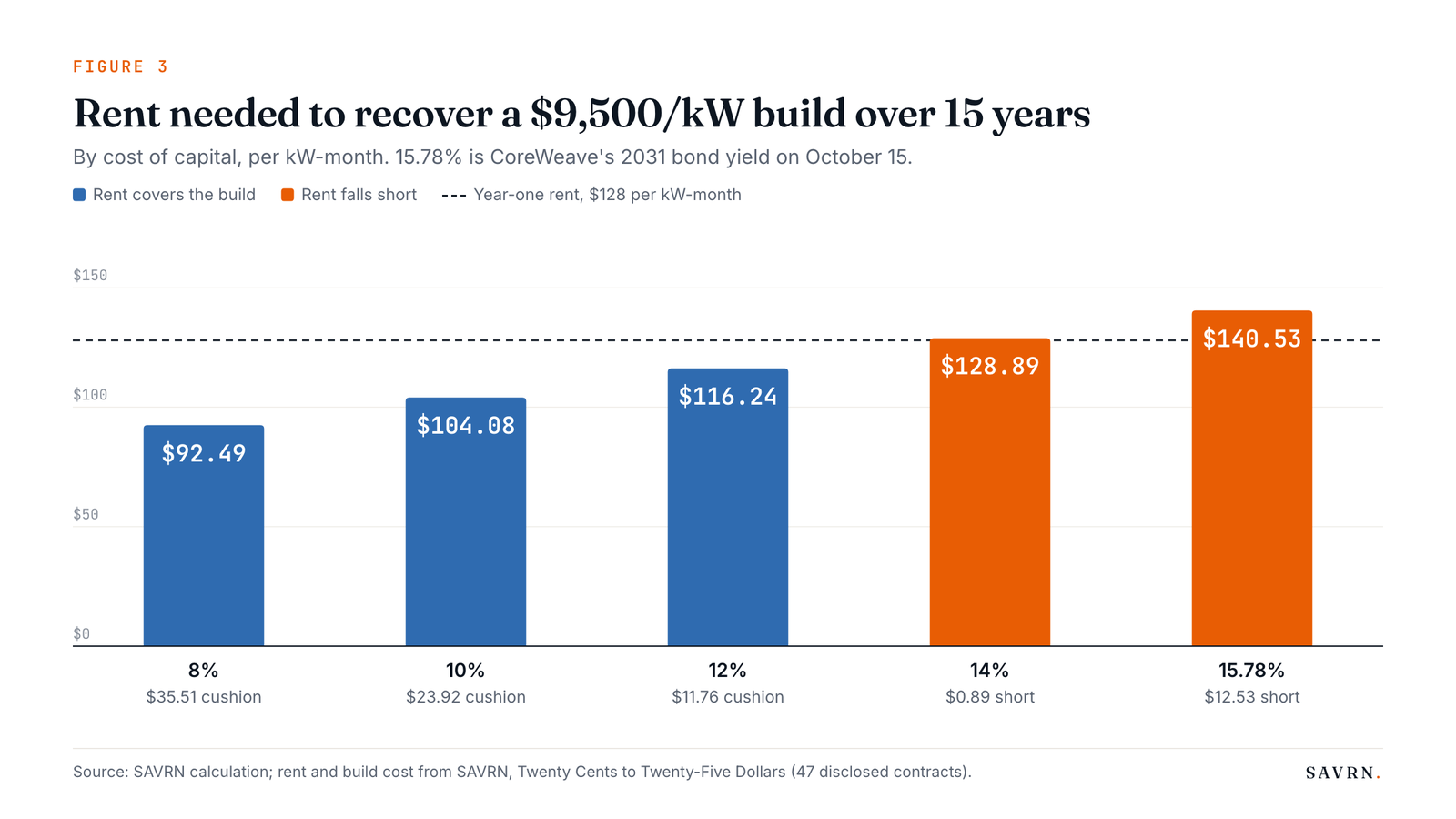
At 14%, year-one rent no longer covers the building. On top of that, a lender that wants 1.25 times coverage at a 12% cost of capital would need about $145 per kilowatt-month. Build costs are also moving up as racks move to liquid cooling. For instance, if a build costs $11,000 per kilowatt instead of $9,500, the recovery rent at 12% is $134.59 before any coverage at all.
Escalators help, although only over time. Most of these leases rise about 2.5% to 3% a year, so the squeeze is worst in the early years. However, that is also when the construction debt is largest.
Why October makes it worse
Now connect it to October. First, a developer’s rent is only as good as its tenant. Second, when the tenant is a GPU cloud operator whose own bonds yield almost 16%, the developer’s lenders price that risk into the developer’s debt. Consequently, the developer’s cost of capital rises toward its tenant’s, while its rent stays fixed for 15 years. That is the squeeze.
Other parts of the market already price higher. For example, the landlord median across 20 wholesale shell leases on the SAVRN Index is $155.65 per kilowatt-month (SAVRN wholesale pricing). Similarly, Cerebras pays $195.00 per kilowatt-month at Digi Power X in Alabama, with power included and a 3% annual escalator14. With vacancy at 1.4% and 80% of new construction preleased, the market can bear higher rents.
My view is simple. If first-year powered rent does not move up from the $128 range, some of the bitcoin-to-AI developers will struggle to service their debt. That is the debt they took on to build for AI tenants. I am not making a call on any single company. That is because each one has different leases, different debt and different tenants. In some deals, the tenant pays for part of the build, which changes the math. Rather, I am saying the pricing model, as a group, leaves too little room for a world where money costs 12% to 16% instead of 8% to 10%. The fix is not less building. Instead, the fix is pricing the landlord layer for the risk it carries.
What to check before you read a headline as a trend
When the next AI infrastructure company makes the news, these are the questions I would ask first:
- Which layer is it? Developer, landlord, GPU cloud or model company.
- What backs the debt? Long leases, short compute contracts, or the parent company’s other businesses.
- Do the contracts outlast the loans? If not, someone is betting on re-leasing.
- Does the rent cover the building at today’s cost of money? Check year-one rent against capital recovery at 12% to 16%, not 8%.
- How much capacity is running today? Active versus contracted versus announced.
- Is power actually there? Check the utility and permit record, not the press release.
- What do GPU prices say? Rising list prices for older chips weaken the short-life argument, while falling ones strengthen it.
Where we see the problem
Put the pieces together and here is where I see the problem. Demand is not it, since space is short and GPU prices are rising. Instead, the problem sits in two places that depend on each other.
The first is the GPU cloud operator that borrowed against short contracts and now pays close to 16% for money. The second is the landlord that leases to it at rents set when money cost 8% to 10%. Both were financed on the assumption that capital would stay cheap. However, in October it did not.
Why we can see it
I would not say that with this much confidence if we had not been tracking the data. That is because no single filing shows it. You have to line up a 10-Q, a loan announcement, a bond price, a GPU price list and a lease rate. Because they come from different places and different dates, that is hard to do. That is why most coverage reports one company’s headline and stops there.
So we built tools that put those pieces side by side:
- GPU Price History shows what older and newer GPUs rent for, and how that changes over time.
- Pricing shows what each layer charges for the same kilowatt, from powered space to GPU-hours to tokens.
- Data Center Capital Atlas shows who lent to whom and on what terms, including a CoreWeave capital profile.
- Neocloud GPU providers and the scarcity tracker show who sells compute and how tight supply is.
- The permits tracker shows whether a project can actually be built.
While each tool answers one question, together they let you see in a few minutes what took us months to assemble: which layer is under stress, and why. They do not show a private company’s contract prices or utilization. They do show the public record in one place, with dates and sources.
The lesson I take from October is simple. Scarcity is not solvency. Backlog is not cash. An accounting life is not an earning life. Finally, announced power is not a running AI factory. Those four facts explain this headline, and they will explain the next one too.
Chad Harris is the founder of SAVRN. Figures checked October 22, 2026. This analysis is educational and is not investment advice.
Frequently asked questions
Did CoreWeave default on its debt?
No. As of October 22, 2026, CoreWeave had not defaulted. Its unsecured bonds traded at distressed prices and its credit default swap spreads hit records. That shows investor concern, not a missed payment.
Why did CoreWeave's bonds fall if demand is strong?
The worry is financing, not demand. CoreWeave spent about $14.12 billion on equipment in the first half of 2026 against $3.66 billion of operating cash. In addition, it paid $640 million of net interest in Q2. As a result, investors are asking how that debt gets refinanced and repaid.
Is the AI data center industry in a bubble?
In fact, the data does not show a glut. CBRE reported 1.4% primary-market vacancy and 80.4% preleasing of capacity under construction in the first half of 2026. Instead, stress is showing up in heavily indebted GPU cloud operators, not in overall demand for space.
What is a neocloud?
A neocloud is a specialized AI cloud company that owns or finances GPUs and rents computing time. For example, CoreWeave, Lambda, Nebius and Crusoe are neoclouds. The SAVRN Index groups them in its neocloud GPU providers category.
How long do GPUs stay useful?
CoreWeave depreciates GPUs over six years. However, critics argue chips now lose their edge much faster, because NVIDIA ships a new architecture about every year. CoreWeave has a contract for 2020-era A100 capacity running into 2029, and SAVRN’s data shows H100 list prices up 3.8% on a same-item basis since tracking began.
Are GPU rental prices falling?
Not in published list prices. On October 22, 2026, the SAVRN Index showed medians of $4.33 for H100, $5.72 for H200, $8.15 for B200 and $10.38 for B300 per GPU-hour. In fact, all four were higher on a same-item basis than when tracking began.
Are data center landlords charging enough rent?
In my view, not at today’s cost of money. SAVRN’s research puts typical first-year powered rent at $128 per kilowatt-month against a $104.08 capital recovery cost at 10%. However, at a 14% cost of capital the recovery cost is $128.89, so the rent no longer covers the building.
Why does contract length matter for GPU lenders?
If a loan runs five years and the customer contract runs three, the last two years depend on renewing or re-leasing the GPUs. For example, CoreWeave’s $2.6 billion DDTL 5.5 facility has that structure.
How are hyperscalers different from GPU cloud companies?
Because they run much larger businesses, they can fund AI from their own cash. For instance, Meta generated $31.9 billion of operating cash flow in Q2 2026 and guided 2026 capital spending to $130 billion to $145 billion. By contrast, a specialized GPU operator relies more on outside capital.
Where can I track these numbers myself?
The SAVRN Index publishes GPU price history, company profiles and a scarcity tracker. In addition, the Data Center Capital Atlas records financing deals, and the permits tracker follows whether projects can be built. All of them are free at savrn.com.
Sources
- CoreWeave Q2 2026 results; CoreWeave, "CoreWeave Reports Strong Second Quarter 2026 Results," August 2026. Q2 revenue, adjusted EBITDA, operating loss, net interest, net loss, backlog, active and contracted power, six-month operating cash flow and capital spending.
- CNBC; CNBC, "CoreWeave credit default swaps hit distress levels as investors sour on AI debt," October 15, 2026. 2031 bond yield of 15.78%, CDS spread peak above 1,140 bps and close near 1,038 bps.
- CoreWeave DDTL 5.5 (SEC Ex. 99.1); CoreWeave, DDTL 5.5 announcement filed with the SEC as Exhibit 99.1, August 2026. $2.6 billion facility, ~5-year maturity, contracts averaging ~3 years.
- CoreWeave Form 10-Q, Q2 2026; CoreWeave Form 10-Q for the quarter ended June 30, 2026. Six-month operating cash flow of $3,663 million, equipment purchases of $14,117 million and net financing inflows of $13,985 million.
- CBRE; CBRE, "North America Data Center Trends H1 2026." Vacancy, construction, preleasing and absorption.
- SAVRN GPU Price History; SAVRN Index, GPU Price History, snapshot October 22, 2026. Published list prices only; spot and committed rates excluded.
- Meta Q2 2026 results; Meta, "Meta Reports Second Quarter 2026 Results." Revenue, operating income, operating cash flow and 2026 capital spending guidance.
- 24/7 Wall St.; 24/7 Wall St., October 16, 2026. The 15.46% stock decline on Wednesday, October 14, bonds near 80 cents, and $640 million of Q2 net interest against a $626 million net loss.
- Tom's Hardware; Tom's Hardware, on CoreWeave's A100 contract running into 2029, the H100 rebooking at 95% and Michael Burry's depreciation estimate.
- Computing; Computing, "Australia's Firmus shelves $5bn AI datacentre IPO," October 2026.
- BDC Credit Reporter; BDC Credit Reporter, "BDC Exposure to CoreWeave Inc.," October 2026. Bloomberg's report of 2032 notes below 80 cents, later quotes of 76.5 to 81 cents, and the roughly 60% implied default figure at a CDS spread near 1,200 bps.
- SAVRN, Twenty Cents to Twenty-Five Dollars; SAVRN, "Twenty Cents to Twenty-Five Dollars." 47 disclosed contracts; $128 year-one powered rent, $9,500/kW build cost, $104.08 capital recovery at 10% over 15 years, triple-net share and escalators.
- Core Scientific Form 10-Q, Q2 2026; Core Scientific Form 10-Q for the quarter ended June 30, 2026. Customer concentration and CoreWeave leased capacity.
- Digi Power X Form 10-Q; Digi Power X Form 10-Q, August 14, 2026, Note 20. Cerebras rate of $195.00 per kW per month, all-in including power, 3% escalation, 10 years.
- SAVRN Index pricing; SAVRN Index, Pricing, including the $128 and $1,358.70 per critical kilowatt-month figures and wholesale lease median.
Want the next one?
When a new piece publishes on SAVRN Insights, you get one email with what it covers and a link to read it. Choose the research that interests you.
Also send me
Receive a short introduction on days 3, 7 and 14, plus the updates you select. Unsubscribe in one click. Privacy
The Data Center Industry Is Not One Business Model
Get new SAVRN Insights by email
A short introduction on days 3, 7 and 14, plus new SAVRN research articles. Unsubscribe at any time.
We use your address to send the introduction and updates described above. See our Privacy Policy.