Data Center Moratorium Tracker Update: September 7, 2026
77 state-level measures across 40 states and 352 local jurisdictions, each linked to its primary source.
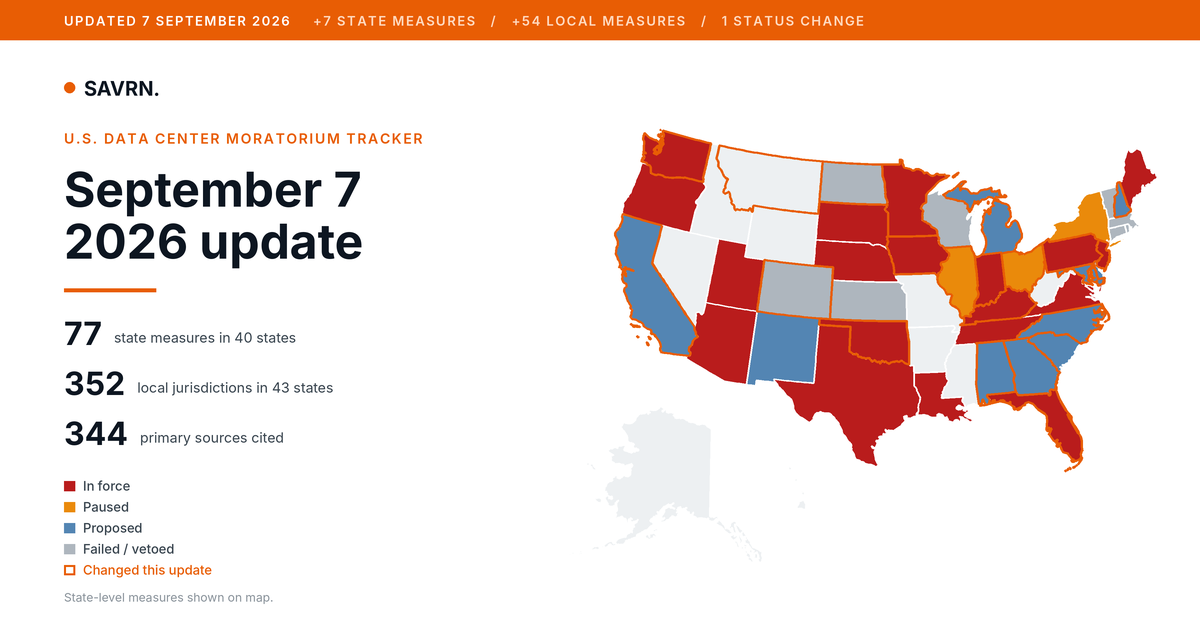
The U.S. Data Center Moratorium Tracker was refreshed on September 7, 2026. This is the record of what changed since the previous refresh on August 31, 2026. Every entry below links to the primary source behind it.
Where the count stands
| Measure | Previous | Current | Change |
|---|---|---|---|
| State-level measures | 70 | 77 | +7 |
| States with state-level action | 39 | 40 | +1 |
| Local jurisdictions | 298 | 352 | +54 |
| States with local action | 43 | 43 | 0 |
| Primary sources cited | 298 | 344 | +46 |
Of the 40 states with a state-level measure on the tracker, 19 have a restriction in force, 3 are under an active administrative pause, 10 have a measure pending, and 8 saw their most advanced measure fail or be vetoed.
New state measures this period
- California, AB 1577: Data center reporting requirements. Assemblymember Rebecca Bauer-Kahan’s bill would require data centers to file operational data with the California Energy Commission, including power usage effectiveness, waste heat and onsite generation, and would require water use reporting when a project applies for a discretionary permit. The Senate passed it 29 to 10 on Aug. 26, 2026, the Assembly concurred in the Senate amendments 58 to 11 on Aug. 27, 2026, and the bill was enrolled and presented to the Governor on Sept. 4, 2026. Source
- California, AB 2383: Fair Share in Energy Act. Assemblymember Rick Chavez Zbur’s bill would require electrical corporations, community choice aggregators and electric service providers to adopt separate generation and transmission tariffs for new large load customers taking service on or after Jan. 1, 2027, so that data center costs are not spread to other customers. The Senate passed it 28 to 9 on Aug. 31, 2026, the Assembly concurred in the Senate amendments 67 to 2 the same day, and the bill was enrolled on Sept. 4, 2026. Source
- California, AB 2469: Data centers: water use disclosures. Assemblymember Diane Papan’s bill would bar a city or county from approving a discretionary or ministerial permit for the construction of a data center, or an expansion that increases maximum peak water use, unless specified water disclosure and cost responsibility conditions are met. The Senate passed it 28 to 9 on Aug. 30, 2026, the Assembly concurred in the Senate amendments 61 to 12 on Aug. 31, 2026, and the bill was enrolled on Sept. 4, 2026. Gov. Newsom vetoed a comparable data center water reporting bill in 2025. Source
- California, SB 1168: Data center electricity rate structures. Sen. Jerry McNerney’s bill adds a new article to the Public Utilities Code directing the Public Utilities Commission to examine data center energy use and to ensure that data centers pay their share of transmission and distribution costs rather than shifting them to other ratepayers. The Assembly passed it on Aug. 28, 2026, the Senate concurred in the Assembly amendments 38 to 0 on Aug. 30, 2026, and the bill was enrolled on Sept. 1, 2026. It awaits action by Gov. Newsom. Source
- New Hampshire, Announced budget proposal (2027 session): Proposed statewide multi-year data center moratorium. Gov. Kelly Ayotte told the Executive Council on Sept. 2, 2026 that she opposes siting data centers in New Hampshire and intends to include a multi-year statewide moratorium in her next budget proposal, citing electricity prices and water and noise impacts. Because the proposal would travel with the budget, it would not take effect before July 2027 unless the Governor acts sooner by executive order. No bill has been introduced. Source
- North Dakota, SB 2406: Penalties for data center nondisclosure agreements. Would have attached consequences for data center developers that enter nondisclosure agreements with public agencies or officials. A joint House-Senate policy committee gave it a do-not-pass recommendation on Sept. 2, 2026 after amending it to preserve confidentiality agreements for sensitive information, and the Senate rejected the bill 32 to 15 on Sept. 3, 2026 during a special session. Gov. Armstrong testified that existing transparency law was already sufficient. Source
Newly verified state measures from earlier periods
These actions were taken before this reporting period and were added once a primary source was confirmed. They are research gains, not new activity.
- New Jersey, S-3379 / A-4096: Data center energy and water use reporting. Signed by Gov. Sherrill on Aug. 27, 2026 and effective immediately. Requires data center owners and operators to file semiannual reports with the Board of Public Utilities for three years covering total energy consumption, energy used for cooling versus IT equipment, peak daily water use, water sources, and on-site and backup power supplies. It applies to existing and new facilities above the statutory capacity threshold. It is a disclosure requirement, not a moratorium; the Governor declined calls for a statewide construction ban at the signing. Source
New local measures this period
- Fresno, CA: Proposed 10-year citywide data center prohibition. The City Council voted 7-0 on Sept. 3, 2026 to begin drafting a citywide prohibition on data centers lasting 10 years, covering land later annexed into the city and requiring that councilmembers be notified of applications. Mayor Jerry Dyer co-sponsored the measure. The development code amendment must still clear environmental review, the Airport Land Use Commission and the Planning Commission before returning to the council, so no prohibition is in force yet. Source
- Mendocino County, CA: 45-day urgency moratorium on data centers. The Board of Supervisors voted 5-0 on Sept. 1, 2026 to adopt an urgency ordinance barring any new data center in the unincorporated county. It took effect immediately and runs 45 days, to Oct. 16, 2026. County code does not define or regulate data centers, so one could otherwise be approved through a routine building permit. A hearing set for Oct. 6 could extend the moratorium for up to two years while permanent regulations are written. Source
- Indiantown, FL: Rejected pause on large-scale data center applications. The Village Council voted 4-1 on Sept. 1, 2026 against a resolution that would have paused new large-scale data center applications while the village drafted regulations. An attorney for a proposed project threatened litigation if the village paused applications, and council members said they wanted a further legal opinion and stronger language first. The council fired the village manager the same night. Source
- North Port, FL: Proposed 18-month data center moratorium. After a public hearing that drew hundreds of residents and hours of comment, the City Commission voted 4-1 on first reading to freeze new data center applications and approvals for 18 months, including final approval of an 896,000 square foot proposal. Commissioner Demetrius Petrow was opposed. The ordinance returns for a final vote later in September 2026, so it is not yet in force. Source
- Bulloch County, GA: Data center moratorium through Dec. 31, 2026. The county’s moratorium on data centers remains in force and is scheduled to expire Dec. 31, 2026. On Sept. 1, 2026 the Board of Commissioners voted 4-3 to reject a text amendment that would have prohibited data centers outright in unincorporated Bulloch County, with the chairman breaking the tie, and chose to continue work on regulations instead. Source
- Mattoon, IL: Moratorium on large-scale data center development. The City Council passed a moratorium on Sept. 3, 2026 covering new data center developments larger than 21,780 square feet, roughly half an acre, inside Mattoon and within the 1.5 mile area where the city holds zoning authority. Existing operations may continue. The moratorium renews annually unless the council acts to change or end it. Source
- Rowan County, KY: Two-year moratorium on large-scale data centers. The Fiscal Court approved a two-year moratorium on large-scale data centers in early September 2026, before any project had been proposed. The county has no zoning, so a buyer could otherwise start a data center without county review. Officials plan to use the pause to develop conditional use permitting. Source
- Winchester, KY: One-year data center moratorium. The Board of Commissioners voted unanimously on Sept. 1, 2026 to pause data center development for one year inside the city limits, citing the absence of specific zoning rules and unresolved questions about utilities, rates and the environment. The rest of Clark County is not covered, so sites outside the city could still be developed. Source
- Zeeland Township, MI: One-year data center and energy facility moratorium. The township board voted unanimously in early September 2026 to repeal its earlier data center moratorium and replace it with a new one-year moratorium covering data centers and energy facilities, extending the pause while the township updates its master plan and the planning commission finishes a renewable energy ordinance. Source
- Butte-Silver Bow County, MT: Proposed six-month interim zoning moratorium. The consolidated city-county commission voted 11-0 in September 2026 to direct the county attorney to draft a temporary data center moratorium, while a separate fight over a data center ballot initiative heads to the Montana Supreme Court. As an interim zoning ordinance it needs three separate commission votes and a further 30 days before taking effect; if adopted it would run six months, extendable up to two and a half years. Source
- Miamisburg, OH: Nine-month data center moratorium. City Council voted 6-0 on Sept. 1, 2026 to impose a nine-month moratorium on data center development. It followed community concern over a possible large-scale data center at the former DP&L Hutchings Power Station site, and gives the city time to write zoning and development standards it does not currently have. Source
- Newton Falls, OH: 12-month data center moratorium. Council voted 4-0 in early September 2026 to give emergency reading to a 12-month moratorium on data centers, so the zoning department and city manager can examine infrastructure, utilities and zoning code requirements. One councilman argued for a permanent ban instead. Source
- West Hempfield Township, PA: Data center zoning ordinance with size and buffer limits. The Board of Supervisors in Lancaster County unanimously approved an ordinance in early September 2026 regulating data centers, setting limits on facility size and on proximity to residential and agricultural land. No application was pending. The planning commission will review further amendments covering noise and water use. Source
- Port Angeles, WA: Six-month data center moratorium. The City Council adopted a resolution in early September 2026 halting acceptance, processing and approval of facilities whose principal use is digital data processing, storage, management or transmission. It took effect immediately for an initial six months. No application had been filed. Staff has 60 days to produce a work plan covering public participation and analysis of electric rates, water use, industrial land, noise and environmental quality. Source
Newly verified local measures from earlier periods
These actions were taken before this reporting period and were added once a primary source was confirmed. They are research gains, not new activity.
- Harpersville, AL: Six-month data center moratorium. The Town Council adopted a six-month moratorium on Aug. 3, 2026 even though no developer had approached the town, giving the council, the planning and zoning board and the water board time to study economic and infrastructure effects. The planning and zoning board had recommended a longer pause. The town is holding monthly public information sessions during the moratorium. Source
- Escondido, CA: 45-day moratorium on data centers. The City Council unanimously adopted an urgency ordinance in late August 2026 imposing a 45-day moratorium on data centers and other high-intensity computing uses while staff develops land use and zoning regulations. No data center application had been filed. Staff is due back on Oct. 10, 2026, and the council may extend the moratorium by 10 months and then a further 12 months. Source
- Mead, CO: 12-month data center moratorium. Town trustees voted 4-2 on Aug. 31, 2026 to bar data center applications for 12 months while staff studies infrastructure, water use and setbacks and drafts regulations. Trustees Brad Hagan and Jeremiah Crane voted no. The town attorney said the moratorium can end sooner if the review finishes early. Source
- Camden County, GA: Six-month data center moratorium. The Board of Commissioners adopted a six-month moratorium on data centers in early May 2026, making Camden the first coastal Georgia county to do so. It followed a rezoning request tied to a proposed industrial park that was withdrawn after environmental objections and a request from the commander of Naval Submarine Base Kings Bay. Source
- Forest Park, GA: 90-day data center moratorium. At a special called meeting on Aug. 31, 2026 the City Council approved a 90-day moratorium so the city can rewrite zoning rules that currently allow data centers by right. Proposed revisions would define data centers, set buffers from residential areas and add accountability provisions, and the city will form a community advisory committee during the pause. Source
- Garden City, GA: Six-month data center moratorium. The mayor and council voted unanimously on June 15, 2026 to impose a six-month moratorium on data centers in the Chatham County municipality while the city reviews impacts and considers zoning amendments. The resolution cited electrical grid demand, water consumption for cooling, noise from industrial HVAC units and backup generators, and limited job creation relative to footprint. Source
- Emmet County, IA: One-year data center moratorium. The Board of Supervisors voted unanimously on Aug. 25, 2026 to adopt a one-year moratorium on data centers in the northwest Iowa county, citing health concerns, water use and energy demand. No developer had inquired; the board called the measure precautionary and will use the year to finish solar siting rules and then draft a data center ordinance. Source
- Baltimore City, MD: One-year moratorium on data centers of 10 MW or more. The City Council passed a one-year moratorium in early May 2026 on construction of data centers projected to use 10 MW or more of electricity annually, and Mayor Brandon Scott signed it. Introduced by Council President Zeke Cohen and sponsored by 12 of the 15 members, it also requires a nine-month study of impacts on energy infrastructure, ratepayers, the economy, and environmental and public health. Source
- Baltimore County, MD: Freeze on data center permits pending planning study. The County Council passed legislation unanimously on Feb. 3, 2026 freezing new data center permits until 90 days after the Planning Board delivers a study of environmental and economic impacts, with an outside expiration of Jan. 1, 2027. The board must hold a public hearing on its findings. The bill followed a proposed 150 MW conversion at a Woodlawn site. Source
- Caroline County, MD: One-year moratorium on new data centers. County commissioners voted in July 2026 to establish a one-year moratorium on new data centers in the county’s unincorporated areas while officials research impacts and consider regulations. Source
- Carroll County, MD: One-year data center moratorium. The Board of County Commissioners approved a one-year moratorium on data centers on Feb. 19, 2026 to allow study of economic and environmental impacts and drafting of regulations. Commissioners have since directed staff to continue work on zoning rules before the deferral expires, weighing water limits and electricity costs. Source
- Harford County, MD: Permanent ban on data centers in all zoning districts. Bill 26-011, proposed by County Executive Bob Cassilly, passed the County Council unanimously after a public hearing and was signed on June 10, 2026. It removes data centers as a permitted use in every zoning district, making Harford the first Maryland county to adopt an outright permanent ban. The law’s drafting has drawn legal threats and supporters have acknowledged it may face a court challenge. Source
- Howard County, MD: S.M.A.R.T. Siting Act moratorium through Nov. 2, 2027. The County Council voted unanimously in early June 2026 to suspend new data center development through Nov. 2, 2027 and to create a task force that has one year to report findings and recommendations. Existing facilities and projects already approved for construction are not affected. Source
- Queen Anne’s County, MD: 12-month moratorium on data center applications. The County Commissioners approved a temporary 12-month moratorium on the application, processing and approval of data centers, effective immediately on adoption on June 4, 2026, to give the county time to evaluate impacts and develop policies, performance standards and zoning regulations. It may be modified or extended by the commissioners. Source
- Wixom, MI: Moratorium replaced by data center zoning restrictions. Wixom’s six-month data center moratorium began in March 2026. On Aug. 26, 2026 the City Council adopted data center restrictions in the zoning ordinance, including a 1,500 foot setback, a ban on well water use and mandatory sound studies, and passed a resolution putting them in force no later than Sept. 6, 2026, ending the moratorium about two and a half weeks early. A developer is suing the city over the original moratorium. Source
- Pine County, MN: Interim ordinance imposing a 12-month data center moratorium. The Board of Commissioners adopted Ordinance 2026-15 on Aug. 18, 2026, effective the same day, authorizing a study and placing a moratorium on data centers. It runs 12 months unless repealed by board resolution or superseded by a new zoning ordinance covering data centers. It excludes incorporated cities outside county zoning jurisdiction and townships that have already adopted their own data center regulations. The board had rejected an earlier proposal in May 2026. Source
- Asheville, NC: One-year data center moratorium. City Council approved a one-year pause on construction of new data centers in June 2026, citing utility demand and noise, while the city writes zoning rules to regulate them. Source
- Boiling Spring Lakes, NC: One-year data center moratorium. The city adopted a one-year moratorium on data center development on June 2, 2026. Source
- Clay County, NC: One-year data center moratorium. Clay County adopted a data center development moratorium in September 2025, among the earliest in the state. Source
- Fayetteville, NC: 120-day pause on data center approvals. The City Council adopted a 120-day pause on data center approvals in May 2026 while it reviewed standards. Source
- Gates County, NC: 12-month moratorium on data center approvals. Gates County adopted a 12-month moratorium on data center approvals in early 2026. Source
- Harnett County, NC: One-year data center moratorium. The Board of Commissioners adopted a one-year data center moratorium in May 2026. Source
- Holly Springs, NC: One-year data center moratorium. The Town Council adopted a one-year moratorium effective June 17, 2026 and running through June 16, 2027. The town manager advised that Holly Springs can regulate data centers but cannot ban them outright. Source
- Kings Mountain, NC: Data center moratorium, extended one year. Kings Mountain adopted a 182-day moratorium in February 2026 on a 5-2 vote after a second data center proposal. With that pause due to expire in late August, the City Council voted on Aug. 25, 2026 to extend it by a full year, carrying it into late August 2027. Source
- Northampton County, NC: 32-month data center moratorium. Northampton County adopted an unusually long 32-month data center moratorium in May 2026. Source
- Rowan County, NC: One-year data center moratorium. The Board of Commissioners unanimously approved a one-year data center moratorium on April 21, 2026. Source
- Stokes County, NC: Rejected six-month data center moratorium. On July 14, 2026 the Board of Commissioners voted 3-2 to approve text amendments opening the county to data center development and declined to adopt the six-month moratorium its own planning board had recommended. Every public commenter opposed the move. The vote followed a contested hyperscale proposal in Walnut Cove. Source
- Swain County, NC: 12-month data center moratorium. The Board of Commissioners unanimously adopted a 12-month moratorium on April 21, 2026 and formed an ad hoc committee to study data center impacts. Source
- Town of Apex, NC: One-year data center moratorium. The Town Council adopted a one-year moratorium on data center development in April 2026, running through April 2027. Source
- Town of Brevard, NC: Data center and crypto mining moratorium. Brevard adopted one of the first North Carolina moratoriums, a temporary halt on data centers and crypto mining beginning in September 2025 and later carried to a full year. Source
- Town of Canton, NC: One-year pause on data center projects. Canton adopted a one-year moratorium on all data center projects in February 2026. Source
- Town of Franklin, NC: One-year data center moratorium. The Town of Franklin, in Macon County, adopted a one-year data center moratorium on July 6, 2026. Source
- Town of Mayodan, NC: Data center moratorium. Mayodan, in Rockingham County, is among the North Carolina municipalities that had enacted a data center moratorium by mid-July 2026. Source
- Town of Spring Hope, NC: One-year data center moratorium. Spring Hope adopted a one-year data center moratorium in May 2026. Source
- Town of Wendell, NC: Seven-month data center moratorium. Wendell adopted a seven-month data center moratorium in May 2026. Source
- Whiteville, NC: 12-month moratorium on data centers and crypto mining. The City Council voted on Aug. 25, 2026 to enact an immediate 12-month moratorium on new data centers and cryptocurrency mining, running to Aug. 25, 2027 or until the city adopts a zoning ordinance text amendment covering those uses, whichever comes first. Staff was directed to research the industries and draft regulations. Source
- Jerome Township, OH: Nine-month data center moratorium, renewed. Trustees approved a nine-month moratorium on new data centers on Sept. 3, 2025, making Jerome Township in Union County the first Ohio local government to pause data center development. The pause was renewed into 2026 and became a model for other Ohio communities, though residents have criticized the township for approving permits while it was in place. Source
- Village of Ashville, OH: 180-day data center moratorium. The Village Council passed a 180-day moratorium unanimously as an emergency measure on Dec. 20, 2025 after public pushback against a proposed EdgeConneX data center on roughly 680 acres in Pickaway County. The village can consider annexation during the pause but no development on the data center may proceed. Source
- Village of South Bloomfield, OH: 180-day data center moratorium. Neighboring South Bloomfield enacted its own 180-day moratorium on data center construction in December 2025 and also removed industrial zoning that would have allowed applications. Source
- Tulsa, OK: Nine-month pause on new data center construction. The City Council voted unanimously in late March 2026 to pause new data center construction for nine months while the city reviews how data centers are classified in its zoning code, with a planning office report every 60 days. District 4 Councilor Laura Bellis had sought a full year and amended it to nine months. The first two phases of Project Anthem are exempt and Project Clydesdale, already under construction, is unaffected. Source
Status changes, local measures
- Elkhart, IN: Proposed to In force. The City Council voted unanimously at a special hearing on Aug. 27, 2026 to pause new applications for data centers and battery energy storage facilities through Dec. 31, 2027 while the city studies electrical capacity, water use, public safety, traffic, noise and environmental impacts. The pause applies inside the city only, not to Elkhart County. Dozens of residents spoke in favor and some asked for a permanent ban. Source
Removals
No entries were removed. The tracker merges forward: a sourced entry stays on the list unless a new source shows its status changed or it was formally repealed.
How this tracker is maintained
The tracker is refreshed weekly. Every entry requires a verifiable primary source: a legislature page, a governor’s office, a local government record, or established news reporting. Entries are merged rather than replaced, so a measure verified in an earlier week is not dropped because a later pass did not resurface it. Where a measure is single-sourced or a date could not be independently confirmed, the entry says so.
The full dataset, with a filterable map and all 344 citations, is at the U.S. Data Center Moratorium Tracker. The complete source list is at the tracker’s sources page.
Would you like the weekly update?
Every week we re-verify every state and local measure on this map and publish what changed. You get one email when it goes out.
Also send me
Receive a short introduction on days 3, 7 and 14, plus the updates you select. Unsubscribe in one click. Privacy
Data Center Moratorium Tracker Update: September 7, 2026
Get new SAVRN Insights by email
A short introduction on days 3, 7 and 14, plus new SAVRN research articles. Unsubscribe at any time.
We use your address to send the introduction and updates described above. See our Privacy Policy.