Where data center nuclear power is actually coming from
Five deals reported this fall add about 1,640 megawatts of nuclear capacity tied to technology companies, all of it from uprates at plants that already exist. The new-reactor projects in the same reports name no data center buyer.
The nuclear power that technology companies are buying for their data centers and AI work, in the deals reported this fall, is coming from reactors that already exist. Reports published between September 22 and October 8, 2026 describe five arrangements in which a technology company pays for nuclear power or for the uprates that produce it. In each one the power comes from an existing plant, through a long-term contract, an uprate, or both 1, 2, 7, 10, 11. The same reports describe four new-reactor projects in the United States in detail. Those four projects name no data center or technology company as the buyer of their power 3, 6, 9.
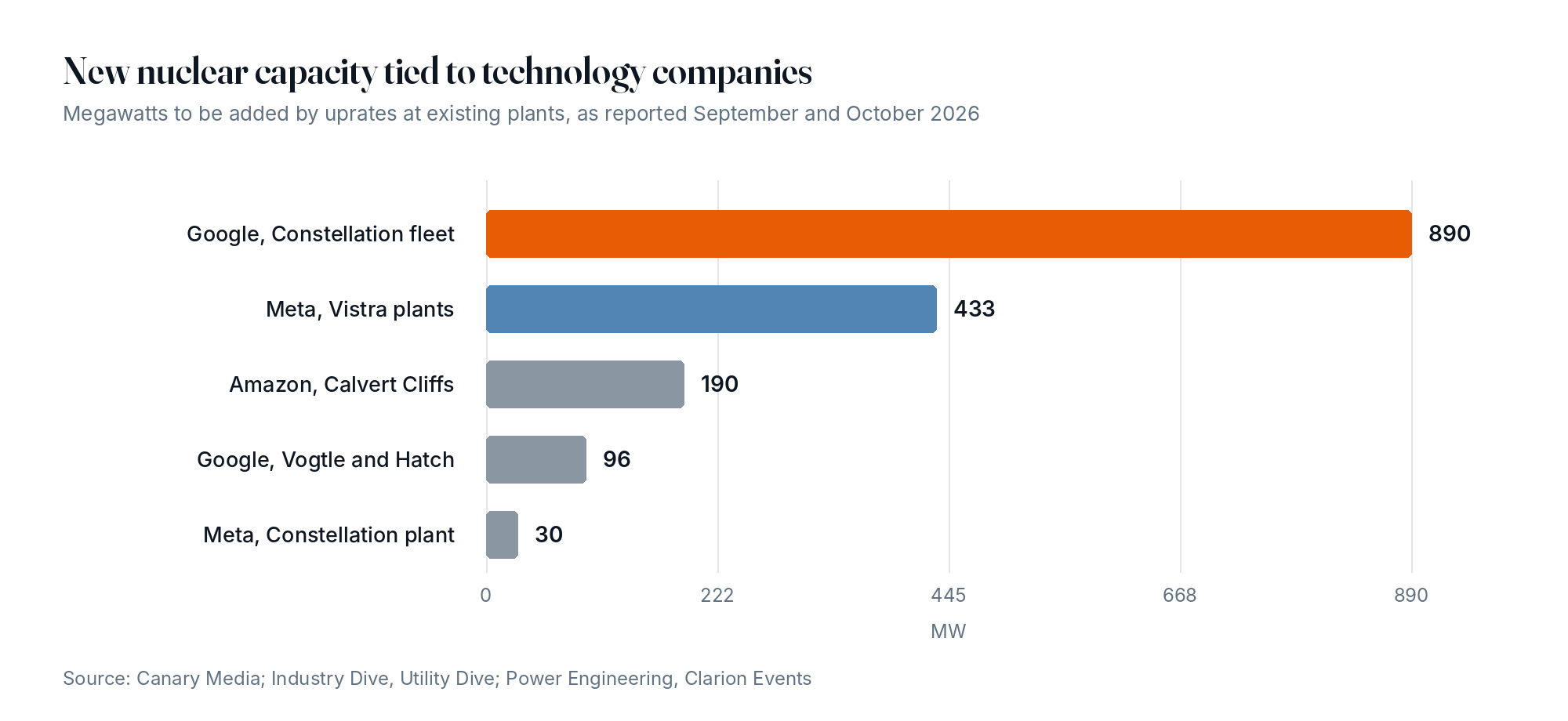
SAVRN analysis: The new capacity tied to technology companies in these reports adds up to about 1,640 megawatts, all of it from uprates: 890 for Google at Constellation plants, 433 for Meta at Vistra plants, about 190 for Amazon at Calvert Cliffs, about 96 paid for by Google in Georgia and 30 for Meta at a Constellation plant 1, 2, 7, 10, 11. That is a tally of what these reports itemize. It is not a count of the whole market.
The arrangements tracked in this report
The table below lists nine nuclear arrangements. In five, a technology company is the buyer or the funder, and all five rest on existing plants. Four are new-reactor projects with no data center buyer named. The reporting mentions other projects in passing, so this is a working list and not a census of the market.
What to take from this
- Five arrangements in this reporting have a technology company paying for nuclear power, and all five use existing plants.
- The new capacity in those arrangements is about 1,640 megawatts, all from uprates.
- In the Google, Amazon and Vistra deals, about one fifth of the megawatts contracted is new capacity.
- A Jefferies analyst estimates uprate potential at 3 to 5 gigawatts nationwide.
- The four new-reactor projects tracked name no data center buyer, and the earliest specific operating date stated is 2031.
Technology companies are paying existing plants to produce more
Constellation Energy signed 20-year power purchase agreements with Amazon and Google within a week of each other 1. The Amazon agreement, announced on September 30, 2026, covers 690 megawatts from the 1,790-megawatt Calvert Cliffs plant in Maryland, including about 190 megawatts of new capacity expected between 2030 and 2032 1, 2. The companies said the agreement allows for more than $3 billion of investment in Maryland, and Constellation said the revenue lets it relicense the plant for another two decades 2.
The Google agreement supports 890 megawatts of new capacity through uprates at 11 existing units in Illinois, Pennsylvania and New Jersey, backed by $4.3 billion of investment by Constellation 1. All 11 units are in PJM, the grid operator for 13 states from Illinois to New Jersey and the District of Columbia 1, 2. Constellation expects the first of those uprates in 2028 and the full set in the early 2030s 10. One project adds 348 megawatts at the Limerick plant near Philadelphia, and another adds 97 megawatts at the Salem plant in New Jersey 10.
Vistra has 20-year agreements to supply Meta with more than 2,600 megawatts from Beaver Valley in Pennsylvania and Davis-Besse and Perry in Ohio, including 433 megawatts of new capacity from uprates 11. The Department of Energy announced a conditional loan commitment of up to $4.2 billion for that work one day before the Google announcement 11. Meta’s purchases begin in late 2026, with capacity added through 2034 11.
In Georgia, Google will pay for uprates on Georgia Power’s share of Plants Vogtle and Hatch that add about 96 megawatts 7. That capacity serves Georgia Power customers. Google subscribes to a new tariff and receives the zero-emission credits, which represent the carbon-free attributes of the added output 7. The agreement is subject to approval by the Georgia Public Service Commission 7.
Google said the Constellation agreement brings the new nuclear capacity it has helped enable in the United States, through uprates and reactor restarts, to more than 1.5 gigawatts 11. The sources itemize 986 megawatts of that: 890 at Constellation plants and about 96 in Georgia 1, 7.
SAVRN analysis: Google’s count includes restarts and projects the sources do not break out, so its 1.5 gigawatts and the 986 megawatts itemized here measure different things 11.
Contracted power and new capacity are two different numbers
In the Google, Amazon and Vistra deals, the total contracted is larger than the capacity added. Google’s overall arrangement with Constellation covers 3,590 megawatts: the 890 megawatts of uprates and a separate 15-year agreement for 2,700 megawatts of Constellation’s existing generation in PJM 11. Only the 890 megawatts is new capacity 11.
The Amazon agreement shows the same gap. Amazon receives 690 megawatts from Calvert Cliffs, of which about 190 megawatts is new 2. Constellation said all of the plant’s electricity will flow to the PJM grid as usual 2. Vistra’s agreements with Meta cover more than 2,600 megawatts, of which 433 megawatts is new 11.
SAVRN analysis: Across those three deals the buyers contracted for at least 6,880 megawatts, and about 1,510 megawatts of it, a little over one fifth, is capacity that did not exist before 2, 11. The rest is generation that already exists, now committed to a single buyer for 15 to 20 years. Anyone sizing these deals against data center demand should count the new capacity, because most of the larger figure is power the grid already had. The existing megawatts still matter for a different reason. Constellation said the Amazon revenue lets it relicense Calvert Cliffs for another two decades, so these contracts also help keep running plants running 2.
The new capacity also arrives in stages. The first Google-backed uprate is expected in 2028, the Calvert Cliffs capacity between 2030 and 2032, and the Vistra capacity through 2034 1, 10, 11.
Constellation’s Google-backed uprates cost less than half as much per kilowatt as Vogtle
An uprate replaces or upgrades turbines, steam generators, digital controls and other equipment outside the reactor itself so the same unit produces more electricity 10. Constellation puts the budget for its Google-backed program at just over $4,800 per kilowatt 10. Canary Media reported that this is well above the cost of utility-scale solar with energy storage or a new combined-cycle gas plant, and less than half the per-kilowatt cost of Vogtle Units 3 and 4 in Georgia 10. Those two reactors finished seven years late at more than double their original $14 billion budget 10.
Not every uprate is priced that way. Utility Dive described the Amazon deal as centered on a $3 billion, 190-megawatt expansion of Calvert Cliffs 1. The companies said the figure covers Maryland infrastructure that includes renovations at the plant, so it is not a clean cost for the 190 megawatts alone 2.
What the buyer gets for that price is output that rarely stops. The Department of Energy puts the average capacity factor of U.S. nuclear plants at 92.3%, against 59.9% for combined-cycle gas plants and 23.4% for solar installations 10.
Judi Greenwald, president and CEO of the Nuclear Innovation Alliance, called uprates “the fastest, most practical and cost-effective ways to add reliable, clean nuclear capacity” for the near term 10.
Uprate potential is finite. Julien Dumoulin-Smith, an analyst at Jefferies, cited an estimated 3 to 5 gigawatts nationwide and said the Constellation and Vistra deals account for most of the potential in PJM 10. The Trump administration wants to add 5 gigawatts of nuclear capacity by 2029 without deploying a new reactor 10.
At least three of the five technology-company arrangements are in PJM 1, 2, 11. The grid operator is short about 6.8 gigawatts of new capacity 1. Demand across its 13 states is expected to grow more than 5% a year for the next 10 years, and retail power prices are expected to rise as much as 60% by 2030 10. PJM says it welcomes new capacity even at a premium price 10.
SAVRN analysis: Those conditions help explain why buyers pay more for uprates than for solar or gas. They also show the ceiling. The whole national uprate estimate is smaller than PJM’s shortfall alone.
New reactors are advancing with no data center buyer named
The Nuclear Regulatory Commission issued the Tennessee Valley Authority a construction permit for Clinch River Unit 1, a 300-megawatt small modular reactor of the BWRX-300 design near Oak Ridge, Tennessee 3. TVA is the first utility authorized to build that design 3. When it applied, TVA said the reactor could begin operating around 2032. It is not yet clear when construction will start or what the project will cost, and TVA is still negotiating a cost-sharing plan with industry partners 3.
TerraPower broke ground in April 2026 on Kemmerer Unit 1 in Wyoming, a 345-megawatt sodium-cooled reactor 6. Its schedule calls for construction to finish in 2030 and commercial operation by 2031 6. TerraPower and its contractor Bechtel could not agree on the next phase of the project, and TerraPower said the timeline would not change 6. The project has been awarded up to $2 billion in federal cost-sharing funds 9.
X-energy is working to bring four 80-megawatt reactors online at a Dow chemical site in Seadrift, Texas, in the early 2030s 9. The Department of Energy said in August 2026 that it would award X-energy $1 billion, and Canary Media put the project’s federal funding at up to $2.1 billion 9. In 2023 X-energy estimated the cost of the full program at $4.75 billion to $5.75 billion 9. The project does not yet have a license from the Nuclear Regulatory Commission, and Dow is expected to decide whether to invest in 2028 at the earliest 9. The reactors would supply heat and power to Dow’s plant 9.
Blue Energy filed the first half of a construction permit application for a plant at the Port of Victoria, Texas, that would start on gas turbines and add BWRX-300 reactors later 6. It expects an investment decision in 2027 and plans to file the second half of the application in late 2027 6.
SAVRN analysis: Technology companies do appear on the new-reactor side of this reporting, as investors. X-energy is described as Amazon-backed, and Kairos Power, another reactor developer, as Google-backed 9. What the reporting does not show is a contract in which a data center buys the output of any of these four projects. Dow is the named user at Seadrift, and the other three name no buyer 3, 6, 9. The earliest operating date stated for any of them is 2031, at Kemmerer, three years after the first uprate megawatts are due 6, 10. Seadrift is given only as the early 2030s, and Port of Victoria has no date 6, 9. Canary Media reported that only a handful of reactors are under construction in the United States and that experts expect few if any to come online before 2030 4.
Licensing rules are changing while the regulator loses staff
An executive order from President Trump directs the Nuclear Regulatory Commission to carry out sweeping regulatory reforms by the end of 2026 4. The order also made it federal policy to quadruple the commercial reactor fleet by 2050 4. The commission has started several dozen rulemakings since the order 4.
One proposed rule would reduce reporting requirements for nonemergency events, remove the expiration date on standard design approvals, allow more staffing flexibility in control rooms and change seismic risk requirements 4. Another proposed change would give developers more flexibility to make design changes during construction without asking the commission for permission 4. Lengthy design-change reviews contributed to the delays at the two AP-1000 reactors built in Georgia 4.
The Government Accountability Office found that the commission lost about 500 staff, on net, from July 2024 through June 2026, most of them to voluntary retirement 5. The commission expects more applications for new reactor licenses 5. Congress gave it three new workforce authorities in July 2024, and by July 2026 it had used one of them, awarding $335,000 in performance bonuses to 18 staff 5.
SAVRN analysis: Licensing matters to the question in the title because both paths run through the same regulator. An extended uprate raises a reactor’s licensed power level, and a new reactor needs a construction permit from the commission 3, 7. TVA said the commission finished its review of the Clinch River permit ahead of schedule 3. Whether it can keep that pace with fewer staff and more applications is the open question the GAO findings raise 5.
What this reporting does not settle
SAVRN analysis: These points are open, and they limit how far the finding reaches.
- The evidence is eleven news and government reports from a 17-day window. Arrangements they do not itemize are not counted.
- The buyers are technology companies. The reporting ties the power to their data centers and AI operations in general terms and does not name the facilities 1, 2.
- Two reports describe a 2025 agreement between Constellation and Meta, one as 1,121 megawatts beginning June 2027 and one as a 30-megawatt uprate. They do not say whether this is one agreement or two 2, 10.
- The reporting gives a cost for Constellation’s uprate program and none for the Clinch River, Kemmerer or Port of Victoria projects 3, 6, 10.
- Kairos Power holds a construction permit and is Google-backed. Nothing more is reported about its project or its customer 9.
- Constellation is spending $1.6 billion to restart a reactor at the Pennsylvania plant formerly known as Three Mile Island. Its buyer is not named 10.
- Ontario Power Generation has signed the first contract toward refurbishing four reactors at the Pickering plant, pending regulatory approval. The reporting gives that work no data center connection 8.
- The Georgia agreement is not yet approved, and several of the dates above are company expectations 7, 10.
How SAVRN builds for this
SAVRN builds AI factories that generate their own power on site and run water-free cooling, with a training institute at the front of every campus that reskills the local workforce. SAVRN also publishes and maintains public research tools that track the same trends this article covers: the Data Center Moratorium Tracker, the Water Tracker, the Data Center Delay Tracker, the Grid Operator Watchlist, the Capital Atlas and the US Data Center Map.
What to do next
SAVRN analysis: The steps below follow from the two timelines in this reporting, uprates from 2028 and new reactors from 2031.
- Operators planning on new nuclear capacity before 2030 should start with uprates and ask each plant owner how much uprate capacity is still uncommitted.
- Operators should separate new capacity from existing generation in every nuclear agreement they evaluate, and size their plans to the new capacity.
- Utilities should study the tariff structure proposed in Georgia, where the large customer pays for the uprate and Georgia Power says other customers are protected from its cost.
- Capital partners should underwrite new-reactor projects on their investment-decision dates, which fall in 2027 and 2028 for the projects reported here.
- Regulators should staff licensing reviews to match the application volume they expect, so that permits issued in this decade become plants in the early 2030s.
Frequently asked questions
How much new nuclear capacity is Google paying for at Constellation plants?
When will the Google-backed uprates come online?
Constellation expects to finish the first Google-backed uprate by 2028 and the full set in the early 2030s 10.
What does Amazon get from the Calvert Cliffs agreement?
How much nuclear power is Meta buying from Vistra?
What is a nuclear uprate?
How much do uprates cost compared with a new reactor?
How much uprate capacity is available in the United States?
When could the first BWRX-300 reactor in the United States operate?
When is TerraPower's Kemmerer reactor due?
TerraPower’s schedule for Kemmerer Unit 1 in Wyoming calls for construction to finish in 2030 and commercial operation by 2031 6.
Does Google's Georgia uprate supply a Google data center directly?
Sources
- Constellation, Google strike 890-MW nuclear deal in PJM, Industry Dive, Utility Dive, Oct 06, 2026.
- Amazon, Constellation sign 20-year PPA to expand Maryland nuclear plant, Industry Dive, Utility Dive, Oct 05, 2026.
- Tennessee Valley Authority gets green light to build first BWRX-300 small modular reactor in the US, Power Engineering, Clarion Events, Oct 01, 2026.
- A ‘wholesale revision’ of US nuclear rules is on the…, Canary Media, Sep 30, 2026.
- Nuclear Power: Actions Needed to Improve NRC’s Assessment of Its Workforce Needs | U.S. GAO, U.S. Government Accountability Office, Sep 28, 2026.
- Blue Energy files first NRC application for Texas gas-to-nuclear project Blue Energy files first NRC construction permit for Texas gas-to-nuclear project, Power Engineering, Clarion Events, Sep 24, 2026.
- Google to pay for nuclear uprates at Georgia Power’s Hatch, Vogtle plants, Power Engineering, Clarion Events, Sep 22, 2026.
- OPG signs $1.7B contract for Pickering nuclear plant refurbishment, Power Engineering, Clarion Events, Sep 22, 2026.
- With federal funding windfall, X-energy advances small…, Canary Media, Sep 23, 2026.
- Constellation and Google go in on nuclear uprates to…, Canary Media, Oct 08, 2026.
- Constellation, Vistra uprate deals signal fastest path to new nuclear megawatts, Power Engineering, Clarion Events, Oct 07, 2026.
Want the next one?
When a new piece publishes on SAVRN Insights, you get one email with what it covers and a link to read it. Choose the research that interests you.
Also send me
Receive a short introduction on days 3, 7 and 14, plus the updates you select. Unsubscribe in one click. Privacy
Where data center nuclear power is actually coming from
Get new SAVRN Insights by email
A short introduction on days 3, 7 and 14, plus new SAVRN research articles. Unsubscribe at any time.
We use your address to send the introduction and updates described above. See our Privacy Policy.