The Rise of the Visionpreneur
For most of history, a big idea needed a big team. That rule is breaking. The people who can see furthest now hold the most leverage in the economy, and most of the country hasn't noticed yet.
The Rise of the Visionpreneur starts with one story. In 2024, a 31-year-old programmer in Israel named Maor Shlomo started a side project. It was an AI tool that let people describe an app in plain language and get a working one back. He called it Base44.
He ran it alone and took no outside money. Three weeks after launch it was bringing in revenue at a $1 million annual pace 1. Six months after launch, Wix bought it for $80 million in cash. By then the company had eight employees, who shared a $25 million retention bonus. It had 250,000 users and had earned $189,000 in profit in May alone 2. A year after the deal, it was running at about $150 million in annual revenue 1.
One person had an idea and shipped a product in weeks. The company scaled to nine figures before most startups finish their first hiring plan.
Stories like that used to be one-offs. Now they form a pattern, and the pattern needs a name.
The old math
For most of the last century, the size of what you could build was capped by the number of people who would believe in it with you.
A vision was cheap. Carrying it out was not. You needed engineers to build it, designers to make it usable and salespeople to sell it. You needed lawyers, accountants and a marketing team, plus managers to coordinate all of them, and investors to pay everyone while you found out whether the idea worked. A founder’s first real job was recruiting. If you couldn’t get fifty people to bet their careers on your idea, the idea stayed in your head.
That math filtered out most visionaries. The ones who got through were usually the ones who could raise money and hire, not necessarily the ones who saw furthest. Plenty of people had the right idea at the right time. They lacked the network, the pedigree or the zip code to assemble a team around it, and the idea died quietly.
Think about what that meant in practice. A woman running a small business in a mid-sized town could see exactly what software her industry needed. Building it meant raising money from people who had never been to her town, hiring engineers she couldn’t afford and waiting a year to learn whether she was right. Most people in that position made the rational choice. They kept the idea to themselves.
There were exceptions, and everyone in Silicon Valley can name them. Instagram had 13 employees when Facebook bought it for $1 billion in 2012 3. People remembered it for a decade precisely because it was so rare.
The new math
Rare is now normal.
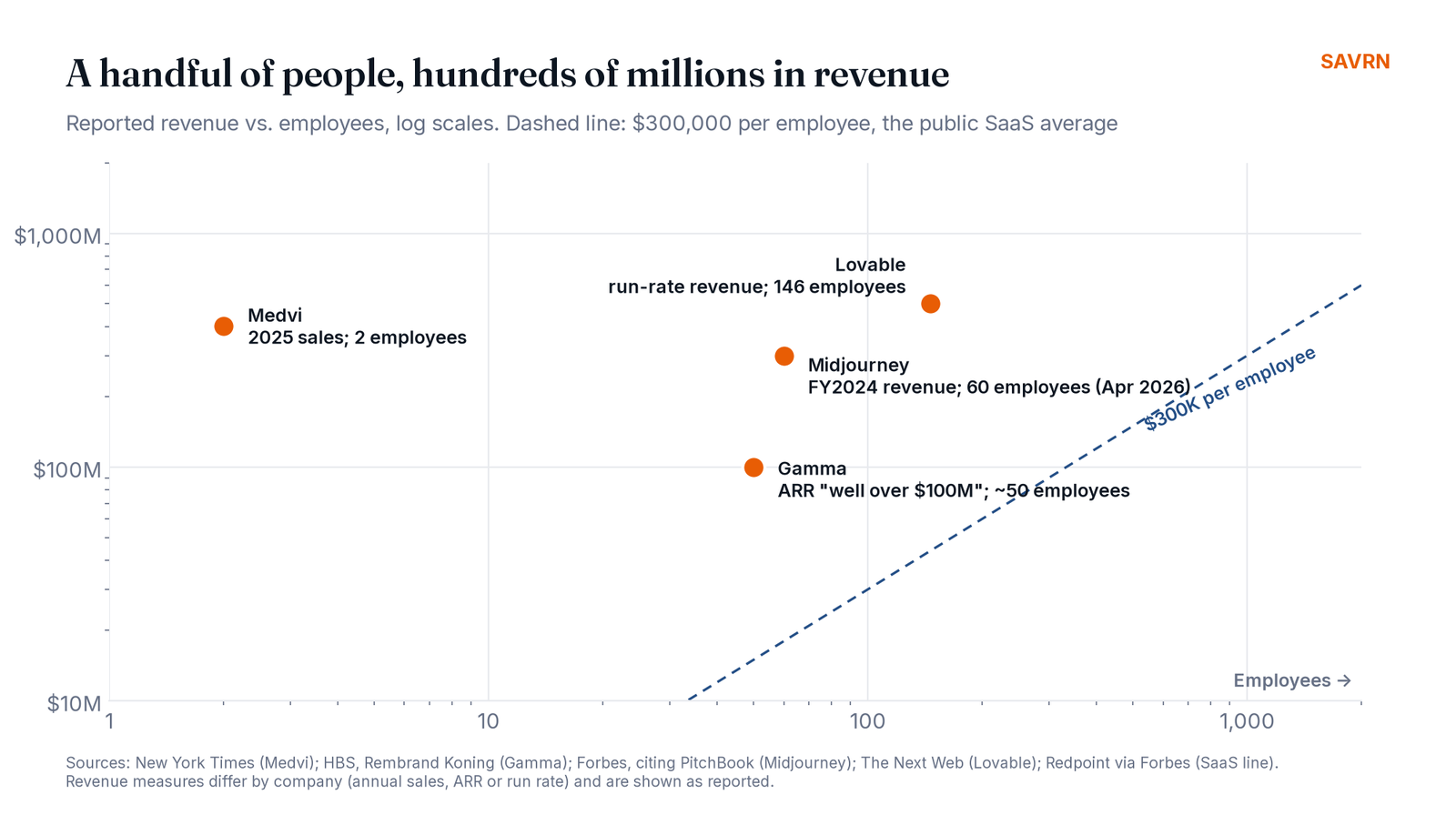
- Lovable reached a $500 million revenue run rate with 146 employees, about $2.77 million per person. It added $100 million of that in a single month. Of the people building software on its platform, 80% describe themselves as non-technical 4.
- Midjourney, the AI image company, brought in $300 million in fiscal 2024 and is profitable. It has never taken outside funding and has 60 employees 5.
- Gamma, which makes AI-generated presentations, reached well over $100 million in annual recurring revenue and a $2 billion valuation with roughly 50 employees 6.
Revenue per employee has been reset. AI-native startups bring in $2 million to $4 million per employee. The average public software company brings in $300,000. The top 20 AI agent startups already earn more per employee than Microsoft ($1.8 million) or Meta ($2.2 million) 7.
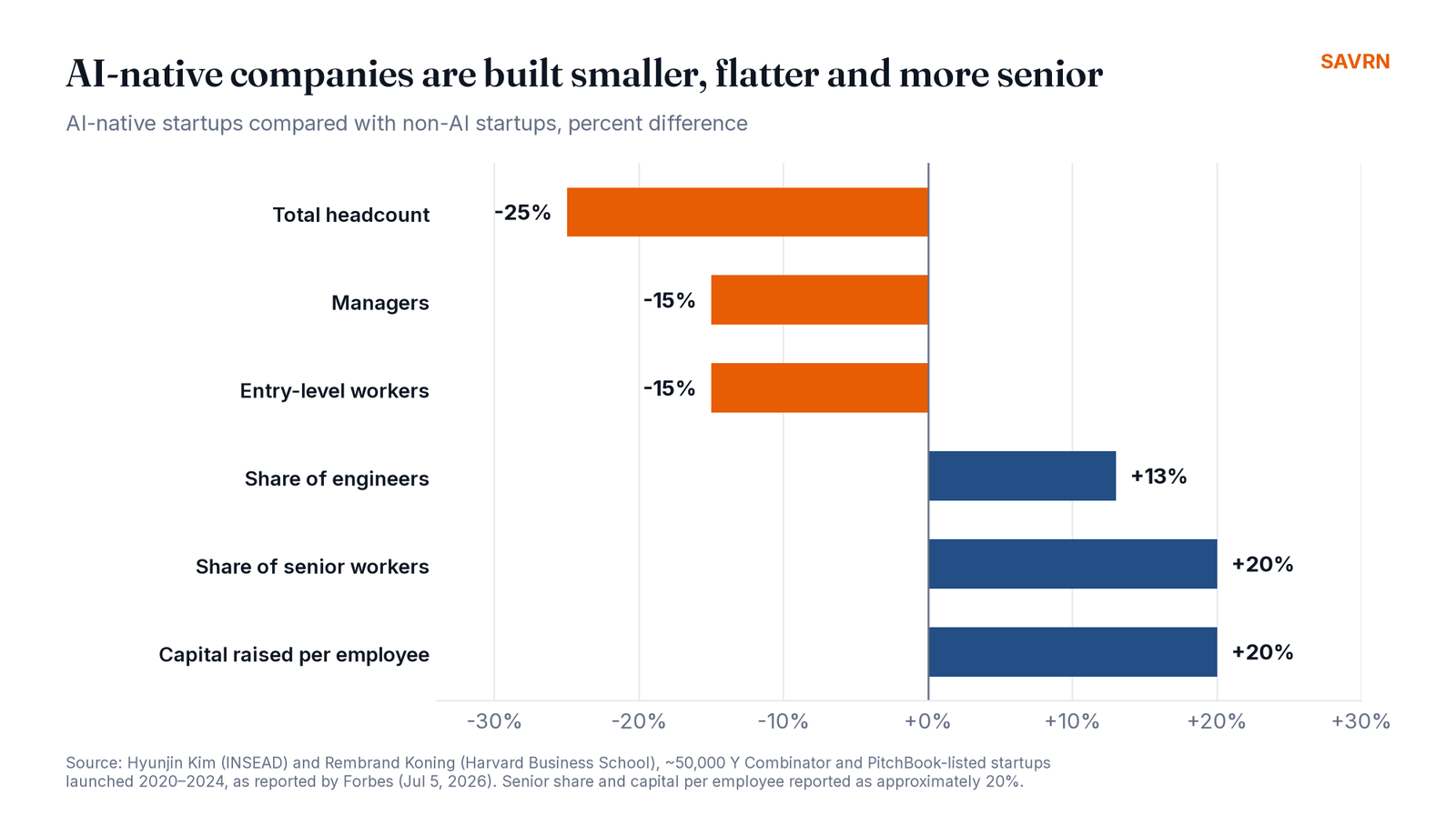
Those are the standouts. The broader data show the same shift. Researchers at Harvard Business School and INSEAD studied close to 50,000 venture-backed startups launched between 2020 and 2024. Compared with non-AI startups, the AI-native companies were 25% smaller, with 15% fewer managers and 15% fewer entry-level workers. They were worth just as much, and they raised about 20% more capital per employee 8.
Rembrand Koning, one of the Harvard researchers, explained what that means for how companies are organized: “If, all of a sudden, we only need two people on a team who can use AI to get more and more types of work done, the need for a big, hierarchical organization structure with lots of managers coordinating talent diminishes” 6.
Think about that last point. For a hundred years, management has existed to coordinate people. Org charts, middle managers, weekly status meetings and the layers of approval between an idea and a decision were all solutions to one problem: getting a lot of humans to move in the same direction. Take away most of the humans and you take away most of that problem. What remains is the idea and the person who holds it.
The team used to come first. Now it can come later, after the idea has already proven itself.
Name the person: the visionpreneur
We have words for people who start companies. “Entrepreneur” describes someone who takes on risk to build a business. “Solopreneur” describes someone who works alone. Neither describes what is actually changing.
What is changing is who holds the leverage. The scarce input in the economy used to be labor and capital. More and more, it is vision: the ability to see something that doesn’t exist yet, clearly enough and far enough ahead to build it.
Visionpreneur (n.): a founder whose main asset is a long-range vision, and who uses AI to turn that vision into a working company without the headcount that work once required.
A visionpreneur differs from a traditional entrepreneur in five ways.
- They see further than looks reasonable. Most people plan for the next quarter. A visionpreneur plans for a world that is five or ten years away. To everyone else that sounds unrealistic, even delusional. That used to be a liability, because you couldn’t hire people to chase something they couldn’t see. Now it is the edge.
- They can make the vision real before anyone else believes it. The hardest part of a big idea has always been explaining it. A visionpreneur can now produce a working prototype, a financial model, a brand, a website and a pitch in days, often before writing a single job description. Seeing the vision changes minds faster than describing it.
- They direct instead of manage. The job shifts from coordinating people to coordinating capability. That means combining AI tools, contractors, partners and a small core team into a system that produces the work.
- They go global from day one. The 100 largest AI companies on Stripe reach an average of 120 markets by their third year. Together they earn 48% of their revenue outside their home market 9. The agent platform Manus reached a $90 million revenue run rate four months after it went viral 9.
- They compound. Every system a visionpreneur builds becomes a tool for building the next one: a workflow, a dataset, an agent, a customer base. Traditional companies add people to grow. Visionpreneurs add capability, and capability doesn’t need a desk, a benefits plan or a manager.
It also helps to say what a visionpreneur is not. It isn’t someone who uses ChatGPT to write marketing emails. It isn’t a freelancer with better software. And it isn’t a person who has decided teams are obsolete. The defining trait is the distance between what they can see and what the people around them can see, combined with the willingness to close that distance themselves.
None of this makes a team obsolete. It changes when the team arrives and why. A visionpreneur hires to scale something that already works, not to find out whether it might.
How a visionpreneur builds
The old sequence for building a company was raise money, hire, build, sell. Each step depended on the one before it, and the first step, persuading investors to fund an idea that existed only on paper, stopped most people cold.
The visionpreneur sequence runs differently.
See it. It starts the same way it always has: someone notices a problem, an opening or a future that others have missed. That part of the work belongs to humans and always will. AI does not supply conviction.
Articulate it. This is where the change begins. Vision used to be trapped in the head of the person who had it, and the only way out was to describe it to someone else and hope they understood. Now a founder can turn a vision into something other people can see and touch: a working interface, a simulated market, a model of the economics, a full brand. The vision stops being a pitch and becomes a product.
Prove it. With a working version in hand, the visionpreneur can test the idea with real customers before raising a dollar or hiring a person. Base44 had revenue three weeks after launch. Medvi’s founder took his company from idea to launch in two months on $20,000 10.
Scale it. Only then does the team come in, and it is a different kind of team: smaller, more senior and organized around the work rather than around the hierarchy. The Harvard/INSEAD data show it. AI-native firms have a 13% larger share of engineers and about a 20% larger share of senior workers 8.
That reorders who gets to play. Under the old sequence, the gatekeeper was whoever controlled the money. Under the new one, the first gate is whether you can see something worth building and whether you’re willing to build the first version yourself.
Why now
Three things changed at once.
The tools got good. On SWE-bench Verified, a standard test of real-world coding tasks, AI performance went from 60% to near 100% in a single year. On OSWorld, which tests whether AI agents can operate a computer to complete tasks, success rose from 12% to about 66% 11. Work that once took a team of engineers can now be done by a person who knows exactly what they want built.
The tools got cheap. OpenAI announced its GPT-6.1 Sol model in September. The company says it comes close to its top model’s capability at one-fifth the price 12. Matthew Gallagher built Medvi with more than a dozen AI tools 10. The barrier to a first version has fallen from a funding round to a credit card.
The gap between novice and expert is shrinking. In a study of about 5,000 customer-support agents, an AI assistant raised productivity 14% on average and 35% for the least experienced workers 13. When AI fills in missing expertise, the scarce thing is no longer knowing how. It is knowing what, and why.
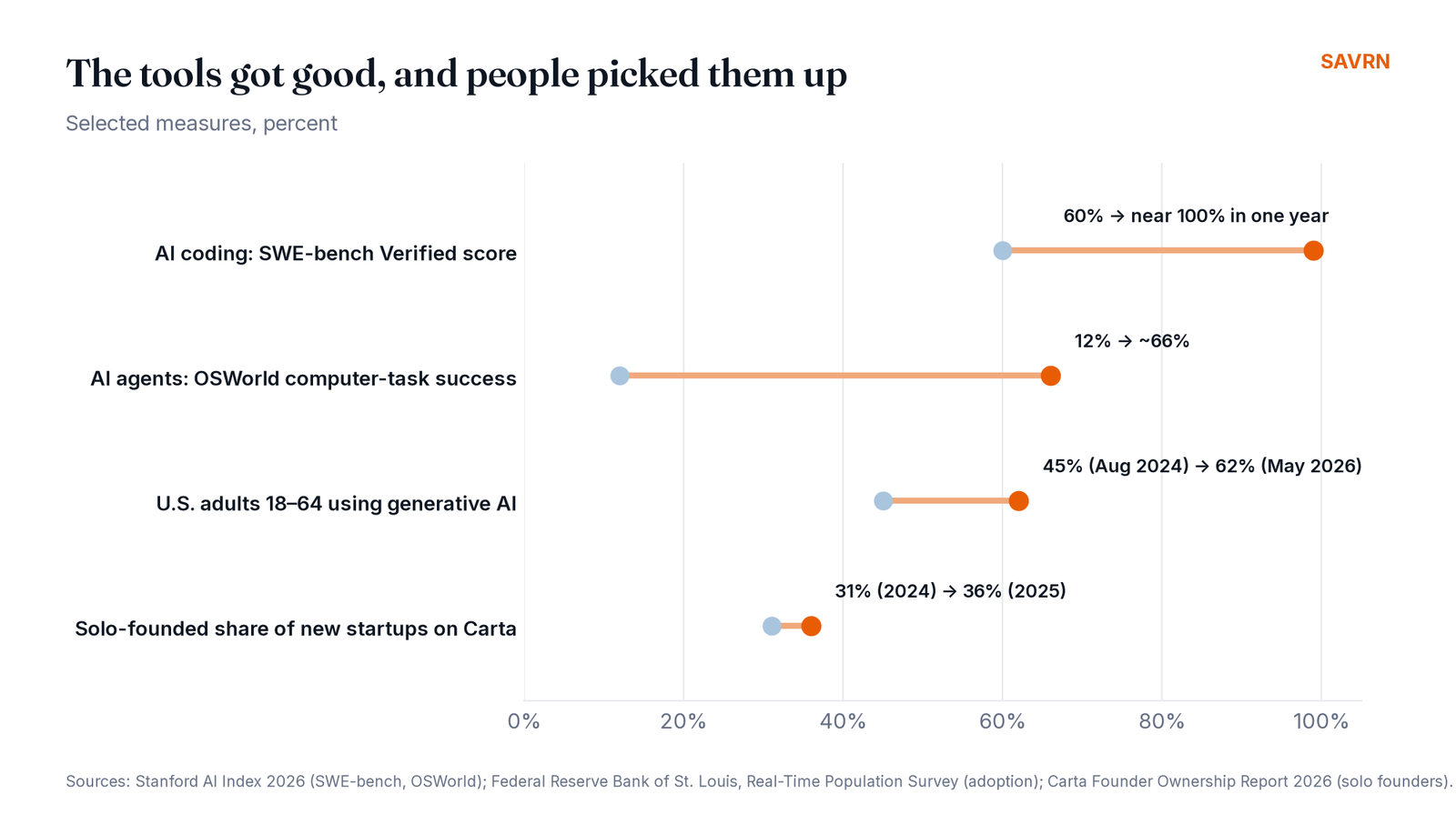
People noticed. Of U.S. adults ages 18 to 64, 62% now use generative AI, up from 45% in August 2024 14. Generative AI assisted 6.3% of all U.S. work hours in the second quarter of 2026, up from 4.1% in the third quarter of 2024 15. On Carta, the equity-management platform, 36% of companies founded in 2025 had a single founder, up from 31% in 2024 16.
Most businesses still haven’t adopted these tools. As of May 2026, 19.8% of U.S. businesses used AI. The rate was 39.7% in the information sector and about 14% in retail 17. Four out of five businesses are still running the old way. That is the visionpreneur’s opening. Every industry slow to adopt is a market waiting for someone who can see how it should work.
Capital is following the vision
Investors have noticed too.
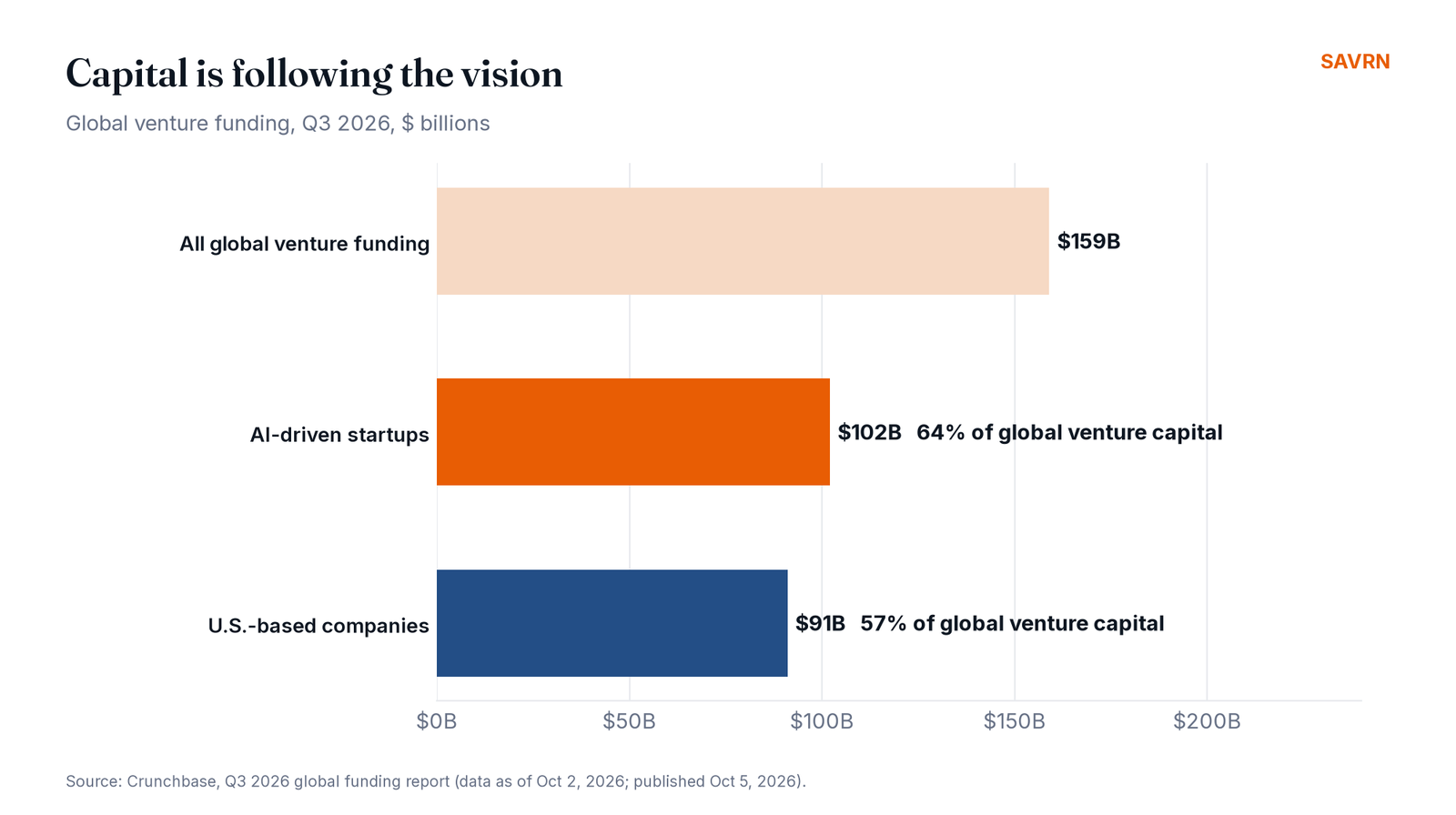
AI startups raised $102 billion in the third quarter of 2026, 64% of all global venture funding. A record 27 companies raised rounds of $1 billion or more 18. The companies building the underlying models are growing at a pace without precedent. Anthropic’s annualized revenue reached $65 billion at the end of July, about seven times its level a year earlier 19. OpenAI’s reached almost $50 billion in September, up from $20 billion at the start of the year 20.
This is not just a technology story. The IMF estimates that AI-related technology investment added half a percentage point to U.S. economic growth in 2025 21. That money becomes infrastructure, which is where the visionpreneur story meets the physical world.
The capital tells you something else, too. The model companies are selling capability, and whoever can see what to do with it is the buyer. Every dollar invested in better models is, in effect, a subsidy for the next visionpreneur.
America is starting things again
The clearest sign is in the government data.
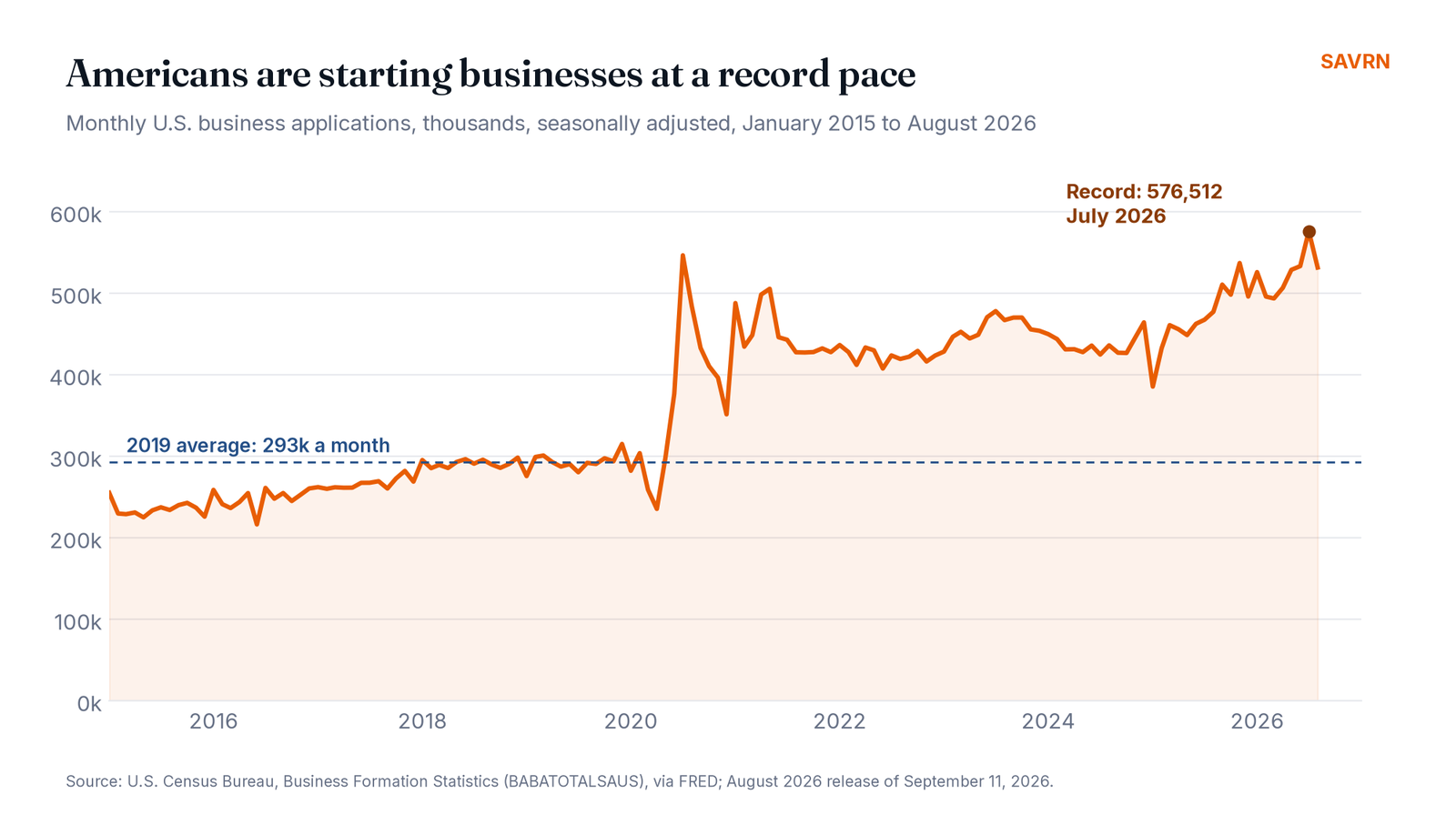
In July 2026, Americans filed 576,512 applications to start new businesses. That is the highest monthly total since the Census Bureau began the series in 2004. So far in 2026, applications have averaged 524,182 a month, 79% above the 2019 average (U.S. Census Bureau, via FRED; averages derived).
Who is starting these businesses is changing too. In 2025, Gen Z founders started more new businesses than Baby Boomers for the first time, 9% versus 5%, according to Gusto’s survey of 1,051 new founders. Women started 44% of new businesses, and first- and second-generation immigrants made up 37% of new entrepreneurs 22.
The next generation is growing up with these tools in hand. Of Americans ages 14 to 29, 51% use generative AI at least weekly 23. Among teens ages 13 to 17, 64% have used an AI chatbot 24. For them, turning an idea into something real won’t feel like a breakthrough. It will feel normal.
This is what lowering the cost of turning an idea into a company looks like. More people try. Those who never had a network, a cofounder or a check from Sand Hill Road now have a way in. A nurse who knows exactly what is broken in patient scheduling no longer needs to recruit a software team to fix it. A machinist with an idea for a better inspection tool can build the software, the website and the business plan alongside a day job. A retired superintendent who has watched every school in the county struggle with the same problem can build the fix.
Those people were always there. What has changed is that the distance between their idea and a working product has shrunk to almost nothing.
Vision beyond software
It would be easy to read all this as a software story. It isn’t. The same leverage is reaching the hardest problems people work on.
- Biology. The AlphaFold Protein Structure Database, an AI-generated map of protein structures, now serves more than 3.4 million users in 190 countries. In 2026 alone it added 1.7 million high-confidence protein-pair predictions, work that would otherwise take about 17 million GPU-hours 25. A researcher with a hypothesis can now start where a lab used to finish.
- Medicine. Developing a drug can cost $2.6 billion and take up to 15 years 26. Insilico Medicine’s rentosertib, a drug discovered with AI for the lung disease idiopathic pulmonary fibrosis, has dosed its first Phase III patient 27. The FDA has authorized more than 1,600 AI-enabled medical devices 28.
- Mobility. Waymo delivered more than 500,000 paid driverless rides a week across 14 cities in early September 29.
- Everyday life. The estimated value Americans get from generative AI, beyond what they pay for it, reached $172 billion a year by early 2026, up from $112 billion a year earlier 30.
Each of these began as somebody’s long-range vision that looked unrealistic at the time. The tools that made them possible are now available to anyone.
The vision still needs a foundation
The visionpreneur story has a physical side.
Every prompt a visionpreneur types runs on a chip, in a server, in a building, on a grid. The leverage is real because someone poured the concrete, pulled the cable and energized the substation. Hyperscalers are on track to spend nearly $800 billion on capital projects this year, and roughly 70% of their spending goes to projects in the United States 31. Private data center construction hit a record $84.95 billion annual rate in August 32. Construction employment reached a record 8.364 million in September 33.
So there are two halves to the same economy. In one, a single person with a vision can do the work of a department. In the other, electricians, linemen, welders and equipment makers build the infrastructure that makes it possible. We wrote about the second half in America Is Building Again.
Neither half works without the other, and we see that in our own work. In Imperial County, California, SAVRN has proposed an Intelligence Center at the redeveloped Mesquite Lake energy site. The published design generates 142 MW on site and uses 132 MW, so the campus imports no power from the grid. Its computers are cooled on a closed loop that uses no water 34.
The campus opens with a school. The Training Institute catalog already lists 43 hands-on courses and 4,668 clock hours, 67% of them in the lab. The courses are organized into nine certificates, from apprentice electrician and medium-voltage technician to AI compute operations technician, and the certificates stack into four associate degree pathways. The ladder starts with Imperial Valley College dual enrollment, already offered in twelve Valley high schools, and runs to a bachelor’s degree without a student having to leave the county 34. The campus has not yet been through California’s environmental review. When it is, it will answer the same questions about energy, water, batteries and emissions that every campus in the Valley now faces.
That is what the two halves look like in one place. The technicians who keep those racks running are the builders. The compute they keep running is what a visionpreneur, maybe a graduate of that same program, uses to build a company with three people. The leverage at the top depends on labor at the base. Communities that host the infrastructure and also train the visionpreneurs who use it will capture both.
What the visionpreneur can’t skip
Leverage amplifies everything, including mistakes. Being honest about that is part of the thesis.
Leverage scales flaws as fast as it scales value. Medvi, the two-person telehealth company, generated $401 million in sales in 2025 and was on track for $1.8 billion in 2026 10. It has since faced an FDA warning letter, lawsuits and allegations that its ads used AI-generated images of people who do not exist 35. A small team can now reach millions of customers before it has the controls a company that size needs. Vision without judgment just fails faster and bigger.
Lean has limits. Some AI startups are finding that running too lean carries its own risks 36. Customers, regulators and lenders still want to know who answers the phone when something breaks.
The first rung of the ladder is moving.
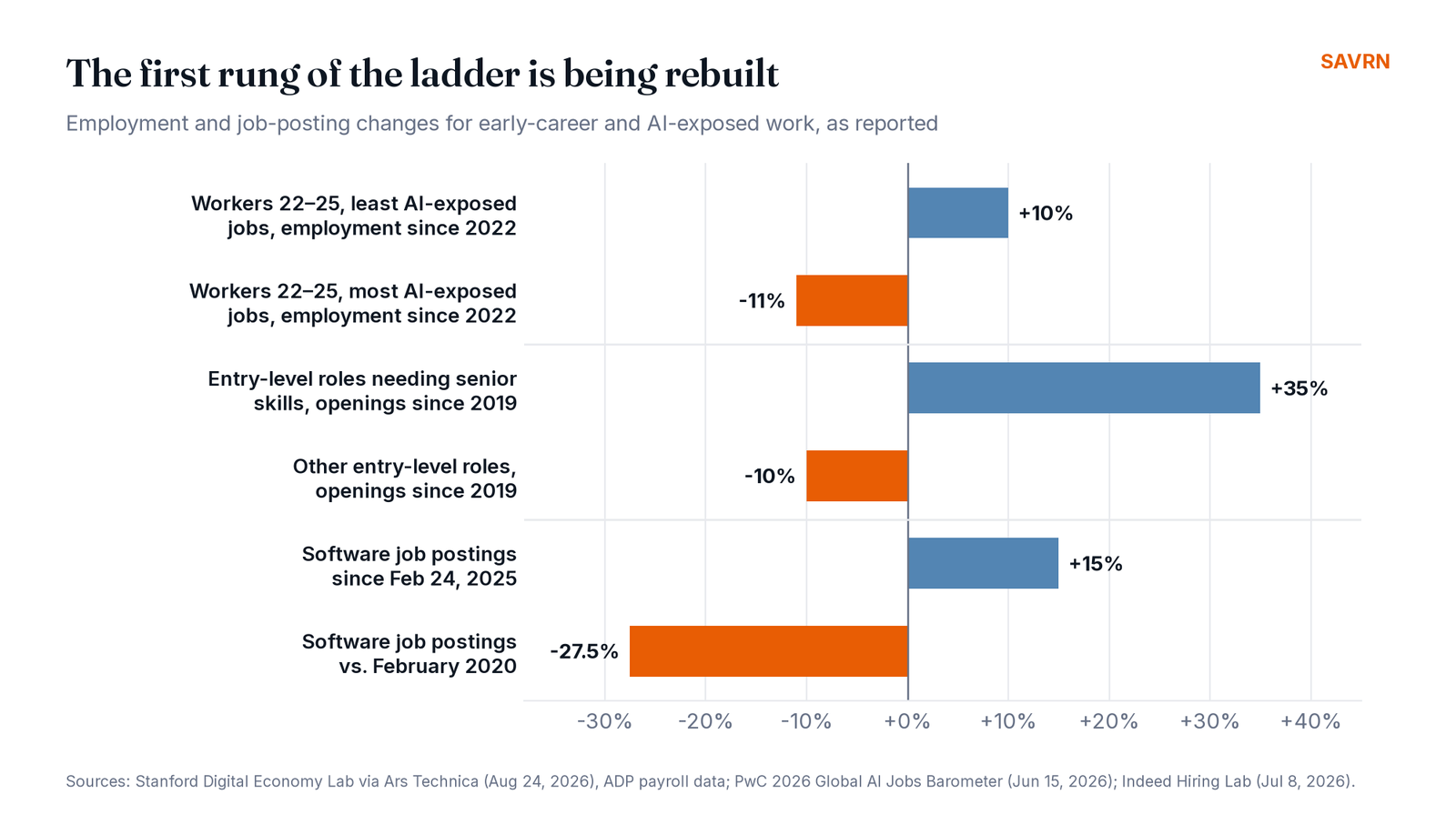
AI-native firms hire about 15% fewer entry-level workers 8. Since 2022, employment of workers ages 22 to 25 has fallen about 11% in the jobs most affected by AI and grown 10% in the least affected 37. Entry-level openings that require senior-level human skills have grown 35% since 2019, while other entry-level roles shrank 10% 38.
The work isn’t disappearing. It is changing shape. From 2018 to 2025, the companies best able to use AI grew headcount 52% and wages 24%, against 36% and 17% at the least AI-exposed companies 38. But if fewer companies hire beginners, more beginners will have to start companies. The visionpreneur path cannot be only for people who already have experience.
Trust has to be earned. In 2026, 52% of Americans say they are more concerned than excited about AI’s growing role in daily life, compared with 37% in 2021 39. That skepticism is earned. The visionpreneurs who last will be the ones who build things people can see, use and rely on, in places they live.
What communities should do
Some places will treat the visionpreneur as a novelty. Others will build an economy around it. The difference will come down to a few deliberate choices.
Connect the two halves. A community that hosts a data center should also be training the people who will build businesses on top of it. The tax base from the infrastructure can fund the programs that produce the founders.
Teach vision, not just skills. Workforce programs built for the last economy teach people to operate tools. The next ones need to teach people to see problems worth solving and to build the first version themselves. The tools will keep changing. The ability to see what to build with them won’t go out of date.
Lower the cost of the first try. Access to compute, mentorship, legal templates and small grants makes the difference between an idea that stays in someone’s head and one that reaches customers. A few thousand dollars and a few months now go further than they ever have.
Back local builders first. The next Base44 doesn’t need to come from San Francisco. It can come from the nurse, the machinist or the superintendent in your town, if the community makes it easy for them to start.
The one-person billion-dollar company
In 2024, Sam Altman said that tech CEOs he knew had a betting pool on the first year a one-person company would be worth $1 billion 3. A one-person billion-dollar business, he said, “would have been unimaginable without AI. And now it will happen” 35.
In May 2025, Anthropic CEO Dario Amodei was asked whether that would happen. “Yes, I think it will happen,” he said. He gave it a 70% to 80% chance of happening by 2026 40. The executive who asked him the question, Mike Krieger, cofounded Instagram. “I built a billion-dollar company with 13 people,” he said.
Whether the first solo billion-dollar company arrives this year or next matters less than what the race signals. The question has changed from “How many people can you get to follow you?” to “How far can you see?”
Seeing further
For a century, the economy rewarded people who could organize others. The next one will reward people who can imagine further than others, and then build what they imagine.
That is the visionpreneur. Visionpreneurs have always existed: the inventor in the garage, the tradesman with a better way, the kid who saw the internet before her teachers did. What is new is that the distance between seeing it and building it has collapsed. The tools that used to belong to large companies now belong to anyone willing to use them.
That shift is most visible in software, but its foundation is concrete, copper and steel, built by people working with their hands. The visionpreneur and the builder are partners in the same economy.
People who were once told their ideas were unrealistic now have the means to prove otherwise. The only question left is whether they will.
Related reading from SAVRN: America Is Building Again: The Data Center Jobs Boom, The Superintelligence Transition and The Inference Layer, Three Ways.
Frequently asked questions
What does “visionpreneur” mean?
Visionpreneur (n.): a founder whose main asset is a long-range vision, and who uses AI to turn that vision into a working company without the headcount that work once required. A visionpreneur differs from a traditional entrepreneur in five ways.
What is the main idea of the article?
For most of history, a big idea needed a big team. That rule is breaking.
How does a visionpreneur build a company differently from the old sequence?
The old sequence for building a company was raise money, hire, build, sell. The visionpreneur sequence runs differently. It starts the same way it always has: someone notices a problem, an opening or a future that others have missed.
Why is this happening now?
Three things changed at once. The tools got good. The tools got cheap.
What evidence shows AI-native startups are more productive per employee?
AI-native startups bring in $2 million to $4 million per employee. The average public software company brings in $300,000.
What are the risks associated with the visionpreneur model?
Leverage amplifies everything, including mistakes. Vision without judgment just fails faster and bigger.
How are workers and communities affected?
The leverage at the top depends on labor at the base. Communities that host the infrastructure and also train the visionpreneurs who use it will capture both.
What does the data say about the growth of single-founder companies?
On Carta, the equity-management platform, 36% of companies founded in 2025 had a single founder, up from 31% in 2024. Four out of five businesses are still running the old way.
How have capital flows changed to support visionpreneurs?
AI startups raised $102 billion in the third quarter of 2026, 64% of all global venture funding. The model companies are selling capability, and whoever can see what to do with it is the buyer.
What is an example of a visionpreneur success story?
In 2024, a 31-year-old programmer in Israel named Maor Shlomo started a side project. He called it Base44. Three weeks after launch it was bringing in revenue at a $1 million annual pace.
Sources
Notes on the data. Every figure comes from a cited primary source or a named publication reporting one, read between October 8 and 10, 2026. Company revenue figures are shown as reported and measure different things: annual sales, annual recurring revenue or run rate. Values marked derived were computed from the cited Census series. Figures for the Mesquite Lake campus come from SAVRN's published Imperial Valley materials; SAVRN has a commercial interest in AI infrastructure. "Visionpreneur" is used here as a descriptive term for a type of founder.
- $1M ARR in 3 Weeks. $150M ARR One Year Later, New Economies
- 6-month-old, solo-owned vibe coder Base44 sells to Wix for $80M cash | TechCrunch, TechCrunch
- Sam Altman wants AI to create a one-person unicorn with a billion-dollar valuation | Fortune, Fortune
- Lovable hit $500 million in revenue with 146 employees. Its new data shows who is actually building software now., The Next Web
- Midjourney | Company Overview & News, Forbes, citing PitchBook
- Lessons from the world of AI startups | Institute for Business in Global Society, Harvard Business School
- Forbes, citing Redpoint Ventures and CB Insights, Forbes, citing Redpoint Ventures and CB Insights
- Forbes, Forbes
- Mapping the AI economy, Stripe
- New York Times, New York Times
- The 2026 AI Index Report | Stanford HAI, Stanford AI Index 2026
- Moneycontrol, Moneycontrol
- Measuring the Productivity Impact of Generative AI | NBER, NBER
- What Work Does Generative AI Do? | St. Louis Fed, St. Louis Fed
- Does generative AI save time at work? | FRED Blog, FRED Blog, St. Louis Fed
- Founder Ownership Report 2026 | Carta, Carta
- Large Firms With at Least 20 Employees Biggest AI Users, U.S. Census Bureau
- Crunchbase Data: Q3 2026 Posted A Record Count Of Billion-Dollar Rounds As The Global AI Race Heats Up, Crunchbase
- Anthropic says annualized revenue climbed to $65 billion in July, CNBC
- Reuters, Reuters
- AI: Deployment and Disruption, IMF
- Gusto, Gusto
- Gen Z's AI Adoption Steady, but Skepticism Climbs, Gallup
- What the data says about Americans’ views of artificial intelligence | Pew Research Center, Pew Research Center
- Millions of protein complexes added to AlphaFold Database shed light on how proteins interact | EMBL, EMBL
- BioPharma Dive, BioPharma Dive
- dailypharmkorea, DailyPharm
- Artificial Intelligence-Enabled Medical Devices | FDA, FDA
- Waymo closes $5 billion term loan to expand robotaxi service, Yahoo Finance
- Economy | The 2026 AI Index Report | Stanford HAI, Stanford AI Index 2026
- How much of the AI boom is adding to U.S. growth? | J.P. Morgan Asset Management, J.P. Morgan Asset Management
- U.S. Census Bureau, U.S. Census Bureau
- All Employees, Construction (USCONS) | FRED | St. Louis Fed, BLS via FRED
- Imperial Valley Update: The Four Questions Answered, SAVRN, Imperial Valley Update
- A $1.8 billion startup with just 2 employees was hailed as the future. Now, the negative allegations are piling up, Yahoo Finance
- Wall Street Journal, Wall Street Journal
- Ars Technica, reporting the Stanford Digital Economy Lab, Ars Technica, reporting the Stanford Digital Economy Lab
- PwC, PwC
- Young US adults are increasingly wary of AI, concerned it will take jobs | Pew Research Center, Pew Research Center
- Anthropic CEO Dario Amodei predict AI will allow just one person to run a billion dollar company by 2026 - India Today, India Today
Want the next one?
When a new piece publishes on SAVRN Insights, you get one email with what it covers and a link to read it. Choose the research that interests you.
Also send me
Receive a short introduction on days 3, 7 and 14, plus the updates you select. Unsubscribe in one click. Privacy
The Rise of the Visionpreneur
Get new SAVRN Insights by email
A short introduction on days 3, 7 and 14, plus new SAVRN research articles. Unsubscribe at any time.
We use your address to send the introduction and updates described above. See our Privacy Policy.